

CNC Grinding Machine for Metal: Selection and Setup Guide
Grinding is the operation that decides whether a part meets tolerance or becomes scrap. Manual grinding depends on the operator’s eye and steady hand, which is fine for one-offs but expensive at scale. A CNC grinding machine for metal replaces that judgment with programmed axes, measured infeed, and controlled wheel speed, so every part is ground to the same size and finish. The payoff is tighter tolerance, lower scrap, and a process you can audit. This guide covers how CNC grinding works, the machine types worth comparing, how to match wheels and coolant to your alloy, and how to specify a machine that fits your production.
What Is a CNC Grinding Machine for Metal?
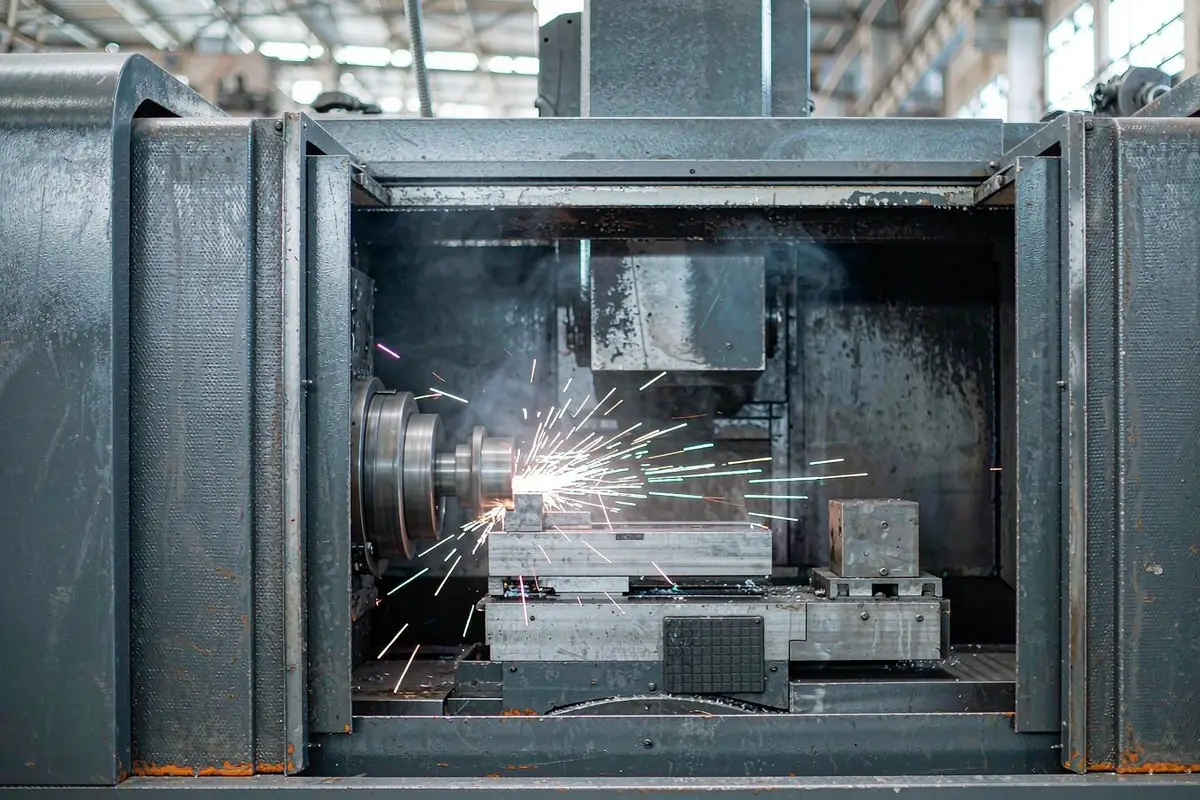
A CNC grinding machine for metal is a grinding system whose axes, infeed, wheel speed, and dressing cycles are controlled numerically rather than by handwheels. The machine follows a stored program, so the same part is ground identically on every cycle and on every shift. CNC control also enables in-process gauging, automatic wheel dressing, and compensation for wheel wear — the three features that make grinding repeatable over long production runs.
These machines serve two broad roles: precision size grinding, where tolerance is the goal, and surface preparation, where finish and flatness matter more than micron-level size control.
How CNC Grinding Works
The cycle follows a predictable sequence:
- Load and locate. The part is clamped in a fixture or chuck that repeats its position within microns.
- Dress the wheel. A diamond dresser restores wheel form and sharpness, either at cycle start or on a programmed interval.
- Rough grind. High infeed removes most stock quickly, with coolant flooding the contact zone.
- Finish grind. Reduced infeed and a spark-out pass bring the part to final size and finish.
- Measure and compensate. In-process or post-process gauging feeds back to the control, which adjusts for wheel wear.
The spark-out pass is often overlooked. Running without additional infeed for a few revolutions lets the system recover deflection and removes the last few microns, which is what separates a part that measures correctly from one that measures correctly and stays stable.
CNC Grinding Machine Types
Five configurations cover most metalworking needs:
| Type | Motion | Tolerance | Best For |
|---|---|---|---|
| Surface grinder | Reciprocating table | ±2 – 5 µm | Flat faces, dies, plates |
| Cylindrical grinder | Rotating work between centres | ±1 – 3 µm | Shafts, pins, spindles |
| Centreless grinder | Work supported on a rest | ±2 – 5 µm | High-volume small rounds |
| Internal grinder | Wheel inside a bore | ±2 – 5 µm | Bores, bearing seats |
| Creep-feed grinder | Deep single-pass cut | ±5 – 10 µm | Slots, deep profiles |
Centreless grinding is the productivity champion for small cylindrical parts because it needs no chucking and loads continuously. Cylindrical grinding remains the standard for shaft work. For foundry and casting cleanup where the goal is surface rather than size, a robotic or automatic grinding machine is often the better economic fit.
Matching Wheels and Coolant to Metal
Wheel specification and coolant decide both finish and part integrity:
- Aluminium oxide wheels — general-purpose choice for carbon steel and alloy steel.
- Silicon carbide wheels — hard materials, cast iron, and non-ferrous work.
- CBN (cubic boron nitride) — hard steels and high-volume production; long life and cool cutting.
- Diamond wheels — carbide, ceramics, and very hard coatings.
- Water-based coolant — best cooling and flushing for most steels.
- Neat oil — superior lubrication and finish for difficult profiles and creep-feed work.
Grade and bond matter as much as abrasive. A wheel that is too hard glazes and burns; too soft wears fast and loses form. Our grinding wheel selection guide explains how to read grade, structure, and bond for automated applications.
Precision and Surface Finish Targets
Specify tolerance and finish separately, because they are achieved by different parameters:
| Requirement | Typical Target | Key Lever |
|---|---|---|
| General machining | Ra 0.8 – 1.6 µm | Wheel grit, infeed rate |
| Precision finish | Ra 0.2 – 0.4 µm | Finer wheel, spark-out, dressing |
| Bearing / sealing surface | Ra < 0.2 µm | Fine grit, rigid setup, oil coolant |
| Dimensional tolerance | ±2 – 5 µm | In-process gauging, thermal stability |
Thermal stability is part of the specification. A machine in a workshop that swings ten degrees over a shift will not hold microns, regardless of control quality.
CNC Grinding vs Manual Grinding
The differences show up in cost and consistency, not just precision:
| Criterion | Manual Grinding | CNC Grinding |
|---|---|---|
| Tolerance | Operator-dependent | Programmed and repeatable |
| Scrap rate | Higher, variable | Lower and predictable |
| Skill required | High | Setup and programming focused |
| Throughput | Lower | Higher, with unattended cycles |
Manual grinding retains a role in repair and one-off work, but for recurring production the CNC route is almost always cheaper per good part once volume exceeds a few hundred pieces.
Automating Grinding With Robots
Not every grinding task needs a precision machine tool. Casting cleanup, weld blending, and edge preparation are better served by a robot holding a grinder and following a taught path. A CNC grinding robot combines path flexibility with force control, which keeps contact pressure steady as casting surfaces vary. The distinction matters commercially: precision size grinding belongs on a machine tool, while surface cleanup belongs in a robotic cell. Our deburring and grinding comparison clarifies where each belongs.
Applications Across Industries
- Automotive. Camshafts, crankshafts, and transmission shafts ground to tolerance at volume.
- Bearing manufacturing. Raceways and rolling elements finished to sub-micron roughness.
- Tool and die. Flat dies and inserts ground for flatness and edge integrity.
- Aerospace. Critical surfaces where tolerance and surface integrity are both specified.
- Hydraulics. Valve spools and bores ground for leak-free sealing.
Benefits of CNC Grinding
- Repeatable tolerance — programmed infeed and compensation hold size across the run.
- Lower scrap — in-process gauging catches drift before parts go out of spec.
- Longer wheel life — automatic dressing and correct parameters prevent glazing.
- Unattended capacity — lights-out cycles with bar feeders or pallets raise output.
- Auditable process — stored programs and logs support quality certification.
How to Select a CNC Grinding Machine for Metal
- Define the feature. Flat face, outside diameter, bore, or profile — each points to a different machine type.
- State tolerance and finish. Both, numerically, before you talk to suppliers.
- Match part size and weight. Confirm swing, centre distance, and table capacity.
- Plan wheel and coolant. Confirm the machine supports your abrasive and coolant choice.
- Consider automation. In-process gauging and auto-dressing pay back quickly at volume.
- Insist on a trial. Grind your parts to your tolerance before committing to the purchase.
Integration and Line Design
Grinding rarely stands alone. It follows heat treatment or machining and precedes inspection, polishing, or assembly. Buffer capacity between grinding and the next operation prevents a stoppage from cascading through the line, and a shared coolant system simplifies maintenance. Where grinding produces a cosmetic surface, a downstream automated surface finishing step can blend the scratch pattern. For casting-heavy shops, our foundry grinding machine guide covers the higher-volume cleanup case.
Safety and Coolant Management
Grinding produces fine swarf and mist that must be controlled at the source. Enclose the contact zone, extract mist at the wheel guard, and keep guarding interlocked so the spindle cannot run with the door open. Burst protection on the wheel housing is a standard requirement, not an option.
Coolant management deserves the same attention as the wheel. Check concentration weekly, skim tramp oil, and change the sump on a planned interval rather than when odour or rust appears. Clean coolant keeps the wheel cutting cool, protects the part from corrosion between operations, and extends both wheel and pump life.
Maintenance Tips
Dress the wheel on schedule rather than when problems appear, keep coolant clean and at concentration, check spindle runout and slide backlash monthly, and verify fixture repeatability with a master part. Coolant that has gone rancid or lost concentration is a leading cause of burning and poor finish.
Common Mistakes to Avoid
- Skipping the spark-out pass. Rushing the finish leaves size and finish inconsistent.
- Wrong wheel grade. Too hard burns and glazes; too soft loses form and size.
- Neglected coolant. Dirty or weak coolant causes burning, loading, and rust.
- Ignoring thermal drift. Micron work demands a temperature-stable environment.
- No master-part check. Fixture wear quietly shifts size until parts fail inspection.
Frequently Asked Questions
What tolerance can a CNC grinding machine for metal hold?
Most production machines hold ±2–5 µm on size, with precision cylindrical grinders reaching ±1–3 µm when the environment and fixturing are controlled.
What is the difference between CNC grinding and robotic grinding?
CNC grinding machines control size and finish with programmed infeed on a rigid machine tool. Robotic grinding follows a path for casting cleanup and weld blending, where flexibility matters more than micron tolerance.
Which wheel should I use for stainless steel?
A silicon carbide or CBN wheel with a softer grade and open structure, run with abundant coolant, gives cool cutting and avoids glazing and burning.
Do I need in-process gauging?
For tight tolerance at volume, yes. It compensates for wheel wear automatically and prevents a drift from turning into a batch of scrap.
Can CNC grinding run unattended?
Yes. With bar feeders, pallets, and in-process gauging, many grinding cells run lights-out for extended periods, with operators checking in rather than tending continuously.
Conclusion
A CNC grinding machine for metal turns grinding from a skill into a controlled process. Define the feature, state the tolerance and finish numerically, and prove the cycle on your own parts before you buy. If you are grinding shafts, bores, or flat faces at volume, send us a drawing and sample parts and our team will return a machine recommendation, a wheel specification, and a verified cycle time.