


Automated Grinding Solutions
for Aluminum Alloy Castings
Aluminum’s hard oxide skin, hidden pores and anodizing demands make finishing unforgiving. Dingzhu solves the 6 hardest pain points in robotic grinding and deburring of aluminum castings — with laser scanning, force control and anti-clog abrasives.
6 Core Challenges in Aluminum Casting Finishing
Aluminum’s oxide layer, porosity and anodizing requirements make automated grinding demanding. Here are the six problems that decide whether aluminum automation pays off.
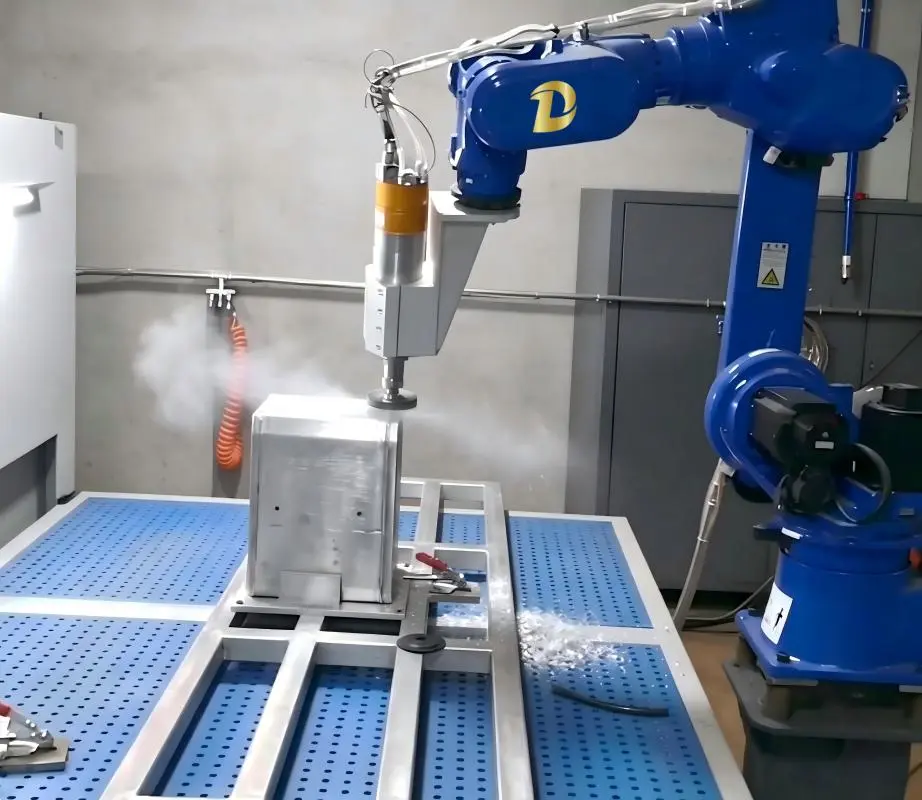
The Dingzhu Approach: Perception + Force, Dual Guarantee
Scan first to locate flash and measure stock, correct the path, then apply capped compliant force with wear compensation. Aluminum castings come out uniform, pore-safe and anodizing-ready.
Sense & Locate
Laser / vision scanning pinpoints flash and measures actual stock
Adaptive Trajectory
Path corrected to flash zones only — surrounding surface untouched
Force-Controlled Grind
Capped compliant force with wear comp for steady oxide cutting
Anodizing-Ready Output
Uniform, scratch-free, pore-closed aluminum ready for anodizing
Which Sensing Method to Choose?
Three mainstream perception approaches. For large, variable aluminum castings, we prioritize laser line scanning.
Don’t Let a Few-Dollar Belt Ruin a Cast Iron Finish
For cast iron, the belt must cut the hard skin without clogging on fine dust. Three rules we apply.
Recommended Belt Linear Speed by Process (Aluminum)
| Process | Column 2 |
|---|---|
| Oxide / Scale Removal | 25 – 32.5 |
| Deburring / Flash | 25 – 32.5 |
| Aluminum Polishing | 20 – 28 |
| Anodizing Prep | 12 – 22 |
| Satin / Brushed Finish | 8 – 15 |