


Automated Grinding & Deburring Solutions for Cast Iron Parts
Gray and ductile iron castings carry a hard molding-skin, brittle edges and stubborn gate flash. Dingzhu solves the 6 hardest pain points in robotic grinding and deburring of cast iron parts — with ceramic belts, adaptive force control and enclosed extraction cells.
6 Core Challenges in Cast Iron Finishing
Cast iron’s hard skin, brittleness and stubborn flash make automated finishing uniquely demanding. Here are the six problems that decide whether cast iron automation pays off.
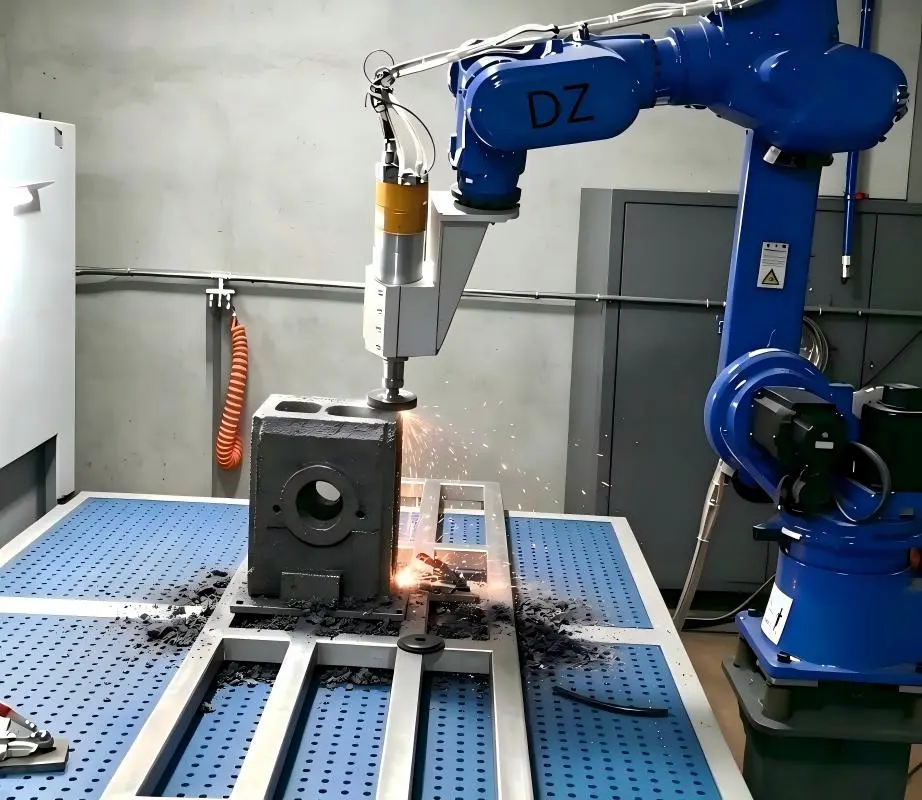
The Dingzhu Approach: Perception + Force, Dual Guarantee
Laser scanning locates flash, gate and hard spots; adaptive trajectory removes position error; compliant force control with a hard ceiling applies just the right pressure. Chip-free, consistent cast iron finish every time.
Sense & Locate
Laser / vision scanning captures the actual 3D position, flash and hard spots of the iron casting
Adaptive Trajectory
Robot path is dynamically corrected — flash located, hard spots flagged before contact
Adaptive Force Grind
Compliant force control with a hard ceiling eases on hard spots, trims edges without chipping
Clean, Chip-Free Output
Uniform cast iron finish from first piece to last — enclosed, extracted, safe
Which Sensing Method to Choose?
Three mainstream perception approaches. For cast iron’s bulky parts, large flash and hard-spot mapping, we prioritize laser line scanning.
Don’t Let a Few-Dollar Belt Ruin a Cast Iron Finish
For cast iron, the belt must cut the hard skin without clogging on fine dust. Three rules we apply.
Recommended Belt Linear Speed by Process (Cast Iron)
| Process | Column 2 |
|---|---|
| Heavy Stock Removal | 25 – 35 |
| Deburring / Deflashing | 20 – 32 |
| Gate Grinding | 20 – 30 |
| Surface Clean-Up | 15 – 25 |
| Light Finishing | 12 – 20 |