

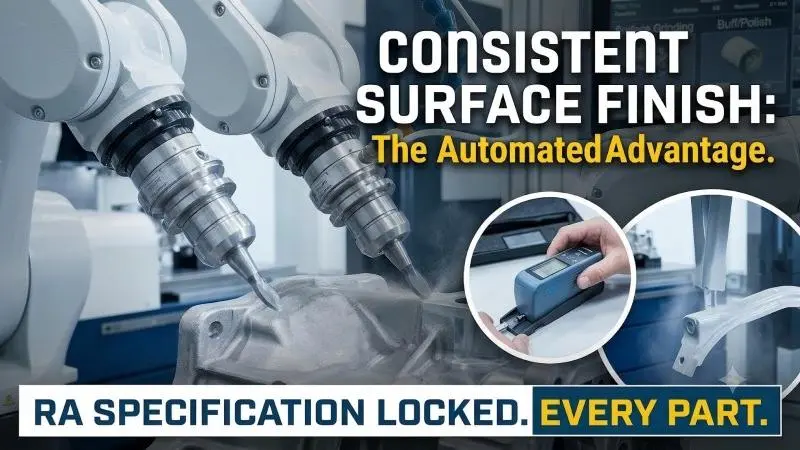
Consistent surface finish in grinding is the difference between a casting that meets Ra spec on every part and one that varies part-to-part because operator pressure, wheel condition, and coolant flow drift through the shift. Automated surface grinding achieves consistency by locking those variables: a programmed path, force-controlled contact, and automatic wheel compensation deliver the same Ra on part 1 and part 10,000. Surface finish standards such as those summarized by ISO directly tie finish quality to function, sealing, and coating adhesion, so repeatability is a specification, not a nicety.
What “Consistent Finish” Means Numerically
Finish is quantified by Ra (average roughness) and Rz (peak-to-valley). For most castings, automated grinding targets Ra 1.6–3.2 µm; critical sealing faces may need Ra ≤0.8 µm via a follow-on polish. Our Ra/Rz standards guide explains how to read the numbers.
Four Controls That Lock Consistency
- Force control: keeps normal force at 50–150 N so cut depth stays constant as the wheel wears.
- Wheel compensation: the controller extends dwell or dresses the wheel when cut rate drops.
- Coolant consistency: steady flow and concentration prevent thermal marks and loading.
- Path repeatability: the robot tracks the contour within ±0.05 mm every cycle.
These controls are built into the robotic grinding machine architecture.
| Factor | Manual Surface Grind | Automated Surface Grind |
|---|---|---|
| Ra variation (same shift) | ±1.0 µm | ±0.3 µm |
| Wheel-wear effect | Finish degrades steadily | Compensated live |
| Coolant control | Operator-dependent | Metered, constant |
| First/last part match | Poor | Excellent |
QUICK DECISION TIP
Measure Ra on the first, 100th, and 1,000th part off the cell — if they match, your force and compensation loop is working; if not, the wheel-wear model needs tuning.
Programming for Uniform Finish
Overlap passes by 30–50% and keep traverse speed constant; inconsistent overlap is the main cause of visible banding. The programming guide teaches the same path-discipline principles for deburring cells.
Quality Verification
Use a portable roughness tester at set intervals and log results. Automated cells can trigger an alarm when Ra drifts beyond the control limit, converting a hidden defect into a managed event. The quality control guide details the measurement plan.
ROI SNAPSHOT
Plants moving from manual to automated surface grinding typically cut finish-related rework by 50–70% and eliminate the “last-part-of-shift” scrap that comes from operator fatigue.
Dealing With Casting Variation
Even in automated grinding, incoming castings vary. Force control absorbs the variation so the finished Ra stays put, but extreme oversize still needs longer dwell. Set a tolerance band on incoming stock and segregate outliers; trying to grind a wildly oversized part to spec every time stresses the wheel and skews the average finish. Stable input is the partner of consistent output.
From Grind to Polish in One Cell
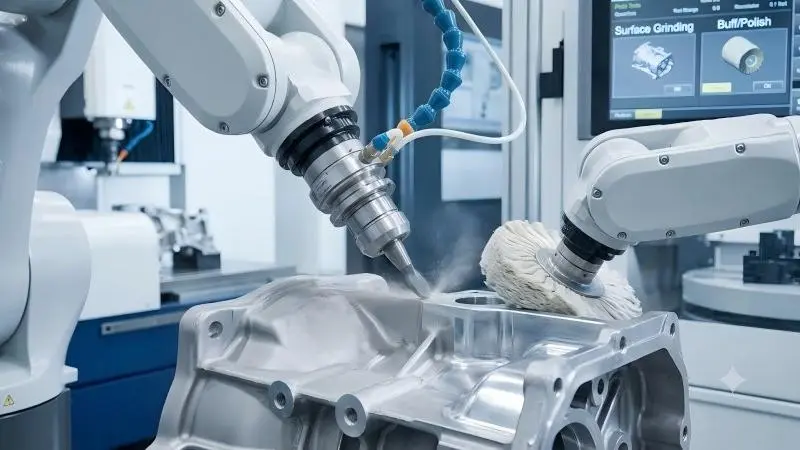
For parts needing both a uniform ground finish and a brighter polish, a single cell can swap from grinding wheel to polishing mop automatically within the program. This eliminates a separate handling step and keeps the part located, improving overall consistency. The two-in-one solutions guide details the combined approach.
Troubleshooting Finish Drift
When Ra climbs mid-shift, check in order: wheel wear (dress or replace), coolant concentration (top up and verify with a refractometer), then traverse-speed setting. Most drift traces to the first two, not the program. Log the corrective action against the part count so the pattern becomes predictable; over time you move from reactive fixing to scheduled intervention before the limit is breached.
Surface Finish and Coating Adhesion
A consistent ground finish is not only cosmetic; it directly affects paint, powder-coat, and plating adhesion. Variable Ra leaves some areas under-prepared, where coating can peel under service stress. By holding Ra in a tight band, automated grinding improves first-pass coating yield and reduces the rework loops that follow a bad finish. For specification detail, our foundry finishing guide connects finish to downstream processes.
Frequently Asked Questions
Can automated grinding hit Ra 0.8 µm?
On most castings yes with a fine finishing pass and proper wheel; below that usually needs a polish stage.
Why does my finish band even on a CNC?
Usually wheel wear or coolant fluctuation; add force compensation and metered coolant before changing the program.
Does material affect achievable Ra?
Yes; iron grinds to a matte uniform finish easily, aluminum needs coolant and the right grit to avoid smear.
How often should I verify Ra?
Every lot start and at a timed interval (e.g., every 200 parts) for critical surfaces; SPC charts catch drift early.
Need help specifying the right machine?
Contact Xiamen Dingzhu Intelligent Equipment — we size deburring and grinding cells to your castings, volume, and tolerances. Talk to our application engineers.
References
- American Foundry Society — afsinc.org
- NADCA — nadca.com
- ISO 9001 — iso.org
This article is for general guidance only and does not constitute a specification or quote. Confirm process parameters with the equipment supplier for your parts.