

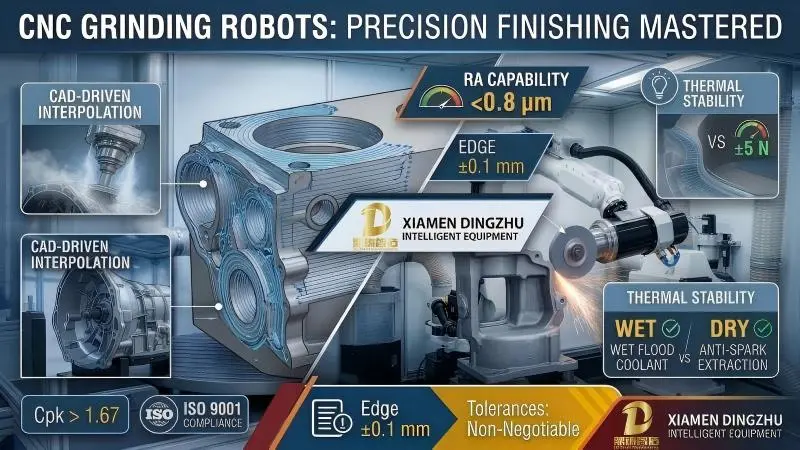
A CNC grinding robot earns its place in precision finishing when the part demands repeatable Ra below 0.8 µm and edge tolerance under ±0.1 mm across thousands of identical pieces. Unlike a free-arm robot taught by demonstration, a CNC-class grinding robot executes interpolated tool paths from CAD with closed-loop feedback, holding process capability Cpk > 1.67 on tight-tolerance automotive and hydraulic castings (ISO 9001 process capability expectations). Our metal casting grinding guide compares it to general-purpose robots for buyers deciding which class to purchase.
Feature 1: CAD-Driven Path Interpolation
The defining feature is true 5–6 axis linear and circular interpolation from a CAD model, not point-to-point teaching. This lets the wheel follow a contoured bore or fillet at a constant feed (e.g., 800–1,500 mm/min) so the stock removal is uniform along the whole profile. Uniform feed means uniform Ra and no local burning, which is impossible to guarantee when an operator varies pressure by hand. It also makes the program portable: the same CAD file drives every cell on the floor.
Feature 2: Closed-Loop Force and Spindle Feedback
- Spindle load monitoring: detects wheel glaze or dulling and triggers dressing before scrap appears, protecting the per-part cost.
- Force/torque sensing: holds normal force within ±5 N of setpoint despite casting variation of ±1.5 mm.
- Acoustic emission: some cells sense grinding burn via high-frequency vibration, stopping the part for rework before it leaves the cell.
These loops are what separate “precision” from “rough” grinding, and they also feed the downstream quality control loop with real data instead of guesswork.
Feature 3: Rigid Structure and Thermal Stability
Precision needs stiffness. Look for a cast-iron or polymer-concrete base, servo-driven axes with 0.001 mm resolution, and a spindle with thermal compensation so a 6-hour run does not drift the finish. Robot repeatability should be ≤0.03 mm, and the fixture must hold the part against cut forces without deflection that would show up as taper on a sealed face. A flimsy base is the most common reason a cheap “precision” cell fails audit.
Feature 4: Automatic Wheel Dressing and Gauging
On a precision cell the wheel is dressed on a diamond roll at a fixed interval (by part count or spindle load), then a touch probe re-zeros the tool offset. Without this, wheel wear of 0.05 mm per 1,000 parts quietly pushes you out of tolerance and ruins a whole batch before anyone notices. The probe also confirms the first article after any wheel change, which is what keeps Cpk high across a long production run.
Feature 5: Integrated Coolant or Dry Extraction
For steel and stainless, flood or mist coolant controls temperature and carries swarf; for aluminum, dry extraction with anti-spark separation is safer. The choice affects achievable Ra and wheel life, and it dictates the cell envelope and maintenance plan. Coolant also enables finer finishes because it suppresses the heat that would otherwise cause burn on thin sections.
Precision Robot vs. Standard Robot
| Feature | CNC precision robot | Standard grinding robot |
|---|---|---|
| Path source | CAD interpolation | Taught points |
| Edge tolerance | ±0.1 mm | ±0.2 mm |
| Ra capability | 0.2–0.8 µm | 0.8–3.2 µm |
| Auto dressing | Standard | Often manual |
| Cost premium | +30–60% | Baseline |
When Precision Is Worth the Premium
Only pay for CNC-class precision when the print calls for it. Sealing faces, hydraulic bores, and mirror-decorative parts justify the cost; rough structural castings do not. A standard force-controlled robot paired with a two-in-one machine often covers 90% of foundry work at lower capital, and a grinding cell delivers most of the consistency benefit.
QUICK DECISION TIP
Only pay for CNC precision if your print calls for Ra <0.8 µm or edge ±0.1 mm. Below that threshold a standard force-controlled robot is the better value.
ROI SNAPSHOT
A hydraulic parts maker moved from hand finishing to a CNC grinding robot and cut rejection for Ra out-of-spec from 9% to 1.2%, saving ≈$140k/yr in rework and premium freight.
Frequently Asked Questions
Is a CNC robot the same as a CNC grinder?
A. No. A CNC grinder is a fixed-axis machine; a CNC grinding robot adds articulated reach for 3D parts while keeping interpolated paths.
What Ra can it hold on cast iron?
A. Typically Ra 0.4–0.8 µm with a fine wheel and coolant; lower needs a separate polish pass.
How long to program a new part?
A. With CAD import, 2–6 hours including dress calibration and first-article validation.
Does it replace polishing?
A. Not for mirror finishes. Pair it with a two-in-one machine if you need both grind and polish.
Need help specifying the right machine?
Contact Xiamen Dingzhu Intelligent Equipment — we size deburring and grinding cells to your castings, volume, and tolerances. Talk to our application engineers.