


Automated Grinding & Polishing Solutions
for Stainless Steel
Stainless is unforgiving on a robot: welds shift as parts cool, force control has a limited float stroke, and friction heat burns the surface blue. Dingzhu solves the 6 hardest pain points in robotic grinding of stainless steel parts — with laser scanning, servo force control and active cooling.
6 Core Challenges in Stainless Steel Finishing
Stainless’s tendency to burn, drift and warp makes automated finishing uniquely demanding. Here are the six problems that decide whether stainless automation pays off.
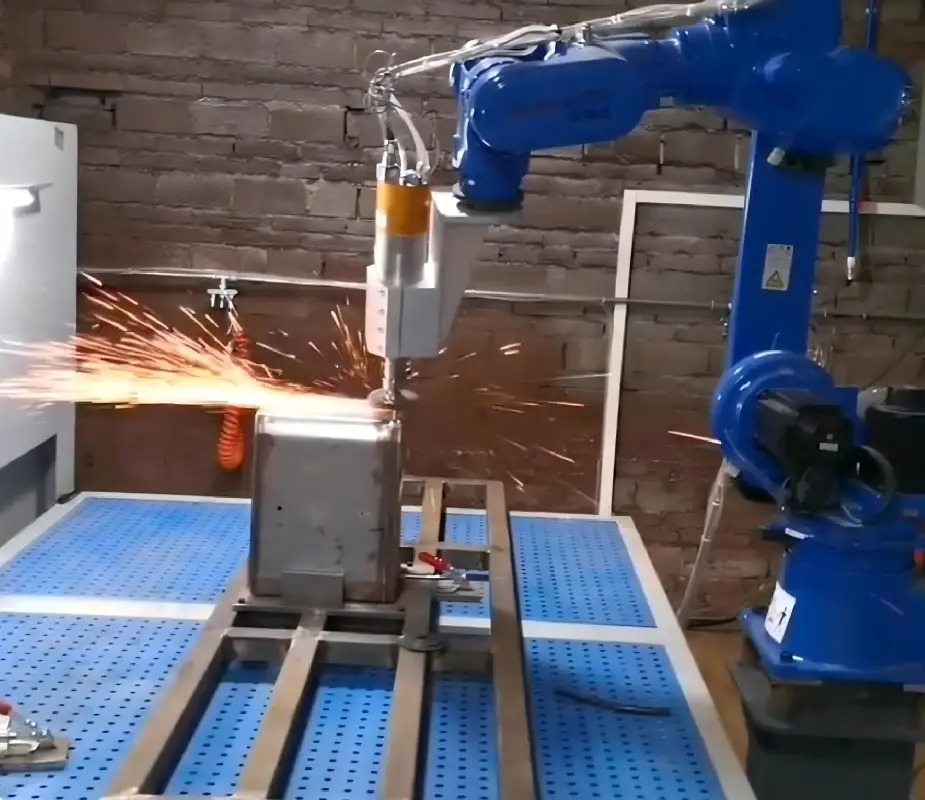
The Dingzhu Approach: Perception + Force, Dual Guarantee
Laser scanning locates the stainless part and weld; adaptive trajectory removes position error; compliant force control with active cooling applies just the right pressure. Burn-free, blue-free finish every time.
Sense & Locate
Laser / vision scanning captures the actual 3D position & pose of the stainless part and weld
Adaptive Trajectory
Robot path is dynamically corrected — weld position error eliminated before contact
Force Grind + Cool
Compliant force control with active cooling holds constant, safe contact pressure
Burn-Free Output
Uniform stainless finish from first piece to last — no blue, no operator dependence
Which Sensing Method to Choose?
Three mainstream perception approaches. For stainless’s weld drift and complex pipe shapes, we prioritize laser line scanning.
Don’t Let a Few-Dollar Belt Ruin a Stainless Finish
For stainless, the belt must cut fast without burning. Three rules we apply.
Recommended Belt Linear Speed by Process (Stainless)
| Process | Column 2 |
|---|---|
| Weld Grinding | 18 – 28 |
| Deburring | 18 – 25 |
| Stainless Polishing | 18 – 28 |
| Satin / Brushed Finish | 12 – 20 |
| Cleaning & Harmonizing | 10 – 18 |