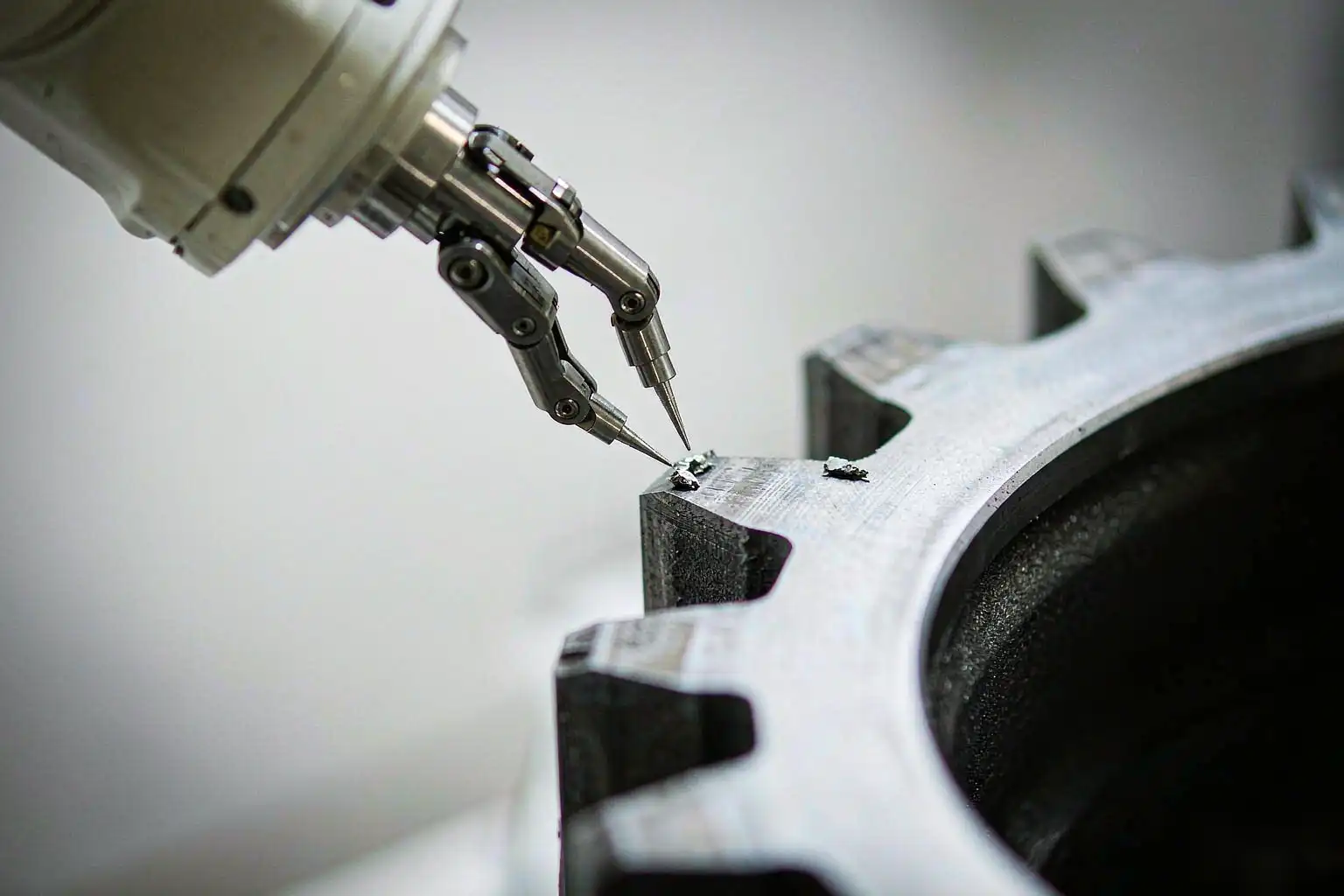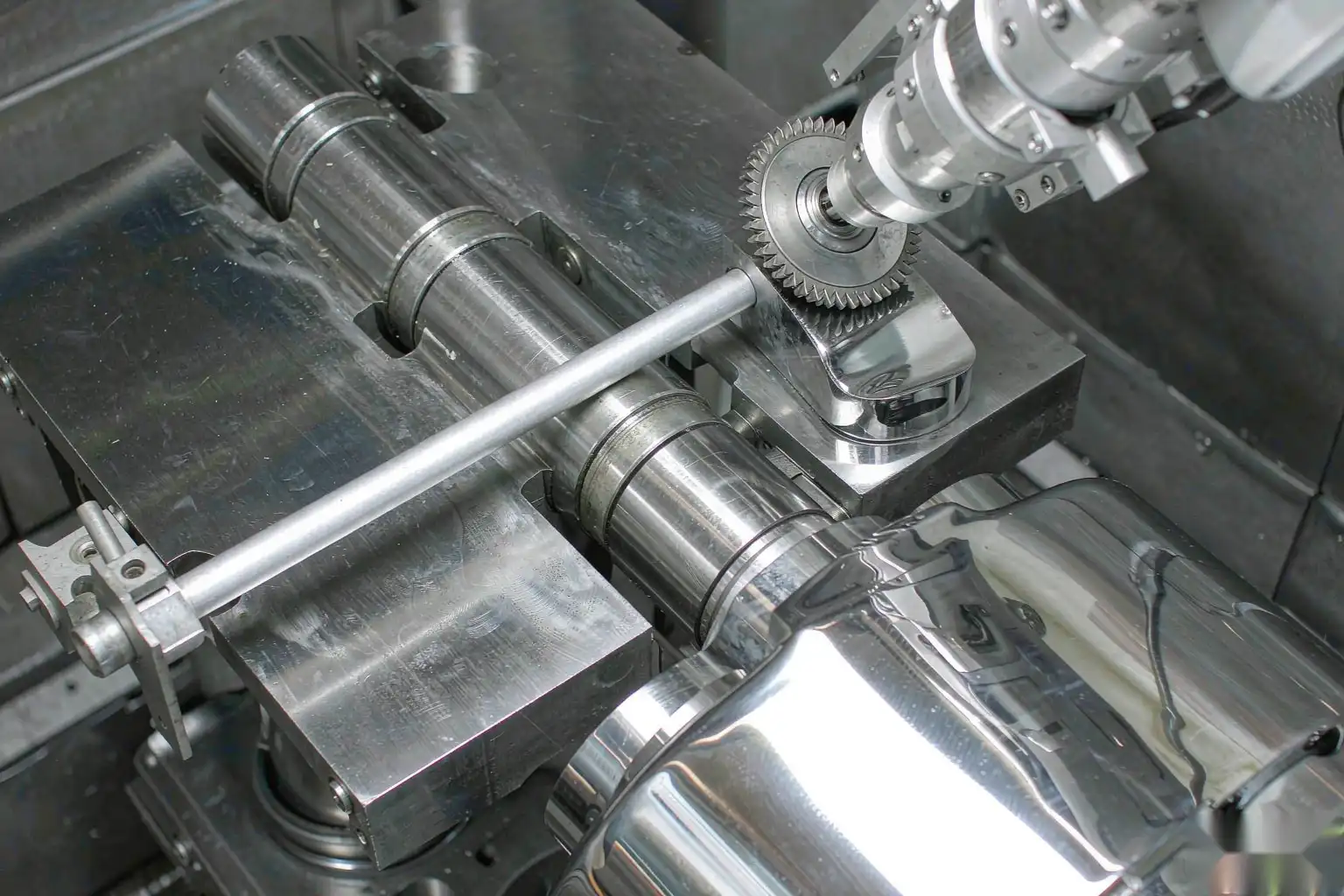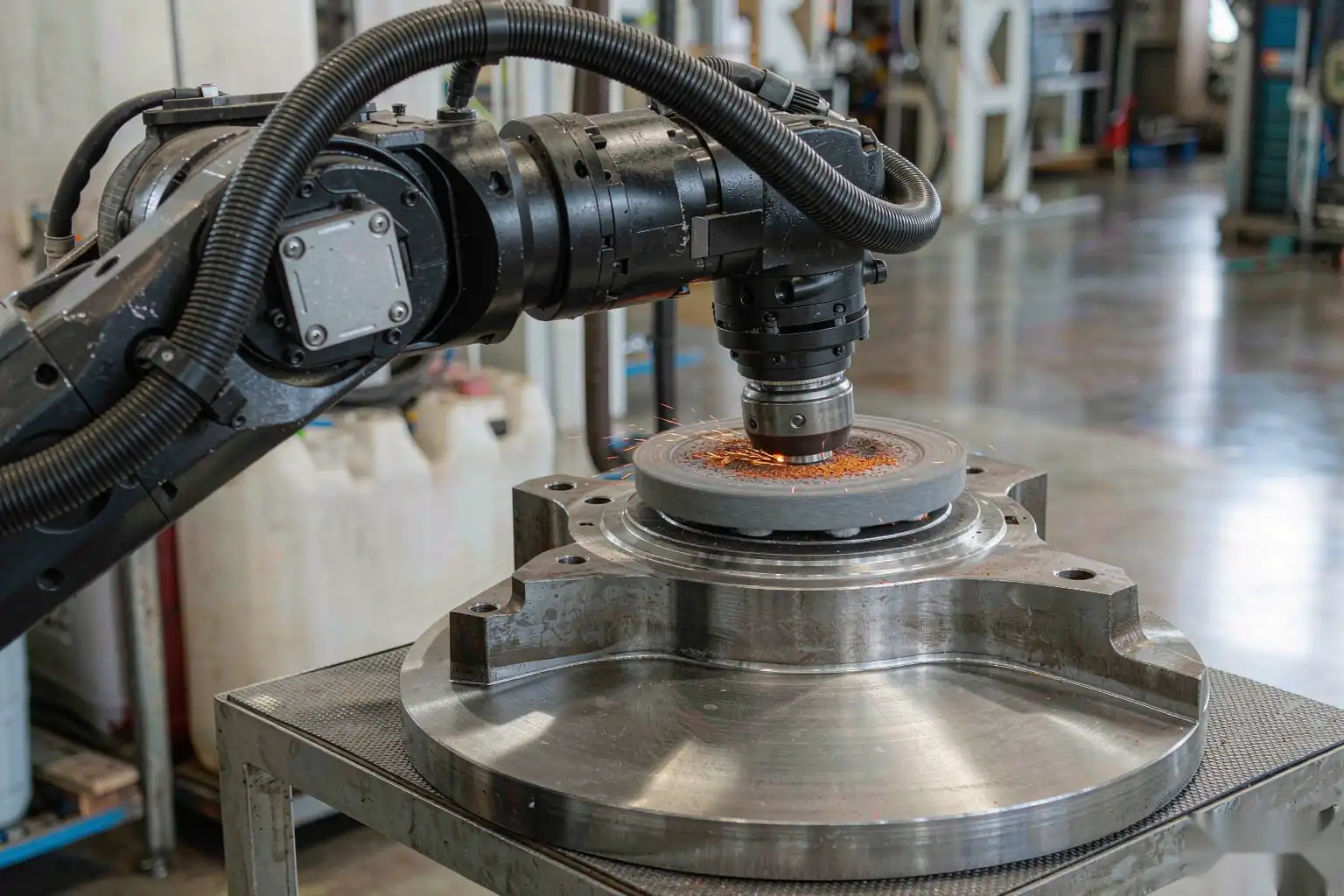


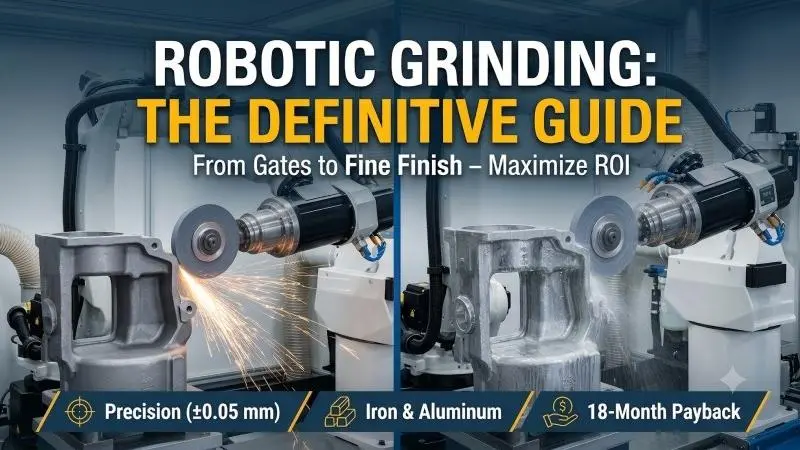
A robotic grinding machine for metal castings uses a 6-axis articulated robot carrying a grinding spindle or contact wheel to remove gates, risers, parting-line fins, and dimensional excess from iron, steel, and aluminum castings with programmed precision. Unlike a fixed CNC, the robot reaches complex internal and angled surfaces in a single fixture, making it the most flexible platform for irregular castings. Per the American Foundry Society, grinding is consistently among the highest-labor finishing steps, so robotizing it is a direct route to lower cost-per-part.
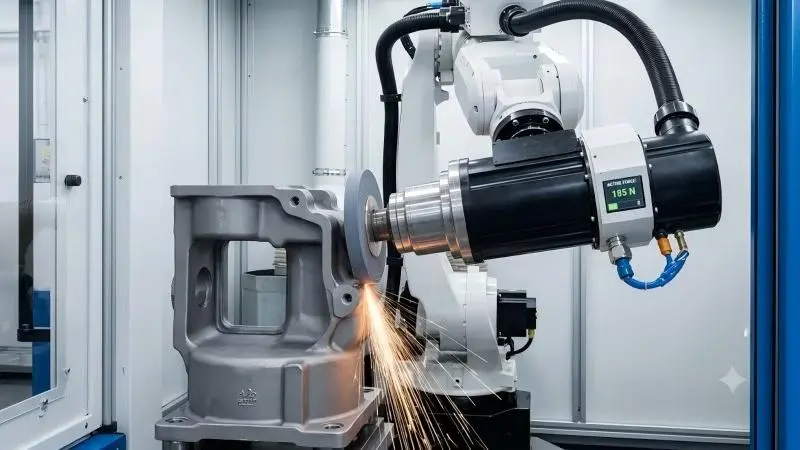
Core Components of a Robotic Grinding Machine
- Robot: 20–50 kg payload class for casting grind forces; ±0.05 mm repeatability.
- Spindle: 7.5–15 kW, 3,000–8,000 RPM with forced cooling for continuous duty.
- Tooling: depressed-center wheel, flap wheel, or contact wheel per operation.
- Positioner: 1–2 axis turntable that presents the grind face to the robot.
- Force control: active compliance holding 50–200 N grind force against casting variation.
Architecture options are compared in our automation step-by-step guide.
Grinding Process by Material
| Factor | Gray/Ductile Iron | Aluminum Die Cast |
|---|---|---|
| Wheel type | Zirconia-alumina, 24–36 grit | Ceramic/AO, 36–60 grit + coolant |
| Spindle speed | 3,000–6,000 RPM | 4,000–8,000 RPM |
| Coolant | Optional (dry OK) | Required (fire/dust control) |
| Typical stock removal | 2–8 mm | 0.5–3 mm |
Programming the Grind Path
The robot follows a taught or simulated path that tracks the casting contour. Force control lets the wheel maintain cut depth even when the casting is ±0.5 mm oversized at the gate. For the teach-validate method, see our robotic grinding cell setup guide. Wheel selection detail is in the wheel selection guide.
QUICK DECISION TIP
Add a 2-axis positioner rather than a longer robot arm — rotating the part to the tool is cheaper and more accurate than stretching reach.
Safety and Dust Considerations
Grinding throws sparks and fine dust. Enclose the cell, fit spark/flame detection, and for aluminum use wet collection to satisfy ISO and NFPA guidance. Interlocked guards per ISO 10218 keep operators out of the envelope.
Quality Outcomes
A tuned robotic grinding machine holds dimensional removal to ±0.05 mm and surface Ra to spec, eliminating the “ground-too-far” scrap common with handheld grinders. The consistent finish guide extends this to surface-quality control.
ROI SNAPSHOT
Replacing two manual grinders on a 300,000-part/yr iron line typically cuts grinding labor 60–75% and reduces over-grind scrap from ~4% to under 1%, paying back in 18 months or less.
Programming: Taught vs Offline Simulation
Path teaching on the real part is fastest to first article but ties up the cell. Offline simulation on a CAD model lets you prepare the next part family while the cell runs, then download and fine-tune in minutes. For shops with frequent changeovers, offline programming is the feature that protects utilization. The programming beginner guide covers the same workflow for deburring.
Wheel Dressing and Life Management
As a wheel wears it cuts slower and runs hotter. A managed dressing schedule — triggered by cycle-time drift or part count — restores geometry and keeps finish stable. Some cells dress automatically; others alert the tender. Either way, tracking wheel life per ton removed turns a mystery cost into a planned one.
Energy and Utility Planning
A 15 kW spindle plus robot and extraction draws meaningful power; size the supply and verify the site can deliver it without voltage drop during simultaneous start. Coolant systems add a pump load and a filtration loop that needs scheduled sump cleaning. Factoring utilities into the total cost avoids surprises and supports a realistic per-part cost model for quoting.
Coolant Filtration and Maintenance
Wet grinding cells live or die on coolant cleanliness. A clogged filter lets abrasive-laden fluid recirculate, scratching the very surface you are finishing. Size the filtration to your flow rate, schedule magnetic and paper-stage service, and monitor concentration weekly. Clean coolant also extends wheel and seal life, quietly lowering the cost-per-part that justifies the machine in the first place.
Frequently Asked Questions
Can the same robot grind iron and aluminum?
Yes, with program presets and separate wheel libraries; never mix aluminum dust and iron sparks in one dry enclosure.
How often are wheels changed?
Depends on stock removal; force-compensated cells run until cut rate drops, then auto-alert for change.
What finish can I expect?
Typically Ra 1.6–3.2 µm after grinding; polishing stages follow if a finer finish is needed.
Do I need a vision system?
Helpful for locating variable castings, but fixed locating pins plus force control is sufficient for most lines.
Need help specifying the right machine?
Contact Xiamen Dingzhu Intelligent Equipment — we size deburring and grinding cells to your castings, volume, and tolerances. Talk to our application engineers.
References
- American Foundry Society — afsinc.org
- NADCA — nadca.com
- ISO 9001 — iso.org
This article ihttps://www.nadca.coms for general guidance only and does not constitute a specification or quote. Confirm process parameters with the equipment supplier for your parts.