

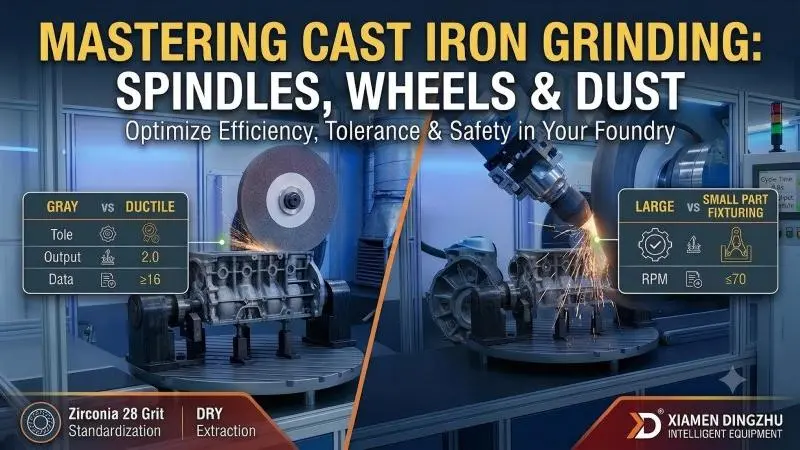
Cast iron — gray, ductile, and malleable — is abrasive, hard, and produces a gritty dust that quickly wears weak tooling, so selecting a grinding machine for cast iron parts demands attention to spindle power, wheel specification, and dust handling rather than just repeatability. The right choice removes gates and parting-line fins efficiently while keeping wheel cost and fire risk under control. The American Foundry Society notes iron grinding is among the most tool-consuming finishing operations, which makes wheel and machine selection the dominant cost driver.
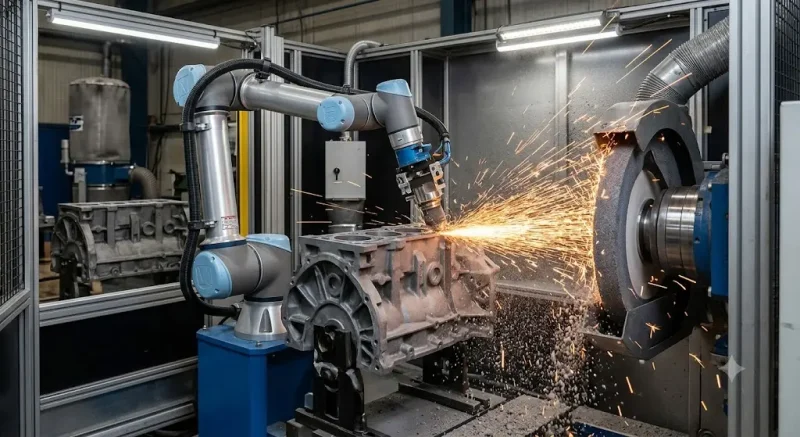
Tip 1: Size Spindle Power to Stock Removal
Cast iron gate cutting can require 5–15 kW of continuous spindle power. Undersized spindles overheat and stall. Our robotic grinding guide lists the 20–50 kg arm and 7.5–15 kW spindle typical for iron work.
Tip 2: Pick the Right Wheel
- Zirconia-alumina: self-sharpening, best for heavy gate/riser removal on iron.
- Silicon carbide: for lighter fin work where finish matters.
- Grit 24–36: aggressive cut; 60+ for finish passes.
The wheel selection guide maps abrasive to material and duty.
Tip 3: Plan Dust and Spark Management
Iron dust is less explosive than aluminum but still a housekeeping and respiratory hazard. Enclose the cell, use dry extraction with spark traps, and follow ISO/OSHA guidance. For aluminum mixed lines, see the automation guide on wet collection.
Tip 4: Consider Ductile vs Gray Iron Differences
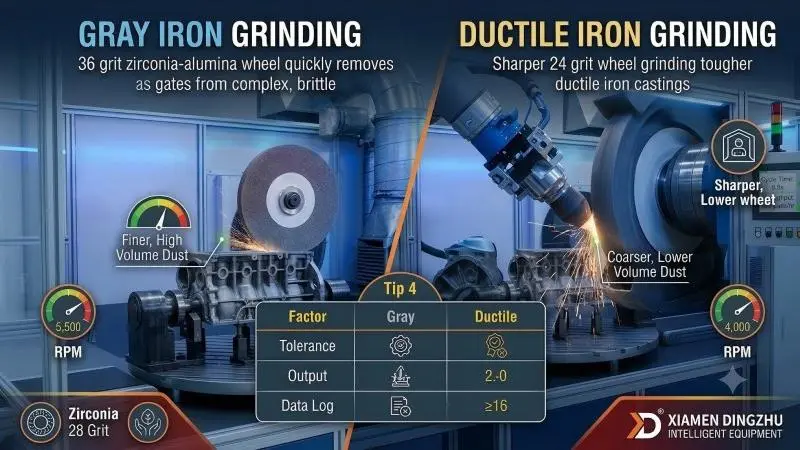
Ductile iron is tougher and work-hardens; it needs sharper, more aggressive wheels and slightly lower RPM to avoid glazing. Gray iron is more brittle and grinds faster but creates finer, dustier swarf.
| Factor | Gray Iron | Ductile Iron |
|---|---|---|
| Wheel preference | Zirconia 36 grit | Zirconia 24 grit, sharper |
| Spindle speed | 4,000–6,000 RPM | 3,000–5,000 RPM |
| Work-hardening | Low | Moderate, watch glazing |
| Dust generation | Finer, higher volume | Coarser, lower volume |
QUICK DECISION TIP
If you grind both gray and ductile iron, standardize on a 28-grit zirconia wheel and adjust RPM per program — one wheel library covers 90% of iron work.
Tip 5: Verify Removal Tolerance
Set the acceptable removal band (commonly ±0.1 mm for finished faces) and validate with a caliper or laser on the first 50 parts. Force control prevents digging past the line. The consistent finish guide covers measurement further.
Tip 6: Budget for Wheel and Maintenance
Wheels are the recurring cost. Track wheel life per ton removed and schedule change before quality drifts. Our maintenance guide provides the checklist.
Matching the Machine to Your Part Size
Large iron castings (engine blocks, manifolds) need a robust positioner and a longer-reach arm or a gantry-style grinder; small brackets fit a compact cell. Undersizing the work envelope forces awkward multi-fixturing and kills cycle time. Measure your largest and heaviest part first, then specify the robot or gantry to that envelope with margin.
Coolant and Rust Prevention
If you choose wet grinding for iron, the parts must be dried or oiled promptly to avoid flash rust before the next operation. Plan a blow-off or rust-inhibiting mist in the cell exit. Dry grinding avoids this but demands stronger extraction — weigh the two against your downstream process and floor layout.
Spare Parts and Lead Times
Iron grinding consumes wheels and contact heads steadily, so confirm spare-part lead times before purchase. Keep a rotating stock of your standard zirconia wheel and one spare spindle belt or motor brush set on site; a two-week wait for a $40 part can idle a $150k cell. Ask the supplier for a bill-of-materials with recommended minimum quantities tied to your projected tonnage.
Vibration and Foundation Requirements
Heavy iron grinding generates reaction forces that, on a weak floor, cause chatter and poor finish. Verify the slab can support the cell’s static and dynamic load, and use isolating mounts where needed. A stable foundation protects both surface quality and spindle bearing life. This is often overlooked in quotes but is cheap to address during cell siting and expensive to fix after commissioning.
Frequently Asked Questions
Can one machine grind all my iron castings?
Yes for mixed gray/ductile families if spindle power and wheel library cover your heaviest gate.
Dry or wet grinding for iron?
Dry is acceptable with extraction; wet improves wheel life and finish but needs rust protection afterward.
How do I avoid glazing on ductile iron?
Use a sharper/coarser wheel and keep RPM in range; dress the wheel when cut rate drops.
What removal tolerance is realistic?
±0.05–0.1 mm with force-controlled robotic grinding; manual is ±0.3 mm or worse.
Need help specifying the right machine?
Contact Xiamen Dingzhu Intelligent Equipment — we size deburring and grinding cells to your castings, volume, and tolerances. Talk to our application engineers.
References/contact
- American Foundry Society — afsinc.org
- NADCA — nadca.com
- ISO 9001 — iso.org
This article is for general guidance only and does not constitute a specification or quote. Confirm process parameters with the equipment supplier for your parts.