

Aluminum Die Casting Heat Treatment: T1 to T7 Tempers, Real Process Windows, and When to Skip It
Most heat treatment advice written for castings was written for permanent mold or sand cast parts. Apply it verbatim to a high pressure die casting and you will get blisters, sagging and a furnace of scrap. We have heat treated hundreds of thousands of die cast components over the last two decades, and the parts that failed usually failed for one reason: somebody specified T6 on a conventional casting that contained five to ten millilitres of entrained air per hundred grams of metal. This article sets out which die cast alloys can genuinely take a solution treatment, what the real time-temperature windows look like, how the part moves and how to verify the result before you accept a production batch.
Which Die Cast Alloys Can Be Solution Treated and Which Cannot
The dividing line is not the alloy family. It is the gas content of the casting, which is a function of the casting process, not the chemistry chart. The same AlSi10MnMg chemistry cast on a conventional machine will blister at 480 °C; cast on a super-vacuum machine with cavity pressure below 5 kPa absolute it will survive a full T6 with a surface you can machine to a sealing face.
- Conventional high pressure die castings, no vacuum or weak vacuum: gas content typically 5-15 mL/100 g Al. Safe thermal exposure is limited to artificial ageing only, roughly 150-230 °C, sometimes with a short stabilisation soak. T5 and T7 only.
- Vacuum assisted HPDC, cavity pressure 10-30 kPa: gas content 2-5 mL/100 g. Short solution soaks are feasible on sections under 6 mm, but the blister rate is dose dependent and rarely drops below a few percent.
- Super-vacuum or ultra-high vacuum HPDC, cavity pressure below 5 kPa, gas content under 1.5 mL/100 g: full T6 is routinely possible. This is the route used for structural nodes and crash-relevant brackets.
- Squeeze casting and low pressure die casting: low gas, low oxide, full T6 with no restriction. If your part genuinely needs T6 mechanical properties, this is often the honest answer rather than fighting the die casting process.
- Semi-solid and rheocast feedstock: near-laminar fill, gas content below 1 mL/100 g, full T6 with excellent results.
Alloy by alloy, the practical picture is:
| Alloy family | Typical die cast grade | Solution treatable? | Typical temper applied | Notes |
|---|---|---|---|---|
| Al-Si-Cu | A380 / ADC12 / AlSi9Cu3 | No, on conventional HPDC | T5, or F as-cast | Copper gives a strong age response; T5 at 175-205 °C recovers most of it |
| Al-Si-Mg | A356 / A357 | Yes, but rare in HPDC | T6, T7 | Almost always LPDC, gravity or squeeze; the classic 540 °C solution alloy |
| Al-Si-Mn-Mg | AlSi10MnMg | Yes, with vacuum | T6, T7 | Structural alloy, low Fe, Sr modified; ductility driven |
| Al-Mg-Si-Mn | AlMg5Si2Mn | Limited | T1, F | Self-ageing at room temperature; Mg rich, poor solution response |
| Al-Mg | AlMg3, AlMg5 | No | F | Work-hardening family, no precipitation response |
| Zinc | Zamak 3, 5, 7 | No | Stabilisation only | 100 °C for 3-6 h for dimensional stabilisation, not strengthening |
| Magnesium | AZ91D | Yes, limited | T4, T6 | 415-420 °C solution, long soak; needs SO2 or SF6 cover gas |
The practical rule we give customers is simple. If the casting was not produced with active vacuum, do not put a solution treatment on the drawing. Ask for T5 or design the part for as-cast properties instead.
Why Conventional High Pressure Die Castings Blister
The mechanism is arithmetic. During a conventional fast-shot fill the metal front fragments, and air is folded into the stream as discrete bubbles. At the moment of fill those bubbles sit at roughly ambient pressure, say 0.1 MPa. Put the part into a solution furnace at 490 °C and the gas expands by the ratio of absolute temperatures: 763 K divided by 298 K is 2.6. That alone gives 0.26 MPa of internal pressure. Hydrogen in solution adds more, because solubility in solid aluminium falls as the part cools and the gas migrates into existing voids.
At 490 °C the yield strength of an Al-Si-Cu alloy is a few megapascals. There is essentially nothing holding the surface down. The blister forms where the internal void sits closest to the skin, which is why they appear preferentially on the last areas to fill and on thick sections where solidification shrinkage has already opened the void up.
Three variables make it worse:
- Longer soak. Blistering is a time-at-temperature phenomenon. Going from 2 h to 6 h at 490 °C can double or triple the reject rate, because gas diffusion and void coarsening keep working.
- Higher temperature. Above roughly 500 °C on Al-Si-Cu you approach incipient melting of the copper-rich eutectic. Local liquid films open paths for gas and you get not just blisters but a visibly swollen, spongy part.
- Thicker sections. Gas bubbles in the centre of a 15 mm boss have more stored volume and a longer diffusion path, so they both grow more and vent less.
The escape routes are all real and all have a cost:
| Measure | What it does | Typical cost or penalty |
|---|---|---|
| Super-vacuum (under 5 kPa) | Removes the gas source | Machine retrofit, higher cycle time, tighter die sealing |
| Short soak, 20-45 min instead of 4-8 h | Limits growth time | Incomplete solution, lower peak properties |
| Step solution, 420 °C hold then final temperature | Homogenises before full expansion | Extra furnace step |
| Lower solution temperature, 470-480 °C | Cuts expansion ratio and incipient melting risk | Slower dissolution of Mg2Si and Al2Cu |
| Vacuum or low-pressure casting instead of HPDC | Removes the gas source entirely | Higher piece price, longer cycle |
Temper Designations T1 to T7 Explained
The temper letters are not quality grades. They describe a sequence of operations, and picking the wrong one is a design error, not a preference.
- T1: cooled from an elevated temperature shaping process and naturally aged to a substantially stable condition. In die casting terms this means the part has come out of the die, cooled in air, and then sat. Al-Mg-Si-Mn alloys gain strength for weeks at room temperature. This is the cheapest temper there is, because you are only paying for warehouse time.
- T4: solution heat treated, quenched, and naturally aged. Almost never specified on HPDC because it requires the solution step that conventional castings cannot survive.
- T5: cooled from the casting process and artificially aged. No solution treatment, no quench. This is the workhorse temper for die castings. The casting retains its as-cast supersaturated structure from the fast die cooling, and ageing precipitates strengthening phases directly from it.
- T6: solution treated, quenched, and artificially aged. Highest strength, requires vacuum or low-gas feedstock, and carries quench distortion risk.
- T7: solution treated, quenched, and overaged or stabilised. Deliberately aged past peak hardness to trade 10-20 percent of yield strength for dimensional stability, stress relief and better corrosion behaviour. The right call when the part sees elevated service temperature, because it stops the microstructure continuing to evolve in service.
Natural Versus Artificial Ageing
Natural ageing at room temperature is slow and self-limiting. Al-Mg alloys pick up most of their gain in the first 7 to 14 days and then effectively stop. Zinc alloys actually lose strength and grow slightly as the metastable phases decompose, which is why zinc parts get a stabilisation treatment at 100 °C for 3 to 6 h before any precision machining.
Artificial ageing is a diffusion-controlled precipitation sequence. For Al-Si-Cu it runs roughly supersaturated solid solution, then GP zones, then theta-double-prime, then theta-prime, then coarse theta. Peak hardness sits at the theta-prime stage. Age longer or hotter and the precipitates coarsen, hardness falls, and elongation rises. That is exactly the T7 trade.
The useful engineering consequence: ageing temperature and time are interchangeable over a limited range, and you can use that to flatten furnace loading. 180 °C for 4 h and 160 °C for 10 h land in a similar hardness band, but they do not land in the same elongation band. Specify both parameters, never just “T6”.
A Working Time-Temperature Schedule
The table below reflects schedules we have run in production. Treat it as a starting window for process development, not a specification to copy onto a drawing. Furnace type matters: a well-circulated air furnace with a load thermocouple will hold ±5 °C; a poorly loaded one can swing ±15 °C and wreck the age response.
| Alloy | Temper | Solution soak | Quench | Artificial ageing | Typical as-cast to treated hardness |
|---|---|---|---|---|---|
| A380 / ADC12 | T5 | None | None | 175 °C for 6-8 h, or 205 °C for 3-4 h | 75-85 HB to 95-110 HB |
| AlSi9Cu3 | T5 | None | None | 180 °C for 6 h | 80 HB to 100 HB |
| AlSi10MnMg | T6 | 480 °C for 60-90 min | Water at 60-80 °C, or 8-12 percent polymer | 170 °C for 4-6 h | 65-75 HB to 90-100 HB |
| AlSi10MnMg | T7 | 480 °C for 60-90 min | Water at 60-80 °C | 200-220 °C for 3-4 h | 65-75 HB to 75-85 HB |
| AlMg5Si2Mn | T1 | None | None | None, 14 days at room temperature | 60 HB to 75 HB |
| A356 (LPDC) | T6 | 540 °C for 6-8 h | Water at 60-80 °C | 155 °C for 4-6 h | 60 HB to 90-100 HB |
| Zamak 5 | Stabilisation | None | None | 100 °C for 3-6 h | No hardness change, dimensional only |
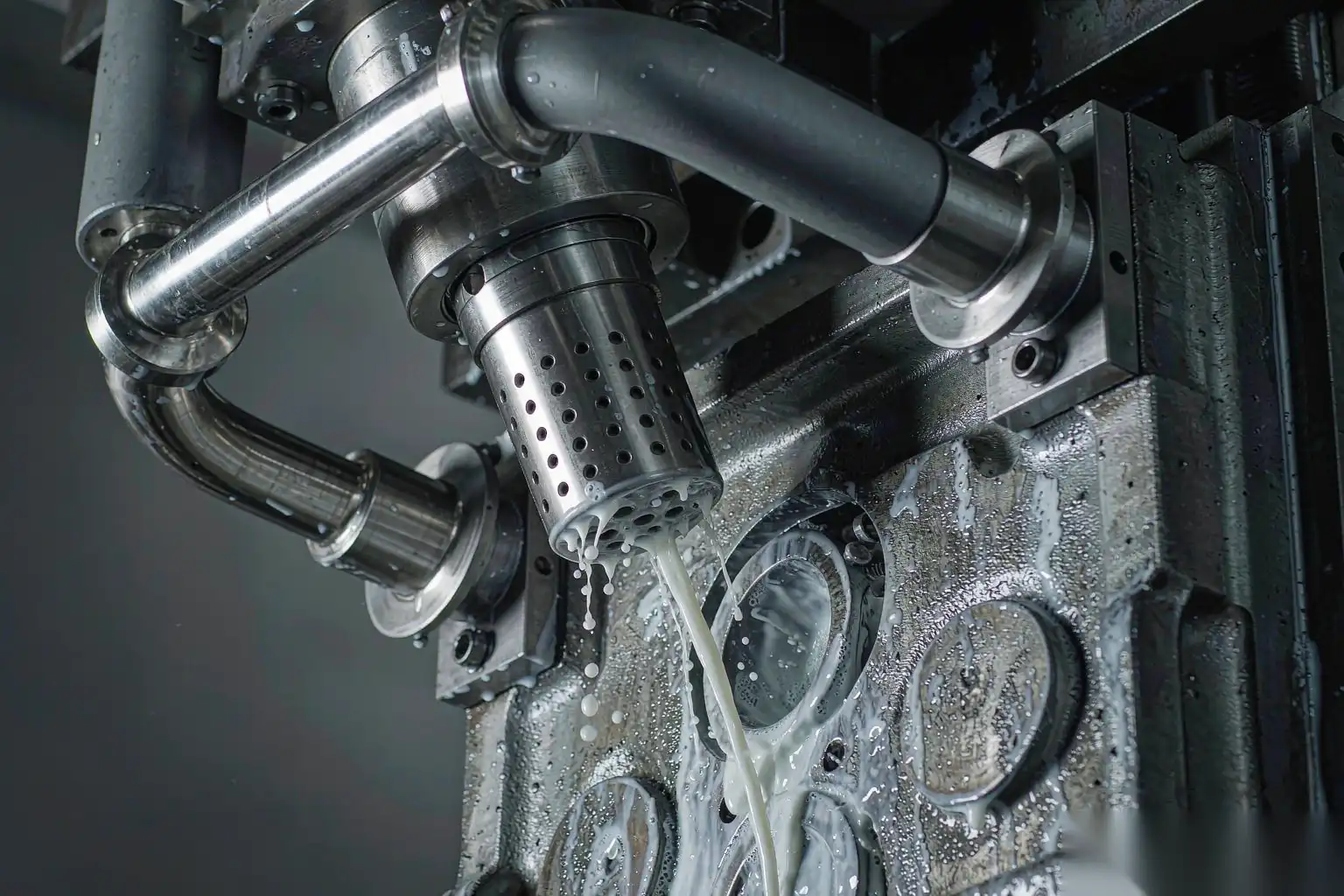
Two practical notes on quenching. Warm water at 60-80 °C, not cold, is the standard for aluminium castings of any complexity, because it cuts the thermal gradient across thick to thin transitions and typically halves distortion with minimal loss of properties. Polymer quenchants at 8 to 15 percent sit between water and oil and are useful on thin-wall structural parts where even warm water distorts. Always specify a maximum delay between furnace exit and quench, typically 10 to 15 seconds, and make sure the rack design does not trap steam pockets that create soft spots.
Peak-hardness mapping is the only honest way to set the ageing cycle. Run coupons at 160, 170, 180 and 190 °C, pull samples every 2 h out to 12 h, and plot hardness against time. The peak is flat and forgiving on Al-Si-Cu and sharp on Al-Si-Mg, which is why the magnesium-bearing alloys need tighter furnace control.
Dimensional Change, Distortion and Straightening Fixtures
Every part moves during heat treatment. The only question is how much and whether you planned for it. The sources are:
- Quench thermal gradient. Thick sections cool last and contract last, so thin walls end up in residual compression and thick sections in tension.
- Stress relief. Casting residual stress from die cooling is released at temperature; the part relaxes toward a new equilibrium shape.
- Precipitation volume change. Small, typically 0.02 to 0.05 percent linear, but measurable on a 500 mm part.
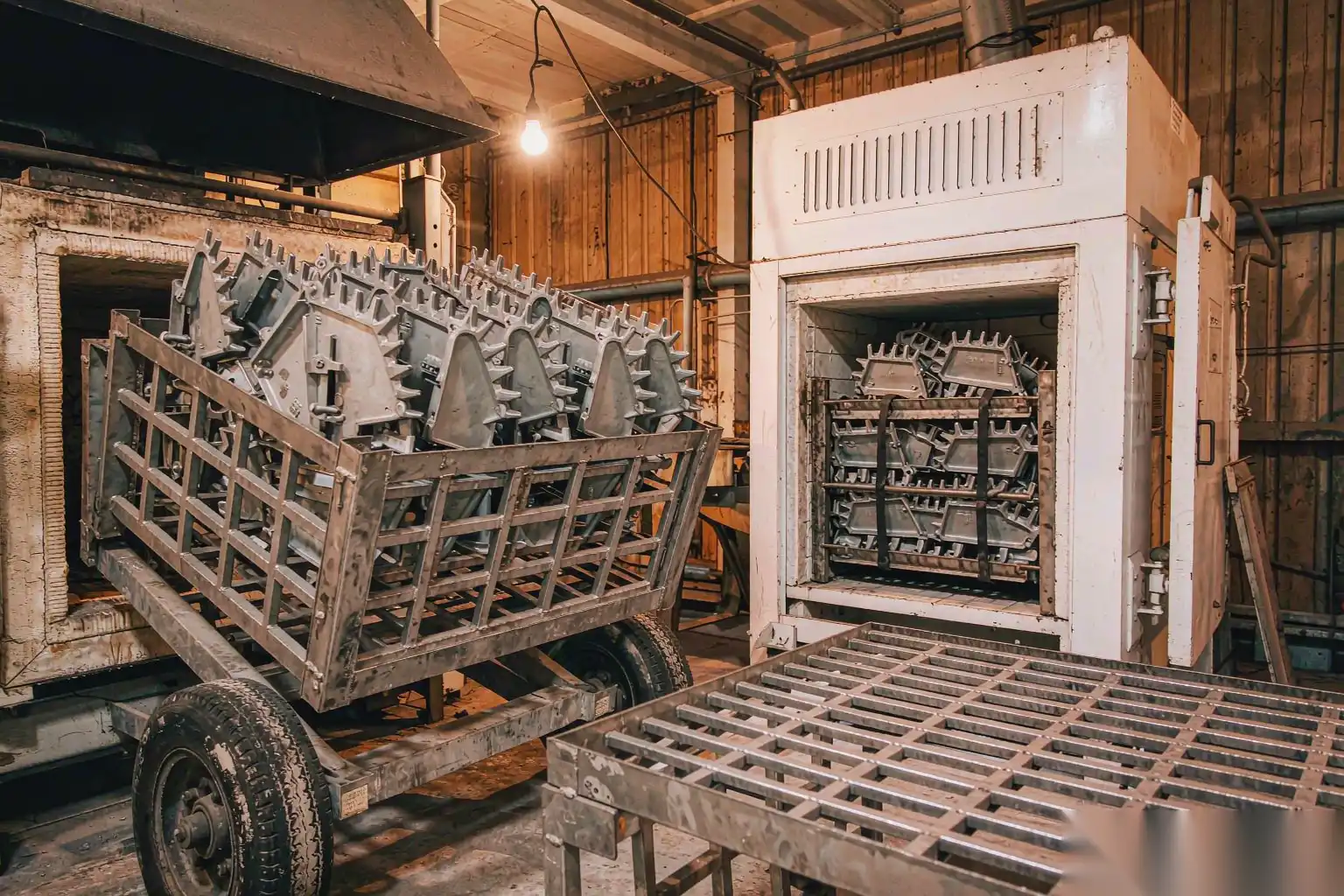
- Gravity sag. At 480 °C an unsupported 1.2 m part will sag. This is the dominant distortion mode on large structural castings and the reason fixtures exist.
What this looks like in practice:
| Part class | Typical post-treatment movement | Control method |
|---|---|---|
| Small bracket, under 150 mm | 0.05-0.15 mm | None normally needed |
| Housing, 150-400 mm | 0.2-0.6 mm | Restrike die or press straightening |
| Structural node, 400-800 mm | 0.5-1.5 mm | Custom fixture, fixture through ageing |
| Large tray or beam, over 800 mm | 1.5-4 mm | Full support fixture plus warm quench |
Fixture rules we hold to. Support the part at three or more points under every heavy section, not at the extremities. Use Invar or mild steel for fixtures that cycle above 200 °C repeatedly, because aluminium fixtures creep and lose their setting. Clamp lightly, enough to restrain gravity sag without inducing plastic strain, because an over-clamped part springs back worse than it started. And where the geometry allows, straighten in the T5 or as-cast condition before the final age, because the material is more forgiving there and the subsequent age cycle will stabilise the new shape.
Acceptance is a measurement question. Straightening is not cheating, but it must be declared. We write flatness into the drawing as measured after heat treatment in the free state, plus a separate limit on the straightening press force, because an unlimited press force lets a supplier hit flatness while filling the part with locked-in stress that will relax the first time it sees service temperature.
Effects on Machinability and Downstream Finishing
Heat treatment changes the way the part cuts and the way it takes a finish, and both matter more to total cost than the tensile numbers usually do.
- Hardness rises. A380 at T5 goes from around 80 HB to 100-110 HB. Carbide tool life drops by roughly 15-30 percent, and built-up edge on the cutting edge reduces, so surface finish often improves even though tool wear increases.
- Silicon morphology changes. Solution treatment spheroidises the eutectic silicon, which is the single biggest machinability lever in Al-Si alloys. Spheroidised silicon fractures cleanly instead of ploughing, and we routinely see Ra improve by one step on the same tooling.
- Dimensional stability improves. Machining before ageing on an alloy that will continue to age naturally is a good way to bore a hole and then watch it move. T5 or T7 before finish machining removes that risk.
- Porosity becomes visible. Blisters that did not open in the furnace frequently open under the cutting tool or under a polishing belt. A part that passes 100 percent visual inspection after treatment can still show porosity at the buffing wheel, which is why we test heat treated parts before they reach finishing, not after.
- Anodising and conversion coating respond differently. Higher copper and silicon content after solution treatment shifts anodic film colour and can give a mottled appearance. If the part is decorative, lock the finish sample down with the same heat treatment lot, not a separate one.
For downstream finishing of heat treated parts, the deburring and polishing parameters need to be re-tuned: harder material needs different abrasive and slightly higher contact force. Our finishing engineers normally re-qualify the cycle whenever a customer moves a part from as-cast to T5, and the same applies when you change suppliers. More on this in our guide to aluminum die casting finishing options.
Verification: Hardness Mapping and Tensile Coupons
A heat treatment certificate that says “T6” is not verification. Verification is measurement on the part, at defined locations, with a documented sampling plan.
- Hardness mapping. Define a grid, typically 25 mm spacing on small parts and 50 mm on large ones, and record Brinell or Rockwell at every node. The acceptance window should be a band, not just a minimum: on a T5 A380 part we would write 95-115 HB. Too high means overaged or wrong chemistry; too low means the load missed the soak or the quench was slow. A spread of more than 15 HB across a single part usually indicates furnace loading problems or a failed circulation fan.
- Tensile coupons. Machine coupons from a designated area of the casting, or better, from separately cast test bars poured from the same ladle at the same time. Test to ISO 6892-1 or ASTM B557. Specify the location on the drawing, because properties in a 3 mm wall and a 20 mm boss differ by more than the scatter between lots.
- Sampling frequency. For a structural application, first article on ten parts across three furnace loads, then two parts per shift per furnace as ongoing control. Anything less and you are inspecting for luck.
- Electrical conductivity. Fast, cheap, non-destructive and surprisingly sensitive to ageing state. Useful as a 100 percent sort where hardness indentation is not acceptable on a visible surface.
- Dimensional layout. Before and after on the first article, then on a defined frequency. If you only measure after, you will never know whether distortion came from the quench or from the casting.
- Destructive sectioning on a defined cadence. Cut one part per month through the thickest section and look for incipient melting, void growth and intergranular attack. This is the only way to catch a furnace drifting toward the top of its temperature band.
When Heat Treatment Is Not Worth Doing
We talk customers out of heat treatment at least as often as we talk them into it. Skip it when:
- The part is loaded well below its as-cast capability and the design already carries a 2x safety factor. Adding T5 to gain 15 percent strength on an over-designed bracket buys nothing.
- The alloy has no precipitation response. Al-Mg and most zinc alloys gain nothing from artificial ageing, so the cycle only adds cost, handling and distortion.
- The part is large and geometrically unstable. On a 1.4 m component, fixture cost plus straightening labour can exceed the entire value of the property gain.
- Dimensional tolerance is tighter than the distortion band. If the drawing calls for 0.2 mm flatness on a 600 mm part, no amount of straightening will hold it reliably through T6.
- Volume is low. A furnace load is a furnace load. At a few hundred pieces a month you are paying for a full cycle plus freight to and from the heat treater, and the cost per kilogram gets ugly fast.
- The part will be coated or painted and never sees elevated service temperature. Stabilisation is only needed if the service temperature is high enough to keep changing the microstructure, typically above 100 °C for Al-Si-Cu.
Typical added cost is USD 0.15-0.60 per kilogram depending on batch size, cycle length and whether straightening is needed. Straightening is often half of that number on its own, and it is the line item most often left out of the quotation.
Spec-Writing Checklist for Buyers
Put these on the drawing and in the purchase order. Ambiguity here is where most heat treatment disputes start.
- Name the full temper, including temperature and time, not just T5 or T6. Write “T5, artificial age 180 °C plus or minus 5 °C for 6 h”.
- State the process route that qualifies the part for treatment: super-vacuum HPDC at a specified cavity pressure, or low-pressure, or squeeze.
- State the gas content limit if you are solution treating, measured by reduced pressure test or vacuum extraction, and the sampling frequency.
- Give the solution temperature band and the soak time band separately, and say whether the soak clock starts at furnace recovery or at load thermocouple.
- Specify quench medium, quench temperature, and maximum delay from furnace to quench.
- Give hardness as a band with an acceptance spread across the part, and name the scale and load.
- Give tensile requirements with the coupon location drawn on the part.
- State that properties are measured after heat treatment, and whether straightening is permitted and under what maximum press force.
- Define the flatness datum and measurement state, free state versus clamped.
- Define the number of permitted re-age cycles. Re-ageing to recover an underaged load is common practice and should be capped, typically at one additional cycle.
- Require furnace chart records with load thermocouple traces to be retained and available per batch.
- Require a first article report covering hardness map, tensile results, dimensional layout before and after, and one sectioned part.
Where a drawing is ambiguous, ask for the process window rather than the property. If a supplier cannot tell you the soak time, quench temperature and delay, they are not in control of the result, whatever the certificate says.
For parts that are heat treated and then finished, the gate removal, deburring and polishing sequence should be qualified on treated parts from the start, using the same robotic deburring and grinding approach that keeps contact force constant across a hardness change. If you are weighing whether a given part needs treatment at all, our notes on porosity and its interaction with thermal processing are worth reading first, because the porosity population usually decides the answer.
DZ Machinery builds robotic deburring, grinding and polishing cells for heat treated die castings, including fixtures that hold post-quench parts where the flatness band is tight. If you are specifying a new T5 or T6 part and want the finishing step validated against the treated condition rather than the as-cast condition, send us the part drawings and we will quote the cell against your takt time and acceptance criteria.