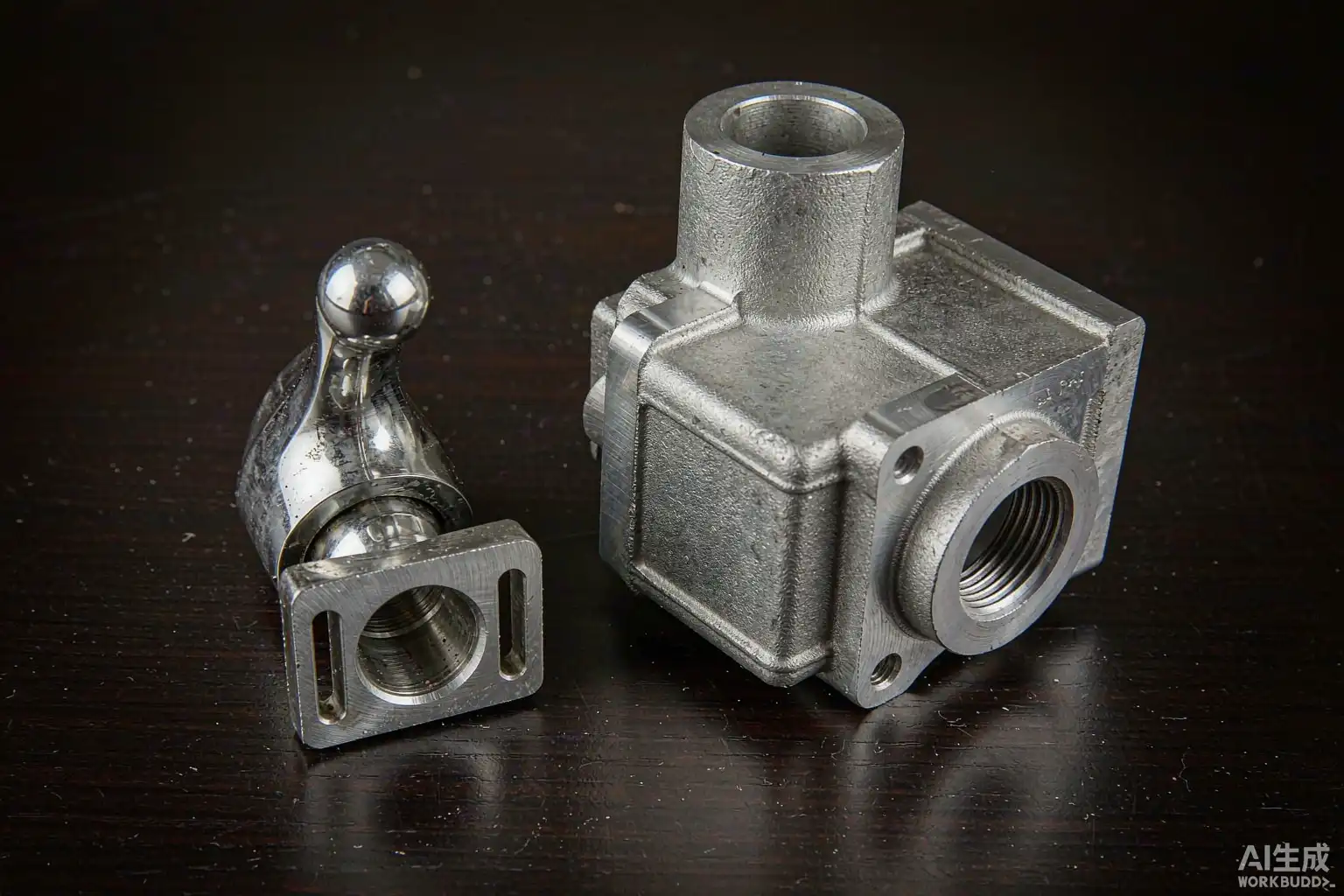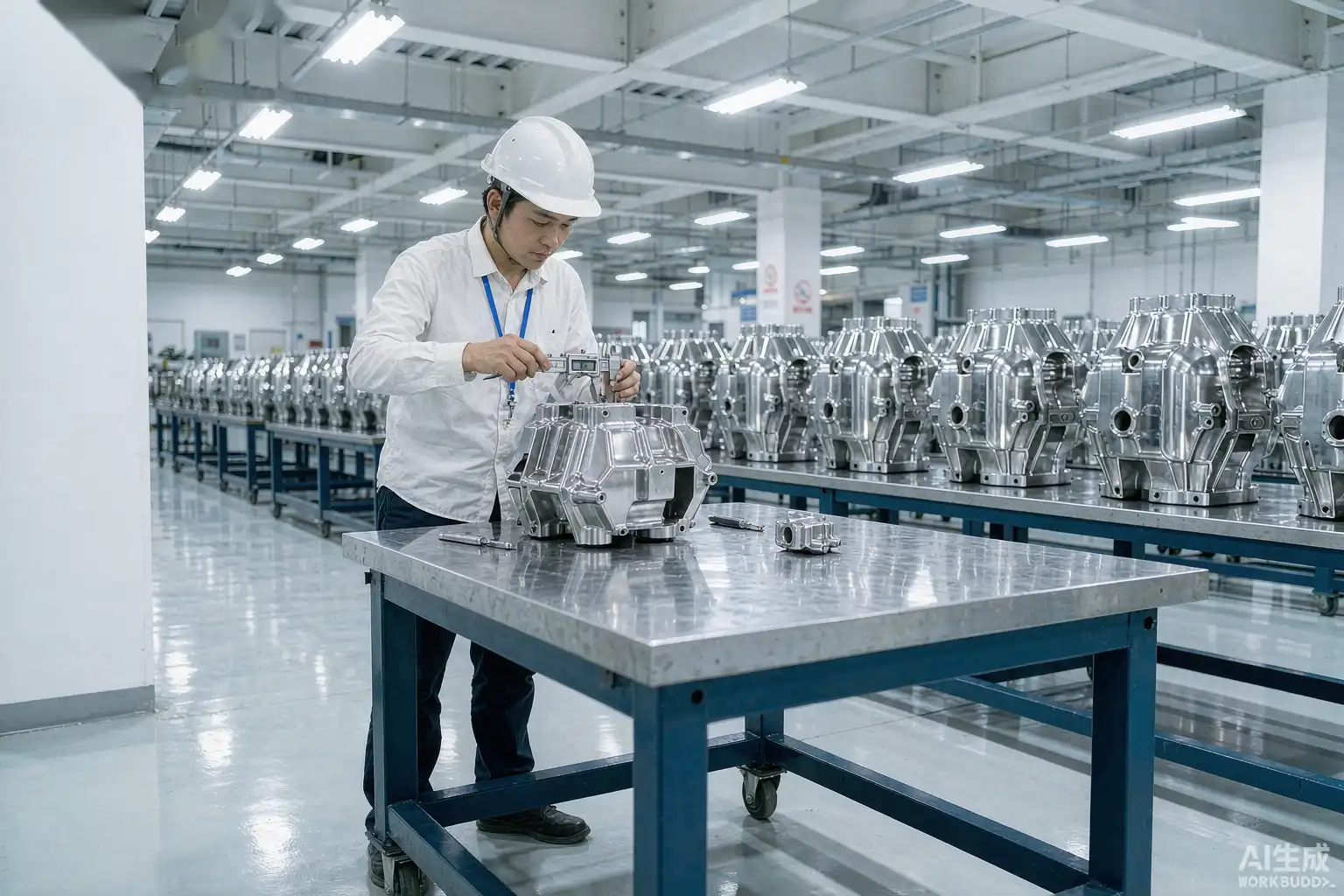


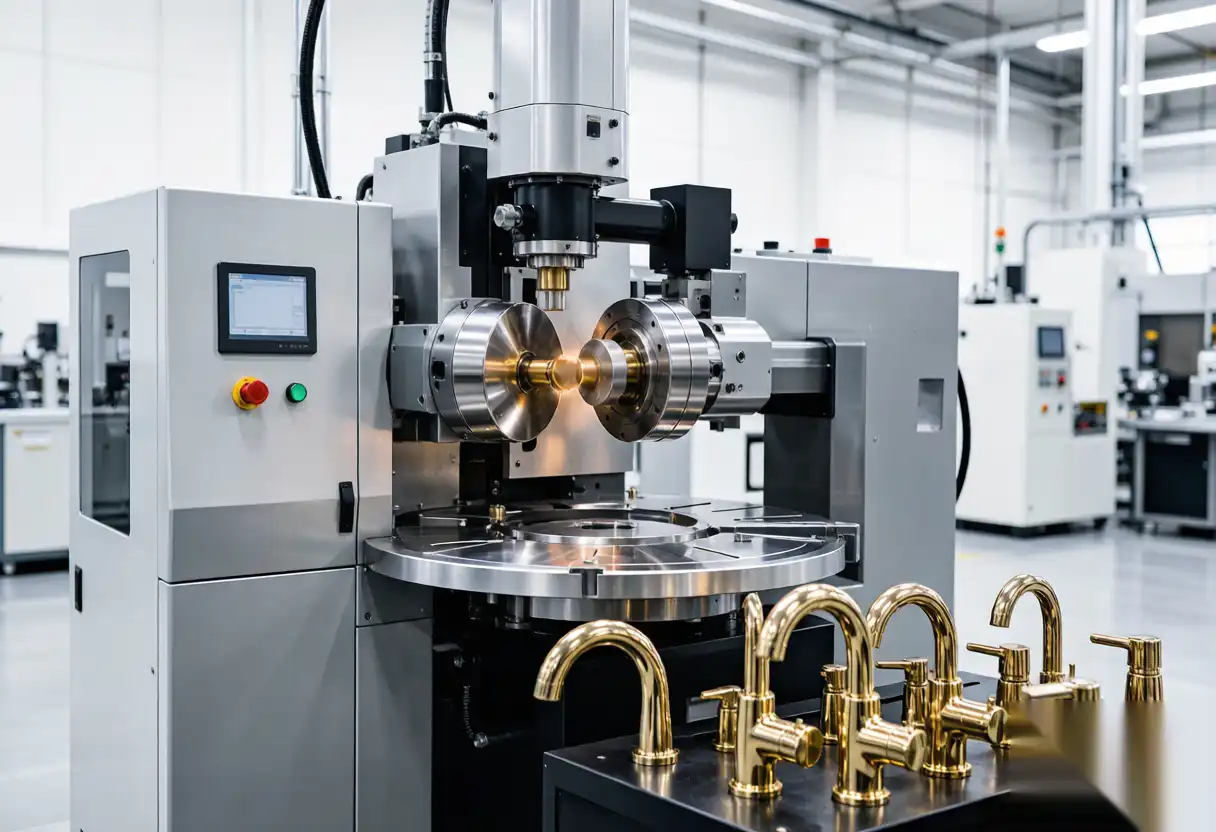
An automatic polishing machine for brass faucets plays a decisive role in preparing the complex contoured surfaces of faucet bodies, spouts, and decorative trim for flawless satin or high-gloss mirror finishes. Because copper-zinc alloys are soft and highly susceptible to thermal scoring or deformation under aggressive pressure, industrial finishing cells must trace complex 3D curves at controlled contact force. This critical step typically follows initial rough deburring where a specialized grinding machine for sanitary fittings has removed parting line flash and gate stubs.
In high-end sanitary ware manufacturing, surface aesthetic quality directly dictates market value. Traditional manual latches create severe process variability, leading to uneven wall thinning, lost detail on sharp geometric edges, and high scrap rates prior to electroplating (PVD, chrome, or nickel). Automated polishing equipment replaces manual inconsistency with closed-loop force compliance and automated compound dosing, ensuring every batch meets strict optical reflection tolerances.
Why Brass Requires Specialized Polishing Mechanics
Brass alloys (such as HPb59-1, C37700, and low-lead brass formulation) exhibit unique thermal and mechanical properties during abrasive processing. While brass cuts easily, its low hardness makes it exceptionally prone to surface gouging, drag marks, and local annealing when exposed to friction spikes. Excessive contact pressure causes grease binders to bake onto the surface, creating dark burnt streaks that fail pre-plating inspection.
Integrating active force-controlled buffing heads resolves these challenges by decoupling spatial tool positioning from applied normal pressure. Our comprehensive automatic polishing machine guide covers the multi-axis kinematic configurations best suited for complex plumbing geometries.
Recommended Machine Architecture for Sanitary Ware
Achieving repeatable Ra < 0.05 µm mirror finishes on brass castings requires combining four core engineering systems within the finishing cell:
- Active Pneumatic Compliance Heads: Floating wheel spindles automatically maintain a constant 10 N to 25 N contact force regardless of casting dimensional tolerances or buffing wheel wear.
- Variable Speed Spindles (1,500–3,000 RPM): High spindle speeds are utilized during initial aggressive cutting passes (28–32 m/s surface speed), while lower speeds (18–22 m/s) are selected for fine coloring passes to prevent compound sling-off.
- High-Pressure Liquid Compound Spray Systems: Automated air-assisted spray guns apply precise micro-doses of emulsion-based polishing compound directly onto the cloth mop, ensuring consistent abrasive action.
- Flexible Material Handling (Rotary Indexing vs. 6-Axis Robots): Continuous rotary tables deliver maximum throughput for high-volume single-SKU runs, whereas 6-axis articulated robots provide fast program switching for high-mix, low-volume designer faucet lines.
Progressive Compound & Media Selection Matrix
A successful mirror finish relies on a strict progressive abrasive sequence. Jumping directly from a coarse grind to a fine coloring compound traps micro-scratch valleys beneath a smeared surface layer. Consult our polishing compound selection guide to align compound viscosity and grit size with your specific brass alloy chemistry.
| Stage | Recommended Wheel Media | Compound Type | Target Surface Roughness | Visual Result |
|---|---|---|---|---|
| 1. Fast Cut / Heavy Polish | Treated Sisal / Stitched Cotton | Brown Tripoli or Heavy Cut Liquid | Ra 0.35 – 0.50 µm | Uniform satin base, grind marks removed |
| 2. Bright Coloring | Open Bias-Cut Cotton Mop | White Diamond or Fine Green Rouge | Ra 0.08 – 0.12 µm | High specular gloss, haze-free reflection |
| 3. Final Super-Finish | Loose Flannel / Fine Soft Cloth | Dry Liquid Emulsion or Protection Wax | Ra < 0.05 µm | True #8 optical mirror, ready for electroplating |
CRITICAL PROCESS TIP FOR FAUCET POLISHING
Brass mirror polishing is entirely unforgiving. Any residual 320-grit or 400-grit grinding line left unrefined during the pre-polishing stage will remain clearly visible under chrome or PVD plating. Ensure the pre-grinding stage achieves a clean Ra 0.8 µm base before transferring the component to the buffing station.
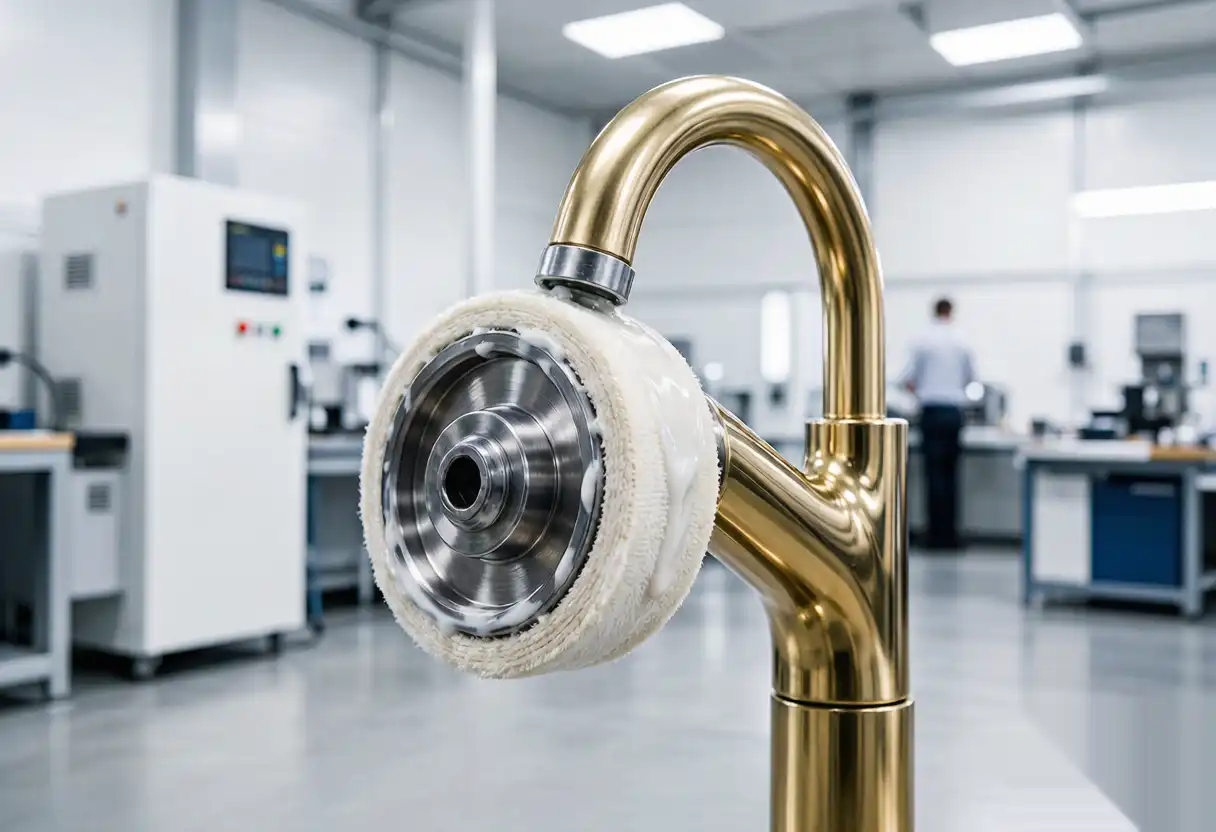
Quality Inspection & Pre-Plating Protocol
Polished brass parts must undergo rigorous surface inspection prior to entering ultrasonic cleaning and electroplating lines. Raking light inspection lamps positioned at a 45-degree angle help operators instantly spot subtle hologram marks, orange peel effects, or residual compound smears. Detailed inspection guidelines and Ra limits are outlined in our quality control guide for automated finishing.
Troubleshooting Common Brass Polishing Defects
| Defect Manifestation | Root Operational Cause | Corrective Action |
|---|---|---|
| “Rainbow” Refraction / Holograms | Inconsistent pressure or compound build-up on cotton wheel | Engage active force compliance; dress wheel with automated rake |
| Dark Grease Burn Lines | Excessive RPM or over-application of solid compound bar | Switch to liquid compound spray; reduce spindle speed by 15% |
| “Orange Peel” Surface Ripple | Over-polishing soft brass with excessive contact pressure | Reduce compliance pressure to 12–15 N; increase TCP feed rate |
Frequently Asked Questions
Should sanitary brass faucets feature a mirror or satin finish?
Luxury residential fittings primarily demand high-gloss mirror finishes (Ra < 0.05 µm) as a base for chrome, PVD gold, or brushed nickel electroplating. Commercial installations often utilize satin or brushed textures to effectively conceal water spots and daily wear.
What causes “rainbow” optical distortion or haze on polished brass?
Rainbow banding occurs when rigid tool execution causes localized pressure spikes, forcing hot binder wax into the brass micro-pores. Implementing closed-loop force compliance and automated wheel dressing eliminates this haze completely.
Can a single automated machine execute both heavy cut and mirror color passes?
Yes. Dual-head work cells or dual-arm robotic systems allow a brass faucet body to undergo heavy tripoli polishing on a sisal wheel, then immediately transfer to a soft cotton wheel with white diamond compound within the same continuous cell cycle.
Why is liquid compound preferred over solid compound bars in automated faucet lines?
Liquid emulsion compounds sprayed via automated air guns ensure uniform micro-dosing directly onto the buffing zone. This prevents compound starvation, extends cotton wheel life by up to 40%, and eliminates heavy wax residue buildup on intricate faucet spouts.
Need Help Specifying the Right Machine?
Selecting the right automated polishing configuration depends on your part geometry, daily production volume, and electroplating quality targets. Talk to the application engineers at Xiamen Dingzhu Intelligent Equipment — we custom-engineer grinding, polishing, and surface finishing systems specifically for brass fittings, zinc die-castings, and sanitary hardware. Explore our full portfolio of heavy-duty automatic grinding machines and 6-axis automatic polishing machines today.