


QUICK FACTS
| Typical cycle | 20–120 s/part |
| Spindle range | 6,000–18,000 RPM |
| Force control | Active compliance ±5 N |
Small and medium foundries share a problem. They produce good castings, but the finishing step eats their margins. Labor is hard to find, rework is high, and the bench is always the bottleneck. Automation feels out of reach, because the catalog is small and the budget is tight.
However, automation is more affordable than most small foundries think. The trick is choosing the right size of solution. This article reviews five options, from a single cell to a phased line, and shows what fits a small budget.
Why Small Foundries Hesitate
The hesitation is honest. Small foundries fear a robot that sits idle, a system nobody can run, and a payback that never comes. Those fears are real when the solution is oversized.
In addition, surface finishing automation for foundries used to be sold as one big package. Small plants do not need the big package. They need the right slice.
Therefore, the answer is to start small, share the cost, and grow with the volume.
Solution 1 — Robotic Deburring Cell
A single deburring cell is the classic first step. It removes flash and blends edges on one part family. It is simple, proven, and cheap compared to a full line.
For example, a cell that deburrs a gate stub off one casting family can run 500 parts a shift. One operator loads and monitors. The bench work that took three people disappears.
As a result, the first cell pays back fast and teaches the team the automation basics.
Solution 2 — Grinding Cell for Gates and Flash
If heavy gates dominate the defect list, a grinding cell comes first. A force-controlled belt head removes gates and parting-line flash at a steady rate. The polish that follows becomes easier and cheaper.
For example, robotic grinding for metal castings removes the gross material consistently. The downstream finish stops depending on luck.
In addition, the grinding cell protects the polishing media. Less aggressive work downstream means longer media life and lower cost per part.
Solution 3 — Polishing Cell for Cosmetic Parts
For foundries that ship cosmetic parts, a polishing cell delivers the visible win. It turns a variable manual finish into a repeatable one. Customers notice the difference in the first shipment.
However, polishing is the most sensitive process. It needs force control and a solid recipe. Start with your highest-volume cosmetic part and prove it there.
Consequently, the polishing cell builds the quality reputation that supports pricing.
Solution 4 — Shared Flexible Cell
A flexible cell with quick-change fixtures serves several part families. It fits small foundries perfectly, because no single family has enough volume for a dedicated cell. The shared cell runs more hours and earns its keep.
For example, one flexible cell handles five families. Each family has a fixture and a recipe. Changeover is minutes. The utilization stays high, and the payback shortens.
In addition, the recipe library grows with every family. The foundry builds its own process knowledge over time.
Solution 5 — Phased Line Expansion
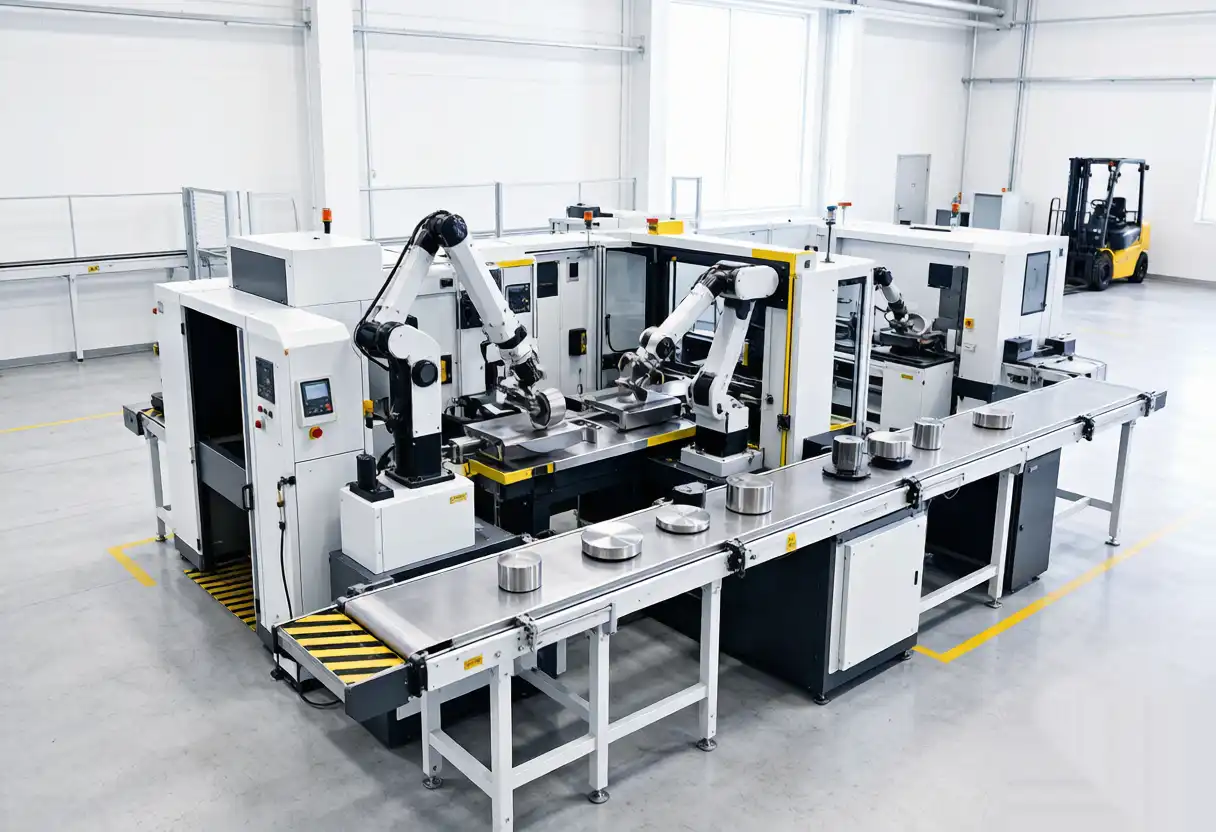
As volume grows, the foundry links cells into a line. A shuttle moves parts from grinding to polishing without re-fixturing. The line looks like a casting-to-polishing production line at a smaller scale.
For example, a foundry starts with one deburr cell, adds a polish cell, and then connects them. Each phase pays for the next. The final line runs with two operators instead of eight.
Therefore, the phased path spreads the capital and the risk across years, not weeks.
What Fits a Small Foundry’s Budget
- Start with one cell. A deburr or grind cell is the cheapest proven entry.
- Reuse the fixture standard. Every future cell shares the same locating logic.
- Buy force control. It is the difference between a toy and a tool.
- Plan extraction. Dust control is not optional. Budget it from day one.
In addition, consider financing the first cell against the labor savings. The payback itself funds the investment.
How to Start
Pick your worst finishing problem. Not the easiest one, the costliest one. Collect sample parts. Write the finish spec. Ask for a cell design around your part, your volume, and your budget.
For example, a foundry with a high-rework faucet part starts there. The cell removes the rework, the data proves the gain, and the next phase gets approved on evidence.
Consequently, the first cell is the proof point. Everything else follows it.
The Role of the Operator
The operator changes from a polisher to a cell manager. They load parts, start cycles, swap fixtures, and read the reports. The job is easier on the body and harder on the mind, which is a good trade.
For example, one operator manages a flexible cell that finishes five families. The foundry keeps the same headcount and gains capacity. The operator’s day is planning, not pushing.
In addition, name the role and train for it. A cell operator who understands recipes and fixtures is worth two bench workers. The training investment returns quickly.
Media and Consumables Budget
Consumables are a recurring cost that surprises small foundries. Belts, wheels, compound, and brushes add up. The good news is that automation makes them predictable.
For example, a cell that tracks media life by part count shows a steady cost per part. The budget becomes a number on a spreadsheet, not a surprise at the end of the month.
Therefore, plan the consumables budget when you plan the cell. Ask the supplier for expected media life per part family, and check it against your first months of data.
Growing From One Cell
The first cell is the foundation, not the finish. Most foundries add a second cell within a year. The second one costs less, because the fixture standard and the recipes already exist.
For example, the first cell proves the deburr step. The second adds polishing. The two cells share the same robot model, the same controller language, and the same operator skills. The learning curve is nearly free.
Consequently, plan the growth path when you buy the first cell. Choose the robot family and the controller that scale. The future cells will thank you.
Realistic Timelines for a Small Foundry
Set realistic expectations. From order to first parts, most small foundries need six to ten weeks. The fixture design takes the longest, so share part data and drawings early.
For example, a foundry that sends CAD files and sample parts on day one saves two weeks of fixture back-and-forth. The supplier designs against reality, not a phone call.
In addition, plan the installation week around your schedule. Shut down the finishing bench for three days, install the cell, and commission. The disruption is short and the gain is permanent.
Measuring the First Cell’s Success
Define success before the cell arrives. Pick three numbers: labor hours per 100 parts, first-pass yield, and rework rate. Measure them for two weeks before, then monthly after.
For example, a foundry that sees yield rise from 88 to 97 percent and rework halve in the first month has its proof. The numbers go straight into the next cell’s business case.
Therefore, the first cell’s report card is simple and honest. It decides whether the second cell gets funded. Keep the metrics visible to everyone.
Frequently Asked Questions
Is automation worth it for low volumes? Yes, through a shared flexible cell. The cell spreads its cost across families, so no single volume has to carry it.
Can my existing staff run it? Yes. Most foundries train one operator and one technician. The cell simplifies the job, it does not complicate it.
How do I finance the first cell? Many suppliers offer staged payment or lease options. The labor and rework savings cover the monthly cost.
What is the first step? Audit your defects and pick the costliest one. Then request a cell design for that part family.
How long before the first cell runs? Four to eight weeks after the order, depending on fixtures. The fixture design is the long pole, so share your part data early.
Do I need a big floor space? No. A single cell fits in about 12 to 25 square meters, including guarding and extraction. Most foundries find the space by clearing a corner.
What happens when my volumes grow? The cell scales with you. Add a second fixture, a second tool, or a second cell. The architecture stays the same.
Do I need to change my casting process? Usually not. The cell works with your existing castings. Over time you may tighten the gate design to make finishing easier, but it is not required.
Who do I call when something breaks? Your supplier, with a service agreement. Ask for response-time guarantees and a spare parts list before you sign. The agreement protects your uptime.