


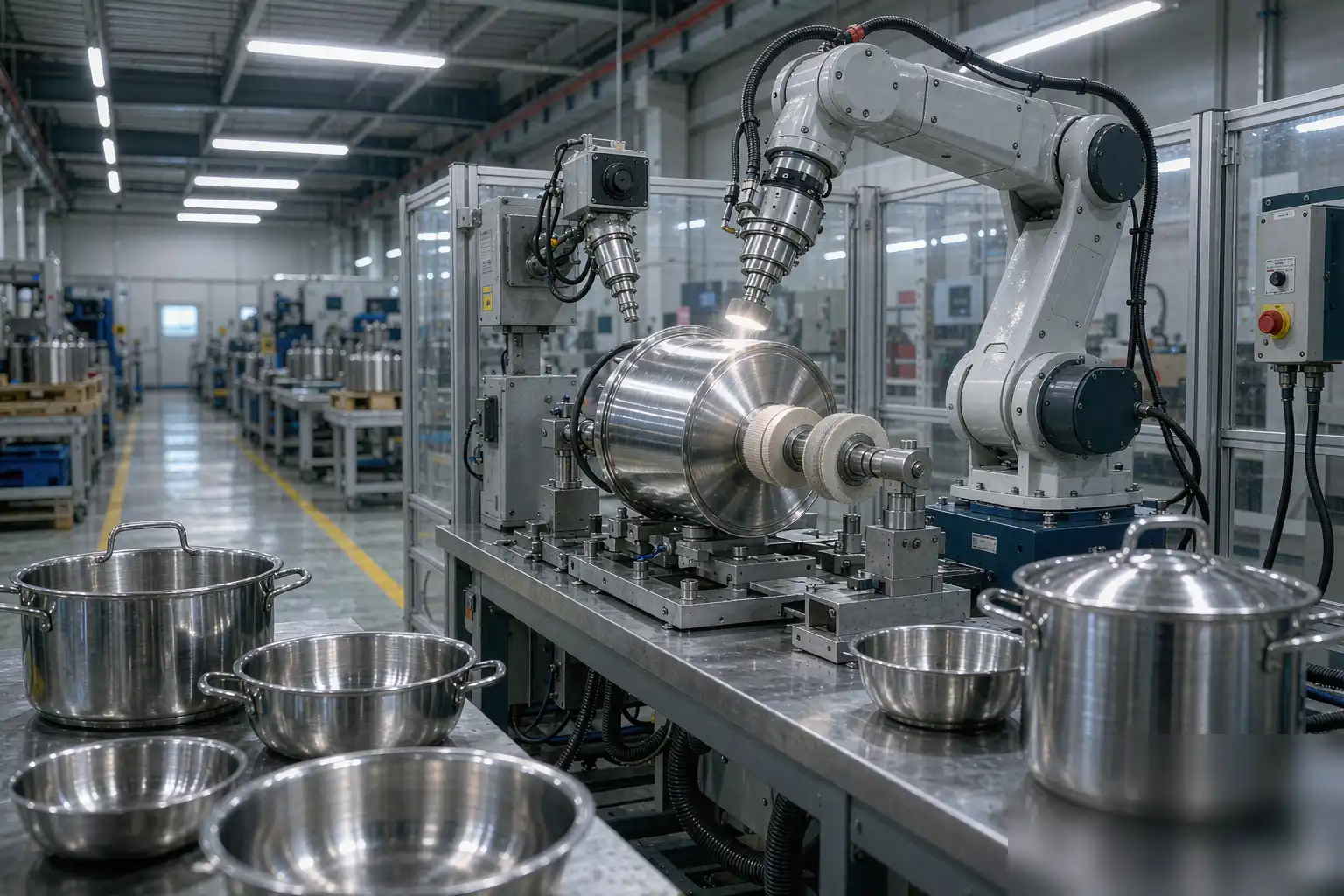
Kitchenware polishing automation covers four distinct product categories — cookware bodies, lids, kettles, and small utensils — and each category carries its own finish spec, cycle shape, and line configuration. A plant that polishes pots well cannot assume the same cell handles ladles. Automatic polishing machine guides describe the equipment class; this guide maps it onto kitchenware’s specific categories.
Why Kitchenware Is Its Own Polishing World
Kitchenware finishes live in public view and under consumer hands. A mirror pot body shows every drag line; a satin utensil shows every patch of missed grain. The finish is the product.
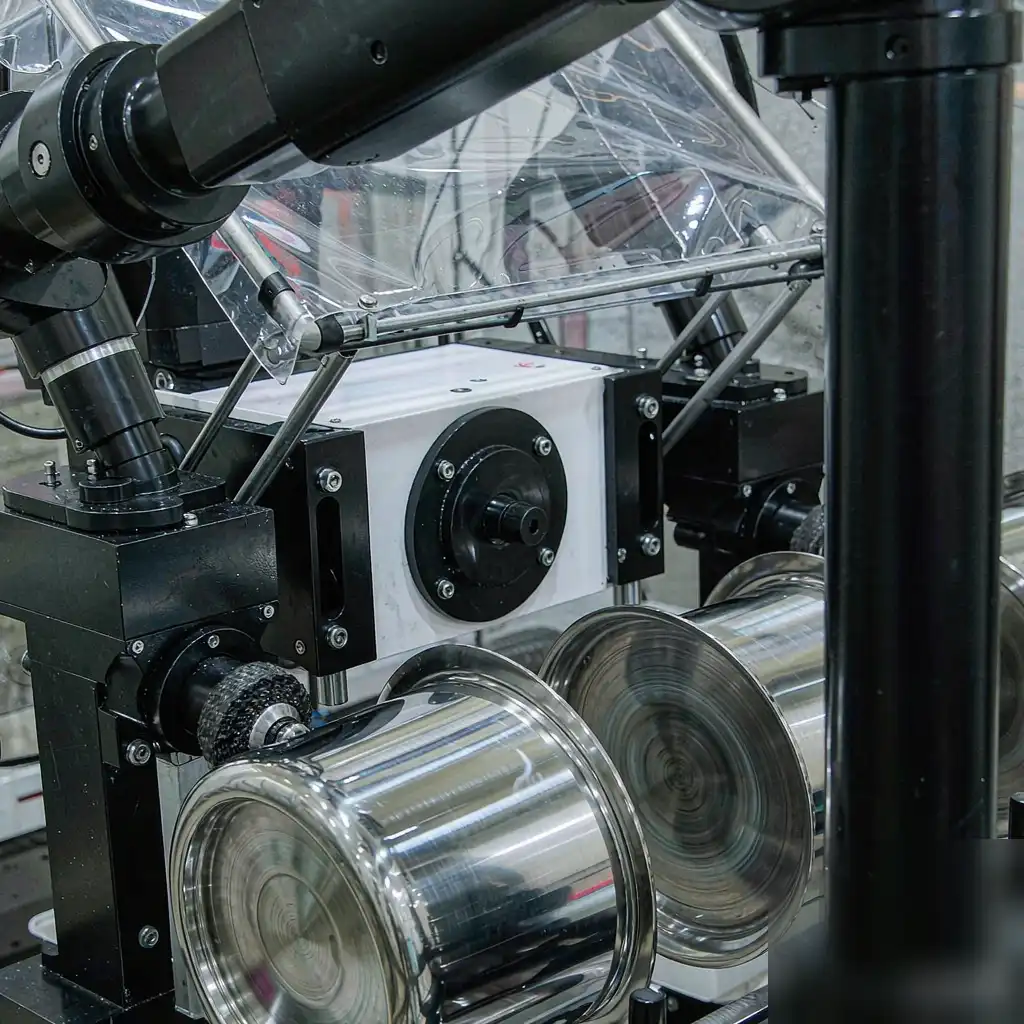
Volumes are consumer-scale — tens of thousands per SKU, seasonal peaks, and a SKU count that grows yearly. That mix of volume and variety shapes every decision that follows.
Materials vary too: spun aluminium, stamped stainless, cast aluminium bodies, and welded assemblies. Each responds differently to belt and mop work, so the process routes split by material before they split by category.
Category Requirements Matrix
The matrix below collects the finishing requirements that recur across kitchenware programmes. Treat it as the first page of any automation evaluation.
| Category | Typical Finish | Key Zones | Cycle Driver |
|---|---|---|---|
| Cookware bodies | Mirror exterior, satin interior | Flank, bottom radius, rim | Curved flank path length |
| Lids | Satin or mirror, dome top | Dome, rim edge, knob seat | Dome access angles |
| Kettles | Mirror body, brushed spout | Body flank, spout blend, base seam | Spout geometry complexity |
| Small utensils | Satin grain, edge safe | Full body grain, handle join | Part count per hour |
Notice what the last column says: each category’s cycle time is dominated by a different geometric feature. That is why one cell configuration rarely serves all four well.
Process Routes: Satin versus Mirror
Satin routes run two passes. A cut pass on a belt erases forming marks, then a satin pass with an abrasive nylon belt lays the grain. Total cycle for a utensil or lid runs fifteen to thirty seconds.
Mirror routes add a colour pass on a cotton mop with compound, plus residue wipe. Cookware bodies and kettles pay the extra twenty to forty seconds per part, and the compound system becomes a line-level service rather than a station add-on.
Interior work differs by construction. Spun bodies often finish interior and exterior in one presentation; stamped assemblies may route interiors separately to keep mops away from rim edges.
Grain direction is a spec, not a style choice. Satin utensils fail consumer inspection when grain crosses at the handle join, so the program fixes pass order and the audit checks it.
Line Configurations by Scale
Kitchenware plants cluster into three scales, and the equipment follows.
| Scale | Daily Volume | Configuration | Staffing |
|---|---|---|---|
| Boutique | 1,000–3,000 pcs | Single robot cell, manual load, 2 stations | 1 operator |
| Regional brand | 3,000–12,000 pcs | 2–3 cells, tray conveyor, wash | 2–3 operators |
| Export volume | 12,000+ pcs | Dedicated line per category, auto pack | Supervisory |
The regional-brand tier is the sweet spot for automation economics: enough volume to amortise the cells, enough margin left to justify quality upgrades like dosed compound and wheel dressing.
Labour and Throughput Arithmetic
Manual mirror polishing of pot bodies runs ninety to one-fifty seconds per part with a skilled buffer. A cell with two mops and force control runs the same part in fifty to seventy seconds, day and night.
At eight thousand bodies a day, that difference is roughly seven buffers versus one line with two operators. Wage levels set the exact payback, but the ratio holds across markets.
Satin utensils automate even harder. Thirty-second cycles at high part counts make tray density and load time the real constraints — and both are engineering problems with engineering answers, not skill problems.
End-to-end finishing from deburr to mirror polish shows how the same arithmetic extends when the line starts at raw blanks rather than formed bodies.
Food-Contact Compliance Notes
Food-contact surfaces carry regulatory expectations on top of finish specs. The finishing process itself becomes a compliance item: compound chemistry, residue removal, and documentation of both.
Choose compounds certified for incidental food contact and keep the certification on file. Auditors ask for the paper, not the marketing claim.
Wash validation closes the loop. Residue checks on interior surfaces after wash prove the process removes what it applies — run them quarterly and after any compound change.
Separate interior and exterior tooling physically where finishes differ. A mop that touches both carries exterior compound into the food zone, and that is a finding no rework can undo.
Quality Control That Matches Consumer Eyes
Consumer inspection happens in kitchen lighting, so set your inspection station the same way. Standardised lamps at fixed angles catch the drag lines and haze that flat shop lighting hides.
For satin grain, a tactile-plus-visual check at the handle joins catches the crossings. For mirrors, a dark-field view finds haze before the consumer’s window does.
Sample by SKU, not by shift. SKU-level sampling catches tool wear patterns that hide inside shift averages, because different SKUs wear different path segments.
Trend the gloss or Ra readings by wheel age. When the trend kinks, the wheel has crossed its useful life — change it on the trend, not on the failure.
Scaling Across Categories
Most plants automate cookware bodies first: highest value, clearest payback. Lids come second on shared infrastructure, since they share the mirror route at lower cycle cost.
Utensils come third because the win is throughput, not finish difficulty. Tray density and quick-change nests matter more than force control, and the cell design reflects that.
Kettles come last by geometry, not by value. Spout blends and base seams want multi-axis access, and flexible finishing cells handle the variety — but the programming investment only makes sense on stable volumes.
Seasonal Peaks and Capacity Planning
Kitchenware demand is seasonal in a way few industries match: cookware peaks before holidays, utensils run steadier, and export orders cluster around retail buy cycles. The line you size for the average month fails in October.
Size to the peak month with a stated service level — say, ninety-five percent on-time at peak — and accept idle capacity in the trough. The alternative, overtime at peak, reintroduces the manual finishing you automated away, with worse quality.
Mirror and satin routes help here. Mirror capacity converts to satin easily — the satin route is the mirror route minus a pass — so peak flexibility hides inside the route structure you already bought.
Plan changeover calendars against the order book weekly. Category-level batching (all bodies Monday, lids Tuesday) trades a little inventory for big changeover savings, and the inventory cost is usually the cheaper side of that trade.
What the Numbers Look Like on Paper
A worked example anchors the arithmetic. Take a regional cookware brand at six thousand pot bodies per day, mirror finish, running three manual shifts of nine buffers today.
A two-cell automated line with tray feed runs the same six thousand in one shift pattern with two operators and a loader. At a blended fully-burdened wage, the labour delta alone returns roughly nine to eleven thousand dollars monthly.
Add the rejects: manual mirror finishing at 3.5 percent rework against the cell’s 0.8 percent, on a twenty-dollar body, adds another three thousand monthly. Compound savings reach the line’s cost in roughly eighteen to twenty-two months.
Your wage rates and body values move those numbers, but their shape holds across markets: labour first, rework second, consumables a distant third — and the peak-month capacity you gain is free.
Choosing Equipment for This Industry
Demand kitchenware references from any supplier you shortlist. A supplier strong in automotive castings will build you a robust cell that nevertheless misses consumer-finish subtleties.
Insist on a compound system designed for mirror work: timed dosing, wheel dressing, and residue management. The mirror finish lives or dies in consumable discipline.
Verify changeover with your own SKU mix during acceptance. Two bodies, a lid, and a utensil through the same cell inside thirty minutes is a reasonable proof, and it exposes fixture logic gaps early.
Ask for the trend data tools, not just the machine. The SKU-level quality control above runs on the cell’s own logs, so the data export belongs in the purchase spec.
The Compound System Decides Mirror Quality
Mirror finishing lives or dies on compound discipline, and the system around the compound matters as much as the compound itself. Timed dosing by cycle count, automatic wheel dressing, and residue management together hold the gloss band that manual stick application only hits on good days.
Size the dosing system for the route, not the average. A mirror route running two mops consumes compound at a rate a satin-only line never sees, and an undersized reservoir turns into a mid-shift refill routine that drifts into “when someone notices”.
Track gloss by wheel age alongside the compound consumption. When the gloss trend kinks before the compound log says the wheel is done, the dressing interval is too long — shorten it before the consumer’s kitchen window finds out.
Kitchenware polishing automation pays when the categories are respected — separate routes, separate fixtures, shared infrastructure where the matrix allows it. Treat the matrix as the plan, and the line grows by category instead of by crisis.
Safety and guarding requirements vary by region — follow local codes and OEM guidance.