

Polishing Labor Shortage: Building the Automation Business Case
Ask a production manager in any faucet factory, hardware plant or die casting finishing shop what limits their output, and the answer has shifted over the past five years. It used to be machine capacity. Increasingly it is people — specifically, the absence of skilled polishers. This article builds the business case for automating those stations with numbers you can defend to a finance director, rather than arguments about productivity that nobody can verify.
The Shortage Is Structural, Not Cyclical
It is tempting to treat hiring difficulty as a temporary labour market condition. It is not. Three forces make it permanent in most manufacturing regions:
- Demographics. Skilled polishers are disproportionately experienced workers. In many markets a large fraction of the existing polishing workforce is in the 45 to 58 age band, and replacement hiring occurs against a shrinking pool of younger entrants.
- Apprenticeship economics. Competent polishing takes real time to learn. A new hire becomes productive on simple geometries in two to three months, and genuinely skilled on difficult cosmetic parts in eighteen months to three years. During that period you are paying for output you are not receiving.
- Occupational perception. Polishing is loud, dusty and physically demanding. Once safer service-sector alternatives exist nearby, recruiting becomes structurally harder regardless of wage levels.
The practical consequence is that even where you can hire, you hire at a higher cost with higher attrition and you carry the training risk yourself.
What a Manual Polisher Actually Costs
Most automation business cases fail because they compare robot capital cost against headline hourly wage. That comparison omits most of the cost.
Consider a single-shift finishing station in a mid-cost manufacturing market:
| Cost element | Typical annual figure | Note |
|---|---|---|
| Base wage | USD 8,000 to 14,000 | Varies widely by market |
| Employer contributions and benefits | 20 to 35 percent of base | Social insurance, insurance, meals, transport |
| Overtime premium | 10 to 25 percent of base | Almost always incurred in season |
| Recruitment and onboarding | USD 400 to 1,500 per hire | Agency fees are the expensive version |
| Training ramp to full output | 2 to 6 months of reduced output | Hidden but real cost |
| Attrition replacement cost | 25 to 60 percent replacement rate annually | Some shops see higher |
| Quality escapes and rework | 3 to 8 percent of production value | Very geometry dependent |
| Personal protective equipment and consumables | USD 300 to 900 annually | Respirators, gloves, hearing protection |
Sum these honestly and the fully loaded cost of one manual polishing position is typically 1.6 to 2.2 times base wage, before considering the output you lose while training a replacement. If your attrition runs at 40 percent and training takes four months, you are permanently carrying meaningful lost capacity simply to stand still.
Throughput: The Comparison That Surprises People
Assume a mid-size cast part requiring three finishing stages — gate removal, surface grinding to remove parting line evidence, then a cosmetic polish.
Manual station:
- Cycle time per part across all three stages: 3.5 to 6 minutes depending on geometry and required finish class
- Effective working minutes per shift after breaks, setup and cleanup: roughly 400 to 430
- Practical output per shift: 70 to 110 parts
- Second shift output is typically 85 to 92 percent of first shift
- Output in the final hour before break drops measurably — fatigue is real and measurable
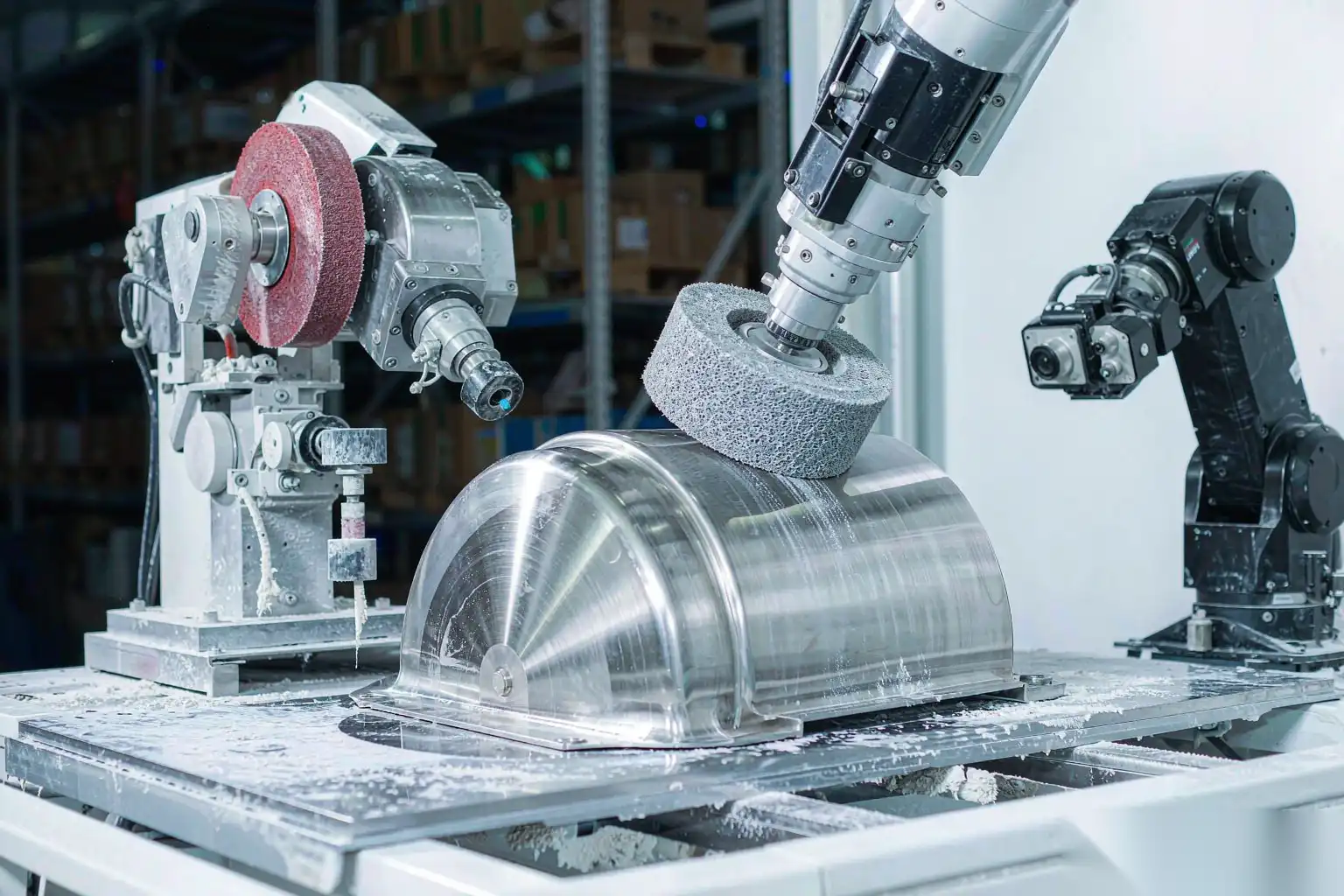
Enclosed robotic cell:
- Cycle time per part on the same geometry, all stages in one fixture: 90 to 170 seconds
- Effective minutes per shift excluding planned changeover: roughly 430 to 450 with only load/unload attendance
- Practical output per shift: 180 to 300 parts depending on part complexity and fixture strategy
- Shift 2 output equals shift 1 output — robots do not get tired, and this is often worth more than the headline speed advantage
One cell typically replaces between two and four manual positions on parts in this size range, while producing lower variance. The second shift equivalence matters more than it appears: if your plant already runs two shifts with a second-shift yield penalty, automating recovers that penalty rather than merely adding capacity.
Quality Variance: The Cost Nobody Books
Labour cost is visible in the ledger. Quality variance is not, yet it often exceeds labour in total impact.
Manual finishing quality varies with operator skill, shift, hour of shift, and how recently the abrasive was changed. Typical consequences on cosmetic parts:
- Rework loop where 4 to 10 percent of parts need refinishing, consuming second-pass cycle time
- Scrap on the cosmetic rejects that cannot be recovered, carrying all upstream cost with them
- Variation in appearance within a single batch, which creates assembly-level mismatch complaints
- Customer credits and returns on parts that passed your inspection but not the customer’s eye
Robotic finishing attacks all four. Once a path is proven, the cell repeats it within a narrow band. Change the abrasive on schedule and cell output is stable in a way manual output structurally cannot be. On mirror-finish faucet parts and plated zinc hardware — where appearance standards are the tightest — this is frequently the dominant argument, not the labour saving. Our examination of how robotic polishing improves quality for zinc alloy parts details the yield improvement patterns we see on plated parts.
Payback Calculation With Real Numbers
Here is a defensible model. Adjust the inputs to your own market; the structure is what matters.
Scenario: Two-shift operation, three manual polishers replaced by one robotic cell handling a family of four similar cast parts.
Annual cost avoided:
- Fully loaded cost of three positions at USD 18,000 each: USD 54,000
- Rework reduction: 6 percent of 120,000 parts at USD 1.40 rework cost: USD 10,080
- Scrap reduction: 2 percent of 120,000 parts at USD 7.50 upstream cost: USD 18,000
- Attrition and training avoided (approximate): USD 6,000
- Total annual benefit: USD 88,080
Annual cost added:
- Cell depreciation over seven years on USD 240,000 installed: USD 34,300
- Maintenance, consumables and abrasive: USD 11,000
- Operator/technician attendance (part of one person): USD 12,000
- Energy: USD 4,500
- Total annual cost: USD 61,800
Net annual benefit: USD 26,280.
Simple payback on USD 240,000: approximately 9.1 years — poor.
Wait. That result matters, so examine what drives it. The cell here is expensive relative to local labour, and a two-shift model only recovers two shifts of benefit. Re-run with three shifts — which a cell can genuinely run while manual staffing on the third shift is hardest to fill and commands premium pay:
- Same cell, benefit recovered over three shifts: labour avoided rises to roughly USD 81,000, rework and scrap benefits scale proportionally to USD 42,000
- Annual cost: depreciation unchanged USD 34,300, maintenance USD 14,000, attendance across three shifts USD 18,000, energy USD 6,700
- Benefit USD 123,000 against cost USD 73,000: net USD 50,000 per year
- Payback: approximately 4.8 years
This is why the honest answer to “what is the payback” is “it depends on shifts and local wages”. Cells make strongest sense where labour is expensive or scarce, where quality requirements are tight, and where the cell can run three shifts. Where local labour is cheap and available and quality requirements are loose, the financial case weakens considerably.
Add the non-financial factors — inability to hire at any price, tightening customer cosmetic requirements, safety compliance in grinding dust areas — and most shops find the decision makes itself even when financial payback alone is marginal.
How to Phase It
Do not attempt a full line conversion as the first project. Three phasing principles:
- Start with the worst station. Choose the operation with the highest rework rate, the hardest geometry, or the position you have failed to fill for the longest time. Success there is unambiguous and generates internal credibility.
- Fix fixturing before you buy hardware. Robot economics depend on repeatable part location. If your castings vary part to part in gate stub length or flash location, standardise upstream first. This single step determines whether a cell succeeds more than the robot brand does.
- Standardise the part family. One cell serving four parts with common fixturing logic is dramatically better economics than one cell per part.
A sensible sequence: identify worst station → stabilise upstream casting consistency → build first cell → prove it for three months on real production → then expand to the next station using the measured data from the first.
Skills You Need That You May Not Have
Automation changes the skills profile rather than eliminating people requirements.
- Cell operator. Loads parts, monitors cycle, responds to alarms. Trainable in two to three weeks from existing finishing staff — this is your retention path for good people you cannot afford to lose.
- Programming/process technician. Owns paths, abrasive selection and process adjustment. Either develop internally from your best polisher or hire externally. This role is the difference between a cell that runs and a cell that is parked.
- Maintenance technician. Needs pneumatic, electrical and basic robot servicing skills.
Shops that succeed almost always convert an existing skilled polisher into the process technician. They already understand what a good finish looks like; the cell is simply a new way to achieve it. This is worth stating explicitly during planning, because operator resistance drops sharply when people see their expertise becoming more valuable rather than obsolete.
What to Ask a Cell Supplier
Before signing anything, require answers to these:
- Prove cycle time on my parts, in writing, at defined tolerances — not on a demonstration sample
- Show finish acceptance against my cosmetic standard with agreed limit samples
- Specify fixture strategy for my part family and what happens when I add a part later
- State abrasive consumption per 1,000 parts and who supplies it
- Detail dust extraction and enclosure design — this is part of the machine, not an accessory
- Confirm training hours included and what the follow-up support costs
- Provide references for cells running on comparable geometries for at least twelve months
- Clarify who owns process support if finish quality drifts in month nine
A supplier unwilling to run parts in your daily coal — real production parts with their natural variation — has not understood the problem.
DZ Machinery builds enclosed robotic deburring, grinding and polishing cells specifically for die castings and sanitary hardware, and we quote against your parts rather than catalogue promises. Send us drawings for the two or three part families causing the most difficulty, tell us your shift pattern and local loaded labour cost, and we will build the payback model with you — including telling you honestly when the numbers do not yet justify a cell.