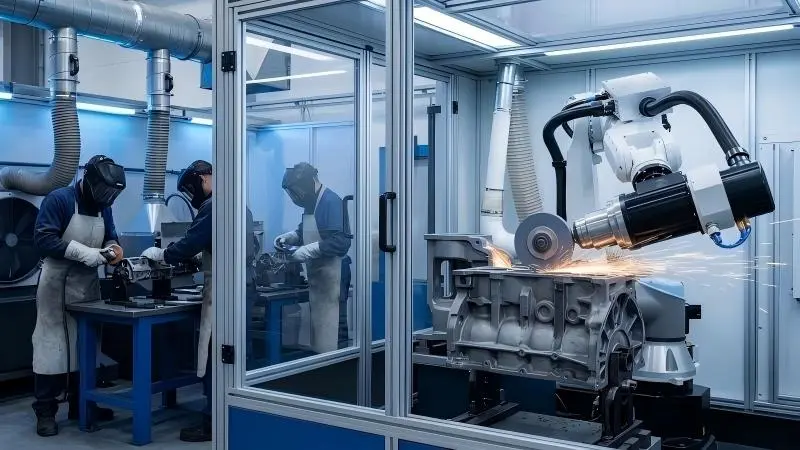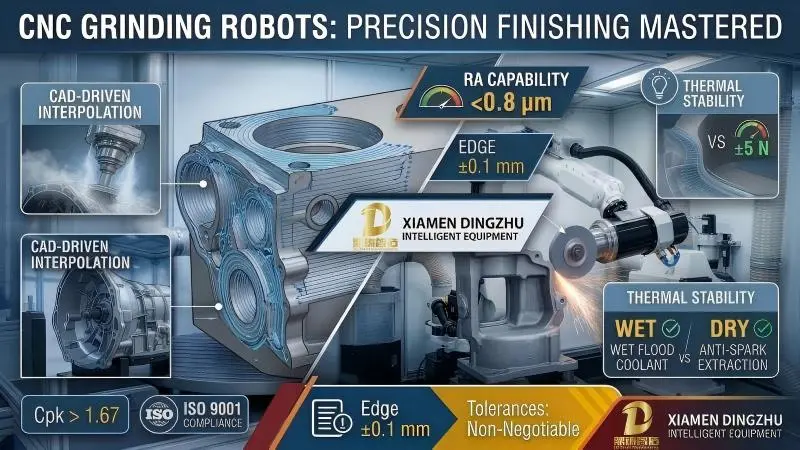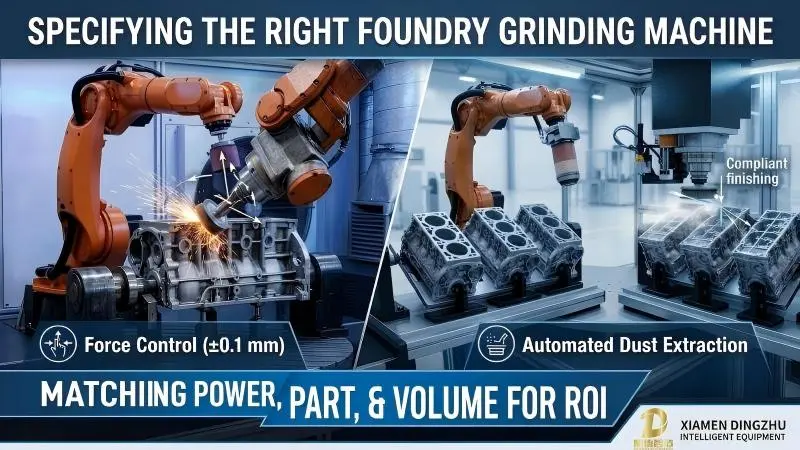


An industrial grinding robot brings programmable, force-controlled material removal to the shop floor, replacing inconsistent handheld grinding with a repeatable process that runs the same path on the 10,000th part as on the first. For manufacturers of metal castings, the benefits extend well beyond labor savings into quality, safety, and capacity that scales without hiring. The American Foundry Society consistently ranks grinding among the most labor-intensive and injury-prone foundry tasks, so robotizing it improves both the P&L and the safety record.
Benefit 1: Consistent Dimensional Removal
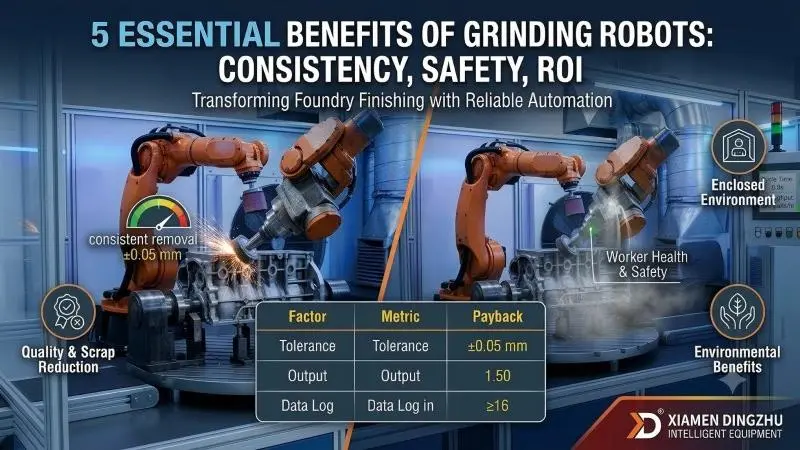
Manual grinding drifts with operator fatigue and skill; a robot holds removal to ±0.05 mm all shift. That consistency is what downstream machining and assembly depend on. The full robotic grinding guide shows the component stack that delivers it.
Benefit 2: Lower Scrap From Over-Grinding
Handheld grinders routinely cut past the line, scrapping otherwise-good castings. Force control stops the cut at the programmed depth. See the related scrap-reduction methodology for the measurement loop.
Benefit 3: Improved Worker Safety
Grinding exposes workers to noise above 85 dBA, silica/metal dust, and vibrating tools linked to HAVS. Enclosing the robot removes people from the hazard envelope entirely, supporting ISO 45001 objectives.
Benefit 4: Scalable Capacity
Add a second robot or a twin fixture and throughput rises without adding headcount. Our benefits overview pairs with the automation steps for rollout planning.
Benefit 5: Data and Traceability
Every grind cycle logs force, RPM, and cycle time per part serial, feeding SPC and making deviations auditable — something impossible with a handheld grinder.
| Factor | Manual Grinding | Industrial Grinding Robot |
|---|---|---|
| Removal tolerance | ±0.3 mm | ±0.05 mm |
| Operator noise/dust exposure | Direct, high | Enclosed, minimal |
| Output per shift | 150–400 parts | 800–2,000 parts |
| Process data | None | Full per-part log |
QUICK DECISION TIP
Justify the robot on safety and scrap avoidance first, then labor — the hidden savings often exceed the headcount reduction alone.
Where the Payback Hides
Beyond direct labor, plants recovering 3–5% of over-ground scrap and cutting grinding-related injury incidents typically shorten payback to under two years. The ROI analysis guide models the full cost picture.
Comparing Robot to Fixed CNC Grinding
A CNC grinder is rigid and fast for one known profile; a robot trades some per-part speed for the ability to handle varied and 3D surfaces in one fixture. If your parts are family-based with frequent changeovers, the robot wins on flexibility; for a single high-volume profile, a dedicated CNC may edge it on cycle time. The cell vs single machine guide frames the trade-off.
Skills Your Team Needs
Running a grinding robot needs less brute strength but more process discipline: fixture care, program backup, and SPC reading. A short internal training plan — covered in our operator training guide — gets tenders productive within days. The bottleneck is usually changeover discipline, not operation.
A Simple Payback Formula
Estimate payback as (annual manual labor saved + annual scrap saved) ÷ (cell price + annual media/maintenance). For a cell at $180k with $110k/yr labor savings and $30k/yr scrap recovery, net annual benefit is $140k minus ~$20k running cost, giving roughly 18-month payback. Even conservative numbers usually beat most other capital projects a plant can fund, which is why grinding robots rank high on improvement roadmaps.
Environmental and Noise Benefits
Beyond safety, enclosing the grinding robot cuts workshop noise from hazardous levels above 85 dBA to a compliant ambient, and captures dust at the source rather than letting it settle across the plant. That improves the working environment for everyone nearby and reduces housekeeping labor. For plants in urban or strict-regulatory locations, this secondary benefit can be as decisive as the direct cost savings when approving capital.
Scaling From One Cell to a Line
Once a single grinding robot proves its numbers, replicating it is straightforward because the fixture, program, and media are already defined. Plants often move from one cell to a tandem or a U-shaped line where parts flow through grind, deburr, and polish without manual handling. This is where the finishing line design guide becomes useful for laying out the full sequence and balancing station cycle times.
Frequently Asked Questions
Is a grinding robot only for large foundries?
No; a single-cell unit suits jobbing foundries doing 50k+ parts/yr on repeat families.
Will it handle my odd-shaped castings?
Yes, with a positioner and 6-axis reach; complex internal faces are exactly where robots beat fixed fixtures.
How much floor space does it need?
A typical cell occupies 3×3 m to 4×5 m including enclosure and load station.
What about maintenance?
Spindle and wheel are the wear items; our maintenance guide covers the schedule.
Need help specifying the right machine?
Contact Xiamen Dingzhu Intelligent Equipment — we size deburring and grinding cells to your castings, volume, and tolerances. Talk to our application engineers.
References
- American Foundry Society — afsinc.org
- NADCA — nadca.com
- ISO 9001 — iso.org
This article is for general guidance only and does not constitute a specification or quote. Confirm process parameters with the equipment supplier for your parts.