一、Product Overview
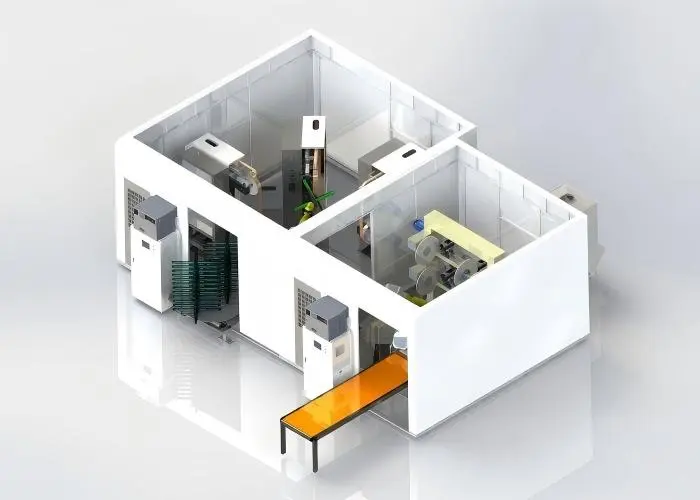
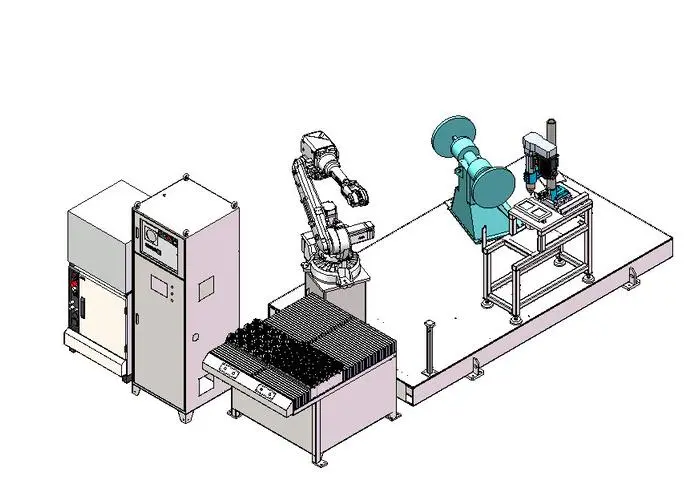
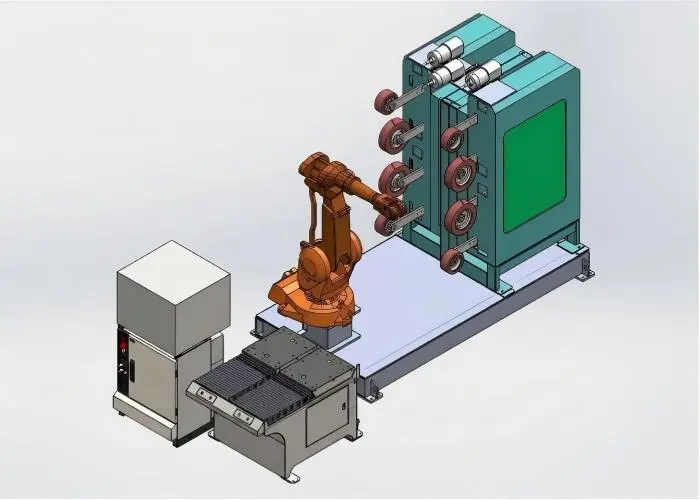
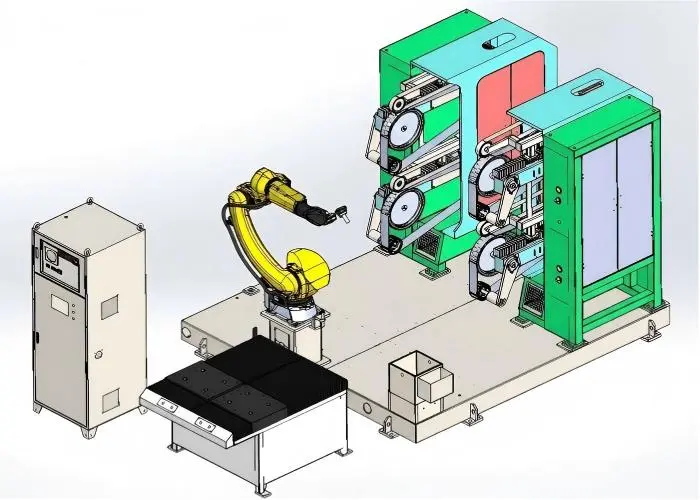
The HLD50‑3D24‑B1‑XZ robotic grinding & polishing cell is a high‑capacity full‑process automated finishing workstation equipped with 2 sets FANUC M‑710iC/50E 6‑axis industrial robots. One robot is dedicated for grinding & deburring, the second robot performs fine buffing & mirror polishing. Integrated with 3 abrasive‑belt machines, large buffing unit with 4 big cloth wheels, rotary feeding table and conveyor unloading table, this one‑cell solution completes rough grinding, fine sanding and mirror buffing in one compact enclosed unit.
It solves key manufacturing pain‑points for large‑volume sanitary hardware factories: low throughput of single‑robot cells, inconsistent manual polishing quality, heavy dust pollution, high cost & shortage of skilled polishers. Designed for 24‑hour continuous mass‑production of brass faucets, valve bodies, door handles and complex curved metal ornaments, it delivers stable repeatable surface gloss and greatly cuts labor expenditure.
二、Standard Configuration
✅ 1 set FANUC M‑710iC/50E robot for grinding & deburring
✅ 1 set FANUC M‑710iC/50E robot for fine buffing & polishing
✅ 3 sets abrasive‑belt grinding machines (6 belts total: 3 standard belts +3 small belts)
✅ 1 set buffing machine with 4 large cloth buff wheels
✅ Rotary‑type feeding table for bulk workpiece loading
✅ Transit feeding table + conveyor unloading table
✅ Complete electrical control cabinet with touch‑screen HMI
三、Core Competitive Advantages
1. Dual‑Robot Split‑Process Design for Higher Throughput
Two independent FANUC robots handle separate process stages: one robot completes rough grinding & deburring, the second robot carries out fine buffing and mirror finishing. Parallel workflow greatly improves hourly output compared with single‑robot cells. Ideal for high‑volume sanitary‑ware mass‑production.
2. Multi‑Wheel & Multi‑Belt System, Automatic Process Adjustment
Multiple grinding contact wheels are available inside the cell. Abrasive‑belt speed is adjustable; system automatically adjusts belt tension and selects available contact wheels without manual intervention. Full‑digital control saves programs for different parts, operators can recall recipe parameters directly on touch‑screen HMI.
3. Powerful Robot Control System with Polishing‑Dedicated Module
Built‑in professional polishing module for FANUC robot. Two programming modes are supported:
1. Teach‑pendant teaching: simulate manual polishing movement and record motion path.
2. Off‑line programming software: edit paths offline to reduce machine downtime during new‑product debugging.
Touch‑screen displays real‑time running status and fault alarm codes for quick troubleshooting and easier maintenance.
4. Large‑Capacity Rotary Feeding Table for Batch Loading
Custom rotary stacking feeding table supports bulk workpiece loading. Operators load raw parts onto rotary racks, robot automatically picks workpieces. Combined with conveyor unloading table for finished‑part output, realizing semi‑unmanned continuous production workflow. Reduce frequent manual loading‑unloading operations.
5. Professional Fixture Customization & On‑site Programming Service
Our in‑house fixture design team develops dedicated clamping jigs according to your samples or drawings to guarantee stable holding during high‑speed grinding & buffing.
We supply on‑site programming service for new workpiece process development. Our experienced programmers optimize grinding paths to achieve better surface gloss and shorten cycle time.
6. Fully‑enclosed Integrated Cell for Safe & Eco‑friendly Production
Whole‑cell enclosed housing contains grinding and buffing dust inside the workstation. Protect operators from metal dust hazards, meet international factory environmental standards, reduce workshop cleaning workload. Heavy‑duty machine base suppress vibration during 24‑hour continuous heavy‑duty operation.
四、Packaging Standards
Ackaging that complies with international sea freight transportation requirements. 👉 View packaging guide →
Frequently Asked Questions (FAQ)
Q1: What workpieces is the HLD50‑3D24‑B1‑XZ dual‑robot cell suitable for?
A: It is specially built for high‑volume production of brass faucet bodies, valve bodies, door handles and complex curved decorative metal hardware. You can send us your samples or drawings, and we will provide you with free solution services.
Q2: What is the difference between this dual‑robot cell and single‑robot grinding cell?
A: This model adopts two FANUC M‑710iC/50E robots for split‑process production: one robot for rough grinding/deburring, another robot for fine mirror buffing. It delivers much higher hourly throughput and is recommended for large‑volume mass‑production orders. Single‑robot models fit medium‑output demands. Contact us for production‑cycle evaluation according to your target output.
Q3: Does this robotic cell support offline programming?
A: Yes. Off‑line programming software is supported to shorten debugging time for new products. Besides, we provide on‑site programming service for new‑part process development and program optimization.
Q4: Can you customize fixtures and rotary feeding racks for my parts?
A: Yes. Our professional fixture‑design team custom‑makes clamping jigs and rotary‑table stacking racks according to your samples or drawings. Feeding & unloading conveyor structure can also be adjusted. Please share workpiece information for technical evaluation.
Q5: What robot model is adopted in this workstation?
A: Equipped with 2 sets FANUC M‑710iC/50E 6‑axis industrial robots. Max wrist payload 50 kg, repeatability ±0.07 mm, perfectly adapted for heavy‑duty continuous grinding and buffing tasks.
Q6: What power supply and air pressure does the machine require?
A: Standard input voltage 380 V, working air pressure 0.4‑0.7 MPa. We can adjust electrical configuration to match your local factory power grid conditions.
Q7: What is your warranty term for this robotic grinding‑polishing cell?
A: 12‑month warranty counting from shipment date for manufacturing‑defect related failures. Consumables such as abrasive belts, contact wheels and buff cloth wheels are not covered under warranty. Overseas on‑site commissioning and technical training services are available.