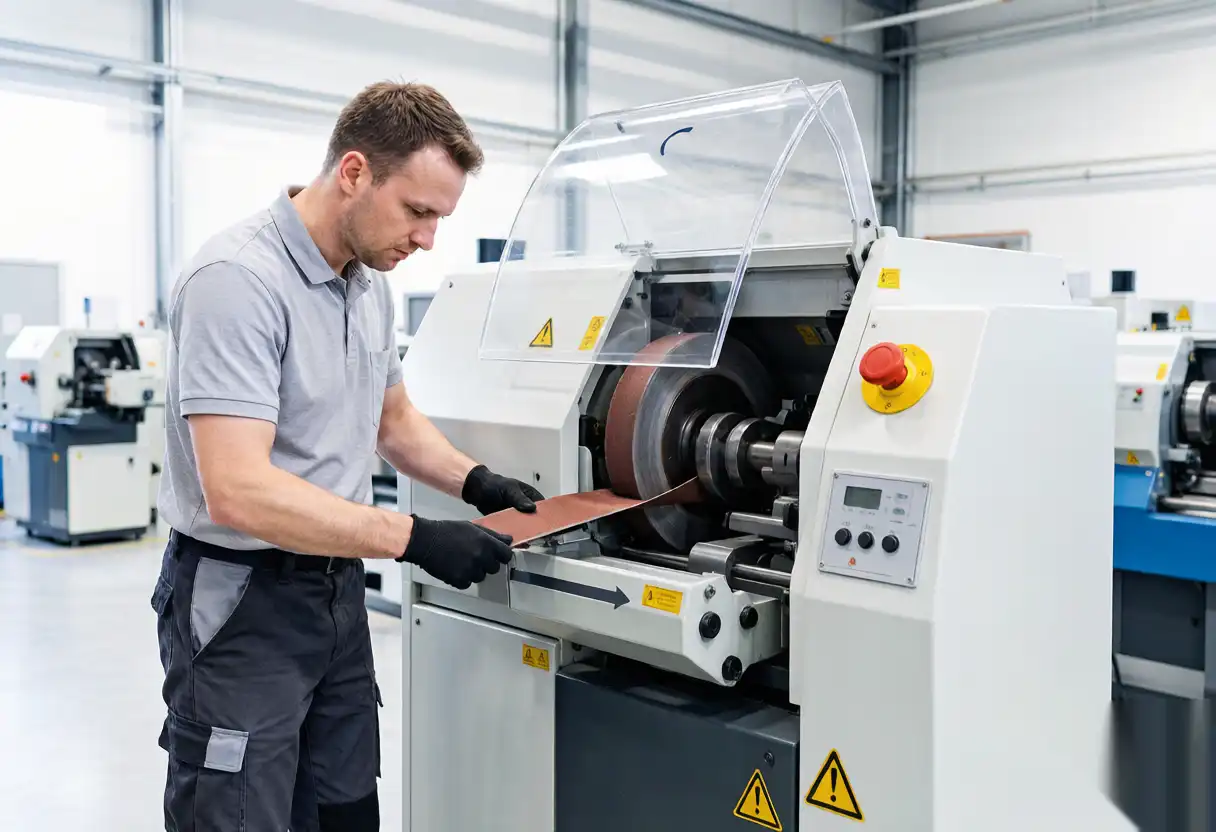


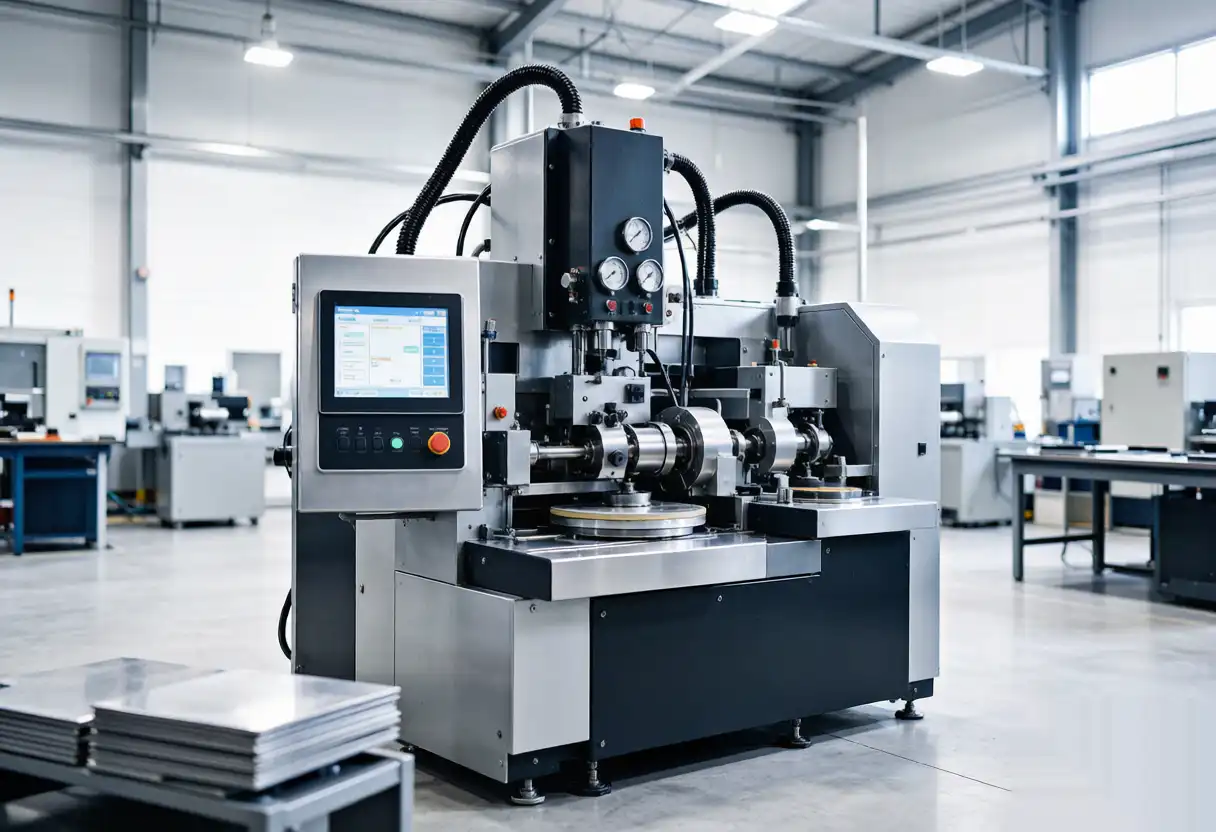
An automatic buffing machine looks like a spinning wheel and an arm, but the value is in the control systems that keep a compliant, repeatable cut on a part that is never perfectly consistent. This deep-dive explains the core technologies inside a modern buffing machine so you can judge a supplier’s claims instead of taking the brochure at face value.
Force and Compliance Control
The single most important technology in buffing is contact force control. A buff is a consumable — it loads, flattens, and changes diameter as it runs. If the machine drives position only, the actual pressure on the part drifts every minute, and so does the finish. Active force control closes a loop around a load cell or servo torque estimate and holds the contact force to a setpoint regardless of buff wear.
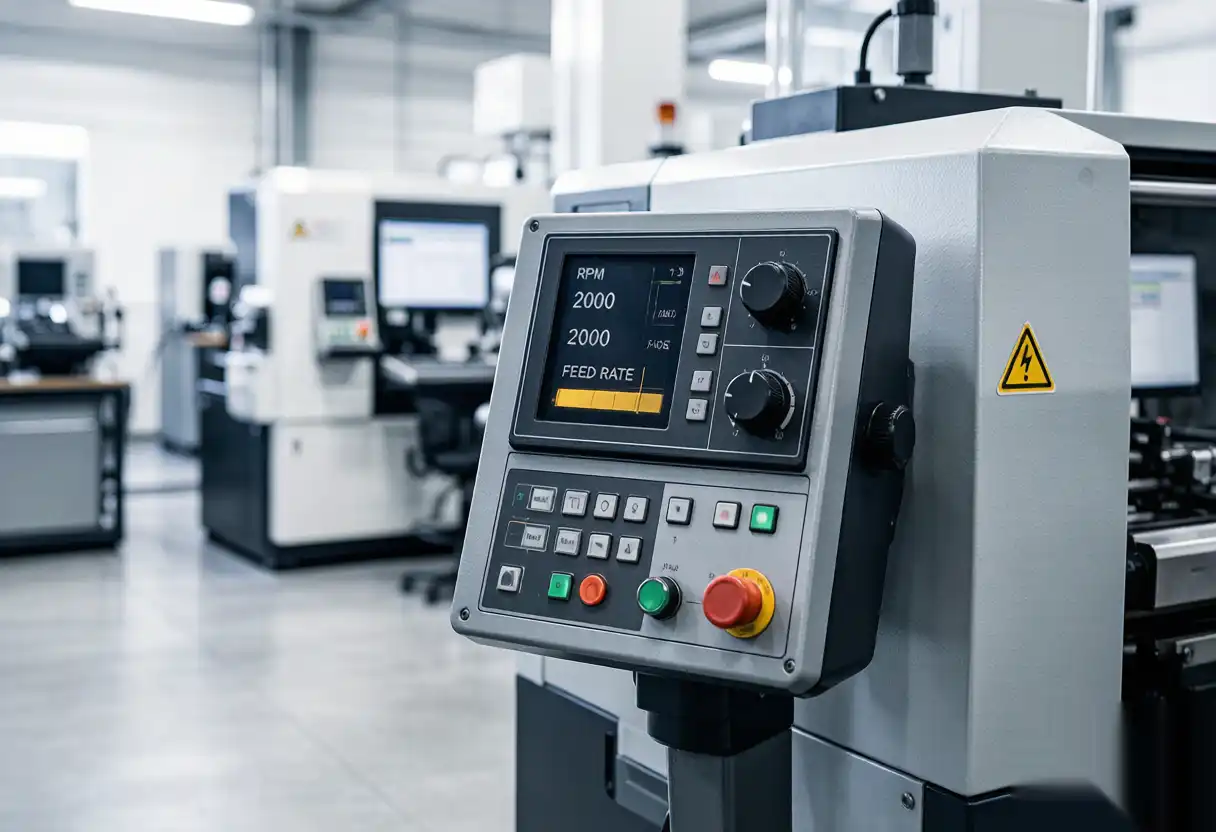
Two approaches dominate. Active compliance uses a servo or pneumatic actuator with a force sensor feeding a controller that adjusts in real time — expensive but tight. Passive compliance uses a spring- or air-cushioned floating head that yields when it meets resistance — cheaper, simpler, and good enough for many parts, but it follows the buff’s shape rather than commanding a precise force. For soft metals and mirror finishes, active control pays for itself in reject reduction.
Adaptive Vision and In-Process Measurement
Castings and stamped parts vary part-to-part. A fixed path assumes every part is identical, so it either misses low spots or digs into high ones. Vision and metrology close that gap.
A 3D laser scan or structured-light capture builds a point cloud of the incoming part; the controller offsets the toolpath to the actual surface. Lower-cost systems use a touch probe or a single displacement sensor to find a reference plane. The payoff is consistency across a batch of imperfect parts — the difference between a cell that needs an operator watching it and one that runs unattended.
Abrasive and Compound Delivery
Buffing is a tribological process: the cut comes from abrasive particles carried in a compounding lubricant against the part. How that compound reaches the buff decides repeatability.
Manual rag application is the weakest link in semi-automatic cells — an operator drips compound by eye, so the cut varies with the person and the hour. Automated spray or roller applicators meter a consistent film onto the buff at a set rate, which stabilizes the cut and reduces waste. Impregnated or tripoli-based bars fed against a running buff give another route to consistency. The key technology is not the chemistry but the metering: a closed loop that keeps the abrasive rate steady as the buff wears.
Spindle, Tooling, and Contact Dynamics
The spindle sets the surface speed, and surface speed interacts with force and abrasive to set the cut rate and the finish. A buff’s effective diameter shrinks as it wears, so a constant-RPM spindle slows the surface speed unless the controller compensates. Better machines hold surface speed by adjusting RPM as the buff diameter changes — a small control detail with a large finish impact.
Tooling choice — loose buff, bias buff, sisal, flap wheel, or non-woven — sets the aggression and the scratch pattern. The technology worth noting is quick-change tooling: a collet or pneumatic lock that swaps a buff in seconds so a cell can move between cut and color stages without a long stop.
Cooling and Heat Management
Friction generates heat, and heat changes both the metal and the compound. On soft alloys, too much heat burns the surface or work-hardens a layer that then needs re-cutting. On lacquered or clear-coated parts, heat ruins the coating.
Active technologies here are forced-air or mist cooling at the contact zone and thermal monitoring that throttles speed or feed if a part trends hot. Passive management is simply lower surface speed and lighter force, which costs throughput. The right answer depends on the part, but the machine should have a deliberate heat strategy, not luck. Some cells run a thermally stable coolant loop through the spindle bearing itself, holding the tooling at a constant temperature so expansion does not shift the contact geometry mid-shift — a detail that matters on long mirror-finish runs where a few microns of thermal drift become visible in the reflection.
Programming and Path Generation
The toolpath is the recipe. Three generation methods exist.
An operator moves the head through the motion and the controller records it. Fast to set up for one part, brittle when the part changes.
The path is generated from the part model, then simulated. Strong for known geometry and for documenting a repeatable process.
A scanned part drives the path on the fly. Best for variable or unknown incoming geometry; needs the vision stack above.
CAD path corrected live by sensor feedback. The most capable and the most expensive; reserve it for demanding finishes.
Robotics and Motion Integration
When the part is 3D and the contour matters — wheels, faucets, handles, surgical instruments — a multi-axis robot or a controlled-axis machining center carries the buff around the part. The technology that makes this work is TCP (tool-center-point) force control: the robot holds a commanded force at the contact point while following a path, so the buff stays engaged on a curved surface instead of lifting off or gouging.
Equally important is coordinated motion — the part rotator and the buff head moving in sync so the contact point velocity stays in the correct band. Poor coordination shows up as uneven cut at the part’s edges and centers.
Sensing, IoT, and Closed-Loop Quality
The newest layer is connected quality. Torque, force, spindle speed, compound rate, and part counts feed a controller or a dashboard. When a buff wears past a threshold, the system flags it or auto-compensates. When a finish drifts, the data shows which parameter moved first.
This matters because it turns buffing from an art watched by a person into a process managed by numbers. For a plant chasing traceability or lights-out running, this sensing layer is the difference between a machine and a system.
How the Technologies Combine
No single technology makes a good buffing machine; they compound. Force control without metered compound still drifts. Vision without force control sees the part but gouges it. Path programming without heat management burns soft alloys. The mature machines integrate all of these behind one controller with one recipe per part, so the operator picks a SKU and the system holds the finish. When you evaluate a supplier, ask which of these layers are native to their controller and which are bolted-on afterthoughts — a stack of unrelated boxes talking over a loose interface is far harder to keep consistent than one coherent system, and it shows up as finish variation the first week you run a difficult part.
Safety, Housekeeping, and Consumable Management
Buffing throws fine dust and uses rotating tooling, so the technology list is incomplete without the systems that keep the cell safe and clean. Spark-resistant extraction pulls metal dust away from ignition sources and protects the finish from re-deposition. Interlocked guarding or light curtains stop a cycle if a person enters the envelope. On the consumable side, a disciplined buff-change schedule and a logged compound rate turn repeatability from luck into procedure — the best controller in the world cannot hold a finish on a glazed, loaded buff.
Training is the last enabling technology. An operator who understands force, speed, and abrasive interaction diagnoses drift before it becomes scrap, and programs new parts faster. Budget for it; a cell run by someone who only knows the green start button will underperform its hardware every time.
Frequently Asked Questions
Do I need active force control or is passive enough? Passive floating heads suit many parts and cost less. Choose active control when finish consistency, soft metals, or mirror targets make drift expensive.
Is vision scanning worth the cost? If your incoming parts vary and you want unattended running, yes. If every part is nearly identical and you run one SKU, a taught path is cheaper and adequate.
What wears out fastest? The buff and the compound delivery hardware. Budget for buff changes per shift and for keeping the applicator calibrated; this, not the robot, drives daily consistency.
Can an older machine be upgraded? Often yes — adding metered compound, force control, or a scanner to an existing spindle can recover much of the gain without replacing the frame. Ask the supplier what is retrofittable on your model.