

QUICK FACTS
| Typical cycle | 20–120 s/part |
| Spindle range | 6,000–18,000 RPM |
| Force control | Active compliance ±5 N |
Sanitary ware is finished to be seen every single day. Faucets, shower heads, towel bars, valve bodies and basin wastes all sit in bathrooms and kitchens where a dull patch, a hairline scratch or an uneven reflection is the first thing a customer notices. Choosing the right polishing machine for this industry is rarely about buying the biggest spindle on the floor. It is about matching a process to your exact part mix, your finish specification and your production volume, then making sure the cell keeps hitting that spec on the thousandth part as cleanly as it did on the first. This guide walks through the decision criteria that actually matter, the machine types on the market, the specifications that move the needle, the cost and payback math, and the mistakes that quietly erode return on investment.
Why Sanitary Ware Finishing Has Its Own Rules
A sanitary fitting is both a functional component and a decorative surface. That double duty creates constraints most general metal-finishing jobs never face. Brass bodies are usually chrome- or nickel-plated after polishing, so any micro-scratch left in the substrate shows straight through the plating. Stainless 304 and 316 parts are polished for a mirror or satin look that must stay hygienic and easy to clean. Zinc alloys are soft and smear if the tooling or compound is too aggressive. Each material therefore demands a different abrasive strategy, contact force and coolant balance, and a machine that lets you dial those in per material rather than forcing one setting across the whole line.
Finish consistency is the other hard rule. A visible seam where two polishing passes overlap, a slightly greyer reflectivity on one batch, or a satin band that drifts between fixtures will all fail quality control even when the average roughness looks fine on paper. Because the human eye is the final inspector on most sanitary lines, the machine has to produce repeatable, symmetric results without relying on an operator’s feel. That is why force-controlled, programmable cells have been displacing hand polishing and basic tumbling in this sector.
Decision Criteria — What to Lock Down First
Before comparing brands or asking for quotes, pin down the variables that will decide the whole configuration. Get these wrong and every later decision is built on sand.
- ✓Part geometry and size envelope — maximum length, recessed surfaces, internal threads, and thin walls all limit tool access and force.
- ✓Material and coating stack — brass-plus-zinc lines need different media than stainless; plan for changeover.
- ✓Target finish — mirror (Ra near 0.02–0.05 µm), brushed/satin (Ra 0.2–0.4 µm), or a two-tone combination.
- ✓Annual volume and batch size — high-volume single-SKU favours dedicated cells; high-mix favours flexible robots.
- ✓Labour cost and operator availability — the single biggest driver of payback in developed markets.
- ✓Footprint, power and extraction — compound dust and coolant mist need real ventilation, not an afterthought.
- ✓Integration — robot load/unload, upstream casting and downstream plating or assembly.
- ✓Changeover time between SKUs — the hidden throughput tax on mixed lines.
Machine Types Compared
Five families dominate sanitary ware polishing. None is universally best; the right one depends on your geometry, finish and volume.
| Type | Best for | Throughput | Finish control | CapEx |
|---|---|---|---|---|
| Vibratory / rotary tumble | Small castings, deburr + pre-polish in bulk | Very high (batch) | Low – isotropic only | Low |
| Belt / orbital | Flat and gently curved surfaces, satin | High | Medium | Medium |
| Drag / stream | Delicate, complex, high-value parts | Medium | High | Medium–High |
| CNC polishing | Rigid, repeatable mirror on stable parts | Medium | Very high | High |
| Robotic cell | Mixed parts, force-sensitive, full finish | Medium–High | Very high | High |
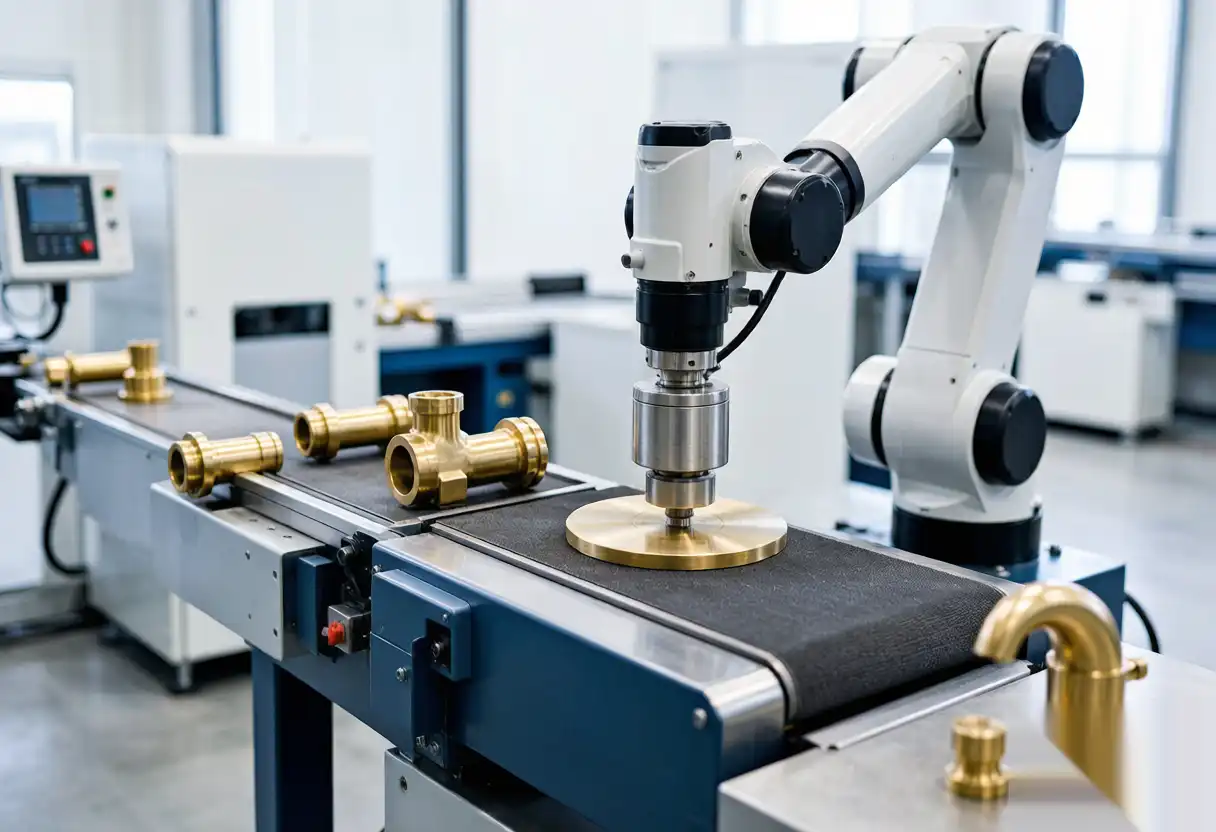
For most sanitary lines that need a true mirror on brass or stainless with frequent SKU changes, a force-controlled robotic cell is the pragmatic default. Tumble and belt systems are excellent as pre-stage or for satin-only work, and CNC earns its keep on high-volume rigid parts.
The Specifications That Actually Matter
Spindle power and speed range
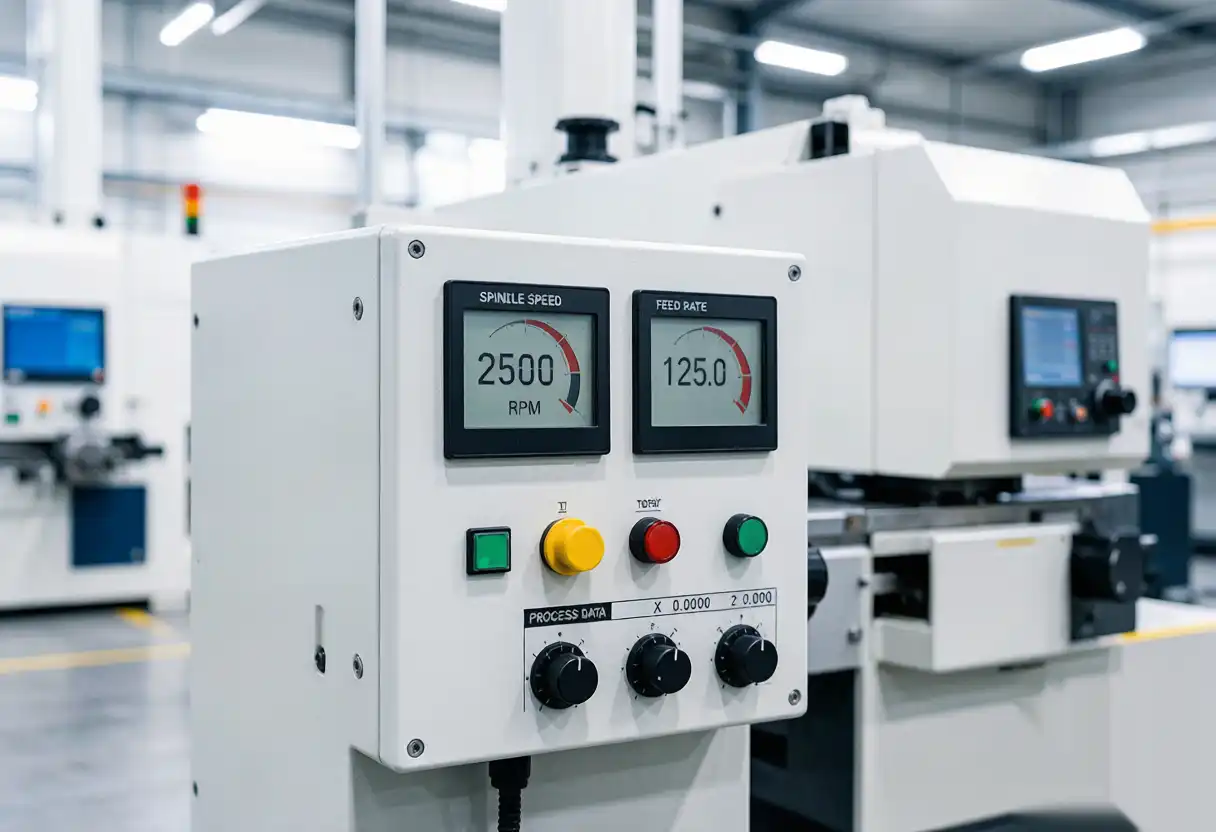
Mirror finishing needs enough torque at speed to keep the abrasive cutting rather than burning. Look for a spindle that holds speed under load and covers roughly 6,000–18,000 RPM with programmable curves per operation. A single fixed speed forces compromise across your part range.
Active force compliance
This is the feature that separates a robotic cell from a fancy milling arm. Active compliance holds a set contact force (typically ±5 N) as the tool follows curved and varying surfaces, so pressure stays constant whether the robot is on a flat face or a tight radius. Without it, you get either missed material or thinned walls.
Tooling and media compatibility
The machine should accept flaps, buffs, brushes and compounds for your materials without bespoke adapters. Quick-change tooling cuts changeover from hours to minutes and is what makes mixed-volume lines viable.
Changeover and fixtures
Ask for pneumatic or magnetic fixturing and a program library. The cost of a cell is not just the robot; it is the minutes lost every time you switch a faucet style. Sub-15-minute changeover is the bar worth holding.
Extraction and cell controls
Compound dust and coolant mist are real occupational and housekeeping issues. Size the extraction to the cell, and choose controls that log cycle counts, force and rejects so you can trend quality over a shift.
Estimating Cost and Payback
A polishing cell is rarely justified on cycle time alone; the payback comes from three places at once. Labour replaced per shift, rework and scrap avoided, and the extra throughput that lets you take orders you currently turn away.
These are illustrative ranges, not a quote. A mid-volume sanitary line running two shifts will usually land inside an 18-month payback once labour savings and rework reduction are modelled together; high-mix, low-volume shops take longer and should weight the flexibility and consistency benefits more heavily than pure throughput.
Common Selection Mistakes
- ✓Buying by horsepower. Power without force control just thins walls faster.
- ✓Ignoring changeover. The minutes between SKUs quietly eat the throughput you paid for.
- ✓Under-specifying extraction. Mist and dust turn a clean cell into a maintenance sink.
- ✓Skipping a sample run. Specifying from a drawing instead of a finished part hides the real finish risk.
- ✓Forgetting upstream and downstream. A fast polisher starved of parts or blocked by plating is just an expensive buffer.
Integration and Validation in Five Steps
Questions to Put to Every Supplier
- ✓Can you hit my Ra target on a sample of my actual part?
- ✓What is the real changeover time between my SKUs?
- ✓Do you supply fixtures and tooling, or do I source them?
- ✓How do you handle extraction and local safety compliance?
- ✓What are service and spare-part lead times in my region?
Frequently Asked Questions
Should I go robotic or stay manual at low volume? If your finish spec is tight and your labour cost is high, even a small robotic cell usually pays back through consistency and rework reduction, not just speed. Manual remains sensible only for very low volumes or purely prototype work.
Can one cell handle both brass and stainless? Yes, with programmable force, speed and tooling per material. Budget changeover time and confirm the supplier has media suited to both without cross-contamination.
How do I keep the finish consistent across shifts? Lock the validated program, use active force compliance, and trend Ra and reflectivity by shift so drift is caught before it becomes scrap.
What Ra counts as a mirror finish? True mirror is typically Ra 0.02–0.05 µm with high reflectivity; satin or brushed sits around Ra 0.2–0.4 µm. Define both the number and how it is measured.
Do I need separate machines for satin and mirror? Not necessarily. A force-controlled cell with swappable tooling and compounds can produce both; the question is changeover time versus dedicated stations.
How long does integration take? From sample approval, a pilot cell is typically running in a few weeks; full multi-SKU rollout is usually a few months including fixtures, training and validation.
A Note on Plating Preparation
Most brass sanitary parts are not sold as raw polished metal; they are polished, then plated. That means your polishing step is really preparing a substrate for plating, and the plater’s yield depends on the surface you hand over. A consistent, direction-controlled finish with no embedded compound residue plates more evenly and rejects less at the plater. When you evaluate a machine, ask to see plated samples, not just bare polished ones, because that is the result your customer actually receives. Building the polishing cell and the plating spec as one conversation, rather than two separate purchases, is one of the cheapest ways to lift first-pass yield across the whole line.