

Stainless Steel Polishing Machine: The 2026 Buyer’s & Operator’s Guide
Stainless steel is prized for corrosion resistance and a clean look — but only if the surface is finished correctly. Hand polishing is slow, inconsistent, and impossible to scale, while the wrong machine leaves orange peel, heat tint, or a finish that fails salt-spray testing. A purpose-built stainless steel polishing machine delivers repeatable mirror and satin finishes on sinks, hardware, cookware, and architectural parts. This guide covers how these machines work, the finish types they produce, how to choose consumables, and how to automate the line.
What Is a Stainless Steel Polishing Machine?
A stainless steel polishing machine is a surface-finishing system that abrades, buffs, and refines stainless components to a specified roughness and appearance. It may be a single buffing lathe, a belt-based line, or a fully robotic cell, but all share one goal: remove scratches and oxidation while preserving the chromium-rich passive layer that gives stainless its corrosion resistance. Unlike carbon steel, stainless work generates heat quickly and work-hardens, so machine speed, contact pressure, and compound choice all matter more than they would on a softer metal.
How Does Stainless Steel Polishing Work?
The process moves through progressively finer abrasives:
- Prepare the surface. Remove weld scale, scratches, and oxidation with coated abrasives or a grinding pass.
- Set the grain. A directional satin or hairline finish is built with a defined grit belt or flap wheel.
- Cut and colour. Successively finer compounds cut the surface, then “colour” it toward a uniform lustre.
- Mirror polish. Loose-fibre buffs and high-grade compounds close the grain to a reflective, near-flawless surface.
- Clean and passivate. Residue is removed and the surface is passivated to restore maximum corrosion resistance.
For a deeper dive on achieving a flawless reflective result, our automated mirror-polishing guide explains the cell-level workflow.
Mirror vs Satin: Which Finish Do You Need?
The two most requested outcomes are very different in cost and process:
| Attribute | Mirror finish | Satin / brushed finish |
|---|---|---|
| Surface roughness (Ra) | < 0.05 µm | 0.2–0.8 µm |
| Process steps | Many (cut + colour + buff) | Few (defined grit only) |
| Throughput | Lower per part | Higher per part |
| Typical use | Cookware, décor, medical | Architecture, appliances, hardware |
| Cost per part | Higher | Lower |
Choosing between them up front shapes the entire machine specification. Our robotic stainless-steel casting polishing case study shows how both finishes are run on one cell.
Choosing the Right Polishing Compound
Compound selection is where finish quality is won or lost. A good polishing compound guide matches the compound to the alloy and the stage:
- Cutting compounds — high-density abrasives for fast stock removal and scratch elimination.
- Colouring compounds — finer abrasives that close the grain and build lustre.
- Greaseless vs greased — greaseless bars suit robotic consistency; greased bars cut faster but need more cleaning.
- Colour coding — match bar colour to grit step so operators do not skip a stage.
Getting this wrong leaves smears or residual compound that fails later cleaning and passivation.
Key Applications Across Industries
A stainless steel polishing machine serves any sector where appearance and hygiene meet:
- Cookware & food service. Mirror-finished pots and pans that are easy to sanitise.
- Architectural & décor. Satin handrails, panels, and trims with a uniform grain.
- Medical & pharmaceutical. Ultra-clean surfaces that withstand sterilisation.
- Sanitary ware & hardware. Faucets and fittings polished before plating or assembly.
For die-cast components in particular, our polishing machine guide for die-cast components covers alloy-specific settings.
Benefits: Consistency, Hygiene, and Brand Value
The case for automation is strong:
- Repeatability. Robotic cells hold the same pressure and path every cycle, eliminating operator variance.
- Hygiene. A proper finish removes crevices where bacteria and corrosion start.
- Labour savings. One cell replaces multiple manual polishers on the same volume.
- Brand value. A flawless surface is often the first thing a buyer notices about your product.
How to Select the Right Stainless Steel Polishing Machine
Use this checklist before you request a quote:
- Finish spec. Mirror, satin, or both — this decides belts, buffs, and robot count.
- Part geometry. Flat sheet, curved sinks, or complex castings each need different tooling.
- Grade of stainless. 304, 316, and 430 behave differently under heat and pressure.
- Volume. Batch cells versus in-line systems depend on daily throughput.
- Downstream steps. Plan cleaning, passivation, and inspection into the cell footprint.
- Changeover. If you run many SKUs, prioritise quick tool and program changeover.
Our complete automatic polishing machine guide expands each of these points for specifiers.
Integrating With a Robotic Polishing Cell
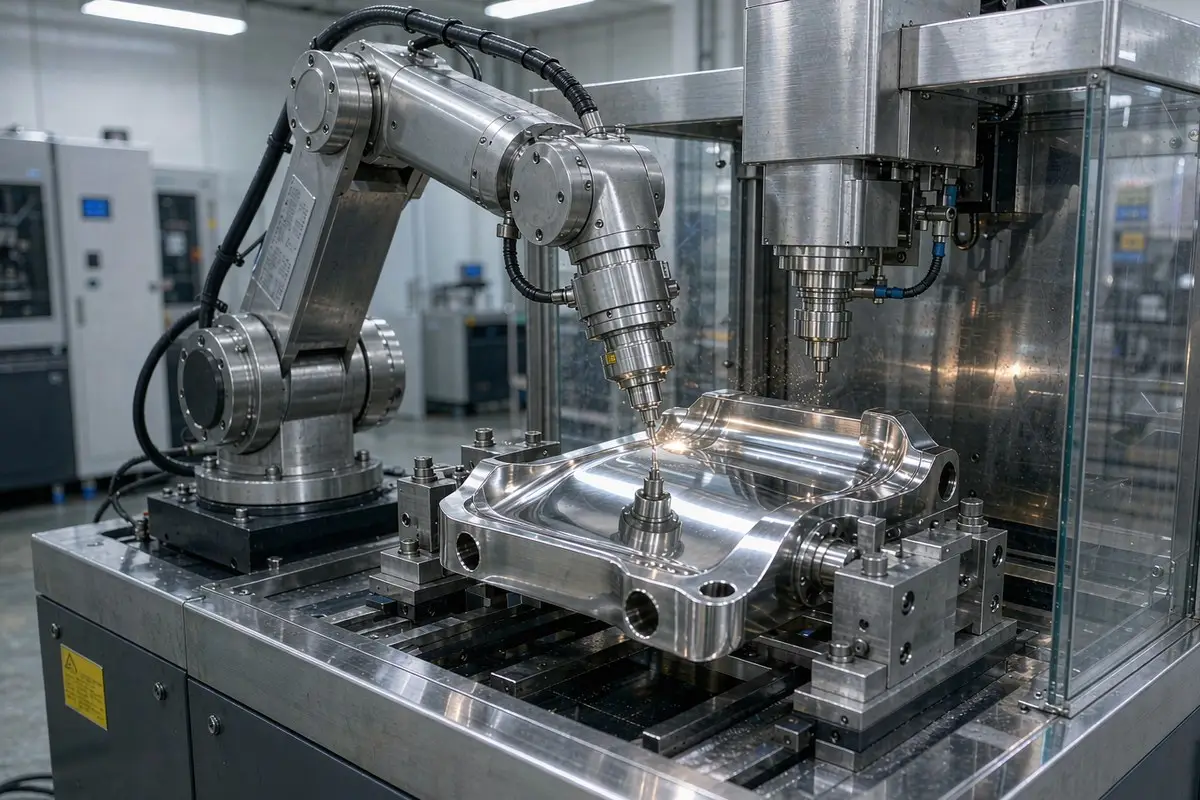
The most capable setup today is a robotic polishing cell that handles grind, polish, and buff in one fixture. Force control keeps pressure constant as the buff wears, and vision or offline programming handles families of parts. This is the natural home for a stainless steel polishing machine when volume and finish consistency both matter.
Maintenance Tips for Maximum Uptime
Protect your investment with routine discipline. Rotate and dress belts before they load the robot, clean compound build-up from fixtures, verify coolant and dust extraction, and log buff wear. The same reliability mindset applies as described in our mirror-polishing walkthrough.
Common Mistakes to Avoid
Stainless is unforgiving, and most polishing defects trace back to a handful of setup errors:
- Skipping passivation. Without it, stainless loses the corrosion resistance you just improved, and the part can stain or pit in service.
- Wrong compound for the grade. A bar tuned for 304 can smear or load on 316; match the compound to the specific alloy and stage.
- Over-polishing. Excess cut removes the passive layer and builds heat tint that is difficult and costly to remove later.
- Ignoring dust and coolant. Stainless dust is both a health hazard and a fire risk; extraction and mist collection are not optional.
- No defined finish spec. Polishing to “looks nice” instead of a measured Ra leads to subjective, rejectable results.
- Poor tool changeover. Mixing satin and mirror tooling without a clean program switch leaves cross-contamination and inconsistent grain.
Cost and ROI Considerations
A stainless steel polishing machine is a brand and compliance investment as much as a production one. Manual polishing ties up skilled labour and produces variable results that fail salt-spray or hygiene audits. Automation fixes both: one cell holds the same Ra every cycle and frees polishers for value-added work. Payback typically arrives within a year at production volume, and the damage avoided from a single failed corrosion audit often exceeds the machine cost. For shops running multiple finishes, the ability to switch between satin and mirror programs on one cell removes the need for separate lines and halves the floor space.
Energy use stays modest because modern cells run motors only under load, and compound consumption falls once application is metered instead of hand-applied. Beyond direct savings, a consistent finish protects downstream value: plating and coating adhere better to a properly polished, clean surface, so a polishing machine indirectly lifts the yield of every later process. When you model the decision, include the cost of rejects and rework, not just labour — a finish that drifts out of spec can mean an entire batch is stripped or scrapped, and that risk is exactly what a closed-loop, force-controlled cell removes.
Safety and Compliance Notes
Polishing stainless is not just a finishing task; it carries real obligations. Fine stainless dust is a known health hazard and, in sufficient concentration, a combustion risk, so local extraction and regular filter maintenance are mandatory rather than optional. Coolant and sludge must be collected and disposed of under local environmental rules, and any solvent-based cleaners need vapour controls. Operators should have eye and respiratory protection sized to the compound in use. Building these requirements into the cell from day one is far cheaper than retrofitting after an inspection, and it keeps your finish consistent by keeping the workspace clean.
Frequently Asked Questions
What grit is needed for a mirror finish on stainless steel?
Typically you start around 120–180 grit to remove scratches, progress through 240, 320, 400, and finish with buffing compounds rather than abrasive grit for the final reflective stage. The exact sequence depends on the starting surface.
Can one machine do both mirror and satin finishes?
Yes, with the right tooling and program changeover. Robotic cells commonly store both a satin belt program and a mirror buffing program, letting you switch finishes without buying two machines.
Does polishing remove the stainless corrosion-resistant layer?
Only if done badly. Proper polishing preserves the surface, and a final passivation step restores the chromium-rich passive film so corrosion resistance actually improves.
Is wet or dry stainless polishing better?
Wet polishing controls heat and dust on stainless, which work-hardens and discolours easily, so it is usually preferred for mirror work. Dry satin finishing is common for architectural grain where heat is less of a risk.
How much labour does a polishing machine replace?
A single robotic cell often replaces three to five manual polishers on the same volume, while improving consistency and reducing rework from uneven hand finishing.
Conclusion
A stainless steel polishing machine is the only reliable way to deliver mirror and satin finishes at production volume without sacrificing consistency or corrosion resistance. Define your finish spec, match the compound and tooling to your grade, and integrate the cell upstream of cleaning and passivation for a result that looks better and lasts longer. If you are specifying a new line, talk to our team about a stainless polishing cell sized to your parts and throughput.