

Sourcing Aluminum Die Casting from China: A Buyer’s Guide
Why Companies Source Aluminum Die Casting from China
The economics are real. A typical custom aluminum die casting part sourced from a Tier-1 Chinese supplier is 30-50% cheaper than the same part from a North American or European supplier, including tooling and logistics. The savings come from:
- Lower labor costs (still significant in 2026, even with Chinese wage increases)
- Larger scale die casting foundries (China produces roughly 60% of global aluminum die castings)
- Cluster effects — entire supply chains (alloy, steel, finishing, assembly) within a few hours’ drive
- Government support for export-oriented manufacturing
The question is not whether the savings are real, but how to capture them without getting burned. This guide covers the practical mechanics.
When China Sourcing Makes Sense (and When It Does Not)
Strong fit:
- High-volume parts (5,000+ pieces/year) where the absolute savings are large enough to justify project management overhead
- Parts with generous tolerances and forgiving cosmetic standards
- Mature part designs that are unlikely to require rapid design changes
- Buyers who can place tooling-fund capital upfront and wait 6-10 weeks for first article
- Products where logistics cost (sea freight) is reasonable relative to part value
Poor fit:
- Low-volume, high-mix parts (the project management cost kills the savings)
- Parts requiring rapid iteration or frequent engineering changes
- Tight cosmetic standards (Class A surface) where 12-hour time zones and video calls cannot replace being on the floor
- Highly regulated industries (medical, aerospace) where certification is the constraint, not cost
- Buyers who cannot visit the supplier at least once during the project
If your situation is in the “poor fit” category, source domestically or from a Western-owned Chinese facility. The savings are smaller but the project is manageable.
Step 1: Identify Candidate Suppliers
Three primary channels:
- Alibaba / Made-in-China / Global Sources: the broad marketplace. Search for “aluminum die casting manufacturer”, filter by “verified supplier” with 5+ years on platform, look for Gold Supplier status with audited reports. Expect to contact 30-50 suppliers to get 10-15 quality responses.
- Industry trade shows: the most important is Metal China (China International Foundry Expo) held annually in Beijing or Shanghai. Other useful shows are Die Casting Congress (North America, but Chinese suppliers attend) and EUROGUSS (Germany, with strong Chinese presence). Trade shows let you meet engineering staff, see sample parts, and judge capability in person.
- Referrals from existing buyers: the highest-quality channel. If you know peers at other OEMs who are already sourcing die castings from China, ask for their supplier list. Honest referrals save months of evaluation.
Avoid: any supplier that contacts you first with a “we have exactly the part you need” message. These are trading companies, not manufacturers, and they will broker your work to the lowest bidder.
Step 2: The First Round of Qualification
For each candidate supplier, request:
- Company profile and ownership structure (manufacturer vs. trading company vs. hybrid)
- Factory photos or video walk-through — dated, showing actual production lines
- List of die casting machines (tonnage, number, age — newer than 2015 preferred)
- Annual die casting tonnage and part weight range
- Customer references in your industry (with contact info if possible)
- Certifications: ISO 9001 minimum, IATF 16949 for automotive, ISO 14001 for environmental
- Sample parts similar to your geometry, with material certifications
A serious manufacturer responds within 2-3 business days with a complete package. A trading company takes longer, asks for more drawings, and offers to “find the right partner” — avoid these.
Step 3: Engineering Evaluation (DFM and Sampling)
Once you have 3-5 qualified suppliers, send each the same 3D model, drawing, and specifications. Ask for:
- Written DFM report with marked-up 3D model (PDF or marked-up STEP)
- DFM-driven quotation (price per part at 1,000 / 5,000 / 10,000 / 50,000 quantities)
- Tooling cost and lead time for the proposed die
- Alloy specification (with material cert format)
- Sampling plan (T0 / T1 / T2 milestones with timing)
- Finishing capability (in-house or subcontracted — both are fine, just disclose)
Compare the DFM reports. The best suppliers will identify issues you missed, propose design changes that reduce cost, and explain their reasoning. The worst will quote a low price on the design as-drawn and wait until tooling to surface problems.
Step 4: Tooling Ownership and IP Protection
This is where most China sourcing projects go wrong. Three core principles:
- Tooling is owned by you, period. The PO must state that the die is your property, paid for in full upon milestone, and must be returned or destroyed if the relationship ends. Get this in writing, ideally with a separate tooling agreement.
- Patent your part design in China if it is unique. Chinese patent law has improved dramatically since 2015, and design patents are inexpensive ($1,000-$3,000 through a Chinese IP firm). If your part is novel, this is cheap insurance.
- Use a Non-Disclosure Agreement (NDA) before sending any drawings. Use the Chinese legal system’s contract law, not US/EU contract law — engage a Chinese lawyer to draft or review the NDA. The standard “international NDA” template you find online will not hold up in a Chinese court.
A good supplier has no problem signing a robust tooling ownership and NDA package. A bad supplier gets evasive when these topics come up.
Step 5: Quality Control — The On-Site Audit
You should visit the supplier at least once before placing production orders, and ideally once per year thereafter. The audit covers:
- Workshop tour: die casting area, finishing area, QC lab, warehouse. Look for organization, cleanliness, equipment age, and worker safety practices. A clean, organized shop is not cosmetic — it correlates strongly with quality.
- Document review: quality manual, work instructions, calibration records, corrective action logs.
- Process capability review: ask to see Cpk data for a part similar to yours. A capable supplier shows you 1.33+ Cpk routinely. A weak supplier deflects the question.
- Material traceability: how is each heat of alloy tracked from receipt to part shipment? Can they show you a specific heat certificate for a specific production lot?
If you cannot visit in person, hire a reputable third-party inspection company for an audit. Cost is typically $500-$1,500 per audit day.
Step 6: The Production Phase — Communication and Cadence
Once production starts, the relationship works if you set the right communication cadence:
- Weekly email updates with production counts, quality issues, and shipping schedule
- Monthly video calls with the supplier’s quality and engineering leads
- Quarterly business reviews with on-site visit or third-party audit
- A real-time chat channel (WeChat is standard) for urgent issues
The 12-hour time zone is workable but requires discipline: decide upfront which hours you will be available, and require the same of the supplier’s key contacts.
Step 7: Logistics and Import Mechanics
For sea freight (the default for production volumes):
- FOB vs EXW vs DDP: most China sourcing projects ship FOB (Free on Board) from a Chinese port. The buyer arranges ocean freight and customs clearance. DDP (Delivered Duty Paid) is convenient but the supplier marks up the freight heavily.
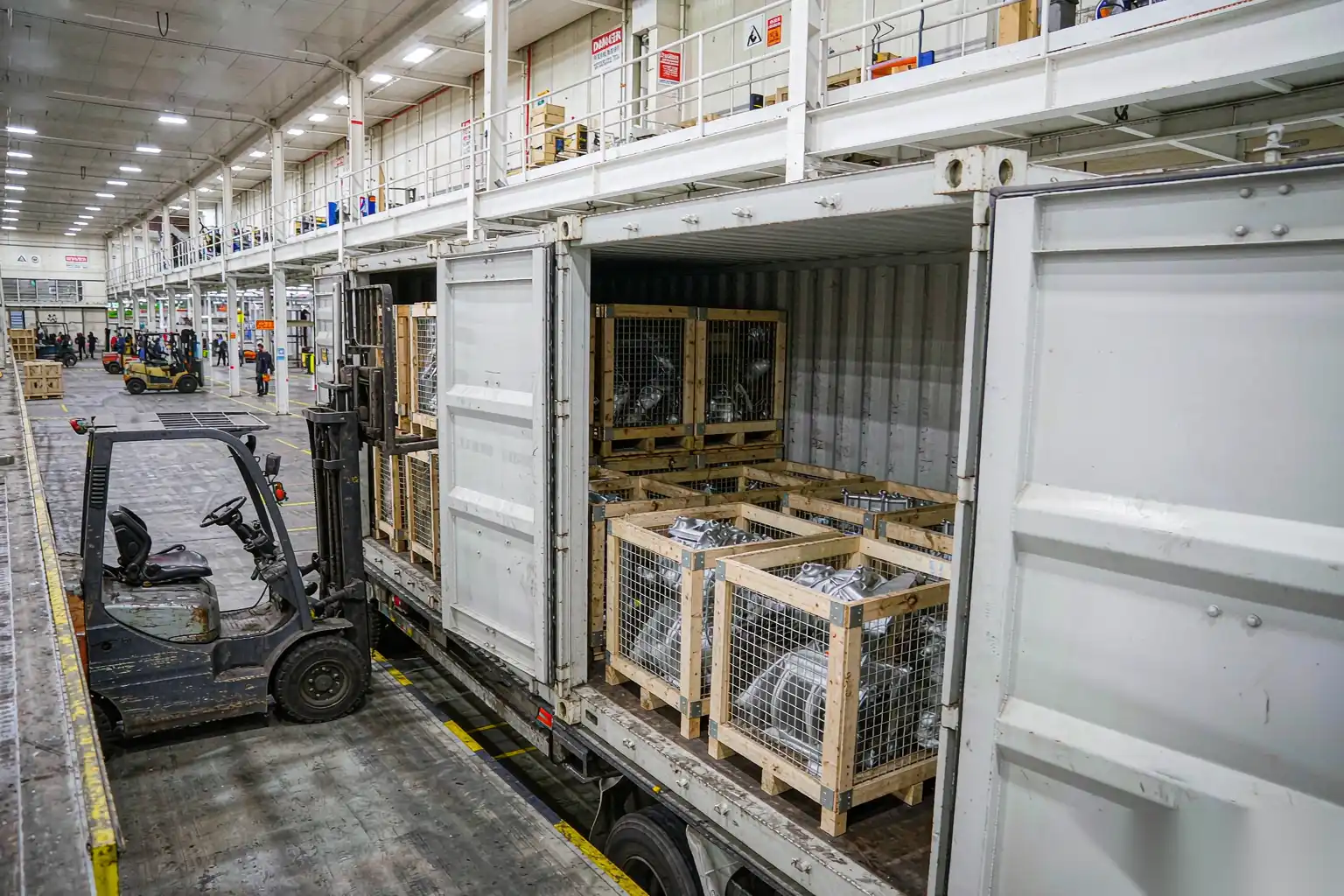
- Container loading supervision: hire a third-party inspector to witness container loading and confirm count, condition, and packaging. Cost $100-$300 per container.
- Customs documentation: the supplier provides commercial invoice, packing list, and certificate of origin. The buyer files customs entry in the destination country.
- Duties: die castings typically have a 2-5% import duty in most markets, depending on HTS code. Verify with your customs broker before placing the PO.
Air freight is used for samples and rush orders — typically 4-5x more expensive than sea freight, but 7-10 days instead of 35-45 days.
Step 8: Payment Terms
Standard payment structure for a China die casting sourcing project:
- 30% deposit on PO, due upon order confirmation
- 30% on T1 sample approval
- 40% on first production batch shipment
For tooling:
- 50% deposit on PO
- 50% on T1 sample approval (after you have the parts in hand and the die is paid for)
Avoid 100% upfront payment for tooling — that gives the supplier no incentive to deliver on time. Avoid 100% payment on shipment — that puts all the risk on you if the parts are defective.
Use T/T (wire transfer) for most payments, or L/C (Letter of Credit) for larger orders where the supplier requires payment security.
Common Failure Modes and How to Prevent Them
| Failure mode | Prevention |
|---|---|
| Supplier is actually a trading company | Verify factory ownership during qualification |
| Tooling ownership dispute | Written agreement before any drawings are sent |
| Design copied for other customers | NDA + Chinese design patent |
| Quality drops after first batches | Quarterly audits + third-party pre-shipment inspection |
| Hidden engineering change fees | Detailed DFM upfront, written change order process |
| Communication breakdown | Set explicit response-time expectations in the agreement |
| Logistics damage | Spec packaging, hire loading supervisor, photograph container at departure |
Most of these failure modes are preventable with upfront effort. The cost of prevention is small compared to the cost of a failed sourcing project.
FAQ About Sourcing Aluminum Die Casting from China
How much can I realistically save by sourcing die castings from China?
For a typical custom aluminum die casting project, 30-50% on part cost (including tooling amortization) is realistic. The savings are higher on simple parts and lower on complex parts requiring extensive finishing. The savings drop further if you factor in project management cost, inspection cost, and inventory carrying cost from longer logistics chains.
What is the typical lead time from order to first article in China?
Plan for 8-12 weeks: 1-2 weeks for DFM, 5-7 weeks for tooling, 2-3 weeks for sampling and T1. Add 1-2 weeks for finishing setup if finishing is in-house at the supplier.
How do I find a supplier I can trust?
Start with referrals. If you cannot get any, the trade show route is next (visit the supplier’s booth, see their parts, talk to their engineers). If you must use Alibaba, demand the verification documents and plan to visit before placing the order. Never place a full production order without at least one on-site visit or third-party audit.
Can I use a Chinese supplier for highly regulated parts (medical, automotive safety-critical)?
Yes, but the qualification process is longer and the cost savings are smaller. The supplier needs IATF 16949 for automotive, ISO 13485 for medical, and PPAP or equivalent documentation. Budget 2-3x the qualification time of an un-regulated part.
A Practical Recommendation
If you are considering sourcing aluminum die casting from China for the first time, start with one part, one supplier, one production cycle. Do not commit your entire product line to a new sourcing relationship. Get the part through tooling, sampling, and first production run. Audit the supplier in person. Then decide whether to expand.
At DZ Smart Manufacturing, we work with foundries across China, India, Turkey, and Mexico to integrate our robotic finishing cells with their die casting lines. If you are evaluating Chinese die casting suppliers and want a second opinion on their finishing capability, send us their finishing line video and we will tell you what we see — what is well-designed, what is handwork hiding, and where the real quality risks are.
See how automated finishing integrates with die casting production