

Robotic Polishing for Stainless Steel Castings
Why stainless is not just “aluminum with a harder belt”
Engineers who move from aluminum die castings to stainless steel castings often assume the polishing cell is the same machine with a coarser belt. It is not. Stainless, typically 304, 316, or CF8M cast grades, behaves differently under abrasion in three ways that decide the cell design: it work-hardens instead of smearing, it generates less visible heat but more local hardening, and its passive film is what makes the part corrosion-resistant in the first place. A polishing program tuned for aluminum will either rub uselessly on stainless or destroy the surface it was meant to beautify.
The job of robotic polishing on stainless is to cut the casting scale and parting-line marks, build a uniform grain, and leave the passive layer intact so the part does not rust in the warehouse. That sequence needs different media, different compounds, lower contact heat, and tighter force control than an aluminum line. At DZ we treat stainless as its own cell configuration rather than a mode on the aluminum line.
Stainless needs different media and compound
Aluminum polishing leans on coated abrasives and a cutting compound that runs fairly hot; the aluminum smears and the compound cleans the belt. Stainless needs a more aggressive cut and a cooler operation. The media ladder we use:
- 120 to 180 grit zirconia or ceramic alumina belt for scale and parting-line removal.
- 240 to 320 grit for grain building.
- 400 to 600 grit followed by a sisal or cotton buff with a greased tripoli or white compound for the final grain.
- A non-woven Scotch-Brite type wheel at the end for a satin, directional finish where specified.
The compound matters as much as the grit. Aluminum compounds are waxy and meant to keep the belt open; stainless compounds are sharper and carry more cutting agent because stainless loads a belt fast. A belt that loads on stainless stops cutting and starts rubbing, which is exactly the condition that work-hardens the surface. We change belts at 200 to 800 parts depending on the grade and the pressure, versus 1,000 to 2,000 on aluminum, because stainless wears the abrasive faster.
Coolant is the other difference. On aluminum we often run dry because the part sheds heat. On stainless we prefer a light water-based coolant or a flooded compound at the contact, because the cut generates local heat that, without cooling, drives the hardness up and the passive film down. A 5 to 15 percent emulsion at 0.5 to 2.0 L/min at the contact keeps the interface under roughly 150 °C, below the point where the chromium oxide layer is damaged.
Work-hardening and the orange-peel risk
The defining hazard on stainless is work hardening. When the belt rubs instead of cuts, the surface strain-hardens; 304 rises from about 180 HV in the as-cast skin to 280 to 350 HV in a rubbed layer 5 to 20 µm deep. That hardened skin then resists the very cutting you need, so the operator pushes harder, which hardens more. The cycle ends in a surface that will not take a uniform grain.
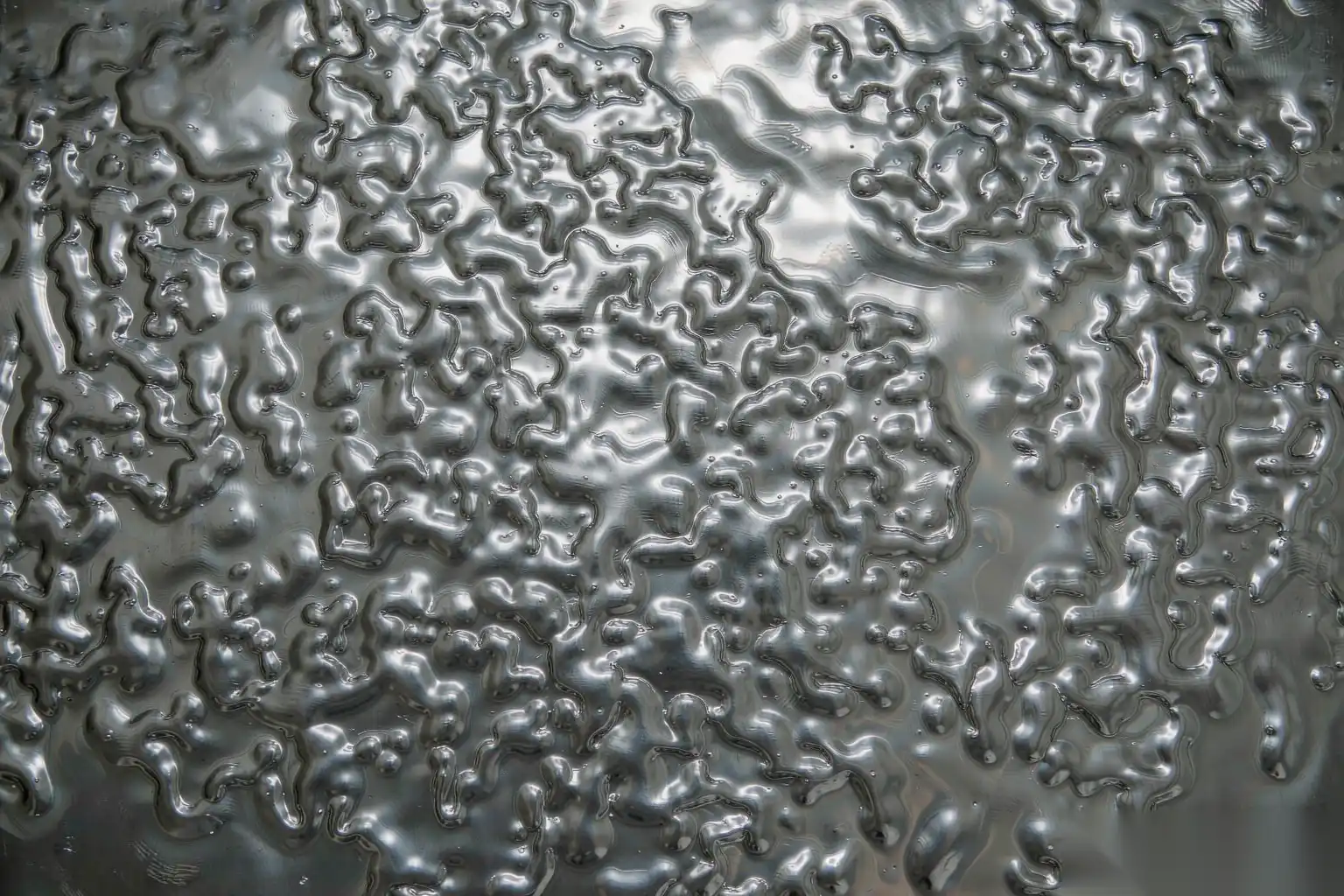
Orange peel is the visible result. Orange peel is a rippled, dimpled texture that appears when a hardened surface is finally cut by a coarser belt; the hard spots and soft spots cut at different rates and leave a wave pattern 0.5 to 2.0 µm deep. Once orange peel is in, only a return to a coarser belt and a fresh cut removes it, and that costs material and time.
The prevention is force and speed discipline:
- Keep the belt in the cut, not rubbing: target contact force 50 to 120 N by grade, with the loop holding plus or minus 5 N.
- Keep belt speed in the 18 to 30 m/s band; too slow rubs, too fast glazes.
- Replace the belt before it loads; a loaded belt is the start of the hardening loop.
- Use coolant at the interface so the local temperature stays under the hardening threshold.
This is why aluminum die casting finishing options do not transfer directly; the force and coolant settings that suit aluminum smear would harden stainless.
Passivation and cleanability after polish
A stainless casting is corrosion-resistant because of its chromium-rich passive film, roughly 1 to 3 nm of chromium oxide. Polishing abrades that film and, worse, can embed iron particles from a steel-backed belt or a contaminated wheel into the surface. If those particles are not removed, the part rusts despite being “stainless.”
After robotic polish the part must be passivated. The standard routes:
- Nitric acid passivation per ASTM A967, 20 to 50 percent by volume at 20 to 60 °C for 20 to 30 min, which dissolves free iron and rebuilds the film.
- Citric acid passivation, 4 to 10 percent at 50 to 70 °C for 10 to 30 min, where a non-nitric process is required.
- Electropolish for the highest cleanability, removing 5 to 25 µm and leaving a bright, low-Ra surface.
Cleanability is the point for food, medical, and sanitary castings. A polished but unpassivated stainless part can harbor iron and bacteria in the grain valleys. We specify a passivation step inside the cell sequence, not as a separate job, so the part leaves the line ready for service. For sanitary finishes we also hold Ra under 0.8 µm, because above that the valleys hold soil; the robotic force control is what holds that Ra consistently across a variable casting.
Force and contact control for a consistent grain
A uniform grain is the product of a constant cut, and a constant cut comes from force control. On stainless the force band is higher than aluminum but the tolerance is tighter, because a 10 N sag at a corner leaves a visible change in grain direction. Table 1 gives the working bands.
| Step | Force | Belt or wheel | Speed | Target Ra |
|---|---|---|---|---|
| Scale removal | 80 to 120 N | 120 to 180 ceramic | 20 to 28 m/s | 1.6 to 3.2 µm |
| Grain build | 50 to 90 N | 240 to 320 | 18 to 26 m/s | 0.8 to 1.6 µm |
| Final buff | 30 to 60 N | Sisal plus compound | 15 to 22 m/s | 0.4 to 0.8 µm |
| Satin finish | 20 to 40 N | Non-woven | 12 to 18 m/s | 0.6 to 1.2 µm |
The force loop must hold through corners and over varying radii, because stainless shows every force change as a grain change. A loop that settles in under 150 ms and holds plus or minus 5 N gives a grain that passes visual at 2x without a touch-up. We also control the contact angle; a 15 to 30 degree approach to the surface cuts cleanly, while a 5 degree grazing angle rubs and hardens.
Contact time per area sets the remove rate. At 90 N and 24 m/s a 240 grit belt removes roughly 0.2 to 0.8 cm³/min on 316, so a 6 cm² scale patch at 0.1 mm depth clears in about 45 to 90 s of contact. The cell cycles the robot over the patch with a 30 to 50 percent overlap so no lane is missed, and the force loop keeps the cut even as the belt wears.
Where a DZ cell fits versus manual polishing
Manual polishing of stainless is slow and inconsistent. A skilled polisher takes 3 to 15 min per part depending on size and finish, and the grain varies with the worker and the shift. A DZ robotic cell runs 1 to 4 min per part with a repeatable grain and no operator at the wheel. The comparison that matters to a foundry:
- Labor: one cell replaces two to four polishers on medium parts.
- Consistency: Ra variation drops from plus or minus 0.6 µm manual to plus or minus 0.15 µm robotic.
- Safety: no operator in the dust and coolant, with the cell enclosed and extracted.
- Throughput: a two-station cell with a rotary table clears 60 to 200 parts per hour by size.
The cases where manual still wins are very low volume, one-off, or parts with deep internal contours a robot cannot reach. Everything else, especially sanitary and decorative stainless castings in series of hundreds or more, belongs on a cell. The decision tree is the same one we lay out in the surface finishing automation complete guide for foundries: volume and reach decide manual versus robotic, and stainless volume almost always lands on robotic once the media and passivation sequence is set.
Surface finish standards to spec against
Specifying the finish prevents arguments at acceptance. The relevant scales:
- Ra for roughness, with sanitary stainless typically under 0.8 µm and decorative under 0.4 µm.
- A unidirectional grain specified by grit, e.g. 320 satin, with a direction callout on the drawing.
- A passivation spec, ASTM A967 or AMS 2700, with the method noted.
- A free-iron test, typically a copper sulfate or ferroxyl test per ASTM A967, to confirm no embedded iron.
We tie the robotic program to these numbers so the cell is accepted against the standard, not against an operator’s eye. The die casting surface finish standards we apply to aluminum transfer across to stainless for Ra and grain, with the added passivation and free-iron requirements that are unique to stainless.
Cell layout we recommend for stainless
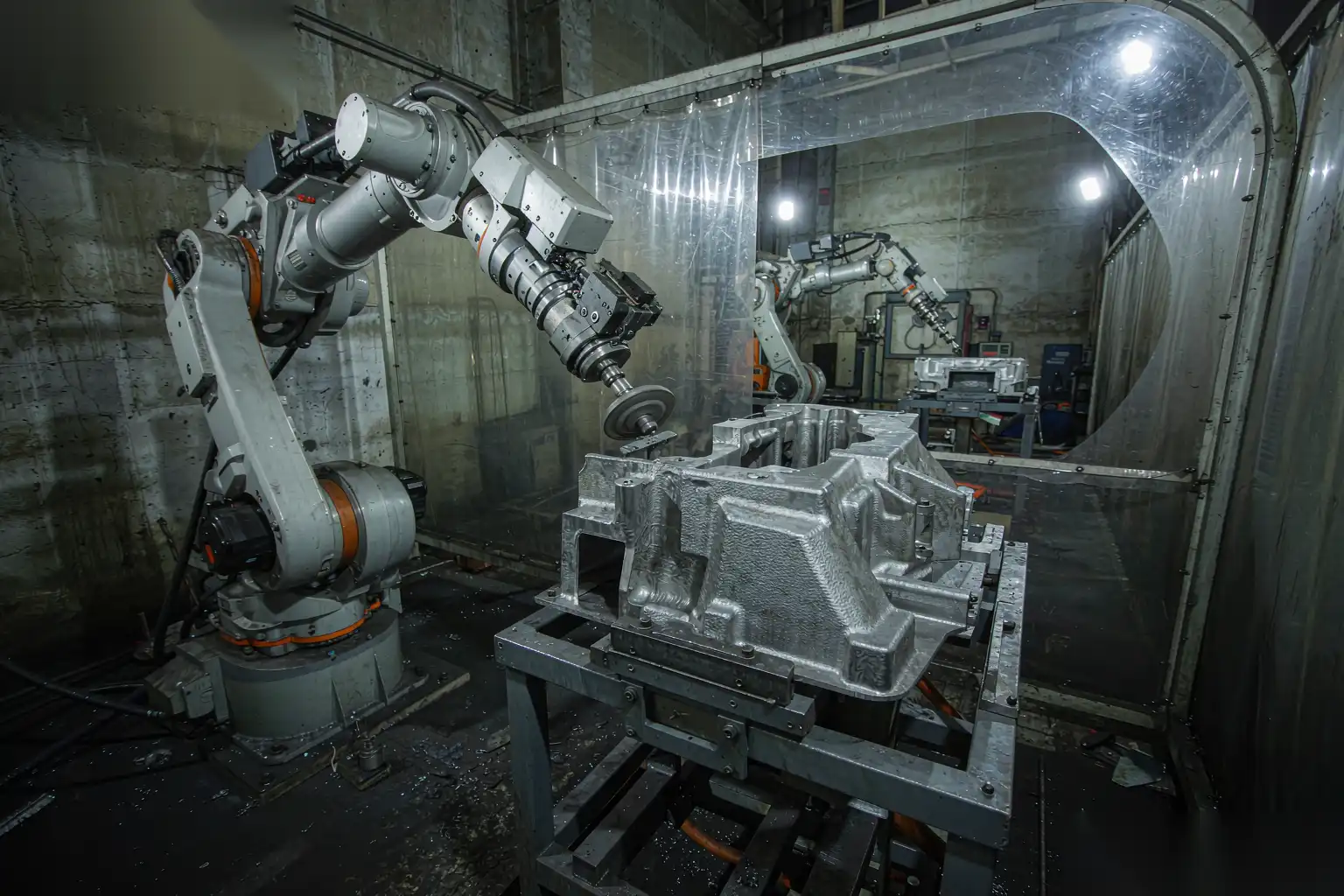
A stainless polishing cell from DZ runs as a sequence, not a single wheel:
- Deburr and scale break on a ceramic belt at 80 to 120 N.
- Grain build on 240 to 320 at 50 to 90 N.
- Buff with compound at 30 to 60 N for the specified grain.
- Wash to remove compound and loose iron.
- Passivate per the spec.
- Free-iron and Ra check at the exit.
The wash and passivation are inside the cell envelope so the part never leaves the line unpassivated. Coolant is supplied at every abrasive station. The dust and coolant are extracted and the cell is enclosed for operator safety. Force control runs the whole sequence so the grain is uniform from scale break to buff.
Defect modes specific to stainless polishing
Knowing the failure modes lets the cell be tuned against them rather than discovering them at the customer. The ones we watch:
- Embedded iron from a contaminated belt or wheel, caught by the ferroxyl test; prevented by dedicated stainless tooling and the wash step.
- Orange peel from the hardening loop, prevented by force and coolant discipline.
- Grain direction break at a corner, where the robot path changed angle; prevented by path blending and a constant contact angle.
- Pitting from over-aggressive electropolish or acid, prevented by holding the removal to 5 to 25 µm and timing the bath.
- Streaking from an uneven compound application; prevented by metered compound at 0.5 to 2.0 g/s rather than manual daubing.
Each defect has a single dominant cause, and once the cause is designed out, the cell runs clean. We log the first-off ferroxyl and Ra on every new part and keep the data so a drift in belt life or coolant concentration shows up as a trend before it becomes a return.
Throughput and cycle balancing on a stainless cell
Cycle balance decides whether the cell is profitable. The scale-break step is the longest, typically 40 to 90 s of contact, while the buff is 20 to 40 s. If both run on one robot, the buff station waits. We balance by either running two robots in series or by giving the long step a wider belt and higher force so it finishes in the same window as the short steps. A two-station rotary cell with a 30 to 60 s index clears 60 to 120 medium parts per hour; a four-station line doubles that. The wash and passivation are piped to run during the robot cycle so they add no standalone time. Getting this balance right is the difference between a cell that pays back in under a year and one that sits half-loaded.
Bringing DZ into your stainless polishing
DZ Machinery builds robotic polishing cells for stainless steel castings with the media ladder, coolant, force control, and in-line passivation engineered to your grade and finish spec. If your stainless castings are hardening, orange-peeling, or failing cleanability because the polish line was set up for aluminum, send us your part drawings and finish standard and we will configure the cell so the grain is uniform, the passive film is intact, and the part passes free-iron and Ra at the exit.