

High Pressure Die Casting vs Permanent Mold Casting: How to Choose
Why the Choice Between HPDC and Permanent Mold Matters
High pressure die casting (HPDC) and permanent mold casting are both widely used for aluminum parts, but they produce parts with different characteristics, costs, and application ranges. Choosing wrong means either overpaying for capability you do not need, or under-specifying and getting parts that fail in service.
The right choice depends on:
- Part size and weight
- Production volume
- Required mechanical properties
- Tolerance and surface finish requirements
- Alloy and heat treatment requirements
- Pressure tightness requirements
- Cost target
This article walks through the decision framework and the trade-offs at each step.
Process Overview
High Pressure Die Casting (HPDC)
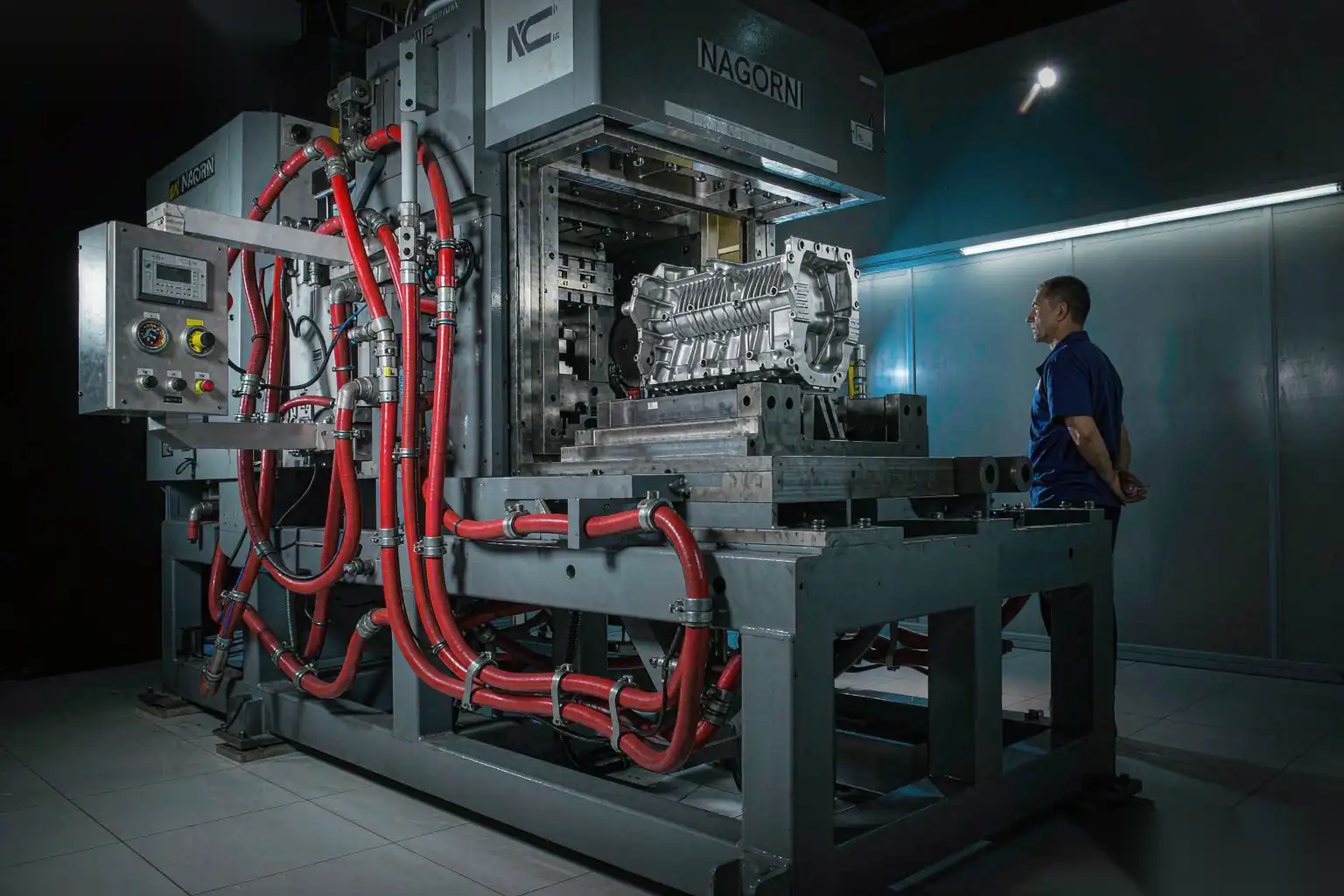
Molten aluminum is injected into a steel die at high speed (1-10 m/s) and high pressure (30-100 MPa). Cycle times are 30 seconds to 5 minutes. The die is water-cooled internally.
Key characteristics:
- Fast cycle time (high production rate)
- Thin walls possible (down to 1.0 mm)
- Complex geometry with internal features
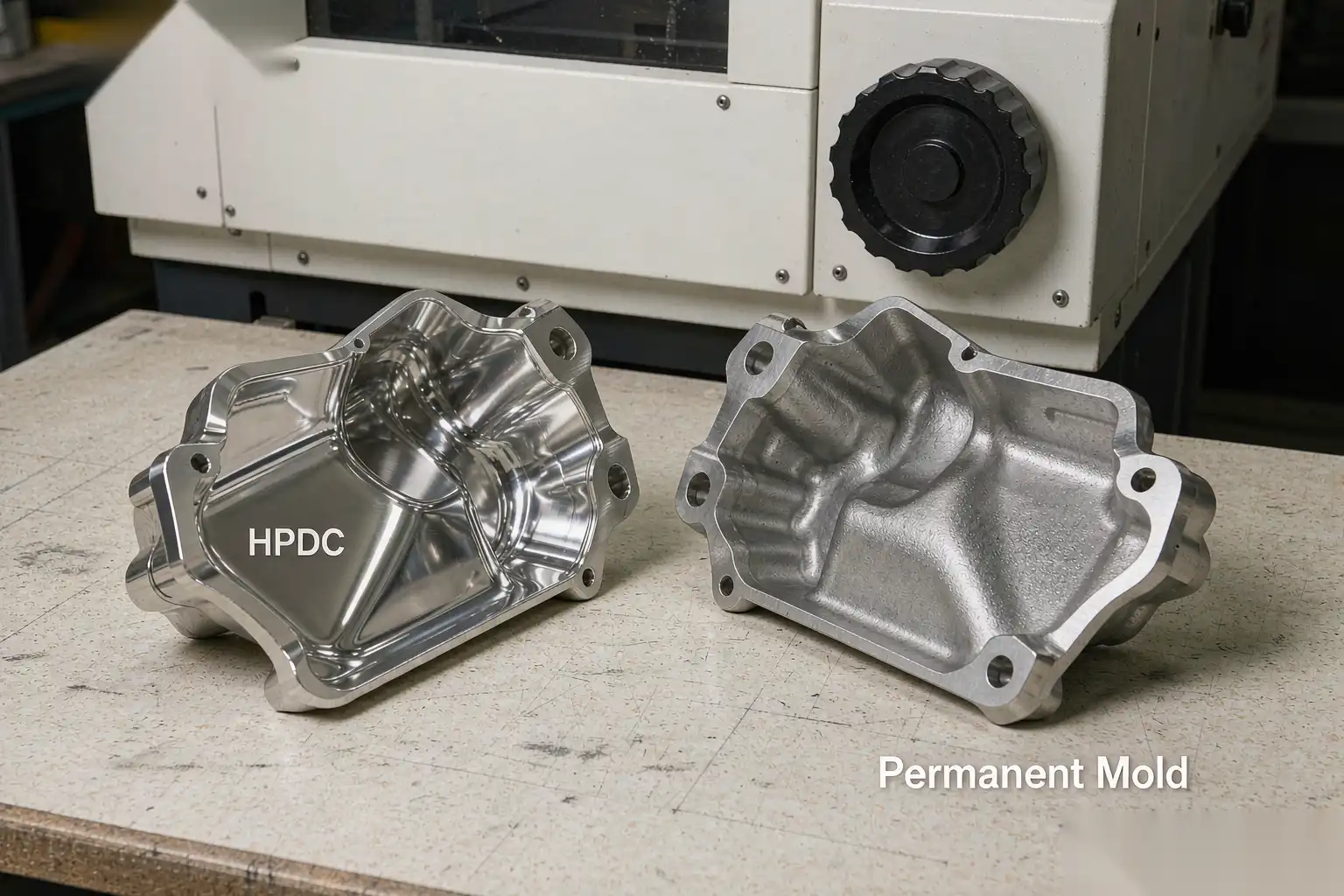
- Excellent surface finish (Ra 3.2-6.3 µm as-cast)
- High tooling cost ($10,000-$100,000+)
- Limited to non-heat-treatable alloys in standard HPDC
- Inherent porosity from trapped air
Permanent Mold Casting (also called gravity die casting or chill casting)
Molten aluminum is poured into a reusable metal mold (typically cast iron or steel) under gravity pressure (no injection). Cycle times are 5-30 minutes. The mold may be tilted or rotated to assist filling.
Key characteristics:
- Slower cycle time (lower production rate than HPDC)
- Wall thickness 3-6 mm minimum (thinner walls are difficult)
- Simpler geometry than HPDC
- Better mechanical properties (slower cooling = denser structure)
- Lower porosity (gravity fill, less air entrapment)
- Can be heat treated (T6, T5) for higher strength
- Lower tooling cost than HPDC (typically 30-50% less)
- Suitable for medium volume (500-50,000 parts/year)
Comparison Table
| Factor | HPDC | Permanent Mold |
|---|---|---|
| Cycle time | 30s-5min | 5-30min |
| Minimum wall thickness | 1.0-1.5 mm | 3-4 mm |
| Maximum part weight | typically <10 kg | typically <50 kg |
| Tolerance (linear) | ±0.10-0.15 mm | ±0.20-0.40 mm |
| Surface finish (as-cast) | Ra 3.2-6.3 µm | Ra 3.2-12.5 µm |
| Internal porosity | higher (gas) | lower |
| Mechanical strength (as-cast) | moderate | good |
| Heat treatable | no (A380 blisters) | yes (T5, T6) |
| Tooling cost | $10K-$100K+ | $5K-$50K |
| Production volume | high (1,000-1M+/year) | medium (500-50K/year) |
| Setup change cost | low (automated) | high (manual operation) |
| Suitable alloys | A380, A383, A384, A390, A413 | A356, A357, A206, A201, custom |
| Pressure tightness | fair (gas porosity limits) | good (lower porosity) |
| Typical applications | consumer electronics, automotive brackets, lighting | structural automotive, motorcycle, aerospace, pump bodies |
When to Choose HPDC
Choose HPDC when:
- Production volume is high (5,000+ parts/year, with the breakeven typically at 1,000-3,000 parts/year)
- Part is complex with internal features, thin walls, or intricate geometry
- Tight tolerances are needed on as-cast features
- Cosmetic surface finish is required
- Cycle time matters (high volume production economics)
- Heat treatment is NOT required for the application
HPDC dominates consumer electronics, lighting, automotive brackets and covers, and most high-volume industrial castings.
When to Choose Permanent Mold
Choose permanent mold when:
- Production volume is medium (500-50,000 parts/year)
- Part is structural and needs better mechanical properties than HPDC provides
- Heat treatment is required (T6 for higher strength, T5 for stress relief)
- Pressure tightness is required (hydraulic, pneumatic, pump bodies)
- Lower porosity is required than HPDC can deliver
- Larger parts that HPDC machines cannot handle economically
- Alloy options beyond standard die casting alloys (A356, A357, A206)
Permanent mold is common for motorcycle frames, automotive suspension components, aerospace structural parts, and pump/valve bodies.
Cost Comparison
For a hypothetical part weighing 2 kg, production volume of 10,000 parts/year:
HPDC Cost Estimate
- Tooling: $25,000 (single-cavity, simple die)
- Per-part cost: $4-8 (material + casting + trim + simple finishing)
- Tooling amortization (over 1 year): $2.50/part
- Total per-part: $6.50-10.50
Permanent Mold Cost Estimate
- Tooling: $15,000 (simpler mold)
- Per-part cost: $6-12 (material + casting + trim + heat treatment)
- Tooling amortization (over 1 year): $1.50/part
- Total per-part: $7.50-13.50
The cost crossover depends heavily on volume and complexity. For very high volume (100,000+ parts/year), HPDC wins on cycle time economy. For lower volume or larger parts, permanent mold is competitive or cheaper.
Mechanical Property Comparison
For a 2 kg part in A356/A380:
| Property | HPDC (A380 as-cast) | Permanent Mold (A356-T6) |
|---|---|---|
| Ultimate Tensile Strength | 320-360 MPa | 260-310 MPa |
| Yield Strength | 160-180 MPa | 180-240 MPa |
| Elongation | 3-3.5% | 6-10% |
| Hardness | 75-85 HB | 80-95 HB |
| Fatigue Strength | 130-150 MPa | 90-110 MPa |
| Impact resistance | moderate | high |
Permanent mold with T6 heat treatment gives significantly better elongation and impact resistance than HPDC. For structural or safety-critical parts where ductility matters, permanent mold is the better choice.
Special Variants Worth Knowing
Low Pressure Permanent Mold (LPPM)
A variant of permanent mold where the molten metal is pushed into the mold by low pressure (0.5-1.5 bar) rather than gravity. This gives better fill, less porosity, and the ability to cast thinner walls (2-3 mm minimum). Used for automotive wheels and structural parts.
Squeeze Casting
A hybrid process: molten metal is poured into a pre-heated die, then high pressure (50-150 MPa) is applied during solidification. The result is near-zero porosity and heat-treatable parts. Used for safety-critical components. Cost is higher than HPDC or permanent mold.
Vacuum Die Casting (HPDC variant)
A modified HPDC process where the die cavity is evacuated before injection. Reduces gas porosity by 80-90%. Used for parts that need to be heat treated or pressure-tight but require the cycle time of HPDC.
Semi-Solid Casting (Thixomolding, Rheocasting)
The alloy is injected in a semi-solid state (between liquidus and solidus temperatures). Reduces porosity and allows heat treatment. Emerging technology, not yet dominant.
A Decision Framework
Use this flowchart to choose:
- Is the production volume over 50,000 parts/year?
– Yes → HPDC (likely)
– No → continue
- Is heat treatment required for the application?
– Yes → permanent mold or vacuum HPDC
– No → continue
- Is the wall thickness below 2 mm?
– Yes → HPDC
– No → continue
- Is pressure tightness required?
– Yes → permanent mold or vacuum HPDC
– No → continue
- Is the part primarily structural with high ductility required?
– Yes → permanent mold with T6
– No → HPDC (likely, for economic reasons)
This framework is a starting point. The final decision should involve a DFM review with both HPDC and permanent mold suppliers, with each quoting their process and giving you cost and capability data.
Tooling and Lead Time Differences
Beyond the part characteristics, the two processes differ in how the tooling is built and how quickly a project reaches first article.
HPDC tooling is a hardened tool steel die (typically H13 at 48-52 HRC) machined to tight tolerances, with internal cooling channels, ejector pins, and often slides and lifters. Die fabrication for a typical part takes 4-6 weeks after the DFM review, and the die is expected to last 100,000-500,000 shots before major refurbishment. Because the die is subjected to thermal cycling and high injection pressure, it requires preventive maintenance: inspection of the cavity surface, replacement of ejector pins, and verification of the cooling channels every 50,000-100,000 shots.
Permanent mold tooling is a cast iron or steel mold with gating, risers, and often sand cores for internal features. Mold fabrication is typically faster and less expensive (30-50% less than a comparable HPDC die) because the mold operates at lower pressure and does not need the same level of precision. Mold life is generally 50,000-150,000 pours, shorter than HPDC die life because of thermal fatigue from repeated heating cycles. Maintenance focuses on coating the mold surface between pours and periodic resurfacing of the cavity.
For project planning, both processes follow a similar sampling sequence: T0 (first shot or first pour), T1 (dimensional approval), and T2 (process validation). The main difference is that HPDC reaches T1 faster once the tooling is complete, because cycle times are shorter and more parts can be produced per hour for the capability study. This is an important practical consideration when the project schedule is tight.
Two Real-World Selection Examples
Abstract comparisons settle nothing, so here is how the choice played out on two representative programs. The first: a motor end shield, 1.8 kg, 320 cm² projected area, 240,000 pieces per year, no heat treatment, cosmetic exterior on one face. Every criterion pointed to HPDC, and HPDC it was — a single-cavity die on a 500-ton cell, cycle under 60 seconds, and the finishing scope handled by a robotic deburring and polishing cell. The deciding factors were volume and cycle time; permanent mold at that volume would have needed a casting floor four times larger for the same output.
The second: a suspension knuckle, 4.2 kg, 55,000 pieces per year, T6 heat treatment required, fatigue-loaded. HPDC was quoted first because the volume looked attractive, but the heat treatment requirement ruled standard HPDC out — A380 blisters — and vacuum HPDC tooling plus process qualification would not pay back at 55,000 a year. Permanent mold in A356-T6 won on function, and the program never looked back.
Notice what both decisions turned on: not which process is better in general, but which constraints — volume, heat treatment, alloy, cosmetic scope — bound the specific part. That is the entire exercise. Write down your four binding constraints before you talk to suppliers, and the process usually picks itself. When the constraints do conflict — moderate volume plus heat treatment plus a cosmetic face, say — that is the moment to bring both a die caster and a finishing partner like DZ Machinery into one conversation, because the finishing cell often decides which casting route actually costs less at the finished-part level.
FAQ About HPDC vs Permanent Mold
Can permanent mold castings be made as thin as HPDC?
No. Permanent mold minimum wall thickness is typically 3-4 mm (gravity) or 2-3 mm (low pressure). HPDC can cast down to 1.0 mm walls. If the design has thin walls, HPDC is the only practical option.
Is permanent mold more expensive than HPDC for low volume?
At very low volume (under 500 parts/year), permanent mold can be more expensive because the cycle time is longer and the per-part cost is higher. The breakeven point varies by part but is typically 1,000-3,000 parts/year.
Can permanent mold use A380 alloy?
Technically yes, but A380 is rarely used in permanent mold because the higher copper content is not needed for the slower process. The standard permanent mold alloys are A356 and A357, which are heat-treatable and have better mechanical properties.
Which process is better for cosmetic parts?
HPDC typically gives better as-cast surface finish than permanent mold. For visible consumer parts, HPDC with secondary polishing is the standard approach.
A Practical Recommendation
For a new part, talk to at least one HPDC supplier and one permanent mold supplier during the DFM phase. Each will give you different design recommendations and cost estimates. The right choice often becomes clear after these conversations.
At DZ Smart Manufacturing, our robotic finishing cells work with both HPDC and permanent mold parts. The finishing process is similar but the abrasive selection and cycle parameters differ. If you are deciding between HPDC and permanent mold and want a second opinion on which process suits your part better, our engineering team can review your drawings and provide a process comparison with cost estimates.
See how automated finishing handles both HPDC and permanent mold parts