

Aluminum Dust Safety in Casting Grinding and Polishing Shops
Every shop that grinds or polishes aluminum generates dust. Almost every shop underestimates what that dust can do. Fine aluminum dust is combustible, and in the right concentration suspended in air it is explosive. This is not a regulatory abstraction — it is the mechanism behind a long, well documented history of incidents in metal finishing facilities. This guide covers the physics, the engineering controls that actually work, and the operating discipline that keeps the controls functioning.
Why Aluminum Dust Behaves Differently
Metal dust hazards vary enormously by material. Aluminum sits toward the more hazardous end for three reasons:
- High surface area to volume ratio. Grinding produces particles in the respirable and coarse ranges. A 20 µm aluminum particle has vastly more exposed surface per kilogram than a solid block, so oxidation proceeds far faster once ignition begins.
- Strongly exothermic oxidation. Aluminum reacting to alumina releases substantial energy, which sustains propagation through the dust cloud.
- Low minimum ignition energy. Fine aluminum dust clouds can be ignited by static discharge, a hot bearing, or a spark from a tool — energies measured in millijoules.
The parameters that quantify this are familiar to anyone who has commissioned a combustible dust assessment:
| Parameter | Typical range for fine aluminum dust | What it tells you |
|---|---|---|
| Kst (explosion severity index) | 150 to 350 bar·m/s | How violently pressure rises; above 200 is a high severity class |
| Pmax (maximum explosion pressure) | 8 to 12 bar | Peak pressure the vessel or room enclosure may see |
| Minimum ignition energy | 10 to 100 mJ | How little energy it takes to set it off |
| Minimum explosible concentration | 30 to 80 g/m³ | How much dust in air before a cloud can propagate flame |
| Minimum ignition temperature (cloud) | 550 to 650 °C | Surface temperature threshold for ignition |
| Layer ignition temperature | 300 to 450 °C | Lower because accumulated layers self-insulate and smoulder |
Note the distinction between cloud ignition and layer ignition. A layer ignites at a much lower temperature because it sits still, retains heat and smoulders. That is why housekeeping is a genuine control measure and not a cosmetic requirement: settled dust on a hot motor housing can ignite without any cloud being present.
Where the Dust Cloud Comes From

Understanding generation points tells you where to put controls.
- Manual off-hand grinding. The worst case. The operator holds the part against a rotating belt or wheel, the dust plume is generated in the open, and it goes straight into the operator’s breathing zone and into the room air.
- Manual polishing and buffing. Similar geometry, plus polishing rouge particulates and cotton wheel lint, which add their own combustible loading.
- Semi-automatic machines with inadequate enclosure. Better, but often only partially enclosed with poor capture velocities at the openings.
- Enclosed robotic cells. The best case. The process happens inside a housing maintained under negative pressure, and extraction removes particulate at source.
The key variable is whether dust is captured before it enters room air. Once it is airborne in the general workspace, every subsequent control becomes more expensive and less effective.
Capture Design: Numbers That Matter
Local exhaust ventilation is the engineering control that does most of the work. The relevant figures:
- Capture velocity at the point of generation. For grinding operations, design for roughly 2.0 to 2.5 m/s of face velocity at the hood opening. Lower velocities let fine particles escape into room air.
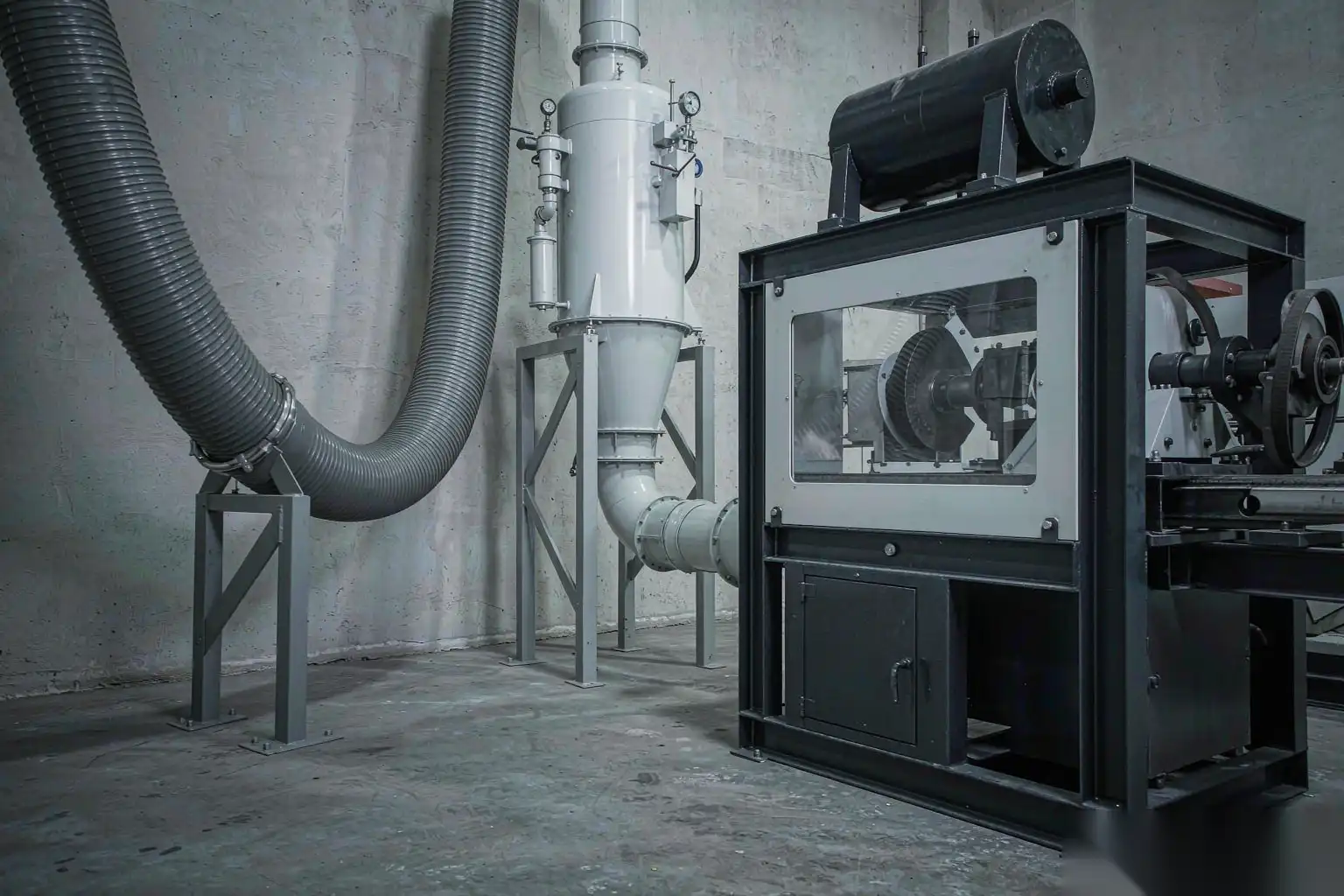
- Duct velocity. Keep transport velocity in the 20 to 25 m/s range for aluminum dust to prevent settling inside the duct. Horizontal runs and elbows are where accumulation begins.
- Hood geometry. place the hood as close as practical to the wheel contact point. Capture velocity falls roughly with the square of distance from the hood face, so doubling the distance quarters the capture.
- Make-up air. A system exhausting thousands of cubic metres per hour needs make-up air or it will pull against itself and lose performance. Undersized make-up air is a common and invisible failure.
For a rough reference, a mid-size grinding station typically needs 2,000 to 4,000 m³/h of extraction depending on hood design and wheel size.
Wet Versus Dry Collection
Both approaches are defensible. The choice depends on your process and your tolerance for maintenance.
Wet collection (water curtain or wet scrubber).
- Advantages: captures combustible dust in a non-combustible medium, effectively eliminating the explosion hazard inside the collector; excellent for high volume fine dust.
- Disadvantages: produces aluminium hydroxide sludge requiring treatment and disposal; freezing risk in cold climates; higher energy consumption; in some jurisdictions the wet slurry still requires controlled handling.
There is a critical compatibility warning: aluminium fines and certain metal dusts generate hydrogen when wetted, particularly if the water is alkaline and the sludge is allowed to stand warm in a closed container. Wet systems need hydrogen management — vented tanks, no prolonged sealed storage of sludge, and never mix incompatible metal fines in one wet collector.
Dry collection (cartridge or baghouse).
- Advantages: no liquid waste stream, recovered material is dry, simpler maintenance routines.
- Disadvantages: the collector itself becomes the highest-risk location in the plant. Requires explosion venting or suppression, isolation between collector and process, and strict cleaning discipline.
If you run dry collection, these features are standard practice:
- Deflagration venting sized to the collector volume and Kst value, venting to a safe outdoor location through a duct, or a listed flameless vent indoors.
- Explosion isolation between the collector and the process equipment — mechanical rotary valve, chemical isolation barrier, or fast acting valve — so a deflagration in the collector cannot propagate back upstream.
- Antistatic or conductive filter media with proper grounding and bonding. Static discharge inside a dry collector is a documented ignition source.
- Differential pressure monitoring to detect for filter loading or failure before airflow drops below design.
Filter Media and Cleaning Discipline
Filter selection is driven by particle size and dust characteristics.
- Standard cellulose or polyester media handles coarse grinding particulate adequately.
- Nanofibre or ePTFE membrane media performs better on fine polishing dust and maintains lower pressure drop, which preserves capture velocity.
- Never clean loaded filters with compressed air inside the shop. Compressed air re-aerosolises settled fines and can create exactly the cloud you are trying to prevent. It can also damage media and destroy the antistatic properties.
Pulse jet cleaning should be automatic on a timer or differential pressure setpoint. Manual shake-down collectors depend on somebody remembering, and they usually result in a loaded filter and reduced airflow for weeks.
Housekeeping and Layer Thickness
Settled dust is fuel waiting for an ignition source. Practical housekeeping rules:
- Clean on a defined frequency based on generation rate, not when it looks bad. In a busy manual grinding shop that may be every shift for surfaces within three metres of the stations.
- Use approved vacuum cleaners rated for combustible metal dust with proper grounding. Never use a standard shop vacuum.
- Never use compressed air for cleaning — this is the single most common and most dangerous violation in metal finishing shops.
- Keep accumulated layer thickness below roughly 1 mm on surfaces in the area. Thin films may seem harmless, but across hundreds of square metres the fuel inventory becomes significant.
- Pay attention to hidden accumulation surfaces: top of cable trays, light fixtures, duct exteriors, roof beams, and inside electrical enclosures that are not dust rated.
- Inspect the area above suspended ceilings. Dust accumulates there undisturbed for years.
Enclosed Robotic Cells as an Engineering Control
This is worth stating plainly because it changes the economics of automation: enclosing the process is the single most effective dust control available, and it happens to come packaged with the productivity investment.
A properly designed DZ Machinery enclosed cell incorporates:
- Fully enclosed housing with interlocked access doors and negative internal pressure maintained by continuous extraction
- Dedicated extraction ducting sized for 20 to 25 m/s transport velocity
- Extraction point positioned at the wheel contact point, not merely somewhere in the enclosure
- Enclosure-rated electrical components or positive-pressure purged cabinets for the robot controller and sensors
- Automatic media compensation and dressing so nobody opens the enclosure mid-cycle
- Filter monitoring with alarms when pressure drop exceeds the design band
The qualitative difference is substantial. In a manual station the operator stands in the plume. In an enclosed cell the operator loads and unloads parts outside the enclosure, and most of the cycle runs with the doors closed and extraction running.
For shops evaluating that transition, our discussion of automatic deburring versus manual grinding covers the productivity and quality side of the same decision.
Maintenance Access and Lockout
The irony of enclosed cells is that maintenance access reintroduces the hazard. Manage it deliberately.
- Establish lockout/tagout procedures covering stored energy: electrical, pneumatic, hydraulic, and the potential energy in raised axes.
- Require hot work permits with a defined dust-free zone and fire watch for any grinding, welding or cutting inside or adjacent to enclosures or ducting.
- Inspect ducts for internal accumulation on a schedule; elbows and horizontal runs are the first places to check.
- Verify grounding and bonding continuity annually — flex connections and vibration loosen connections over time.
- Never bypass interlocks to keep the cell running during a cycle. Interlocks exist because someone calculated what happens when they fail.
Operational Practices Worth Enforcing
A short list, but these are what determine whether your controls survive contact with production pressure:
- Run extraction before starting the spindle, and keep it running after shutdown for a minute to clear suspended fines
- Never mix aluminium and incompatible metal fines in the same collector without an engineering review
- Establish no-compressed-air-cleaning as a written, enforced rule
- Keep spare filters on hand so a loaded filter is replaced rather than tolerated
- Train operators on what the dust hazard actually is — people enforce rules they understand
- Log every incident, including near misses such as a smouldering filter or a tripped differential pressure alarm
DZ Machinery designs every enclosed cell with extraction engineered as part of the machine, not as an accessory added afterwards. If you are planning a new finishing line or enclosing an existing manual area, share your layout and the part families involved, and our engineers will size the cell and its dust extraction together.