

Disc Polishing Machine: Types, Selection, and Best Practices
When a part needs a flat, scratch-free face and a consistent cosmetic sheen, the disc is often the fastest tool for the job. A disc polishing machine spins an abrasive or polishing disc against the workpiece at controlled pressure, removing previous scratch patterns and leaving a uniform finish across the surface. Used well, it delivers the flatness and gloss that belts struggle to hold and that hand work cannot repeat. This guide explains how disc polishing works, the machine types available, how to select discs and speeds, and the mistakes that quietly destroy finish quality.
What Is a Disc Polishing Machine?
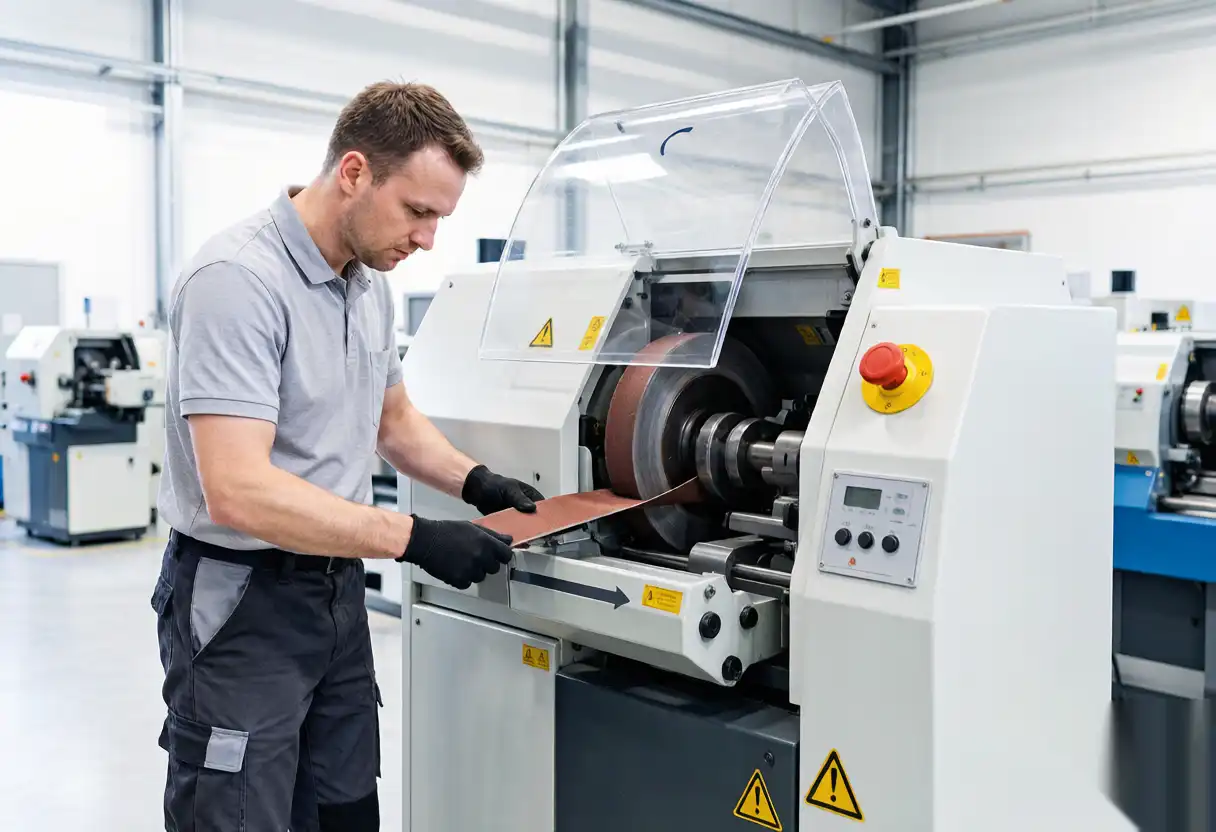
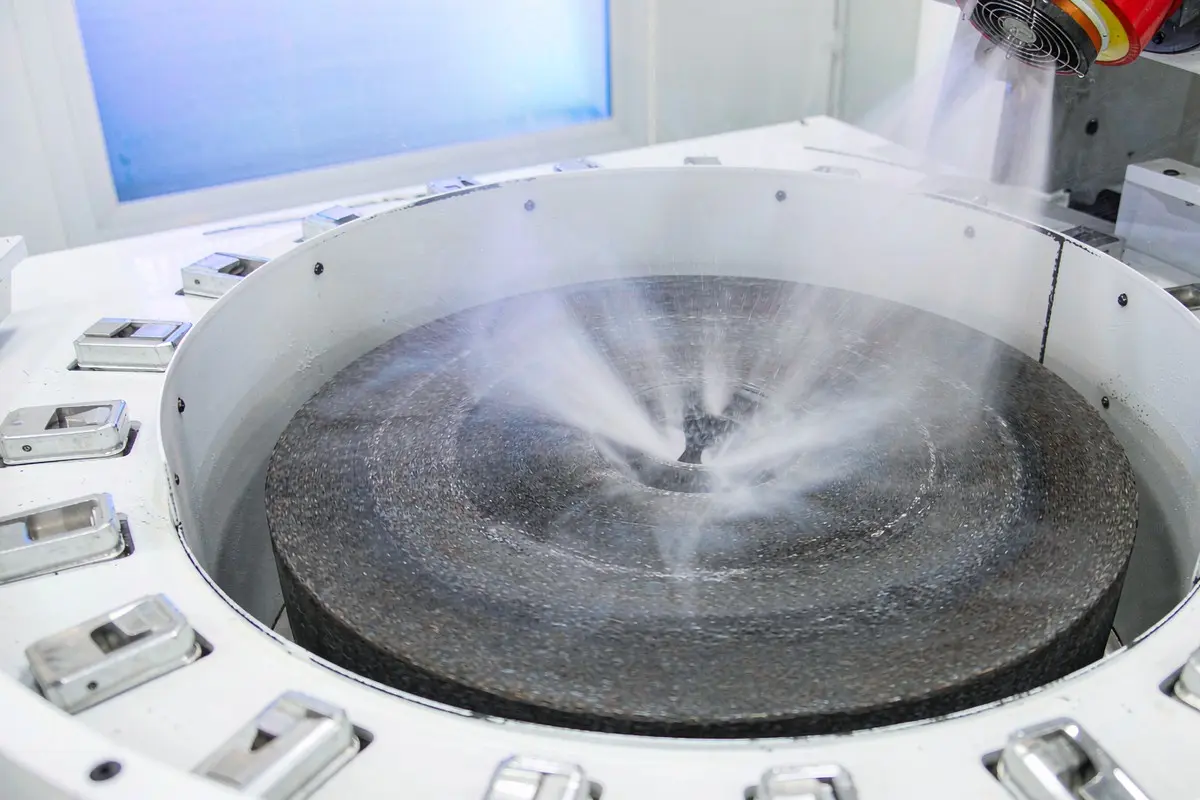
A disc polishing machine uses a rotating circular disc — faced with abrasive paper, non-woven material, felt, or cloth — to cut and refine a metal surface. The part is presented to the disc either manually on a pedestal machine or automatically on a rotary-table or robotic system. Because the disc contacts the surface across a broad arc, it produces a flatter, more uniform result than a narrow belt or a small buff.
Disc machines are common in stainless fabrication, cookware, valve and flange finishing, and any application where a planar cosmetic face must be produced repeatably.
How Disc Polishing Works
The mechanics are simple, but the sequence matters:
- Mount the disc. Select grit and backing for the stage — coarse for stock removal, fine for refinement.
- Set speed and pressure. Surface speed and contact force control cut rate and heat.
- Work the surface. The part is moved across the disc in overlapping passes so no scratch line is left behind.
- Step down grits. Each successive disc removes the previous scratch pattern, typically halving grit size each stage.
- Finish and clean. A final fine or colouring stage produces the target gloss, then the part is cleaned of residue.
The cardinal rule of polishing applies here: you cannot skip a grit. Jumping from 120 to 400 grit leaves deep scratches that the fine disc cannot remove, and the defect only appears after plating or coating.
Disc Polishing vs Belt and Spindle Polishing
Each tool has a distinct strength. Matching the tool to the geometry avoids rework:
| Criterion | Disc Polishing | Belt Grinding | Spindle/Buff Polishing |
|---|---|---|---|
| Surface flatness | Excellent | Moderate | Low (cosmetic) |
| Cut rate | High | Very high | Low |
| Best geometry | Flat faces, large radii | Edges, welds, contours | Curved decorative faces |
| Typical finish | Satin to bright | Coarse to satin | Bright to mirror |
In practice, a disc removes the previous operation’s scratches and flattens the face, a belt handles edges and welds, and a buff delivers final gloss. Our automated surface grinding guide explains how to hold flatness across a batch.
Types of Disc Polishing Machines
- Pedestal disc polisher — a fixed vertical or horizontal disc for manual work; simple, flexible, operator-dependent.
- Rotary-table disc machine — parts on a rotating table pass beneath one or more discs for continuous output.
- Twin-disc machine — opposing discs process both faces of a part simultaneously, ideal for flat components.
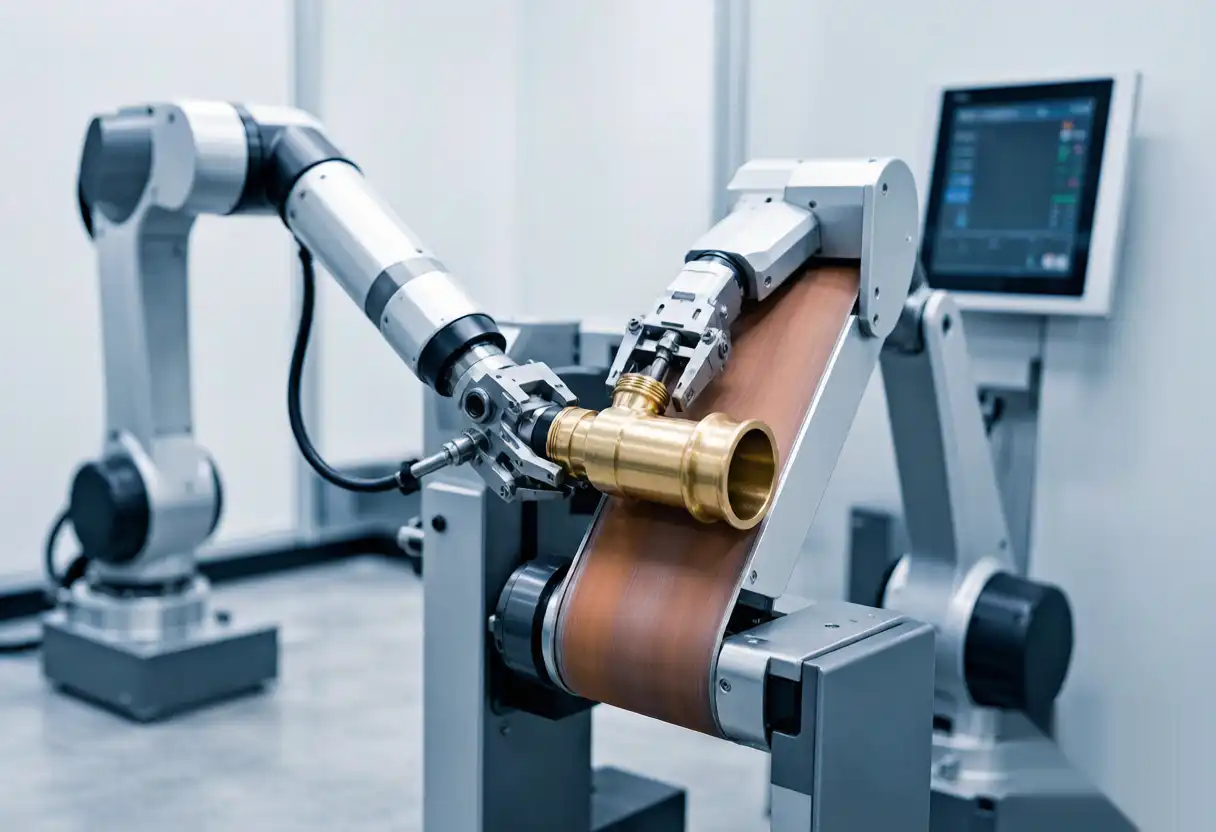
- Robotic disc cell — a robot presents parts to a disc head, combining disc flatness with path flexibility.
- CNC disc polisher — servo axes control pressure and path for repeatable results on complex profiles.
Twin-disc machines are especially efficient for cookware and flat plates, where both faces need the same finish. Robotic and CNC variants make sense when part geometry varies or when pressure must change along a contour.
Selecting Discs and Abrasives
Disc choice determines cut rate, finish, and cost per part:
- Zirconia alumina — heavy stock removal on steel and stainless; long life under pressure.
- Ceramic abrasive — fastest cut and coolest running; best for hard alloys and high volume.
- Aluminium oxide — general-purpose and economical for softer metals.
- Silicon carbide — fine finishing on aluminium, brass, and non-ferrous parts.
- Non-woven / surface conditioning — satin blending and cosmetic refinement.
- Felt and cloth discs with compound — colouring and high-gloss stages.
Backing type matters too: rigid backing holds flatness, while flexible backing conforms to contours. Our grinding wheel and abrasive selection guide covers grade and bond choices in more depth.
Coolant, Speed, and Pressure
Heat is the enemy of a good finish. Excess pressure and speed burnish the surface, load the disc, and can warp thin parts. As a practical starting point, run the lowest surface speed that achieves the required cut, apply steady rather than heavy pressure, and use coolant or mist where the material is prone to loading. Stainless benefits from consistent lubrication to prevent smearing; aluminium needs active chip clearance to stop the disc clogging.
Surface Finish Targets
Define the finish numerically so it can be verified:
| Finish | Typical Ra | Disc Sequence |
|---|---|---|
| Coarse satin | 1.0 – 2.0 µm | 120 → 180 grit |
| Fine satin | 0.4 – 0.8 µm | 180 → 320 grit |
| Bright | 0.1 – 0.2 µm | 320 → 600 → compound |
| Mirror | < 0.05 µm | 600 → 1000 → felt and rouge |
Agree the target with a physical sample before production. A comparator plate on the shop floor prevents arguments at inspection.
Applications Across Industries
- Stainless fabrication. Flat panels and enclosures finished to a uniform satin or bright face.
- Cookware. Pan bottoms and lids with consistent gloss and no scratch carry-over.
- Valves and flanges. Sealing faces polished flat for gasket contact.
- Architectural metal. Visible plate and trim with a repeatable brushed appearance.
- Automotive and appliance. Decorative plates and panels before coating or anodising.
Benefits and ROI
- Flatness — disc contact holds a planar face that belts struggle to maintain.
- Speed — high cut rates shorten the coarse stage dramatically.
- Consistency — fixed speed and pressure remove operator variance.
- Lower consumable waste — controlled pressure extends disc life versus hand grinding.
- Predictable cost per part — measurable cycle time and disc life make quoting reliable.
How to Select a Disc Polishing Machine
- Part size and shape. Flat plates suit twin-disc; contoured parts suit robotic or CNC.
- Finish target. The Ra requirement sets the number of grit stages.
- Throughput. Rotary tables scale output; manual pedestals suit low volume.
- Material. Hard alloys need ceramic discs; soft metals need finer, cooler abrasives.
- Coolant and extraction. Plan mist extraction and coolant handling from day one.
- Sample trial. Polish your own parts at your target Ra before purchase.
Integrating With Upstream and Downstream Steps
Disc polishing should follow a flattening or deburring operation and precede any buffing or coating stage. Feeding a disc machine with parts that still carry deep scratches wastes discs and time. A typical line runs deburr, disc cut, disc refine, then a automatic polishing machine for final gloss. Our end-to-end surface finishing roadmap maps the full sequence, and the CNC polishing machine guide covers control options for contoured work.
Dust Control and Operator Safety
Disc polishing produces fine metal dust and abrasive residue that settles on every surface in the shop. Local extraction at the contact point is the effective control; sweeping afterwards is not. For aluminium and other reactive metals, fine dust is also a fire and explosion hazard, so extraction ducting must be cleaned on a schedule and kept free of accumulated material.
Operators need eye protection, appropriate gloves, and respiratory protection where mist or fine dust is present. Guarding should prevent contact with the rotating disc while still allowing a clear view of the contact zone, and the worktable should be adjustable so operators are not reaching awkwardly. Comfortable, well-guarded operation is also more consistent operation, which shows up directly in finish quality.
Maintenance Tips
Check disc runout and balance weekly; an out-of-balance disc leaves chatter marks that are hard to polish out. Replace discs before they glaze, clean coolant filters regularly, and verify spindle bearings for play. Keep the worktable and fence clean so part presentation stays repeatable.
Common Mistakes to Avoid
- Skipping grits. The most common cause of scratches that appear only after plating.
- Too much pressure. Burns the surface, loads the disc, and distorts thin parts.
- Running a glazed disc. A worn disc polishes rather than cuts and hides defects.
- Inconsistent part presentation. Hand-fed work drifts; use fences or fixtures.
- No finish standard. Without an Ra target and sample, “good enough” changes by shift.
Frequently Asked Questions
What is a disc polishing machine used for?
It flattens and refines flat or gently contoured metal surfaces, removing previous scratch patterns to produce a uniform satin, bright, or mirror finish.
Can a disc machine produce a mirror finish?
Yes, by stepping through grits to 1000 and finishing with felt and rouge. Mirror typically means Ra below 0.05 µm, confirmed against a sample.
What is the difference between disc and belt polishing?
Discs hold flatness better and suit planar faces; belts cut faster on edges, welds, and contours. Most lines use both.
How do I prevent burning on stainless steel?
Reduce pressure and surface speed, use consistent coolant or mist, and keep the disc clean. Overheating usually comes from too much pressure, not too little.
How long does a polishing disc last?
Life depends on material, pressure, and grit. Ceramic discs on stainless typically outlast aluminium oxide several times over; track cost per part rather than disc count.
Conclusion
A disc polishing machine is the right tool when flatness and repeatable gloss matter more than raw edge-cutting speed. Step through the grits, control heat, and verify the finish against a measured standard. If you are finishing stainless panels, cookware, or sealing faces, send us sample parts and we will return a grit sequence, a measured Ra, and a machine recommendation matched to your volume.