

Deburring iron castings is a tougher job than it looks. The as-cast skin of gray and ductile iron is harder and more abrasive than the interior metal, so tool wear is the dominant cost driver — not labor. Choosing the right deburring machine for iron castings means matching abrasive technology, dust handling, and rigidity to a material that fights back. This article covers what you actually need to know before buying.
Pair this with our foundry selection guide and the five features to look for.
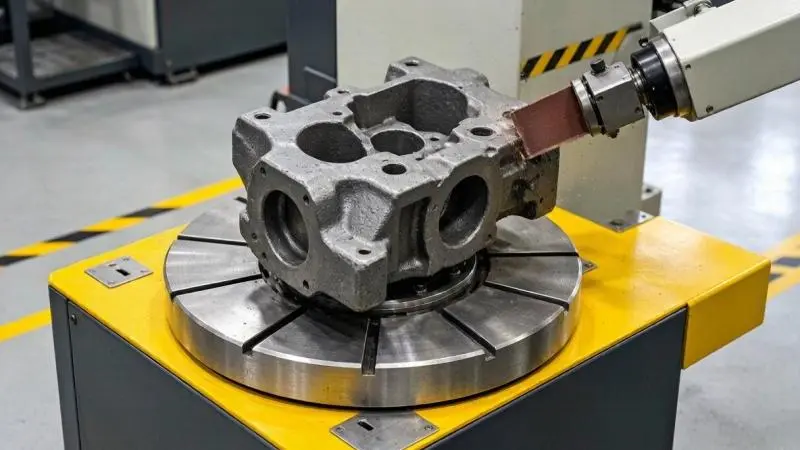
Why Iron Castings Are Hard to Deburr
Unlike machined parts with predictable burrs, iron castings present variable flash from parting lines, gates, and risers. Two material facts dominate equipment choice:
- Abrasive as-cast skin — accelerates belt, brush, and burr wear far faster than steel or aluminum.
- Burr hardness varies — gate stubs and feeder remnants on iron can be thick and tough, demanding aggressive tooling.
Best Machine Types for Iron Castings
1. Through-Feed Belt and Brush Machines
The workhorse for flat or contoured iron castings — brake rotors, manifolds, brackets.
- Abrasives: Zirconia-alumina belts (grit 36–120) resist the abrasive skin better than alumina.
- Throughput: 3–15 seconds per part.
- Price range: $30K–$120K.
2. Robotic Deburring Cells
For complex 3D iron castings and mixed models. Force-sensing spindles with carbide burrs or ceramic abrasives handle thick gate stubs.
- Cycle time: 20 seconds–5 minutes per part.
- Pros: ±0.1 mm repeatability; dozens of part numbers from one cell.
See how a robotic deburring cell works for the architecture.
3. Vibratory / Tumbling
For small-to-medium iron castings in batch. Ceramic media outperforms plastic on iron’s tough flash.
- Cycle time: 15–60 minutes per batch.
- Best for: Under 20 cm / 8 kg parts at 5K–200K parts/year.
Abrasive and Tooling Selection
Tooling choice is where iron deburring lives or dies. The wrong abrasive burns money in weeks.
| Burr / feature | Recommended tooling | Why |
|---|---|---|
| Thin flash (<0.3 mm) | Wire brush, fine ceramic media | Gentle, avoids over-cut |
| Medium flash (0.3–1.5 mm) | Zirconia belt, carbide burr | Cuts hard skin without rapid wear |
| Gate / feeder stubs | Carbide or ceramic abrasive wheel | Aggressive enough for thick remnants |
| Internal passages | Thermal or electrochemical | Mechanical tools can’t reach |
Ask every vendor for expected belt or brush life on your specific iron alloy. Consumable life is the #1 variable in five-year cost of ownership — it routinely outweighs the machine price.
Dust and Safety for Iron
Iron dust is not combustible like magnesium or aluminum, but it is still a respiratory and housekeeping hazard.
- Local exhaust ventilation sized to capture iron fines at the source.
- Magnetic separation in recovery systems where applicable.
- Enclosed cells per ISO 12100 for robotic operations.
Quality Targets
Iron castings usually need a safety edge break (R 0.1–0.5 mm per ISO 13715) and, for sealing faces, a near-zero burr.
- Safety edge: Vibratory or brush finishing.
- Functional/cosmetic: Belt with fine grit or two-stage vibratory.
- Sealing surfaces: Electrochemical or thermal only.
Reducing scrap on iron is covered in our guide to automated deburring systems and scrap reduction.
Frequently Asked Questions
- Q: Why do my belts wear out so fast on iron?
A: The as-cast skin is harder and more abrasive than the base metal. Switch to zirconia-alumina belts and verify coolant/extraction; track belt life per part to quantify the cost. - Q: Can one machine handle both gray and ductile iron?
A: Yes, with tooling changes. Ductile iron is tougher; program force and abrasive grade per alloy to avoid over-cut on gray iron. - Q: Is vibratory finishing suitable for iron?
A: For small-to-medium parts, yes — with ceramic media. Expect longer cycles than for aluminum and plan for media carry-over.
Conclusion
A deburring machine for iron castings lives or dies on abrasive selection, rigidity, and dust handling. Match the technology to your part size, burr severity, and volume, then model consumable life into the five-year cost. Send sample castings for a trial before you commit.
Test Your Iron Castings on Our Equipment
Ship us sample gray or ductile iron parts and we will deburr them, document cycle time and consumable life, and return the results.
References and Further Reading
- Gillespie, L.K., “Deburring and Edge Finishing Handbook” (SME, 1999), Ch. 4: Casting-Specific Burr Considerations.
- ISO 13715:2017 — Technical product documentation. Indication of surface texture (edge break).
- American Foundry Society, finishing cost benchmarking data, 2023–2024.
- Dingzhu — Foundry deburring equipment catalog for iron castings.