

When a foundry or die-casting plant runs more than 50,000 parts per month, manual deburring becomes the bottleneck that caps throughput and inflates labor cost. Selecting the best automatic deburring machine for high-volume production is less about buying the fastest spindle and more about matching cell architecture, fixturing, and abrasive media to your part mix and cycle-time target. According to the American Foundry Society, casting finishing (including deburring) can represent up to 20% of total foundry labor cost, so the right automated deburring system often pays for itself inside a single shift pattern.
High-volume lines share a common profile: repeatable geometries, tight tolerance bands (typically ±0.15 mm on edge break), and a need for consistent surface quality without operator judgment. The automatic deburring machine handles this by combining a rigid workholding fixture, a servo-driven spindle or rotary brush, and a part-present/part-eject sequence that repeats every cycle with no fatigue.
What Defines “High Volume” for Automated Deburring
Volume alone is not the only driver. We classify a line as high-volume when any of the following apply: daily output above 2,000 parts per fixture, a single-shift target that manual labor cannot meet, or a scrap/rework rate above 3% caused by inconsistent hand deburring. If your plant matches those, a robotic deburring machine or a rotary-indexing cell is usually the correct architecture rather than a single-station unit.
Five Machine Types Ranked for Throughput
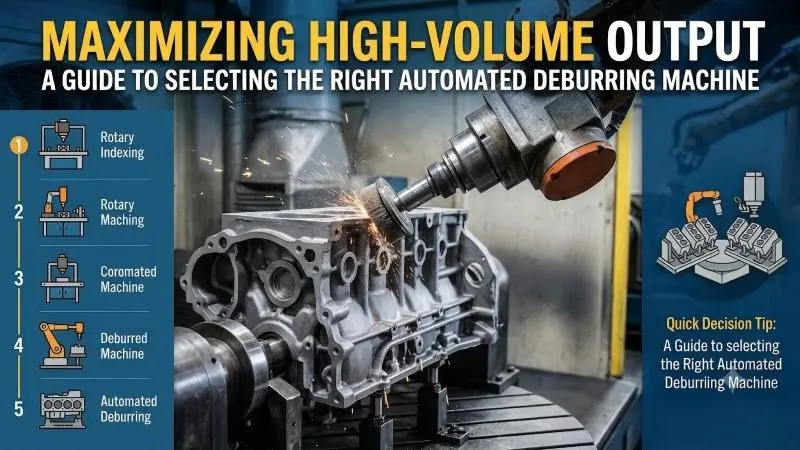
Not every automatic deburring machine scales equally. The list below ranks the common configurations by sustainable parts-per-hour at a typical 8-second edge-break operation:
- Rotary indexing table (4–8 stations): 600–1,200 parts/hr. Best for symmetrical castings with one deburr face.
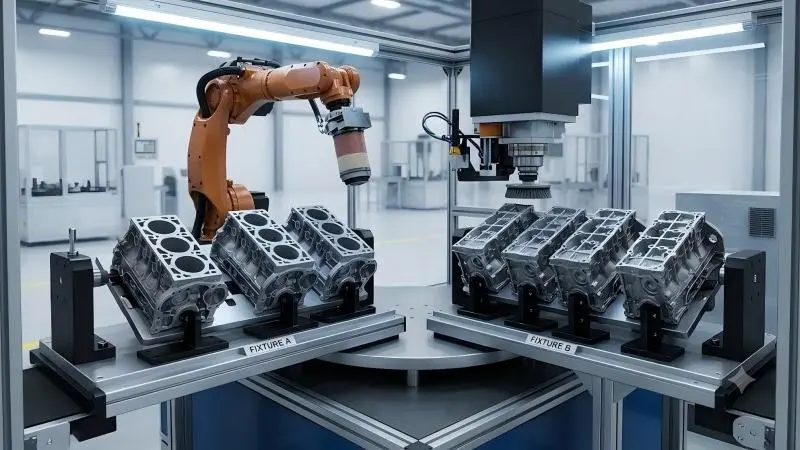
- Robotic cell with dual fixtures: 400–900 parts/hr. Best for complex 3D geometry and variable part families.
- Through-feed brush machine: 1,500–3,000 parts/hr. Best for small, flat zinc and aluminum parts.
- Spindle + CNC (3-axis): 150–400 parts/hr. Best for precision edge control, not raw volume.
- Vibratory/tumble (bulk): batch, not continuous. Best for fragile parts needing radius uniformity.
Feature Checklist: What Actually Moves the Needle
When evaluating options, prioritize features that protect cycle time and quality at scale. A useful companion read is our top 5 features to look for in industrial deburring equipment.
| Factor | High-Volume Winner | Low-Volume Alternative |
|---|---|---|
| Part changeover | Quick-swap fixture + offline program load (<10 min) | Manual fixture re-clamp (>30 min) |
| Spindle control | Closed-loop servo with force feedback | Fixed-RPM pneumatic |
| Deburr media | Replaceable ceramic/abrasive brush cartridges | Single bonded wheel |
| Rework handling | Automatic reject gate + SPC counter | Manual inspection bin |
QUICK DECISION TIP
Specify a dual-fixture or twin-robot layout even if you only need single-part volume today — the second fixture removes load/unload idle time and is the cheapest insurance against future capacity gaps.
Cycle Time Math You Should Demand From Vendors
A credible supplier quotes a cycle time that includes load, clamp, deburr, verify, and eject — not just the spindle cut. For a 6-station rotary cell processing an iron bracket at 3.5 s per station, theoretical throughput is 60 / (3.5 × 6) × 3600 ≈ 1,028 parts/hr, minus an 8% allowance for jam recovery ≈ 945 good parts/hr. Insist on a written acceptance test at your quoted rate using your actual castings.
Robotic vs Manual at Volume
The case for automation strengthens with volume. See our comparison in robotic vs manual deburring for the full labor and consistency breakdown.
Commissioning and Acceptance Testing
Before signing off, run a 500-part acceptance batch at your quoted cycle time using production castings, not polished samples. Measure good-part rate, edge-break consistency with a gauge, and tool wear across the run. A reputable supplier provides a written performance guarantee tied to this test; treat any quote without one as incomplete. Document the baseline so future maintenance can be judged against it.
Consumables and Operating Cost
High-volume deburring lives or dies on media cost. Budget brushes or wheels per 10,000 parts and factor changeover labor. Force-controlled cells extend media life by avoiding stall and over-pressure, typically cutting consumable spend 15–25% versus rigid setups. Track cost-per-part as the real KPI, not just the machine price.
Frequently Asked Questions
What throughput justifies a robotic deburring cell?
Above roughly 2,000 parts/day on a single geometry, the labor savings and scrap reduction typically deliver payback under 18 months.
Can one machine handle multiple part families?
Yes, with quick-swap fixtures and offline program storage; expect 5–10 minute changeovers versus 30+ minutes on fixed tooling.
Which abrasive lasts longest in high volume?
Ceramic-bonded brushes and silicon-carbide impregnated wheels outlast steel wire by 3–5× on aluminum and zinc.
Do I need force feedback?
For castings with dimensional variation, closed-loop force control prevents over-grind and keeps edge break within ±0.1 mm.
Need help specifying the right machine?
Contact Xiamen Dingzhu Intelligent Equipment — we size deburring and grinding cells to your castings, volume, and tolerances. Talk to our application engineers.
References
- American Foundry Society — afsinc.org
- NADCA — nadca.com
- ISO 9001 — iso.org
This article is for general guidance only and does not constitute a specification or quote. Confirm process parameters with the equipment supplier for your parts.