

Edge quality is where casting finishing quietly wins or loses customers. A sharp edge ships a cut hazard and a leak path; an inconsistent edge radius fails assembly and inspection. Automated edge deburring is the most reliable way to make every part meet the same spec — and to prove it with data. This article explains how automation raises production quality and how to implement it without over-investing.
Start from our five features to look for and the selection guide if you have not scoped requirements yet.
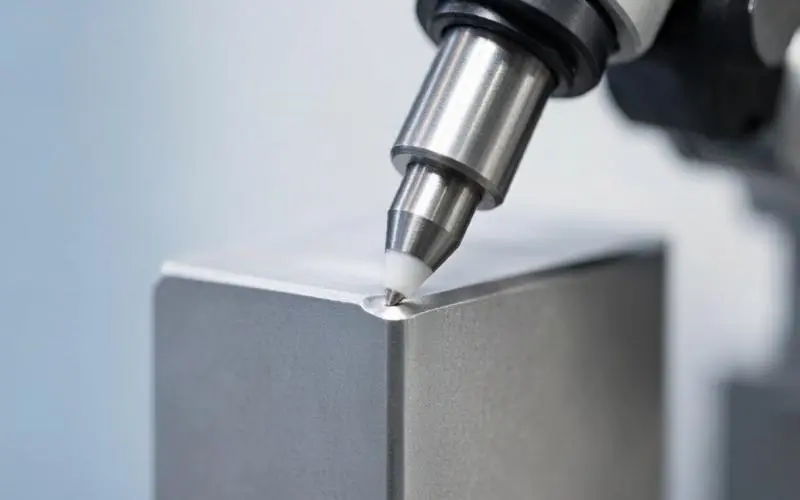
What “Edge Quality” Actually Means
Edge finishing targets a specific radius, not just “no burr.” The spec depends on function:
- Safety edge break: R 0.1–0.5 mm (per ISO 13715) to remove sharp hazards.
- Functional edge: R under 0.1 mm, ±0.05 mm, for sealing and fit surfaces.
- Cosmetic edge: smooth, uniform break for visible parts.
- Zero burr: sealing faces where any remnant causes leakage.
Why Manual Edge Deburring Is Inconsistent
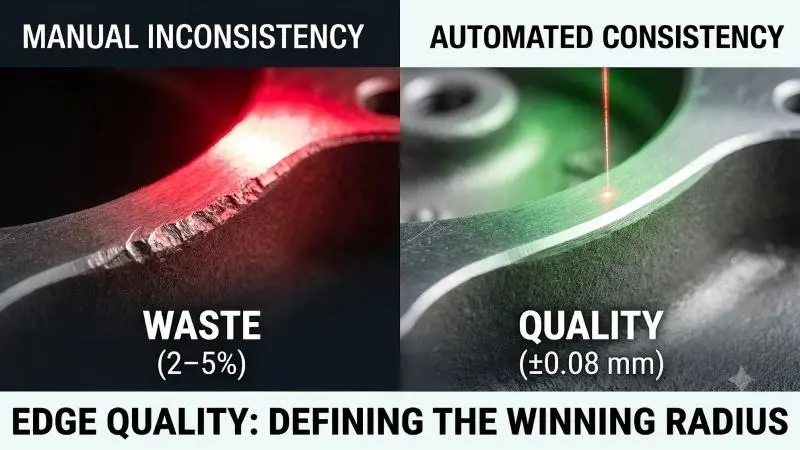
Human operators vary part to part and hour to hour. The result is a distribution of edge radii — some too sharp, some over-broken — that passes inspection loosely but fails in the field. Manual scrap from edge defects typically runs 2–5%.
How Automation Improves Quality
1. Repeatable Geometry
Force-controlled tooling holds the same pressure and path every cycle, delivering ±0.1 mm edge consistency. Vision guidance corrects for casting variation so the radius is correct on the 10,000th part, not just the first.
2. Closed-Loop Verification
Pair deburring with in-line quality inspection — vision or laser stations measure the actual edge and flag outliers immediately, closing the loop before parts ship.
3. Documented Traceability
Every part carries a logged force profile and pass/fail status. When a customer questions a radius, you answer with data, not memory.
Define the edge radius tolerance before you automate. “Deburr it” is not a spec. “Break edge to R 0.3 ± 0.1 mm” is — and it is what makes automation measurable.
Technology Choices by Quality Target
| Quality target | Best technology | Achievable radius |
|---|---|---|
| Safety break | Vibratory, brush | R 0.1–0.5 mm |
| Functional edge | Robotic, electrochemical (ECD) | R <0.1 mm, ±0.05 mm |
| Cosmetic | Belt/brush, fine grit | Uniform break |
| Zero burr (sealing) | ECD or thermal | Burr-free |
Implementation Steps
- Define the spec. Edge radius and tolerance per part feature.
- Shortlist technology matching volume, geometry, and tolerance from the table above.
- Run a sample trial on actual castings; measure radius distribution.
- Add in-line inspection to verify, not just produce.
- Log results for traceability and continuous improvement.
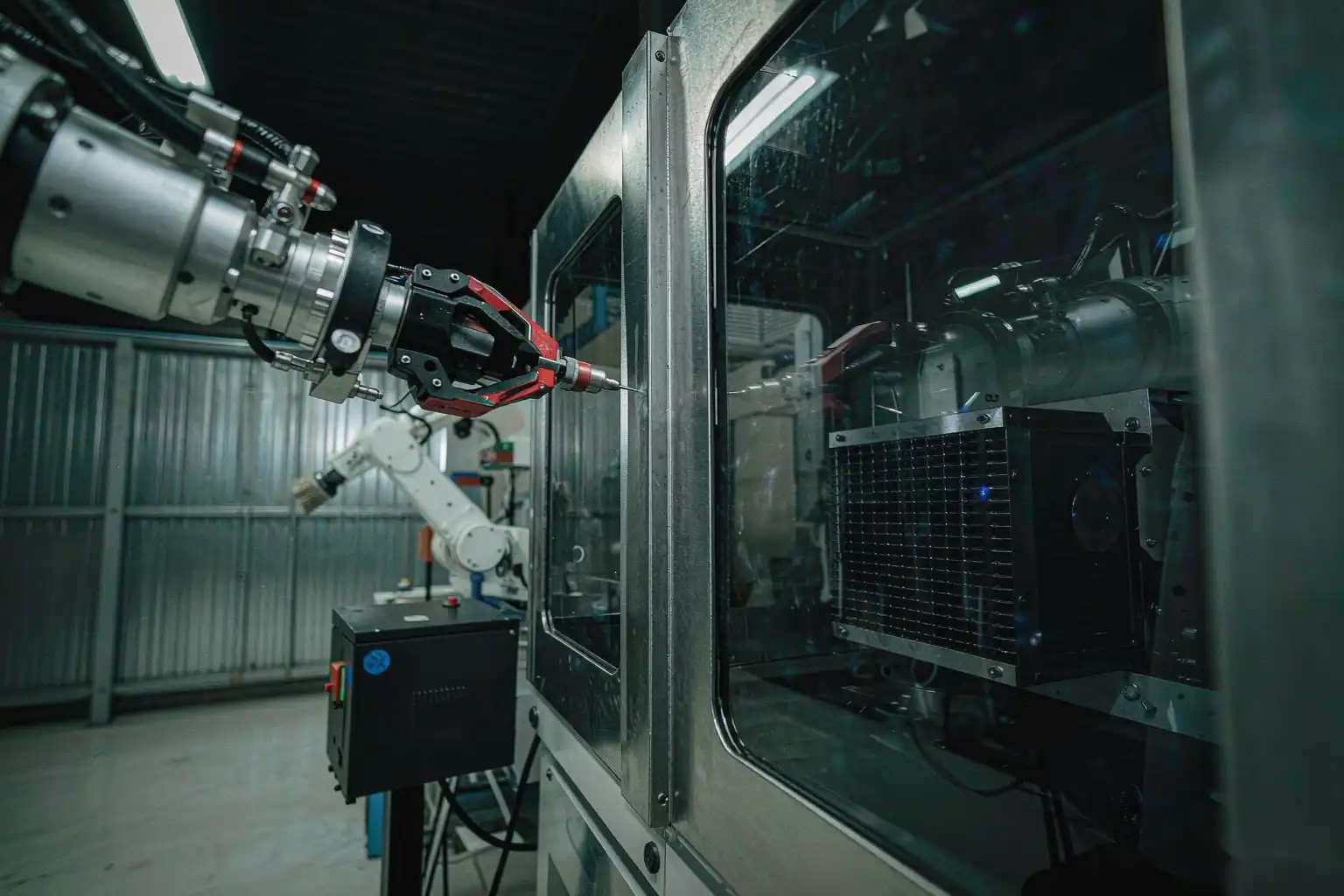
A robotic deburring cell is the usual platform when tolerances are tight and part numbers are many.
An automotive supplier tightened edge consistency from a ±0.4 mm manual spread to ±0.08 mm with a force-controlled cell plus laser inspection. Warranty leaks from mating faces dropped to near zero within two quarters.
Frequently Asked Questions
- Q: Can automation hit a tight functional radius on cast iron?
A: Yes, with carbide or ceramic tooling and force control, or electrochemical finishing for cross-drilled features. The key is defining the tolerance up front. - Q: Do I need in-line inspection to improve quality?
A: It is the difference between “probably consistent” and “proven consistent.” For functional or sealing edges, inspection closes the loop and catches drift early. - Q: How fast is payback for quality-focused automation?
A: Typically 12–24 months, driven by scrap reduction and warranty avoidance rather than labor alone. See our scrap reduction guide.
Conclusion
Automated edge deburring improves production quality by making the edge radius a measured, repeatable output instead of an operator-dependent hope. Define the spec, choose the right technology, verify in-line, and log the results. The payoff is fewer defects, fewer warranties, and a defensible quality record.
Define Your Edge Quality Spec
Send your target radius, tolerance, and sample parts. We will recommend a technology and run a measured trial.