

Aluminum Die Casting Lead Time: From Order to First Article
Why Lead Time Is Often Underestimated
Aluminum die casting lead time is often underestimated by buyers, especially first-time project managers. The actual lead time for a new die casting project (from PO to first production parts) is typically 12-20 weeks, but the planning often assumes 6-8 weeks.
This mismatch creates schedule pressure, rushed decisions, and quality problems. Understanding the actual lead time and the factors that affect it is essential for realistic project planning.
Typical Lead Time Breakdown

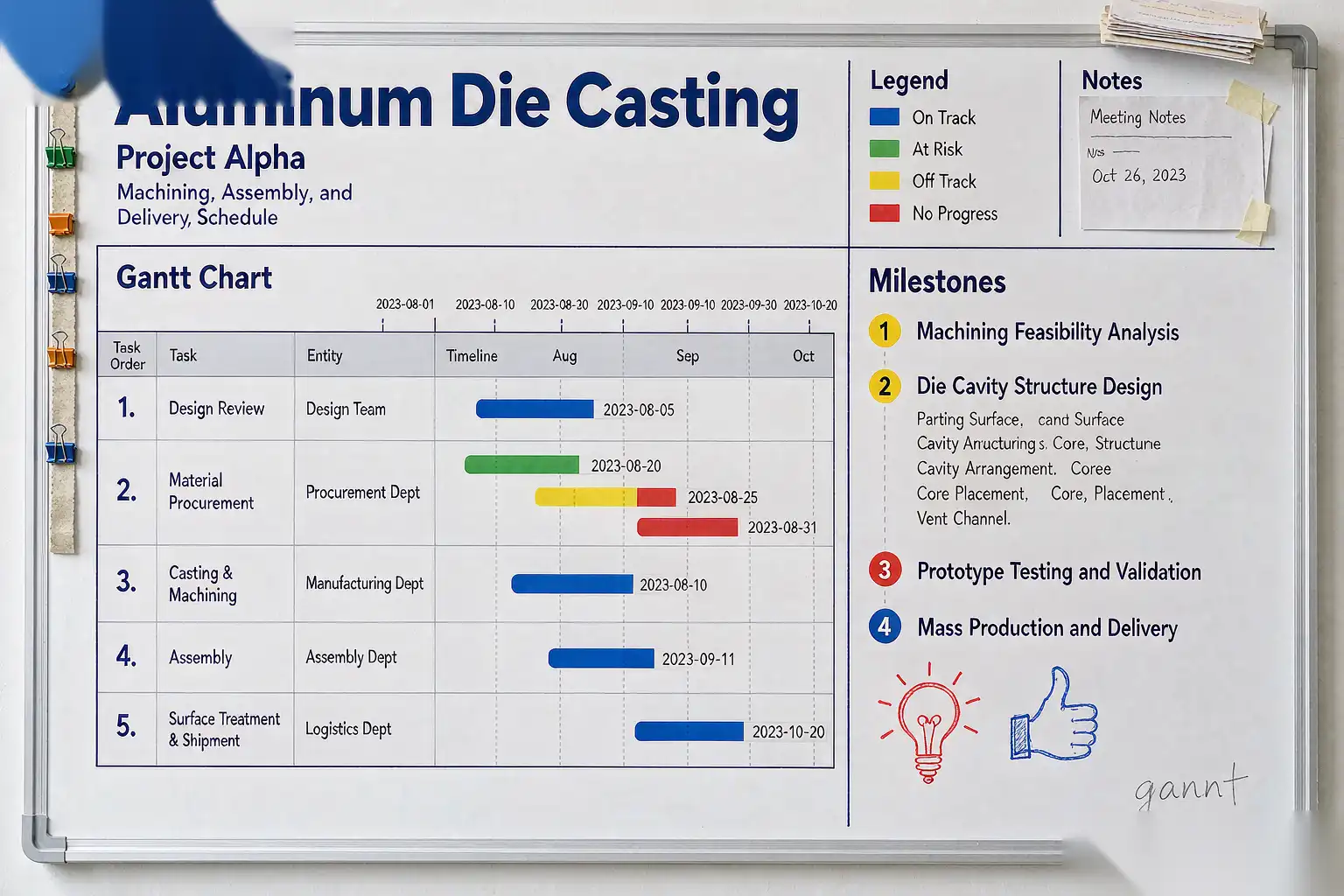
For a standard custom aluminum die casting project, the typical lead time from PO to first article is:
| Phase | Duration | Notes |
|---|---|---|
| PO confirmation and advance payment | 1-2 weeks | depending on payment terms |
| DFM review and design feedback | 1-2 weeks | supplier and buyer collaboration |
| Die design | 1-2 weeks | in parallel with DFM |
| Die fabrication | 4-6 weeks | H13 tool steel, with slides if needed |
| Heat treatment and surface prep | 1-2 weeks | nitriding, polishing |
| Sampling (T0, T1, T2) | 2-3 weeks | includes shipping and inspection |
| Engineering changes (if needed) | 1-3 weeks | based on sampling results |
| PPAP / pre-production | 1-2 weeks | capability studies, customer approval |
| Production start | 1 week | setup, first batches |
Total typical lead time: 12-20 weeks from PO to first production.
For a simpler project (no slides, standard tolerance, standard finish), the lead time can be compressed to 8-12 weeks. For a complex project (multi-cavity, slides, tight tolerance, custom finish), the lead time can extend to 24+ weeks.
Factors That Affect Lead Time
Die Complexity
- Single-cavity simple die: 4-6 weeks fabrication
- Single-cavity with slides: 6-8 weeks fabrication
- Multi-cavity die: 8-12 weeks fabrication
- Multi-cavity with slides: 12-16 weeks fabrication
Each slide adds roughly 1-2 weeks to die fabrication. Each additional cavity adds 1-2 weeks.
Tool Shop Capacity
A busy tool shop may have a queue of 2-4 weeks before starting your die. A less busy shop may start within 1 week. Always ask the tool shop about current capacity when placing the order.
Steel Availability
Standard H13 tool steel is usually available from stock. Premium grades (W302, Dievar) or large die blocks may have lead times of 2-4 weeks. Specify the steel grade early to avoid delays.
Sampling Iteration Count
Most projects require 2-3 sampling iterations (T0, T1, T2). Each iteration includes:
- Machine setup: 0.5-1 day
- Shot production: 0.5-1 day
- Inspection and reporting: 2-5 days
- Customer review: 3-7 days
If the sampling reveals problems requiring die modifications, add 1-3 weeks per major modification.
Customer Approval Cycles
The buyer’s internal approval cycle for each phase (PO, DFM, T1, T2, PPAP) can add 1-2 weeks each. Organizations with formal approval processes often have longer cycles than those that allow the project manager to approve directly.
Logistics and Shipping
For international sourcing (China to North America/Europe), add 1-2 weeks for sea freight of T1 samples. Air freight is 3-5 days but expensive.
How to Compress Lead Time
For urgent projects, several strategies can reduce lead time:
1. Start the DFM in Parallel with PO
Most buyers wait for the PO before starting the DFM. Starting the DFM in parallel with PO approval saves 1-2 weeks. The risk is that the DFM is done for a design that changes after PO, requiring rework.
2. Choose a Less Busy Tool Shop
Tool shops with shorter queues can start the die faster. The trade-off is that the busiest shops often have the best quality. Balance speed and quality for your project.
3. Use Pre-Hardened Steel (P20) for Faster Heat Treatment
H13 requires heat treatment (hardening and tempering) that takes 1-2 weeks. P20 pre-hardened steel skips this step. The trade-off is shorter die life (50,000-150,000 vs 100,000-500,000 shots).
4. Minimize Slides and Cavities
Slides and multi-cavity configurations add weeks to die fabrication. If schedule is critical and volume is moderate, use a single-cavity die with no slides.
5. Compress Approval Cycles
Identify decision-makers upfront and pre-agree on approval timelines. Avoid multi-layer approval for routine DFM and T1/T2 reviews.
6. Use Air Freight for T1 Samples
Air freight adds $500-2,000 per shipment but saves 1-2 weeks vs sea freight. For urgent projects, this cost is worth it.
7. Run T0 and T1 in Parallel
Standard practice is to do T0 (first shot, expect cosmetic defects), review, then T1. For urgent projects, run T0 and T1 together and review both at once. This saves 1 week but may produce less polished feedback.
Lead Time for Repeat Orders
Once the die is built, repeat orders have much shorter lead times:
- Production from existing die: 2-4 weeks (from PO to first parts)
- Cycle time per part: 1-5 minutes (machine cycle)
- Setup time per machine: 4-8 hours (for die changeover)
The bottleneck is usually the supplier’s production schedule, not the die itself. A supplier with capacity will produce in 2-3 weeks; a busy supplier may need 4-6 weeks.
Lead Time for Engineering Changes
Engineering changes (ECs) after the die is built have their own lead time:
- Simple EC (draft angle, fillet): 1-2 weeks
- Moderate EC (wall thickness, gate location): 2-4 weeks
- Complex EC (add slide, change feature): 4-8 weeks
- Major EC (new cavity, new feature): 6-12 weeks
Always include a 10-15% EC budget in the project plan to avoid surprise delays.
Lead Time for Reorder Quantities
Different order sizes have different lead times:
- Small order (1,000-5,000 parts): 2-3 weeks (one production run)
- Medium order (5,000-50,000 parts): 3-6 weeks (multiple production runs)
- Large order (50,000-500,000 parts): 6-16 weeks (extended production schedule)
- Annual contract: ongoing production, weekly or monthly releases
For ongoing production, establish a forecast with the supplier so they can plan capacity and material purchases. Suppliers prioritize customers with clear, consistent forecasts.
The Role of Communication in Lead Time
Many lead time problems come from communication delays, not production delays:
- PO confirmation delay: 3-10 days from PO submission to confirmation
- Design feedback delay: 5-10 days from each DFM submission to feedback
- T1 review delay: 5-14 days from T1 sample receipt to approval/rejection
- Payment processing delay: 3-10 days from invoice to payment receipt
A project with strong communication discipline is typically 2-4 weeks faster than a project with the same production schedule but weak communication.
Realistic Project Planning
For a new aluminum die casting project, plan as follows:
| Milestone | Target Week | Note |
|---|---|---|
| Concept design freeze | Week 0 | design must be stable |
| Supplier selection | Week 1-2 | 3-5 quotes, site visit |
| PO placement | Week 2-3 | with 30% deposit |
| DFM completion | Week 4-5 | in parallel with die design |
| T0 sample | Week 8-10 | first shot from die |
| T1 sample | Week 10-12 | dimensional and cosmetic approval |
| T2 / PPAP | Week 12-14 | capability studies, customer approval |
| Production start | Week 14-18 | first production batches |
This is a realistic plan for a standard project. For complex projects (slides, multi-cavity, tight tolerance), add 4-8 weeks. For simple projects (no slides, loose tolerance), can be compressed by 2-4 weeks.
A Common Mistake: Skipping DFM
The biggest lead time killer is skipping the DFM review. Without DFM:
- The die is built with hidden problems (draft missing, wall too thin)
- T0 reveals issues requiring complete die rework
- Schedule slips by 4-8 weeks (or the die is scrapped and a new one is started)
A proper DFM review adds 1-2 weeks at the start but saves 4-8 weeks later. The ROI on DFM is enormous.
Managing Schedule Risk
Even with a realistic plan, die casting projects slip. The most effective risk controls are straightforward but rarely applied consistently. First, require a written milestone schedule from the supplier at PO placement, with dates for DFM completion, die fabrication completion, T0, T1, and PPAP. Second, require weekly progress reports against that schedule, with photos of tooling in progress — a photo of a half-finished die block is the earliest reliable signal that fabrication is actually underway. Third, identify the critical path items in your own organization: if your approval cycle for T1 samples is two weeks, that time is on the critical path and must be planned for, not discovered later.
For launch-critical programs, qualify a second source in parallel for at least the tooling. A backup die, even if never used, removes the single-point-of-failure risk that a tool shop delay or a failed first article represents. The incremental cost of a second die is typically 60-80% of the first because the design work is already done.
Contract Clauses That Protect the Schedule
A realistic plan still needs enforcement, and four clauses carry most of the schedule risk in a die casting program. First, a milestone schedule with dated deliverables — DFM report, die completion, T0, T1, PPAP — attached to the purchase order, not promised in an email. Second, a defined remedy for milestone slip: not punitive damages, but something concrete, such as expedited shipping at supplier cost when a delay passes an agreed window. Third, a tooling ownership and access clause that lets you move or inspect the die; the day you need to check on your idle tooling should not require a negotiation. Fourth, an engineering change protocol with fixed pricing bands — ECs priced at quotation time, not invoiced as bespoke work after the die is cut.
Add one more clause that costs nothing and saves weeks: named engineering contacts on both sides with a committed response time, typically one business day for technical questions. Most schedule damage in die casting programs is communication latency wearing a production disguise.
DZ Machinery works inside customer schedules on the finishing side of these same programs, and the pattern across hundreds of projects is consistent: the programs that hit first-article dates are rarely the ones with the fastest suppliers — they are the ones where every milestone had a date, an owner, and a consequence. Build the schedule honestly, put it in the contract, and the rest of the program tends to follow the plan instead of the firefight.
FAQ About Aluminum Die Casting Lead Time
How long does it take to get the first production parts?
12-20 weeks from PO is typical for a new project. For repeat orders from an existing die, 2-4 weeks.
What is the fastest possible lead time?
For a simple single-cavity die with a less busy tool shop and compressed approval cycles, 6-8 weeks is achievable. Below that, the quality and capability are typically compromised.
Can lead time be guaranteed?
Most suppliers offer a lead time estimate, but guarantees are rare. Build 2-4 weeks of schedule margin into your project plan.
What is the longest lead time I should expect?
For a complex multi-cavity die with slides and a premium steel grade from a busy tool shop, 24+ weeks is possible. For prototypes or very simple parts, lead times can be 4-6 weeks.
A Realistic Approach to Lead Time
A successful die casting project plans for:
- Best case: 12 weeks (simple, no slides, fast tool shop)
- Expected case: 16 weeks (typical complexity, normal approval cycles)
- Worst case: 24+ weeks (complex, busy tool shop, multiple ECs)
Plan for the expected case. Communicate the worst case to stakeholders. Hope for the best case.
At DZ Smart Manufacturing, our team has experience managing die casting projects from PO to production. If you are starting a new aluminum die casting project and want feedback on the realistic lead time for your part, our engineering team can review your requirements and provide a detailed project plan.
See how our automated finishing integrates with your production timeline