

Aluminum Alloy Die Casting: A Complete Guide for Engineers
Why Aluminum Alloys Dominate Die Casting
Aluminum alloys account for roughly 80% of all non-ferrous die castings globally, and the share is growing. The reasons:
- Low density (2.6-2.9 g/cm³) — one-third the weight of steel, comparable to plastic composites for stiffness
- High thermal conductivity — 80-180 W/m·K depending on alloy, far better than plastic
- Excellent corrosion resistance with proper surface treatment
- Good strength-to-weight ratio — 200-450 MPa tensile strength
- Excellent castability — fills thin walls, captures fine detail
- Recyclable — aluminum scrap retains 90%+ of its properties through remelting
- Cost-effective for medium-to-high volume production
The right aluminum alloy is determined by the part’s functional requirements: strength, corrosion resistance, thermal conductivity, weldability, surface finishability, machinability, and cost.
The Major Aluminum Alloy Families for Die Casting
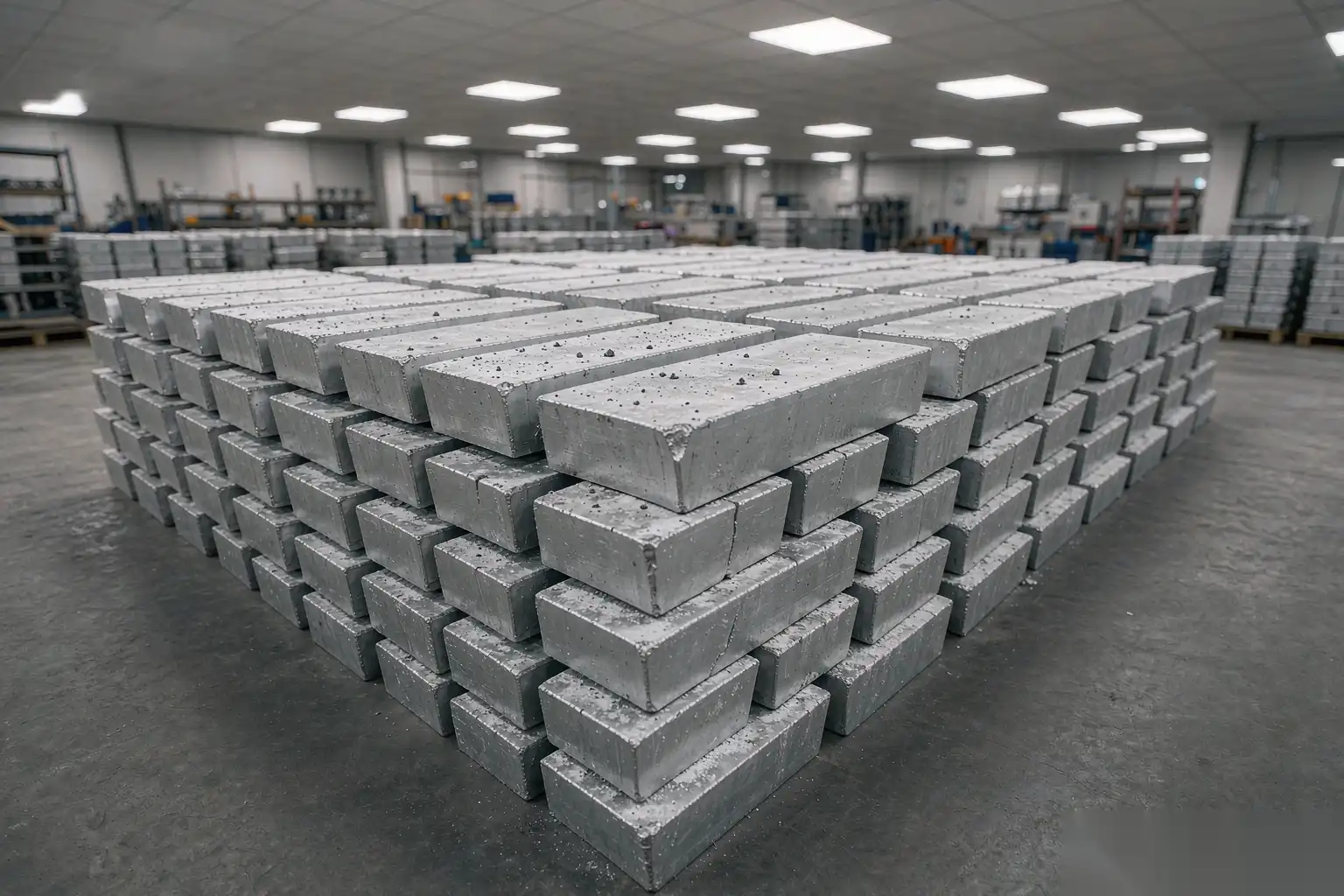
Al-Si Alloys (4xxx series, including die casting variants)
The dominant family for die casting. Silicon (8-12%) gives:
- Excellent fluidity — fills thin sections and complex geometry
- Low hot-tearing tendency
- Low shrinkage during solidification
- Good wear resistance (silicon particles)
- Reduced solubility for hydrogen — easier to degas
The standard die casting alloys in this family:
- A380 / ADC12 — the workhorse, used in 70-80% of aluminum die castings
- A383 / ADC10+ — slight copper boost for pressure tightness
- A384 / ADC12+ — lower copper for thermal cycling
- A390 — hypereutectic (16-18% Si), very hard, used for wear surfaces
- A413 / A-S12 — high silicon, low copper, excellent pressure tightness
Al-Cu Alloys (2xx.x series)
Higher copper content (3-5%) gives:
- Higher strength (up to 450 MPa tensile in some tempers)
- Better machinability
- Heat treatable to higher strength
- POOR corrosion resistance — the copper forms galvanic cells
- POOR castability — high hot-tearing tendency
Rarely used in standard die casting. Used in sand casting and permanent mold for structural parts where corrosion is managed by surface treatment. Not recommended for die casting unless there is a specific reason.
Al-Mg Alloys (5xx.x series)
Higher magnesium content (3-8%) gives:
- Good corrosion resistance (especially in marine environments)
- Higher strength than Al-Si in some tempers
- Better anodizing response for cosmetic applications
- More difficult to cast — Mg oxidizes easily, requires protective atmosphere
- Limited die casting use — most applications use sand or permanent mold
Some specialty die casting alloys (e.g., Magsimal-59) use magnesium for higher strength with good castability. These are growing in use for automotive structural parts.
Al-Zn Alloys (7xx.x series)
Zinc content (5-8%) gives:
- Self-aging at room temperature (no heat treatment needed)
- High strength (up to 400 MPa)
- POOR castability for die casting
- Stress corrosion cracking in some environments
Not commonly used in die casting. Some specialty alloys use zinc for specific properties.
Comparing the Die Casting Alloy Families
| Factor | Al-Si (A380 family) | Al-Cu (A201, A206) | Al-Mg (Magsimal) | Al-Zn |
|---|---|---|---|---|
| Castability | excellent | poor | fair | poor |
| Tensile strength (as-cast) | 320 MPa | 350-450 MPa | 280-330 MPa | 300 MPa |
| Yield strength | 160 MPa | 200-300 MPa | 170-220 MPa | 200 MPa |
| Elongation | 3-4% | 3-8% | 8-15% | 2-4% |
| Corrosion resistance | moderate | poor | good | poor |
| Heat treatable | no | yes (T6) | partial | no (self-aged) |
| Machinability | good | excellent | good | good |
| Anodizing | moderate | good | excellent | moderate |
| Cost | low | medium | high | medium |
| Die casting use | dominant | limited | growing | rare |
For most die casting applications, the Al-Si family is the right choice. The other families come into play for specific performance requirements.
A380 — The Default Die Casting Alloy
A380 (UNS A13800) is the default aluminum die casting alloy, equivalent to ADC12 in Japan and EN AC-46500 in Europe. It was developed specifically for high-pressure die casting.
Composition:
- Silicon: 7.5-9.5%
- Copper: 3.0-4.0%
- Iron: 0.7-1.1%
- Magnesium: 0.10-0.30%
- Manganese: 0.20-0.50%
- Zinc: ≤2.9%
- Others: ≤0.5%
- Aluminum: balance
Properties (as-cast, die cast):
- Tensile strength: 320-360 MPa
- Yield strength: 160-180 MPa
- Elongation: 3-3.5%
- Hardness: 75-85 HB
- Thermal conductivity: 96-110 W/m·K
- Density: 2.71 g/cm³
Why A380 is the default:
- Excellent castability
- Good as-cast properties without heat treatment
- Low cost (uses recycled content)
- Available globally
- Well-understood by every die casting supplier
A380 is the right answer for 70-80% of die casting projects. The other 20-30% need a different alloy, but the engineer should understand why before specifying.
When to Choose a Different Alloy
Choose A413 (or A-S12) for Pressure-Tight Parts
Pump housings, water meters, hydraulic valve bodies, pneumatic components. The higher silicon content (11-13%) and lower copper (≤0.10%) give much better pressure tightness than A380. Cost is comparable, but machining is harder due to higher silicon.
Choose A384 for Anodized Parts
Decorative consumer parts where anodized appearance matters. The lower copper content of A384 (≤0.20% vs 3-4% in A380) gives a much lighter, more consistent anodized color. Cost is 5-15% higher than A380.
Choose A390 for Wear Surfaces
Engine blocks, cylinder liners, brake components, gear housings. The 16-18% silicon makes A390 very hard (120 HB) and wear-resistant, but very difficult to machine. Use near-net-shape casting with minimal post-casting machining.
Choose Magsimal-59 for Structural Lightweighting
Automotive structural parts where weight reduction matters. Magsimal-59 (AlMg5Si2Mn) has higher strength-to-weight than A380 and good corrosion resistance. Cost is 30-50% higher and requires a specialty die caster.
Choose A201/A206 for Heat-Treated Structural Parts
Aerospace, military, racing applications where heat-treated strength matters. A201-T6 has 50% higher strength than A380 as-cast. Cost is much higher and requires a permanent mold or sand casting process — not standard HPDC.
Alloy Selection Decision Tree
Use this decision tree to choose the right alloy:
- Is the part a standard commercial or industrial product with no special requirements?
– Yes → A380 (default)
– No → continue
- Is pressure tightness the primary requirement?
– Yes → A413 or A383
– No → continue
- Is decorative anodized appearance the primary requirement?
– Yes → A384 or A413
– No → continue
- Is wear resistance the primary requirement?
– Yes → A390
– No → continue
- Is weight reduction the primary requirement?
– Yes → Magsimal-59 or A356 (permanent mold)
– No → continue
- Is heat treatment for high strength the primary requirement?
– Yes → A201 or A356 (permanent mold)
– No → A380 (default)
The decision tree covers 95% of common die casting applications. The remaining 5% require a materials engineer for specialty alloy selection.
Material Certification
For any production die casting order, the supplier should provide:
- Heat-by-heat alloy certification from the smelter (chemical composition verified)
- Mechanical property test report on the production lot (tensile, hardness)
- Traceability documentation — each part traceable to the specific alloy heat
A supplier that cannot or will not provide these is not a serious manufacturer.
Common Alloy Mistakes
In our experience, the most common alloy specification errors:
- Specifying A380 for pressure-tight parts that need A413
- Specifying T6 heat treatment for A380 (it will blister — the alloy is not heat-treatable)
- Allowing alloy substitution to a cheaper alloy without notification
- Overspecifying mechanical properties beyond what die casting can deliver
- Not specifying recycled content — A380 routinely contains 30-50% recycled aluminum
- Ignoring the alloy cost premium when the engineering benefit is marginal
A careful alloy specification saves money and prevents field failures.
Alloy Availability and Supply Chain Considerations
Beyond technical performance, the practical availability of an alloy matters. A380 and ADC12 are produced by dozens of smelters worldwide and are stocked by essentially every die caster, so lead times are short and pricing is competitive. Specialty alloys — A390, Magsimal-59, A201 — have far fewer qualified producers. Lead times for these can run 4-8 weeks, and minimum order quantities are often higher, which matters for smaller production programs.
For global programs, confirm that the alloy specified in the drawing is available from the supplier’s regional smelter network. A part designed around a European alloy specification may need a local equivalent substituted for production in Asia, and the substitution should be documented with a material certification showing equivalent chemistry and mechanical properties, not quietly applied by the foundry.
Auditing Alloy Quality at the Supplier
Specifying the right alloy on the drawing is the easy half; confirming the alloy in the crucible is the other half, and it is where programs quietly go wrong. Three checks are worth more than any certificate. First, ask for heat-by-heat spectrometer results, not just a compliance letter — a real spectrometer printout carries furnace number, timestamp, and operator, and it is hard to fake in volume. Second, watch a melt shop practice or two during your site visit: degasser operation, flux handling, how returns are weighed back into melts. Sloppy melt practice shows up before any certificate does. Third, run an independent XRF check on incoming ingot or on finished parts at your own dock; the chemistry either matches the certification or the conversation changes.
Pay particular attention to recycled content claims. A380 routinely runs 30 to 50 percent recycled metal and does so legitimately — but recycled charging needs the same chemistry control as prime metal, and suppliers with weak controls let iron and zinc creep upward batch by batch, which shows up later as soldering and brittleness.
Downstream, alloy discipline is finishing discipline. Iron content that drifts low shows up at the die as soldering, and soldering shows up at the polishing cell as irregular surfaces no robot program can smooth economically. DZ Machinery’s process reviews therefore always read the alloy certificates alongside the finishing data — when a customer’s polish quality drifts month over month, the root cause is upstream more often than not, and the alloy heat records usually say so first.
FAQ About Aluminum Alloy Die Casting
What is the strongest aluminum die casting alloy?
A201-T6 and A206-T6 in permanent mold casting reach 450+ MPa tensile strength. Among standard HPDC alloys, A390 reaches the highest hardness but is not the strongest by tensile. For structural applications requiring both castability and strength, Magsimal-59 is a good compromise.
Can you heat treat A380?
No. A380 is not heat-treatable in the conventional sense. The T6 heat treatment causes blistering due to subsurface gas porosity. If higher strength is needed, switch to A384 (slight improvement) or use a heat-treatable alloy in permanent mold (A356-T6, A357-T6).
Is ADC12 the same as A380?
Functionally yes, with minor differences at the composition limits. Parts designed to A380 will typically meet ADC12 specification. Confirm with the supplier if the spec must match exactly.
What is the cheapest aluminum die casting alloy?
A380 with high recycled content is typically the cheapest, often 10-30% less than specialty alloys. The savings come from the alloy’s tolerance for recycled content, the well-understood die casting parameters, and the global availability.
A Realistic Alloy Strategy
For a new die casting project, the alloy decision is often simple: start with A380, validate that it meets the requirements, and only switch to a specialty alloy if A380 fails a specific test. This minimizes cost and avoids unnecessary complexity.
At DZ Smart Manufacturing, our robotic deburring and polishing cells work with all common aluminum die casting alloys. The abrasive selection and process parameters change with alloy — A390 is much harder to grind than A380, for example. If you are evaluating a new alloy and want feedback on the finishing implications, our engineering team can review your part spec and give you realistic cost and cycle time estimates.