

QUICK FACTS
| Typical cycle | 20–120 s/part |
| Spindle range | 6,000–18,000 RPM |
| Force control | Active compliance ±5 N |
Furniture hardware polishing eats manual capacity faster than almost any other product group, because one plant may run zinc handles, stainless hinges, and bronze trim in the same week. Each alloy wants different wheels, different pressures, and different cycle times. The right answer is not one machine. It is a small set of robotic solutions, each matched to a product family, sharing infrastructure where the math allows it.
Why Furniture Hardware Is a Special Finishing Case
Most finishing articles assume one alloy and one geometry. Furniture hardware plants break both rules. A single order book can include stamped hinges, die-cast handles, extruded rails, and sand-cast brackets.
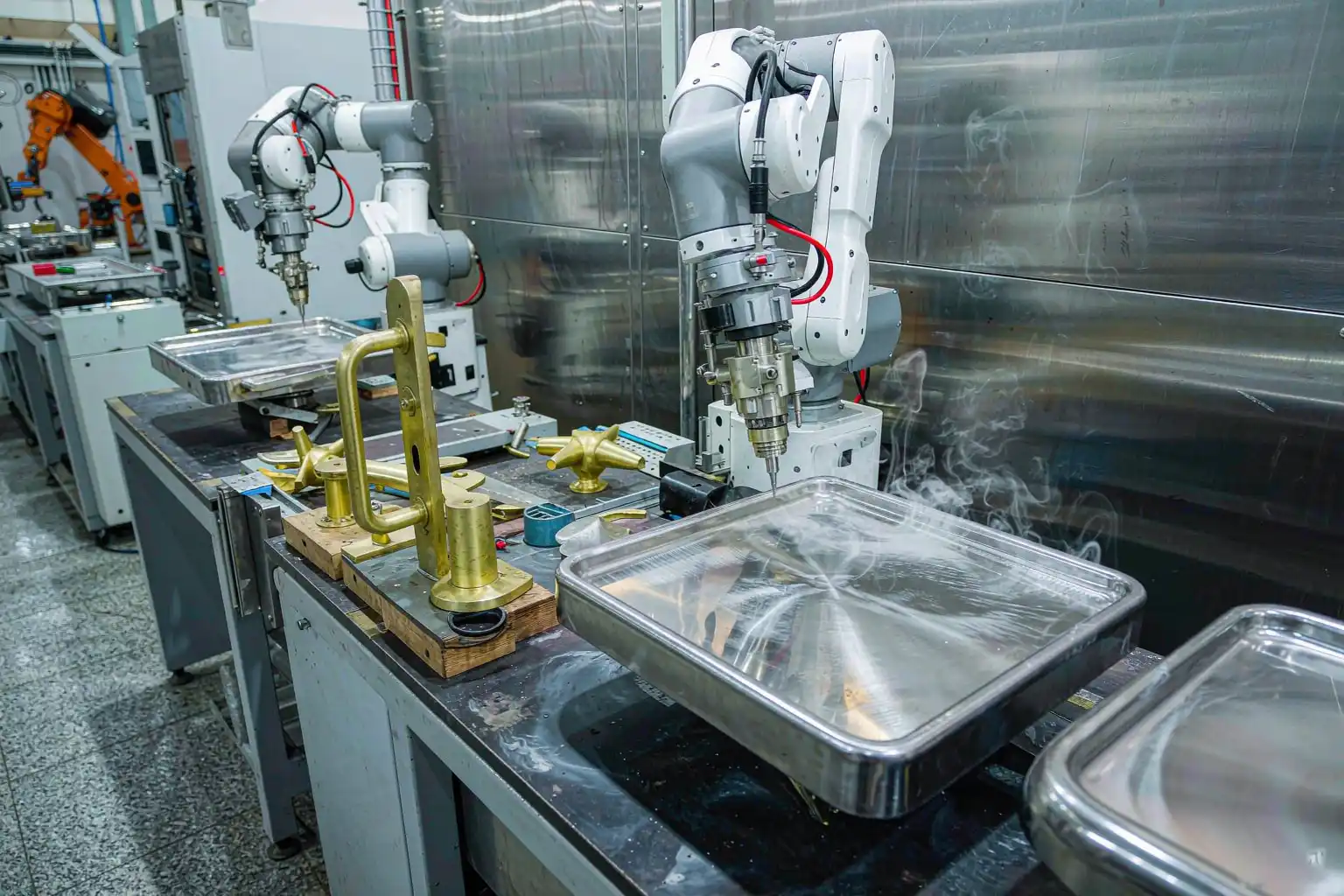
Decorative surfaces dominate the rejects. Handles and pulls are visible on finished furniture, so buyers judge them like jewellery. However, the same plant must also deburr functional parts where nobody sees the surface.
Batch sizes keep shrinking. Furniture brands now order small runs per model and per finish. Manual benches absorb this variety through skill; robots absorb it through fixturing and quick program calls.
Labour pressure lands hardest here because the parts are small and cycle times are short. Paying skilled polishers to repeat eight-second operations is the most expensive way to fill an order.
Family One: Zinc Alloy Handles and Pulls
Zinc die-cast handles are the volume core of most furniture hardware plants. They arrive from the casting cell with parting lines, gate stubs, and orange-peel texture that must go before plating.
The proven robotic route is a two-stage buffing cell. First, a firm sisal wheel with grey compound cuts the parting line and blends the body. Second, a cotton mop with white compound lifts the shine to plating standard.
Force control matters more than speed here. Zinc is soft, so twelve newtons of contact pressure cuts cleanly, but fifteen burns the surface and creates rework. The robot holds the part against the wheel, rotating it to keep a constant contact angle around curves.
Zinc alloy polishing automation has matured into a standard package for this family. Plants typically run two cells per shift and hold rework under one percent.
| Stage | Wheel | Force | Cycle |
|---|---|---|---|
| Cut pass | Sisal + grey compound | 8–12 N | 6–10 s |
| Colour pass | Cotton mop + white compound | 5–8 N | 4–8 s |
| Residue clear | Cloth wheel | 2–3 N | 3–5 s |
| Load and unload | Gripper | — | 4–6 s |
Family Two: Stainless Hinges and Brackets
Stainless parts arrive from stamping or fine-blanking with edge burrs and mill scale. The finish target is usually brushed or satin, not mirror, which changes the tooling completely.
Non-woven belts are the workhorse. A robot carrying the part against a fixed belt produces a consistent grain direction that manual work struggles to hold across a shift.
Edge deburring comes first, surface finishing second. Combining them in one program saves a handling step, but the belt grit must drop two grades between the operations or the edges round over.
Watch the heat. Stainless work-hardens and discolours when pressure runs high. Therefore, keep contact light, passes multiple, and coolant or air blast on the contact zone.
Family Three: Aluminum Extrusions and Rails
Aluminum handles and rail systems machine quickly but mark easily. The finishing job is mostly blending machining lines and preparing for anodising, not creating shine.
Scotch-Brite style belts at moderate pressure remove tool marks without gouging. The goal is a uniform matte surface that anodises evenly, because every scratch telegraphs through the coating.
Floor-standing twin-belt machines with robot load beat manual handling on ergonomics. Cycle times run three to six seconds per face, and one cell can serve several extrusion families with only a gripper change.
Family Four: Bronze and Brass Decorative Trim
Bronze and brass trim command premium prices and premium surface expectations. These parts usually come from sand casting or forging, so the finishing chain starts with heavier stock removal.
A grinding pass with a structured belt removes forging scale and casting texture. Then a buffing pass with brown compound produces the warm lustre buyers expect from living-finish hardware.
Volumes are low, so a shared cell makes sense. For example, one robot can run bronze trim in the morning and zinc handles after lunch, switching programs and wheels in under ten minutes.
Living finishes age by design, so consistency matters more than perfection. Hold the lustre band steady and let the patina do its work over time.
The Selection Matrix
Putting the four families side by side shows why one machine cannot serve them all. The table below is the starting point for equipment discussions with any supplier.
| Product Family | Alloy | Primary Tools | Target Finish | Cell Type |
|---|---|---|---|---|
| Handles and pulls | Zinc die-cast | Sisal + cotton mops | Bright, plating-ready | Dual-wheel buff robot |
| Hinges and brackets | Stainless stamping | Non-woven belts | Brushed satin | Twin-belt robot cell |
| Rails and extrusions | Aluminum | Scotch-Brite belts | Matte, anodise-ready | Belt machine + loader |
| Decorative trim | Brass, bronze | Structured belt + mop | Warm lustre | Shared flexible cell |
Cell Economics for High-Mix Production
Furniture hardware rarely offers the volumes that justify a transfer line. Instead, the economics work cell by cell, family by family.
Start with the zinc family because it carries the volume. Two buffing cells replace eight to twelve manual stations and typically pay back inside fourteen to twenty months at Western labour rates.
The stainless family justifies its cell through quality more than headcount. Consistent grain direction lifts the perceived grade of the whole furniture line, which supports price positioning.
Aluminum and bronze families often share. A single flexible cell with quick-change grippers covers both, running each family in scheduled blocks rather than mixed through the day.
Layout: Cell or Line
Resist the temptation to build one long finishing line. Furniture hardware volume does not support it, and variety punishes it.
Cells arranged around shared infrastructure win instead. One extraction system, one coolant room, and one programmer serve four independent cells. Each cell keeps its own wheel sets and programs.
Material flow stays simple: casting or stamping out, family-specific cell, plating or coating in. For example, plants that already run a turnkey finishing chain for other product lines can bolt a furniture-hardware cell onto the same backbone.
Changeover and Fixtures
Changeover speed decides whether the cell strategy works. Every minute of changeover is a minute the robot stands idle, and small batches multiply changeovers.
Zero-point fixture plates are the core investment. Each product gets a dedicated plate, pre-set and stored at the cell. Swapping plates takes under two minutes with two clamps.
Program recall must be instant. Barcoded totes or RFID tags tell the cell which program to load before the operator closes the door.
| Changeover Element | Manual Bench | Robotic Cell |
|---|---|---|
| Fixture swap | 5–15 min | 1–2 min |
| Wheel change | 3–5 min | 4–6 min |
| First good part | 2–3 parts | 1 part |
| Program recall | — (skill) | Instant via barcode |
Quality Acceptance per Family
Acceptance criteria differ by family, so write them separately. Zinc handles need plating-ready brightness with no burn marks. Stainless hinges need uniform grain and burr-free edges under a ten-x loupe.
Aluminum parts check under raking light before anodising. Any directional mark that shows in the light will show through the coating.
Bronze trim compares against a master lustre panel. The comparison is visual but done in a standard light booth, so shifts and inspectors agree.
Log results by family and by shift. Trends in the data catch wheel wear and program drift before customers catch them.
Avoiding the Classic Mistakes
Three mistakes recur in furniture hardware projects. First, buying one oversized machine to cover every family, which produces mediocre results on all of them.
Second, skipping fixture investment to save budget, which forces manual intervention on every batch and quietly destroys the ROI.
Third, copying a neighbour’s cell without running own part samples. Wheel choices that suit one handle geometry can burn another.
Door handle polishing projects and furniture hardware share these failure modes, and the same phased discipline fixes both.
Implementation Order That Works
Phase one proves the zinc family. Run samples, agree acceptance panels, install two cells, and hold the line for six weeks of stable production.
Phase two adds stainless. The extraction and infrastructure already exist, so the incremental project is smaller and faster.
Phase three consolidates aluminum and bronze into the shared flexible cell. By this point the team programs and maintains cells without external help.
- Weeks 1–2: sample trials and acceptance panels per family
- Weeks 3–8: zinc cells installed and proven
- Weeks 9–14: stainless cell added on shared infrastructure
- Weeks 15–20: flexible cell for aluminum and bronze
- Week 21+: cross-training, spare wheels, and data reviews
Learning from Adjacent Hardware Segments
Furniture hardware sits between two well-automated neighbours. Lock hardware runs the same small-part, high-variety problem at similar sizes, and its defect catalogue transfers directly.
Lock hardware finishing practice shows the value of edge classes and hourly function checks. Furniture hardware can borrow both ideas almost unchanged.
Meanwhile sanitary-ware plants solved curved bright-part buffing years ago. Their force-control settings for brass spouts translate to bronze trim with small adjustments.
What to Ask a Supplier First
Bring your three highest-volume SKUs to the first supplier meeting, not your easiest ones. Ask for a live demonstration on those parts, with your plating house in the loop if possible.
Ask how the cell stores and recalls programs. The answer reveals whether the supplier understands high-mix production or merely tolerates it.
Ask for wheel consumption data per thousand parts. Consumables quietly decide the running cost, and honest suppliers know their numbers.
Finally, agree the acceptance panels before the purchase order. Written surface standards protect both sides and make commissioning short.
The Bottom Line for Furniture Hardware Plants
Furniture hardware polishing rewards the family approach. Match each product family to the right robotic solution, share the infrastructure, and invest where the volume lives.
The zinc family pays the bills. The stainless family lifts the brand. The flexible cell covers the tail. Together they replace the skilled-bench dependency that keeps furniture hardware plants awake at night.
The approaches described are starting points; an application engineer should tune them to your line.