

“Deburring machine” and “grinding machine” are often used interchangeably, but they solve different problems — and buying the wrong one wastes capital. Deburring removes unwanted burrs and flash; grinding removes intended material to hit a size, shape, or surface finish. This article explains the key differences so you specify the right process (or the right combination) for your castings.
For the bigger equipment decision, see our selection guide and the five features to look for.
The Core Difference in One Sentence
- Deburring removes material you did not want — flash, gates, sharp edges.
- Grinding removes material you intentionally take off — stock, weld, or surface — to meet a dimension or finish.
They often run back-to-back, but they are distinct process steps with different tooling, tolerances, and quality goals.
Purpose and Outcome
| Dimension | Deburring machine | Grinding machine |
|---|---|---|
| Primary goal | Remove burrs, flash, sharp edges | Achieve size, shape, surface finish |
| Material removed | Microns to a few mm of unwanted metal | Controlled stock removal, often 0.1–several mm |
| Typical tolerance | Edge radius R 0.1–0.5 mm | Dimensional, often ±0.05 mm or tighter |
| Tooling | Brushes, burrs, fine belts, ECD/TED | Grinding wheels, coated/structured abrasives |
| Quality metric | No burr, consistent edge break | Ra/Rz finish, geometry |
Tooling and Process Differences
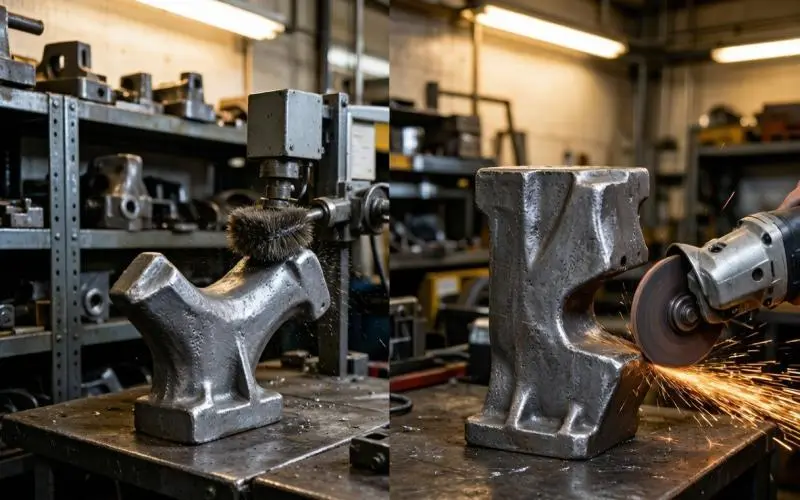
Deburring Tooling
- Wire/abrasive brushes for edge breaks.
- Carbide burrs for tough gate stubs.
- Vibratory media for batch radiusing.
- Thermal/electrochemical for unreachable internal features.
Grinding Tooling
- Aluminum-oxide / zirconia wheels for stock removal.
- Coated abrasive belts for flat-surface finishing.
- Structured abrasives for consistent Ra.
Our automatic grinding guide goes deeper on the grinding side.
When You Need Both
Most casting lines need both steps. A typical sequence:
- Deburr — remove gates, flash, parting-line fins.
- Grind — bring the deburred surface to final dimension and finish.
- Optional second deburr — clean up the edge created by grinding.
Two-in-one grinding-and-polishing machines exist, but a true deburr+grind cell pairs a robotic deburring head with a grinding spindle.
If your pain is sharp edges and flash, buy deburring first. If your pain is dimensional out-of-spec or poor surface finish, grinding is the priority. Solving the wrong one wastes the budget.
Cost and Throughput
- Deburring cells: $80K–$250K; 30–300+ parts/hr.
- Grinding cells: $60K–$200K; similar throughput, higher consumable wear on hard alloys.
- Combined cells: share the robot; add a second spindle rather than a second cell.
See how automatic deburring works and the robotic grinding full guide for specifics.
Frequently Asked Questions
- Q: Can one machine do both deburring and grinding?
A: Yes — a robotic cell with a deburring spindle and a grinding spindle performs both, sharing the robot and fixturing. This is usually cheaper than two separate cells. - Q: Which should I automate first?
A: Whichever step is your bottleneck or quality risk. Deburring is usually the bigger labor and safety drain; grinding is the bigger dimensional-risk step. - Q: Does deburring affect surface finish?
A: Light deburring (brushing) can improve edge appearance but will not set the Ra of a ground surface. Finish is a grinding/outcome, not a deburring outcome.
Conclusion
Deburring and grinding machines are complementary, not competing. Deburring eliminates unwanted metal; grinding achieves intended dimensions and finish. Specify each by its own goal, then decide whether a combined cell makes economic sense for your volume and part mix.
Specify the Right Process
Tell us your bottleneck — burrs or dimensions — and we will recommend a deburring, grinding, or combined cell configuration.