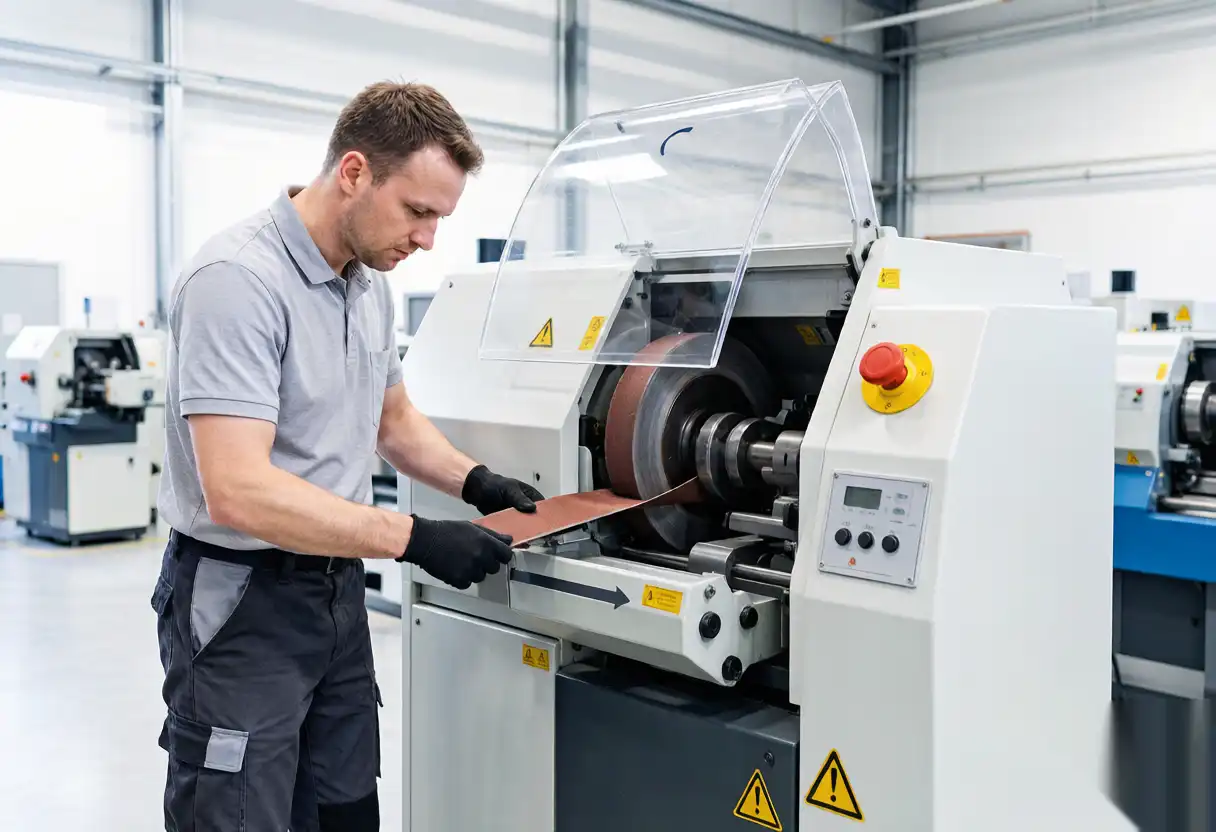


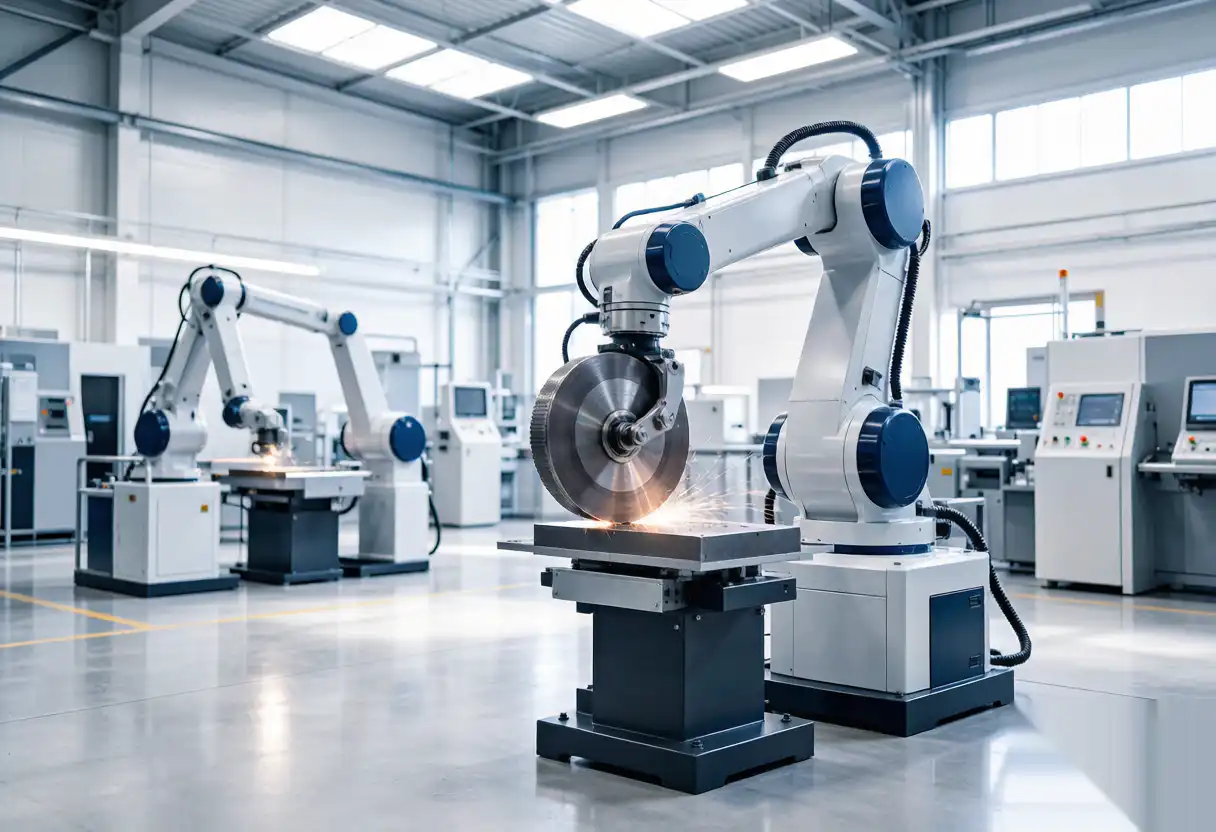
AT A GLANCE · Industrial surface finishing changed more in the last five years than in the twenty before them. Force control went from exotic to standard. Vision moved from a promise to a working tool. Software turned finishing cells into data sources instead of isolated machines.
This article reviews the technologies that matter in 2026. It explains what each one does, why it matters, and how to decide what to adopt first.
The Technology Stack in 2026
A modern finishing cell stacks five layers. The robot moves the tool. The spindle and tooling cut the surface. The controller runs the recipe. Sensors feed force, vision, and wear data. Software connects the cell to the plant. Each layer has advanced on its own.
Therefore, the best systems are not the ones with the flashiest single feature. They are the ones where the layers work together cleanly.
Force-Controlled Robotics
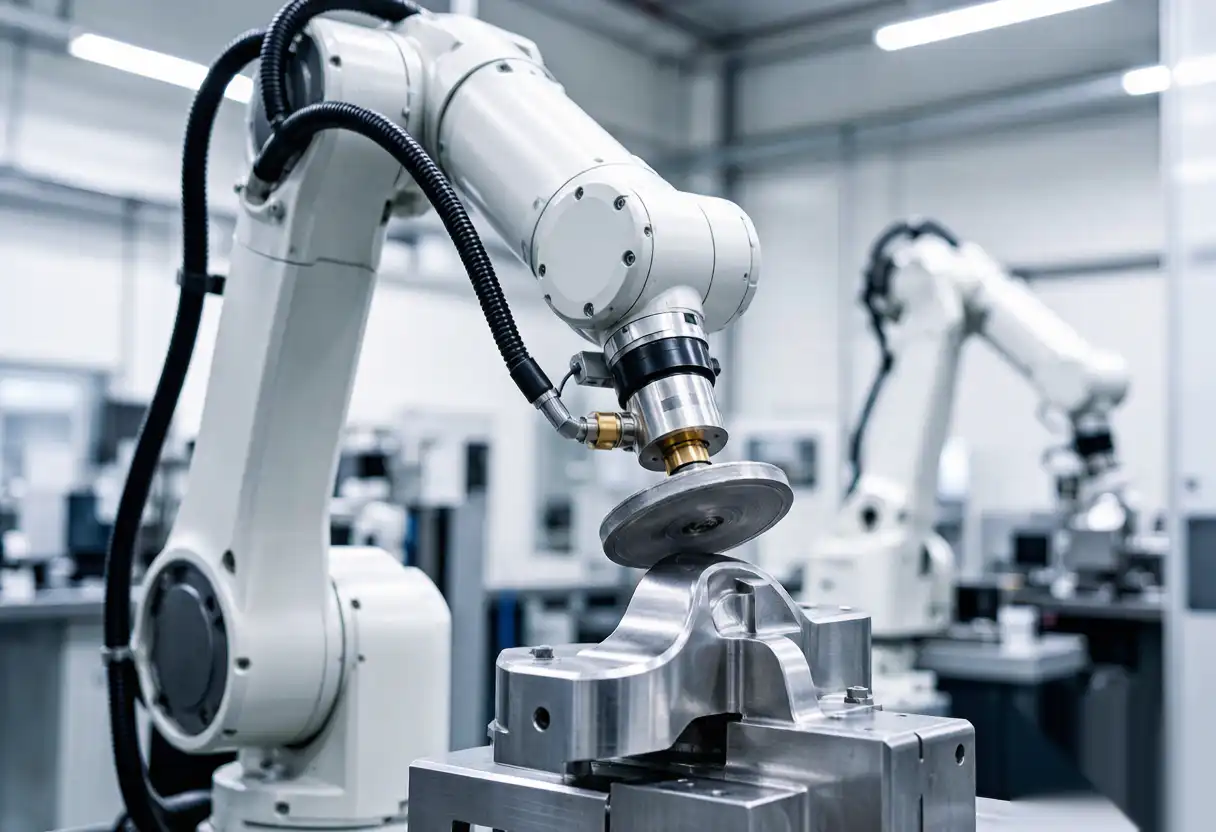
Force control lets the robot press with a set pressure instead of a set position. The tool follows the part surface, so curved and cast parts finish evenly. This is the single biggest quality lever in finishing.
For example, a compliant spindle holds 12 newtons of contact force across a warped casting. The high spot gets the same cut as the low spot. The finish does not vary with the part.
Automatic buffing machine technologies now ship with force control as the default, not an option. That tells you where the industry landed.
High-Speed Spindles and Tooling
Spindle speed drives the cut. Modern finishing spindles run 6,000 to 18,000 RPM with active balance. Higher speed means a smoother cut and a faster cycle on fine finishes.
In addition, tooling improved. Compliant wheels conform to curves. Structured belts cut cooler. Quick-change mounts swap tools in seconds. The tooling catalog keeps widening.
Consequently, CNC polishing machines borrowed the same spindle and tooling advances. Precision and speed rose together.
Vision-Guided Finishing
Vision finds the part, guides the path, and checks the result. A camera locates a casting that shifted in the fixture. The robot adjusts, and the path still hits the right features.
For example, a vision check after the polish pass catches a missed zone in seconds. The cell reworks it on the spot instead of shipping it. That closes the loop in real time.
In addition, vision records images per part. The quality log becomes visual and traceable. Customers accept that evidence faster than paper forms.
Media and Compound Systems
Compound delivery went from a spray gun to a metered system. The cell doses compound by cycle count, so the cut stays constant. Media life is tracked by parts, not by feel.
Meanwhile, automated mirror polishing depends on this discipline. A loaded wheel burns a mirror finish in seconds. Metered compound prevents the load from building.
As a result, the finish is the same at the start of the shift and at the end. The consumables stop being a variable.
Automation Software and MES
Cell software stores recipes, logs cycles, and reports data. Modern cells talk to plant systems through standard interfaces. The plant sees cycle time, yield, and downtime per cell in real time.
For example, a small foundry with three cells runs a simple scheduling screen. Parts flow to the next free cell. The board replaces paper tags and phone calls.
In addition, the data feeds improvement. The cell that drifts shows up in the trend before the parts do. Fixes happen early, not after a bad batch.
Safety and Compliance
Safety technology kept pace. Interlocked fencing, light curtains, and safe-speed modes protect operators. Dust extraction at the source protects lungs and finishes alike.
In addition, compliance documentation got easier. Cells log recipes, parameters, and inspection data. An audit becomes a report, not a scramble.
Therefore, modern cells are safer to run and easier to prove. Both matter more every year.
What to Adopt First
- Force control. The biggest quality lever. Adopt it first.
- Metered compound. Cheap, and it stabilizes every finish.
- Saved recipes. Turn process knowledge into a library.
- Vision check. Add it when manual inspection bottlenecks.
- MES link. Connect the data when two or more cells exist.
Therefore, start with the fundamentals and add intelligence in layers. The foundation pays back first.
Integrating With Existing Equipment
Most plants already own machines worth keeping. The good news is that modern controllers integrate with existing grinders, polishers, and conveyors. The new cell often becomes the brain around older iron.
For example, an existing belt grinder can feed a new robotic deburr cell. The robot loads the parts, and the grinder keeps its job. The upgrade costs far less than replacing everything.
In addition, ask for an integration plan before you buy. The supplier should map each existing machine into the new flow, not assume a blank floor.
Maintenance Implications
New technology changes the maintenance plan. Force sensors need calibration checks. Vision cameras need lens cleaning. Software needs updates and backups. These tasks are small but they are new.
For example, a monthly calibration check on the force sensor takes twenty minutes. Skipping it lets drift build, and drift shows up as finish variation. The check is cheap insurance.
Therefore, build the maintenance list when you buy the cell. The supplier should hand over checklists, not just a machine.
Budgeting the Upgrade
Budget the whole project, not the robot. Include guarding, extraction, integration, tooling, training, and the first consumables. The hidden costs are what break a budget.
For example, a cell that looks affordable on the quote can double in cost once integration and guarding are added. Plan the total from the start, and the project stays on track.
In addition, budget for a spare parts kit. A spare spindle, a force sensor, and a controller card cover most failures. The kit costs less than one day of downtime.
Choosing Between a Robot Cell and a CNC Machine
The line between robot cells and CNC finishing machines keeps blurring. Robots offer flexibility and reach. CNC machines offer stiffness and precision paths. The choice depends on the part.
For example, a complex casting with curved surfaces suits a robot with force control. A flat part with tight dimensional tolerance suits a CNC machine. Many plants run both.
In addition, the controller software is converging. The same recipe logic runs on both platforms. The choice becomes about geometry and volume, not about software.
Training the Team for New Technology
New machines need new skills. Plan the training before delivery, not after. Operators learn the recipes and the screens. Technicians learn calibration and troubleshooting. Engineers learn to tune the process.
For example, a two-week training plan that ends with the commissioning week means the team runs the first parts themselves. The supplier stays for support, not for babysitting.
Therefore, budget training as part of the project. A trained team is the difference between a cell that pays back and a cell that sits idle.
Frequently Asked Questions
Are these technologies proven or experimental? Proven. Force control, vision, and metered compound are installed in production cells across the world. AI is the newest layer and the narrowest in scope.
How much do these systems cost? A complete cell with force control and recipes typically runs in a range that pays back in twelve to eighteen months on volume. Vision and MES add a smaller increment.
Do I need to change my process? No. The technologies automate the process you already know. They make your best recipe consistent.
What is the risk of adopting too early? Small, if you choose proven layers. Buy force control and recipes now. Wait on experimental AI features until the use case is clear.
How long does installation take? Most cells install and commission in four to eight weeks. The fixture design and the integration usually dominate that time.
Do I need new staff? No. Retrain existing staff. A technician and an operator cover a modern cell, with the supplier supporting recipe tuning.
Can the cell grow with my plant? Yes. Buy the controller with spare I/O and the cell with spare footprint. Later stages and machines slot in without a rebuild.
How do I know the technology is right for my part? Run a trial. Send sample parts and your finish spec to the supplier. A trial with your own parts beats any brochure.
What is the learning curve for the team? Most operators are productive in a week. Technicians need a few weeks for calibration and troubleshooting. Plan the training alongside delivery.
Do these systems work with low volumes? Yes. Force control and recipes help low-volume work as much as high-volume. The flexible cell spreads the investment across many small batches.