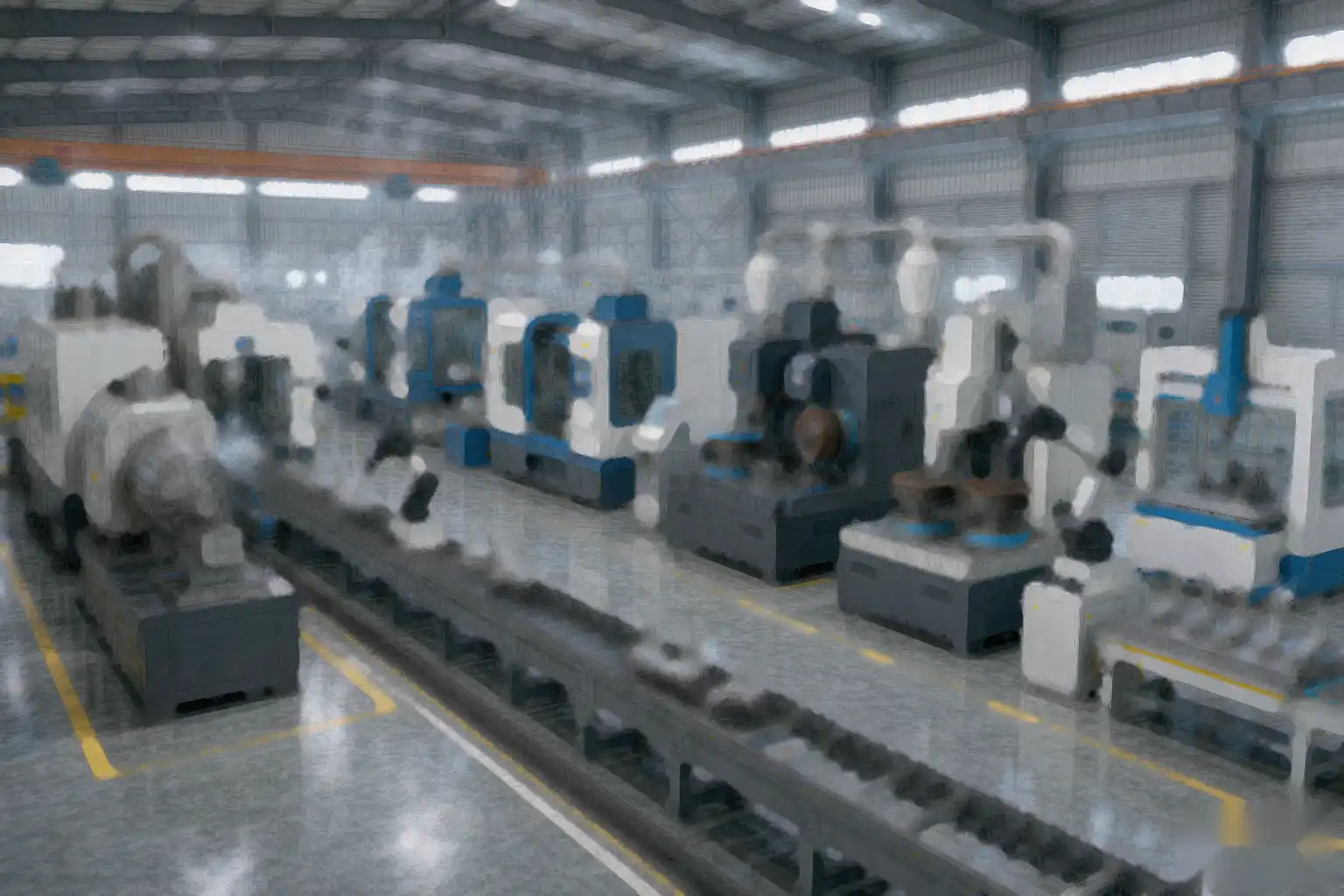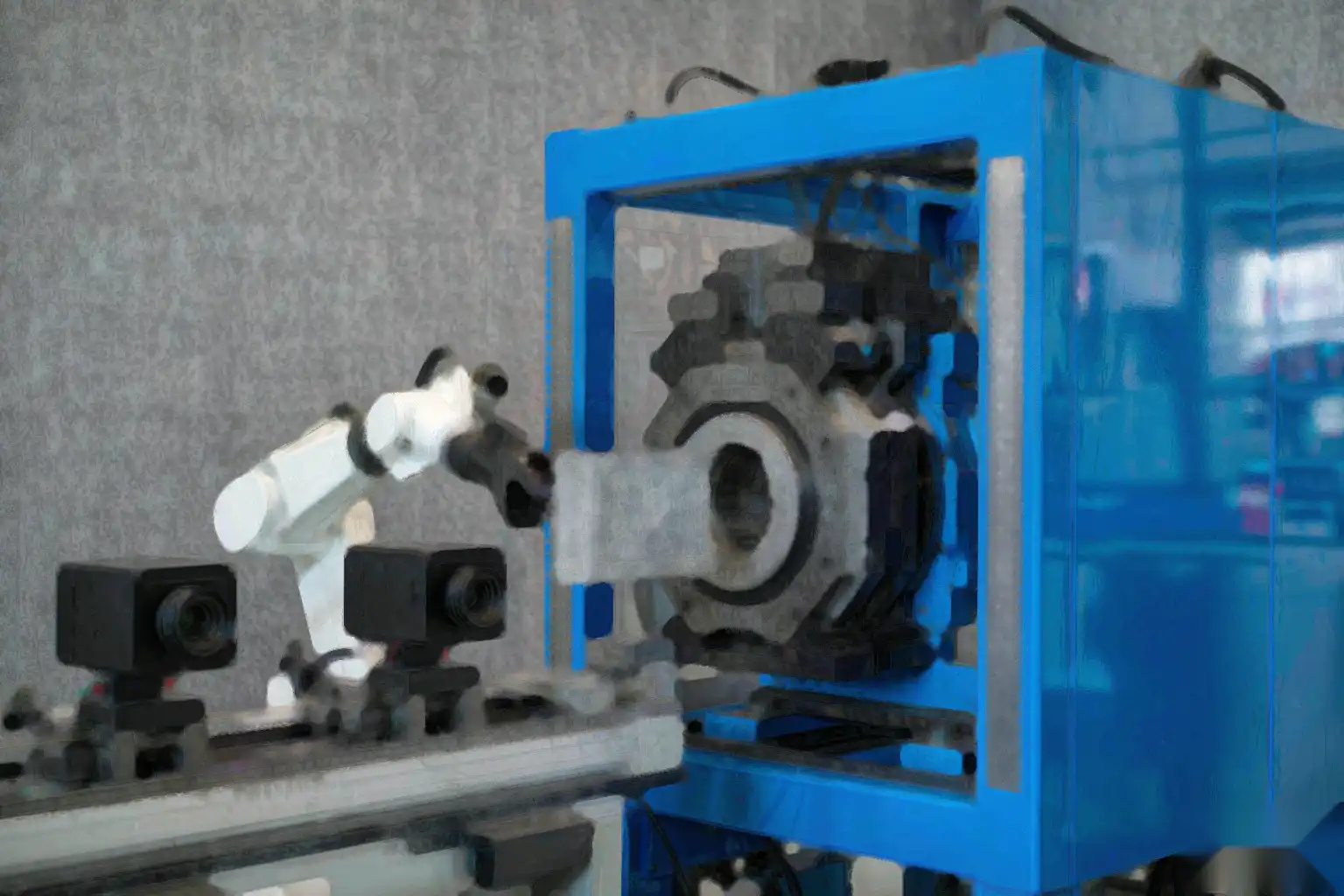


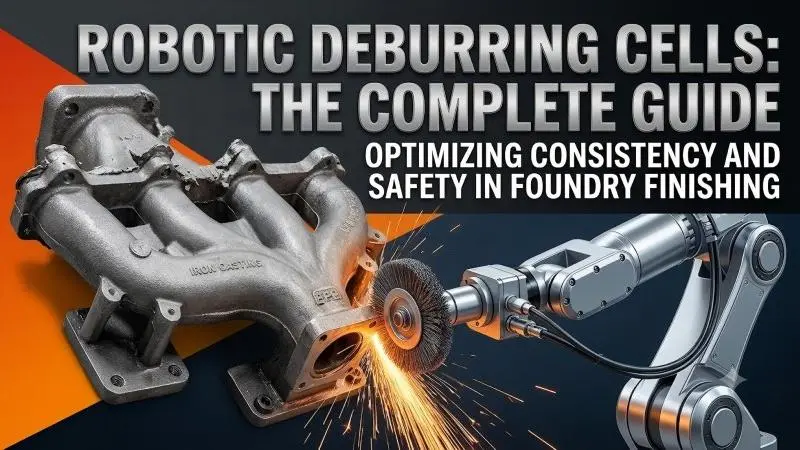
A robotic deburring cell is a self-contained finishing workstation where an industrial robot, fitted with a compliant deburring tool, removes flash, burrs, and parting-line residue from cast metal components under programmatic control. It integrates part presentation, fixturing, spindle or brush actuation, and quality verification so that a single operator can tend several cells instead of manually filing each part. The core value is repeatability: once a path is taught, every part receives identical edge treatment within a tolerance band the American Foundry Society cites as critical for downstream assembly.
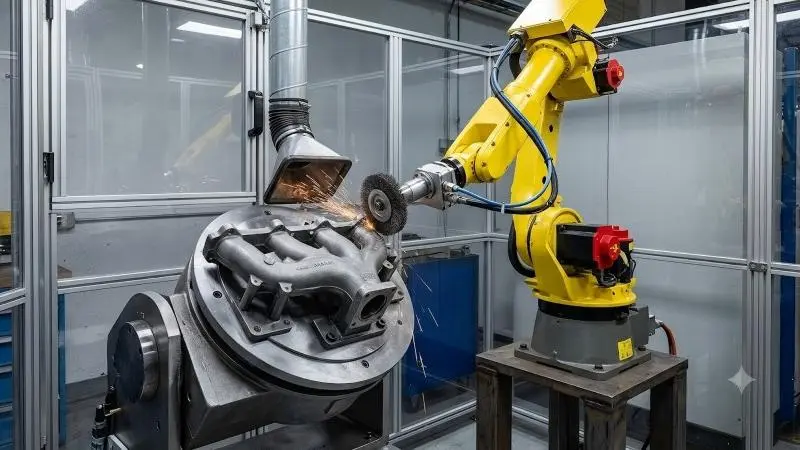
Anatomy of a Robotic Deburring Cell
Every functional cell contains the same building blocks, regardless of part size:
- Robot: usually a 6-axis articulated arm with 5–20 kg payload and ±0.03 mm repeatability.
- Deburring end-effector: rotary brush, carbide burr, or abrasive belt head, often with force-compliance.
- Fixture / positioner: locates the casting within 0.1 mm so the taught path lands correctly.
- Part presentation: conveyor, tray, or rotary table feeding parts to the robot.
- Controller & HMI: stores programs, logs cycle counts, and alarms on deviation.
- Safety enclosure: light curtain or interlocked fence per ISO 10218.
Related context: our guide to the automatic deburring machine covers single-station alternatives when a full cell is not yet justified.
How the Deburring Cycle Works, Step by Step
The operating sequence repeats every cycle:
- Part arrives at the load station and is clamped by the fixture.
- Robot moves to a taught approach point using vision or a locating pin.
- The spindle ramps to 6,000–18,000 RPM depending on material and burr size.
- Compliant force control holds 5–30 N of contact pressure along the edge path.
- Burrs and flash are swept away; chips fall into a collection tray or dust extraction.
- Robot retracts; fixture releases; part is ejected to the good or reject lane.
Compliance: Why Force Control Matters
Castings vary part-to-part because of mold shift and shrinkage. A rigid robot would dig into the surface on an oversized part. A robotic deburring head with active compliance senses resistance and adjusts, keeping edge break consistent at ±0.1 mm. This is the single feature that separates a production cell from a demonstration unit.
| Factor | Compliant (force-controlled) | Rigid (position-only) |
|---|---|---|
| Burr variation tolerance | Handles ±0.4 mm casting variation | Requires ±0.1 mm pre-sorted parts |
| Tool life | Longer, no over-pressure stall | Shorter, frequent burnouts |
| Edge-break consistency | ±0.1 mm | ±0.3 mm |
| Operator skill needed | Low after setup | Medium, frequent tuning |
QUICK DECISION TIP
Specify active force compliance from day one; retrofitting it later costs more than the original spindle and often requires a controller upgrade.
When to Choose a Cell Over a Single Machine
If you need more than one fixture orientation, run mixed part families, or want lights-out operation, a cell beats a bench machine. Our foundry selection guide helps map volume to architecture.
Safety and Standards Compliance
A production cell must meet ISO 10218 for industrial robots and local machinery directives. This means interlocked fencing or a validated light-curtain zone, emergency stop reachable at the load station, and a risk assessment covering jam recovery. Plan the enclosure footprint early — a cramped cell slows part loading and undermines the labor savings you bought it for.
Integration With Upstream and Downstream Equipment
The cell rarely sits alone. It receives castings from a trim press or washing line and hands off to inspection or packaging. Standardize on a pallet or tray interface so the robot’s pick pose is fixed; variable presentation forces the robot to search and kills cycle time. A simple conveyor with locating stops is usually enough.
Selecting a Supplier and Spare Parts Strategy
Evaluate suppliers on commissioning support, not just hardware price. Confirm they provide the teach pendant training, a documented program backup procedure, and a recommended spare-parts list — brushes, compliance modules, and gripper fingers are the items that actually stop a line. Ask for mean-time-to-failure data on the deburring head and verify local or regional stock for the wear parts you will consume monthly.
Frequently Asked Questions
What robot payload do I need for deburring castings?
For most iron and aluminum castings under 5 kg, a 10 kg-class arm with a 1.4 m reach is sufficient; heavier parts need a 20+ kg arm or a positioner.
How long does programming take?
First article path teaching runs 2–6 hours; offline simulation can cut this to under an hour for similar geometries.
Can the cell run unattended?
Yes, with automatic part feeding and chip extraction; many plants run 16–24 hr patterns with one tender.
What RPM works for aluminum vs iron?
Aluminum die castings deburr well at 10,000–18,000 RPM with soft brushes; iron needs 6,000–10,000 RPM with harder abrasive media.
Need help specifying the right machine?
Contact Xiamen Dingzhu Intelligent Equipment — we size deburring and grinding cells to your castings, volume, and tolerances. Talk to our application engineers.