

If your parts leave the foundry, forge, or weld shop with scale, rust, or a coating you need gone, a shot blasting machine is probably the fastest way to clean and prep them at volume. Unlike manual grinding, it bombards the surface with recycled metallic abrasive at high velocity, stripping contaminants while creating the anchor profile your paint or powder coat needs to bite. This guide walks through how these machines work, the main types, how to pick abrasive media, and how to match a machine to your real production.
Key Takeaways
- A shot blasting machine uses a centrifugal blast wheel (or compressed air) to throw steel shot/grit at parts — no silica sand, far safer than old sandblasting.
- Wheel blast = high-volume; air blast = flexible spot work. Choose by part geometry, weight, and throughput.
- Round shot peens/cleans; angular grit cuts for a sharper anchor pattern. Media size follows SAE J444.
- Closed-loop recovery and a good dust collector are what make the process economical and compliant.
- For an end-to-end line, pair blasting with a grinding and polishing machine so parts move straight from cleaning to finishing.
What Exactly Is a Shot Blasting Machine?
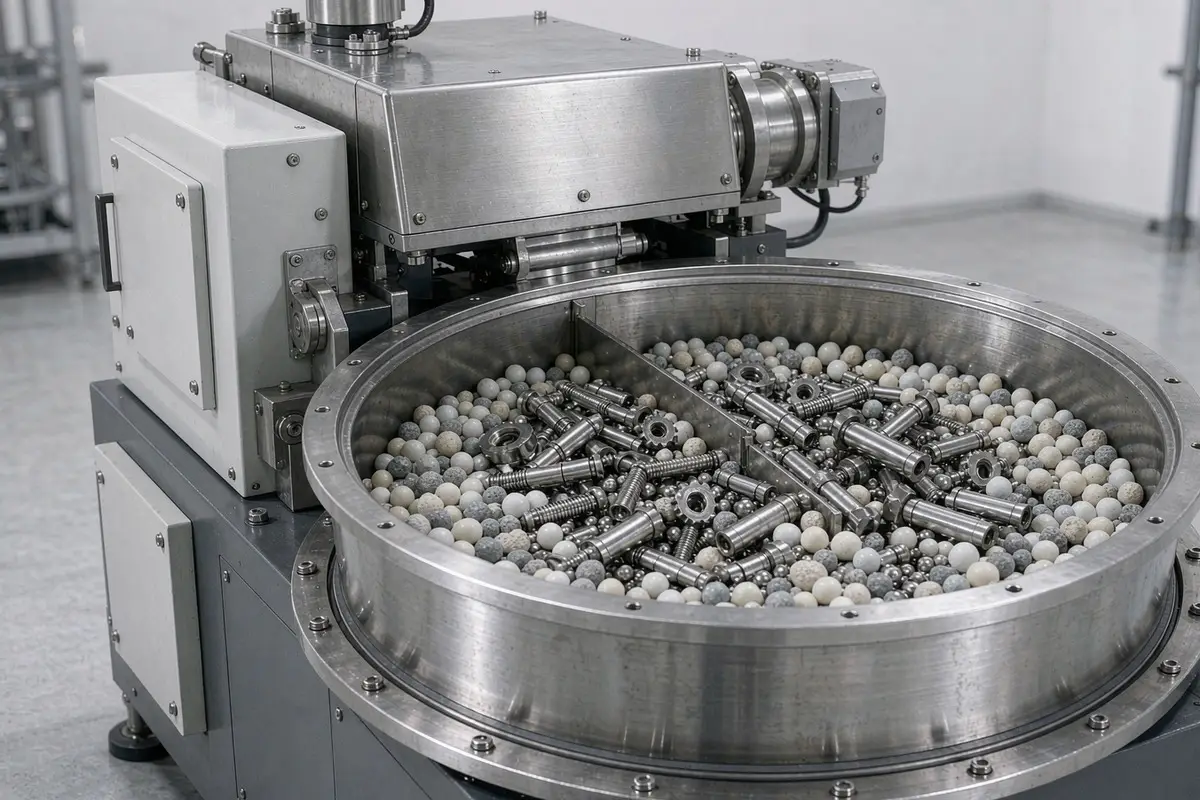
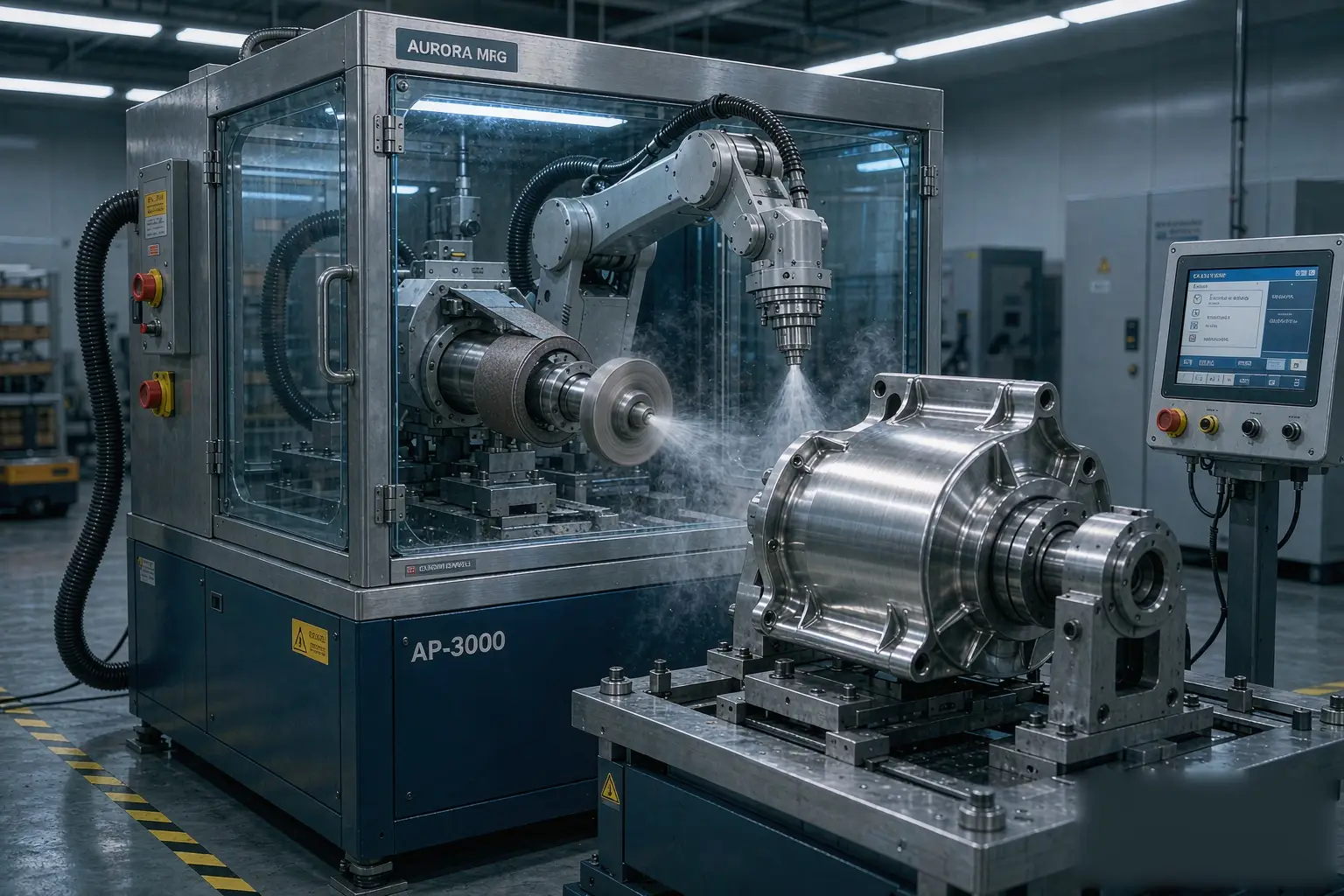
A shot blasting machine is a closed, automated system that propels small metallic abrasive particles — usually called shot (spherical) or grit (angular) — at a workpiece to clean, descale, degrease, or strengthen its surface. The parts sit inside an enclosed blast chamber; abrasive is metered, accelerated, thrown at the work, then collected, separated from dust and broken particles, and recirculated. That recycling loop is the whole economic story: you buy the media once and reuse it for thousands of cycles.
How a Shot Blasting Machine Works — Step by Step
The core principle is the same across machines: accelerate abrasive, hit the part, recover the abrasive. Here is the cycle inside a typical wheel-blast unit:
- Media metering: Steel shot drops from a hopper into the center of the blast wheel through a feed spout, at a controlled rate set by your throughput target.
- Acceleration: A rotating impeller throws the shot onto the leading faces of the wheel’s blades. Centrifugal force accelerates it to rim velocities of roughly 60–90 m/s before release.
- Aiming: A stationary control cage with an adjustable window sets where the “hot spot” — the dense fan of abrasive — lands on the workpiece. This is how you direct coverage without moving the wheel.
- Impact & recovery: Spent shot and knocked-off scale fall through the chamber floor, ride a screw or belt to a separator, where whole abrasive is returned to the wheel and fines/dust go to the collector.
Each wheel typically delivers 120–450 kg/min of abrasive, so a machine with several wheels can strip a structural beam or a drum of castings in a single pass. For a deeper look at the physics, the principles of grinding and polishing machines article covers the complementary material-removal side.
Main Types of Shot Blasting Machines
Machines differ mostly by how the part moves through the blast. Pick the conveyance that matches your part’s shape, fragility, and volume.
- Tumblast (Barrel/Belt): Parts tumble in a rotating barrel or rubber belt. Ideal for robust bulk items — fasteners, fittings, small castings — that tolerate part-on-part contact.
- Spinner Hanger: Parts hang on rotating hooks, so delicate or odd-shaped weldments and housings get 360° coverage without tumbling damage.
- Roller / Through-Feed: Continuous conveyor for plates, beams, pipes, and profiles in a coating line. High throughput, minimal handling.
- Table / Rotary Index: A rotating table presents flat or medium parts to the wheels in short cycles — good for batches of similar discs or plates.
- Air (Portable) Blast: Compressed-air nozzle for on-site work, tanks, ship hulls, or complex internal geometry where a wheel can’t reach.
Shot Blasting vs Sandblasting — What’s the Difference?
They look similar but serve different jobs. The short version: shot blasting is metallic, recyclable, and wheel-driven; sandblasting is air-driven and uses expendable mineral media.
| Aspect | Shot Blasting | Sandblasting (Air Blast) |
|---|---|---|
| Propulsion | Centrifugal blast wheel (no air) | Compressed air through a nozzle |
| Media | Steel shot / steel grit (recycled) | Garnet, glass bead, alumina (spent) |
| Best for | High-volume metal cleaning & peening | Spot work, delicate or mixed substrates |
| Cost per kg | Low (closed-loop recovery) | Higher (media consumed) |
| Health | No silica risk | Modern media avoids silica, but dust control matters |
If your goal is to clean and finish the same part in one flow, a complete guide to automatic polishing machines shows what comes after blasting.
Choosing the Right Abrasive Media
Media shape decides the result. Round steel shot peens and cleans with a dimpled profile — great for fatigue strength and general descaling. Angular steel grit cuts aggressively and leaves a sharper anchor pattern that helps high-build coatings grip. Sizes follow SAE J444: an S330 shot is about 0.84 mm nominal, while a higher grit number means finer particles.
Match media to your coating spec. A near-white finish (Sa 2.5 / SSPC-SP 10) usually needs a coarser grit; a cosmetic clean can use finer shot. Track consumption — a worn control cage or incorrect size wastes media fast. When the part is aluminum or zinc, the same surface-quality logic applies that you’ll find in aluminum casting surface-finishing best practices.
Industrial Applications
Shot blasting shows up wherever metal must be clean before the next step:
- Foundries & die casters: Remove sand, scale, and parting residue from castings.
- Automotive & OEM: Chassis, suspension, and engine parts pre-paint.
- Structural steel & shipbuilding: Beams, plates, and hulls before protective coating.
- Aerospace: Shot peening of turbine blades and springs to extend fatigue life.
- Forging & heat treat: Scale removal after furnace cycles.
How to Size and Select the Right Machine
Before you ask for a quote, pin down five numbers — they decide the machine, not the other way around:
- Largest and heaviest part: Sets the chamber size and whether parts can tumble or must hang.
- Target throughput: Sets the number of wheels and conveyor speed.
- Contaminant and finish grade: Sets media size and blast intensity.
- Available floor space & power: Limits whether a through-feed line or a compact tumblast fits.
- Automation plan: Decides how much load, unload, and media monitoring should be automatic.
In practice, most shops over-buy chamber size and under-buy dust collection. A slightly smaller, well-specified machine with a robust separator and collector will out-produce an oversized one that constantly clogs. If you already run robotic finishing, consider a robotic polishing machine for metal parts as the logical next cell.
Maintenance & Safety Essentials You Can’t Skip
Blast wheels, liners, control cages, and impellers are wear parts — they will erode. A simple plan keeps you running:
- Inspect blades and liners weekly; replace in matched sets to keep the wheel balanced.
- Empty and check dust collector filters on schedule — airflow loss drops cleaning quality and raises fire risk.
- Verify media mix in the separator so you’re not throwing fines.
- Train operators on enclosure interlocks; the chamber must stay sealed during the cycle.
These intervals mirror the discipline in our grinding machine maintenance guide.
Frequently Asked Questions
Is shot blasting the same as sandblasting?
No. Shot blasting uses recyclable metallic shot thrown by a wheel; sandblasting uses air-driven mineral media. Shot blasting is faster and cheaper per kilogram for high-volume metal work.
What media should I use for a paint-ready surface?
For most industrial coatings, use angular steel grit sized to the spec’s profile band (commonly ~50–100 µm Rz). Round shot alone gives a smoother, peened finish better suited to fatigue parts.
How long does a shot blasting machine last?
With proper maintenance, the frame and structure run 10–15+ years. Blast wheels, liners, and cages need periodic replacement, but those are consumable components, not the whole machine.
Can shot blasting be automated?
Yes. PLC controls, auto load/unload conveyors, and media-flow monitoring make modern units fully automatic — essential for consistent quality at volume.
Does shot blasting strengthen parts?
When done as shot peening with round media, it induces compressive stress that improves fatigue and corrosion resistance — a primary reason aerospace and automotive rely on it.
Conclusion
A shot blasting machine turns dirty incoming parts into a clean, profiled, coating-ready surface at throughput manual methods can’t match. Start with part geometry to choose the conveyance type, pick media by the finish you need, and protect your investment with a solid maintenance plan. When you’re ready to build the full line, connect blasting to grinding and polishing so parts flow from clean to finished without a handling bottleneck.