

QUICK FACTS
| Cell footprint | 2.5–6 m² |
| Changeover | <15 min between SKUs |
| Media life | 60–180 parts/belt |
Choosing between a robotic finishing cell and a single machine is an architecture decision that shapes your floor for a decade. Both approaches finish parts well when matched to the right mix. This comparison makes the matching explicit.
We define each architecture, compare capability, footprint, economics, and staffing, then finish with a decision matrix you can apply to your part portfolio in an afternoon.
Defining the Two Architectures
A single machine performs one process on one part at a time. A dedicated deburring machine, a standalone polisher, or a CNC finishing center all fit this category. Parts arrive, one process runs, parts leave.
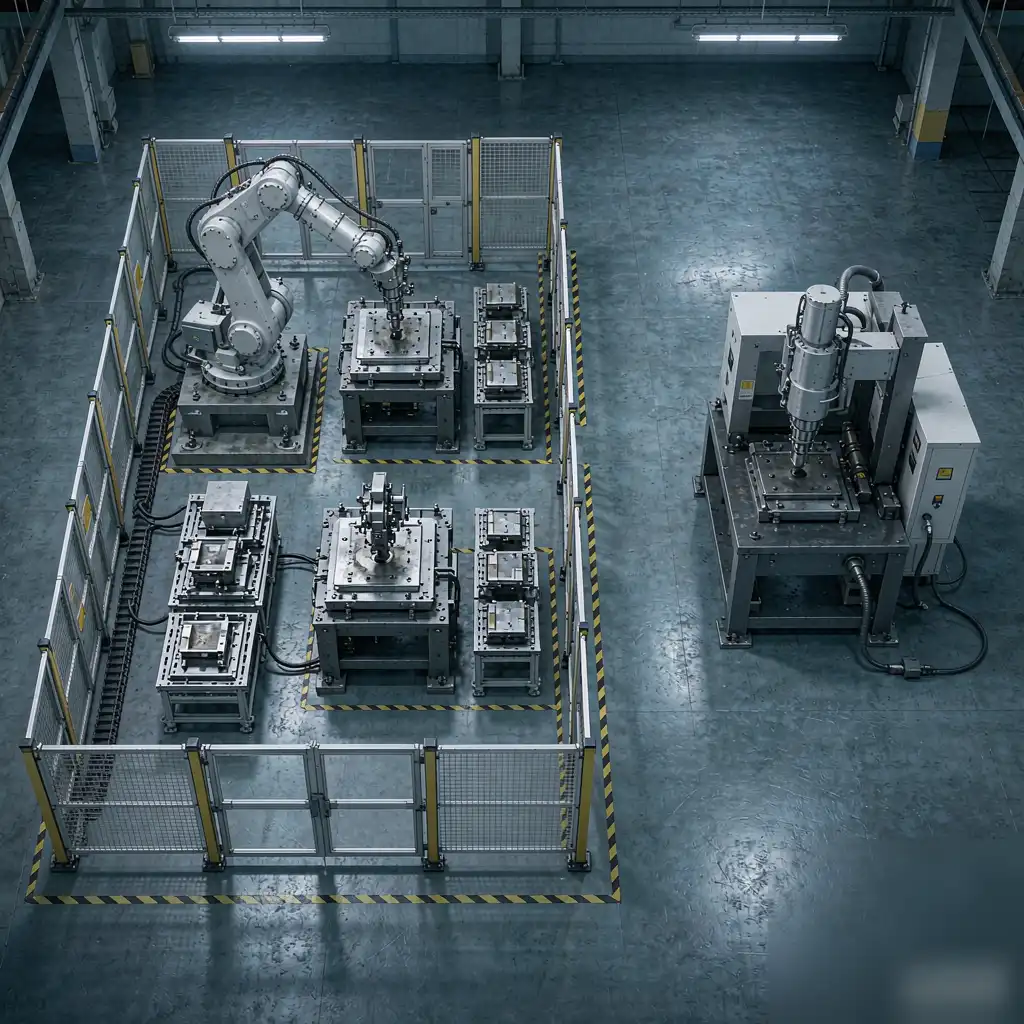
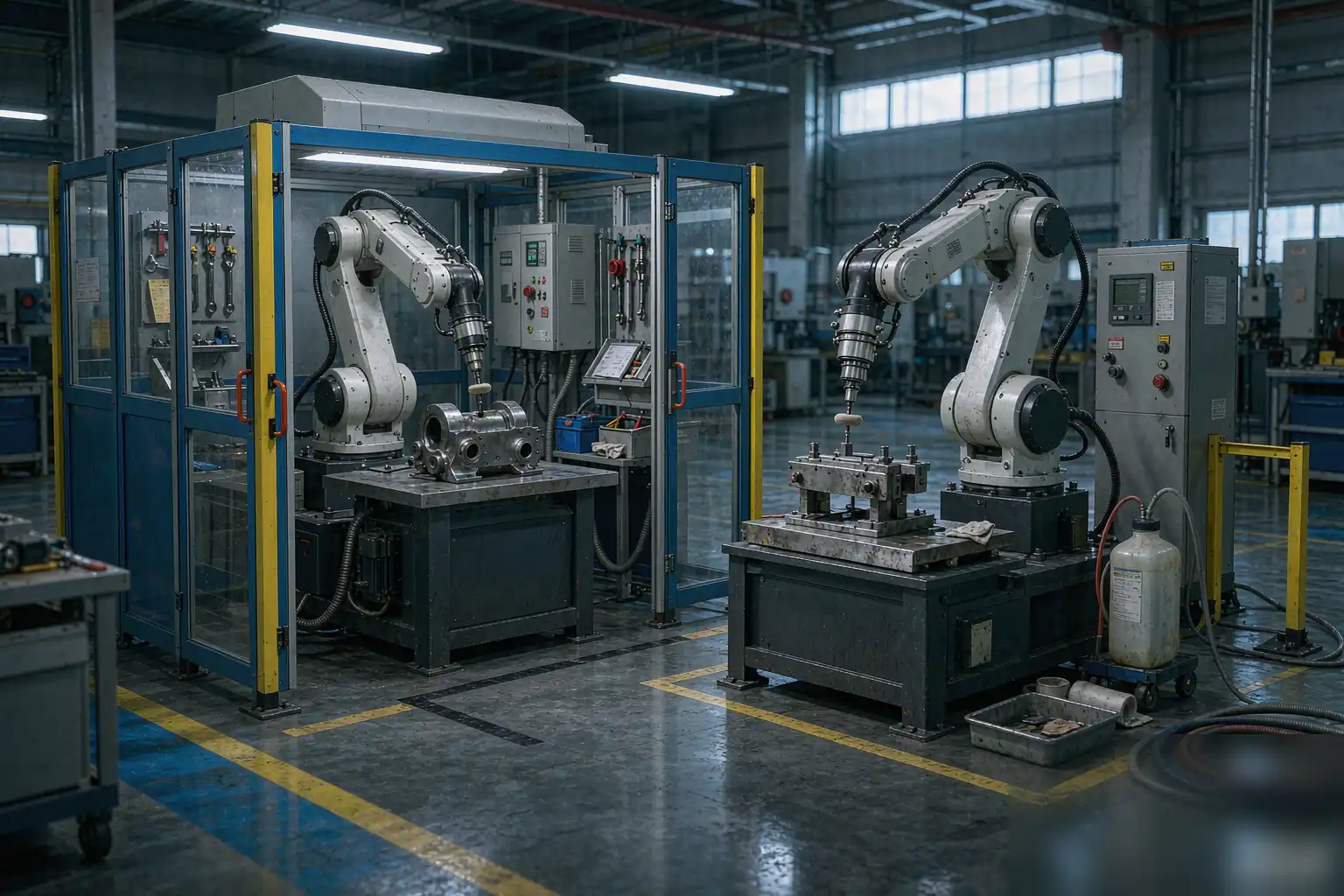
A robotic finishing cell groups a robot with multiple process stations. The robot moves parts between grinding, polishing, and inspection, or moves tools to a fixtured part. Several processes complete in one handling cycle.
| Attribute | Single Machine | Robotic Cell |
|---|---|---|
| Processes per cycle | One | Two to five |
| Part handling | Operator or simple indexer | Robot between stations |
| Flexibility | Limited to its process | Reprogrammable across families |
| Typical investment | $80k – $250k | $150k – $400k |
| Best volume | High, stable | Medium, mixed |
Capability Comparison
The architectures diverge sharply on part variety. A single machine excels when one part family dominates volume and will for years. Changeover is mechanical, slow, and rarely worth doing more than occasionally.
A robotic cell earns its cost when families multiply. Programs replace mechanical adjustment, so changeover becomes a recipe selection measured in minutes. Plants with growing catalogs usually outgrow single machines before the machines wear out.
Process count matters too. Parts needing deburring then polishing then inspection in one flow favor cells strongly. Parts needing only one operation rarely justify the robot’s cost, no matter how attractive the flexibility sounds in the brochure.
Footprint and Layout Reality
Space is rarely the deciding factor, but it surprises people who assumed otherwise. A single machine occupies its own footprint plus operator access. A cell occupies its stations, the robot’s envelope, and a safety perimeter around the whole assembly.
Two single machines usually need more floor than one cell doing both processes, because each machine carries its own operator zone and material buffer. This is where cells quietly win on space in crowded plants.
Measure both layouts to scale before deciding. Include part presentation, finished part storage, and maintenance access. A layout that looks fine on paper can fail the moment a technician needs to reach the spindle with a wrench.
The Economics of Each Path
Cost comparisons must run over years, not purchase orders. Here is a five-year view for a two-process requirement at moderate volume.
| Five-Year Item | Two Single Machines | One Robotic Cell |
|---|---|---|
| Initial investment | $260,000 | $310,000 |
| Operators per shift | 2 | 1 |
| Labor over five years | $620,000 | $310,000 |
| Changeover hours per year | 480 | 120 |
| Floor space required | Larger | Smaller |
| Consumables over five years | $95,000 | $110,000 |
The cell costs more upfront and pays back through labor and changeover. At moderate mix, the crossover usually arrives in year two. At single-family volume, the machines never cross, and buying a cell would be spending for flexibility you never use.
Our robotic grinding machine cost and ROI analysis provides the investment-side model in greater depth, including sensitivity factors worth testing before either purchase.
Changeover and Flexibility
Changeover discipline separates successful cells from disappointing ones. Cells change programs quickly, but fixtures still need swapping. Plants that invest in quick-change fixture plates realize the flexibility; plants that bolt fixtures down discover they built a slow machine.
Single machines change over mechanically. Adjustment time depends on the process and the machine’s design, but it is always longer than a program selection. For stable high-volume families, that cost is paid rarely enough to be irrelevant.
Count your annual changeovers honestly. Below twenty per year, mechanical changeover is affordable. Above a hundred, program-based changeover is the only sane answer, and the architecture decision makes itself.
Staffing Implications
Single machines need operators who know one process deeply. That knowledge is valuable and increasingly hard to hire. Cells need operators who manage a system, monitor several processes, and handle exceptions competently.
Cell roles are generally easier to fill and easier to train, because the system carries more of the process knowledge. Training still matters enormously, and our operator training guide for automated grinding and polishing covers the four-week program that builds those skills.
Consider your hiring market. In regions where skilled polishers are scarce, the cell’s lower skill barrier becomes a strategic advantage rather than a staffing footnote.
Reliability and Maintenance
Single machines fail simply. One process stops, and the diagnosis is usually straightforward. Cells have more components, so more can fail, but well-designed cells isolate faults and keep partial production running.
Availability favors single machines slightly on paper. In practice, the difference is small for well-supported cells, and the cell’s throughput advantage usually outweighs it. Ask vendors for real availability figures from installed machines rather than design targets.
Maintenance skill differs too. Machine technicians are common; robot technicians less so. Budget training for whichever path you choose, and include robot maintenance in the cell business case rather than discovering the gap later.
The Decision Matrix
Score your situation on six questions. More answers in the cell column points to a cell; more in the machine column points to single machines.
| Question | Points to Single Machine | Points to Cell |
|---|---|---|
| Part families in scope | One or two | Four or more |
| Processes per part | One | Two or more |
| Annual changeovers | Under 20 | Over 100 |
| Volume stability | Stable for years | Forecast uncertain |
| Skilled labor availability | Abundant | Scarce |
| Floor space | Ample | Constrained |
Mixed scores suggest a hybrid: single machines for your stable hero family, and a cell for everything else. Many plants run exactly this configuration, and it is often the correct answer rather than a compromise.
Teams also weighing full-line options should read our turnkey finishing line cost guide, which covers the next step up in integration when a cell is no longer enough.
Quality Outcomes Compared
Finish quality differs between architectures in predictable ways. Single machines often produce marginally better results on their dedicated process, because their mechanics are optimized for one operation. A dedicated polisher polishes beautifully.
Cells produce more consistent results across processes, because one handling system maintains part position through every step. That continuity eliminates the re-fixturing variation that appears when parts move between separate machines.
For cosmetic parts, the difference matters. Parts handled once and finished in one cell show fewer witness marks at transitions. Our polishing compound guide explains the chemistry side of consistent cosmetic results.
Floor Integration and Material Flow
Cells integrate into material flow differently than standalone machines. A cell accepts parts at one point and returns them finished, which simplifies upstream and downstream handling considerably.
Single machines require intermediate handling between processes, and every handoff adds labor, buffer space, and opportunities for damage. Plants that count handoff labor often find it exceeds the cell’s cost premium within three years.
Tooling Economics Between Architectures
Tooling costs differ in structure. Single machines concentrate tooling spend in one process, which simplifies inventory and forecasting. Cells spread tooling across multiple processes, which complicates the stockroom but reduces per-part consumable waste.
Cells generally consume less abrasive per part because parameters stay consistent. Manual and semi-automatic processes waste abrasive through pressure inconsistency, and that waste disappears when a robot holds the tool the same way every cycle.
Migration Paths Between Architectures
Good news for the undecided: cells are modular. You can start with one robot and two stations, then add stations as volume grows. The robot, the controls, and much of the guarding carry forward.
Single machines do not migrate as easily, though they retain decent resale value in a healthy used market. If you buy machines first and later need a cell, expect to sell them rather than integrate them. Our used polishing machine guide covers the resale side of that calculation.
Making the Architecture Choice
Match the architecture to your mix, not to your ambitions. Stable, high-volume, single-process work belongs on single machines. Mixed, multi-process, uncertain work belongs in a cell. Both are professional answers.
Run the six questions, price both paths over five years, and choose the one whose strengths your portfolio actually exercises. That decision ages well, which is the only real test of an architecture choice.
Then equip it properly, train the people who run it, and let the configuration earn what you paid for. Architecture sets the ceiling; execution determines whether you reach it.
Revisit the decision whenever your family count changes materially. Architecture should follow the portfolio, and portfolios drift. An annual review keeps the configuration aligned with the work rather than with the year you bought it.
Architecture decisions age slowly and expensively, which is exactly why they deserve an afternoon of careful scoring rather than an hour of enthusiastic guessing.
This article is for general guidance only; confirm process parameters with the equipment supplier for your specific parts.