

Why Wheel Selection Defines Robotic Cell Performance
In an automated robotic cell, the robot arm is only as capable as the abrasive it carries. A poorly matched grinding wheel wastes cycle time, scatters process data, and shortens tool life by half. Therefore, grinding wheel selection must be treated as a core process decision rather than a late procurement step. This article explains the mechanism behind each parameter and gives engineers a practical framework for specifying wheels on robotic platforms.
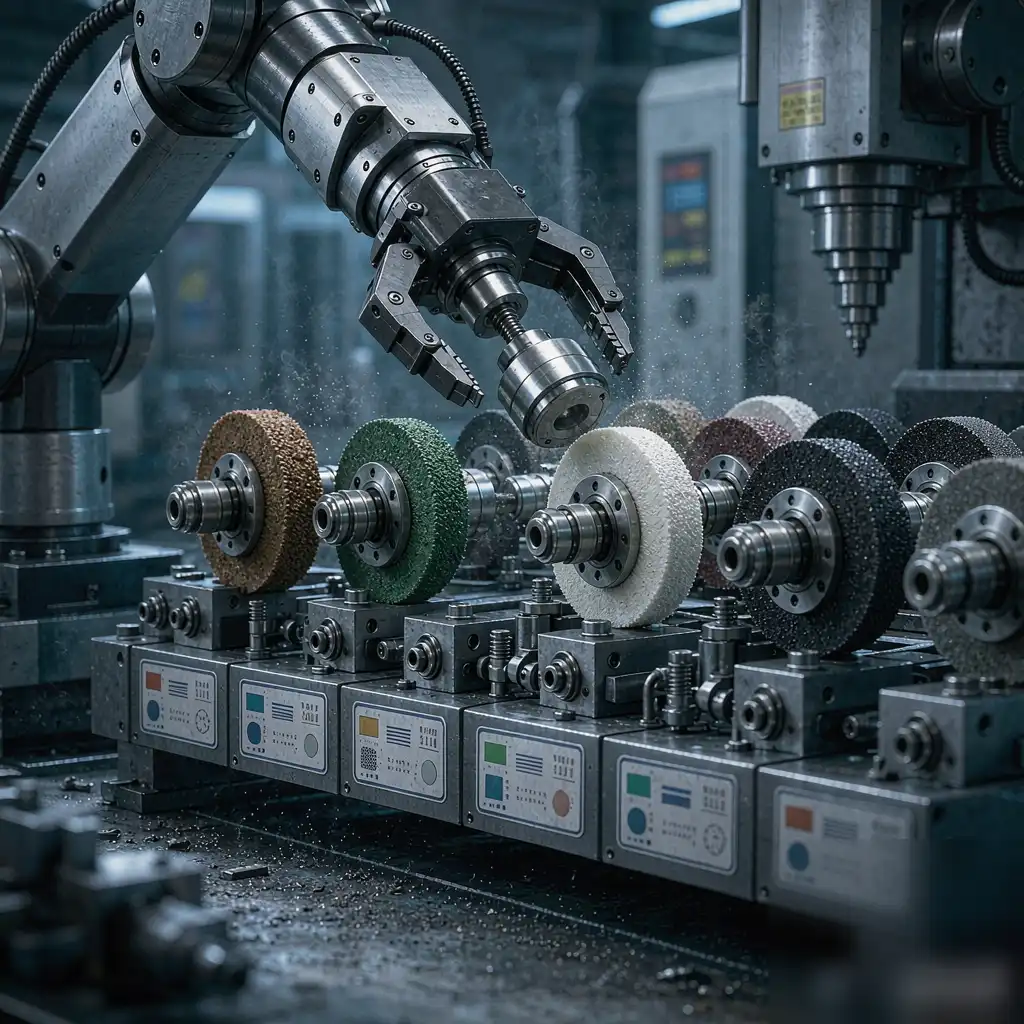
Moreover, robotic cells operate with far tighter repeatability than manual stations, which amplifies the effect of small abrasive mismatches. A wheel that works acceptably on a pedestal grinder can fail quickly under constant robotic feed. Consequently, selection criteria shift toward consistency, thermal control, and predictable wear.
The Anatomy of a Grinding Wheel
Every grinding wheel is a composite of abrasive grain, bond material, and porosity. The grain cuts the metal, the bond holds the grain in place, and the pores clear chips and carry coolant. Understanding this three-part structure is the first step toward rational grinding wheel selection.
Furthermore, each element can be tuned independently to suit robotic duty cycles. By adjusting grain type, bond strength, and pore volume, engineers control cut rate, surface finish, and wheel life together. This modularity is what makes wheel specification a precise engineering task.
Abrasive Grain Types and Their Mechanism
The abrasive grain is the heart of the wheel, and its fracture behavior determines how aggressively it cuts. Conventional aluminum oxide fractures readily to expose fresh edges, while ceramic grains self-sharpen under load for sustained performance. In contrast, superabrasives like cubic boron nitride resist wear on hardened steels.
Additionally, the grain choice interacts directly with robotic force control. A self-sharpening ceramic grain maintains a stable cutting profile, which lets the controller hold consistent contact force. That stability is exactly why many cells achieve robotic grinding consistency in metal finishing only after upgrading grain type.
Abrasive Type vs Application Matrix
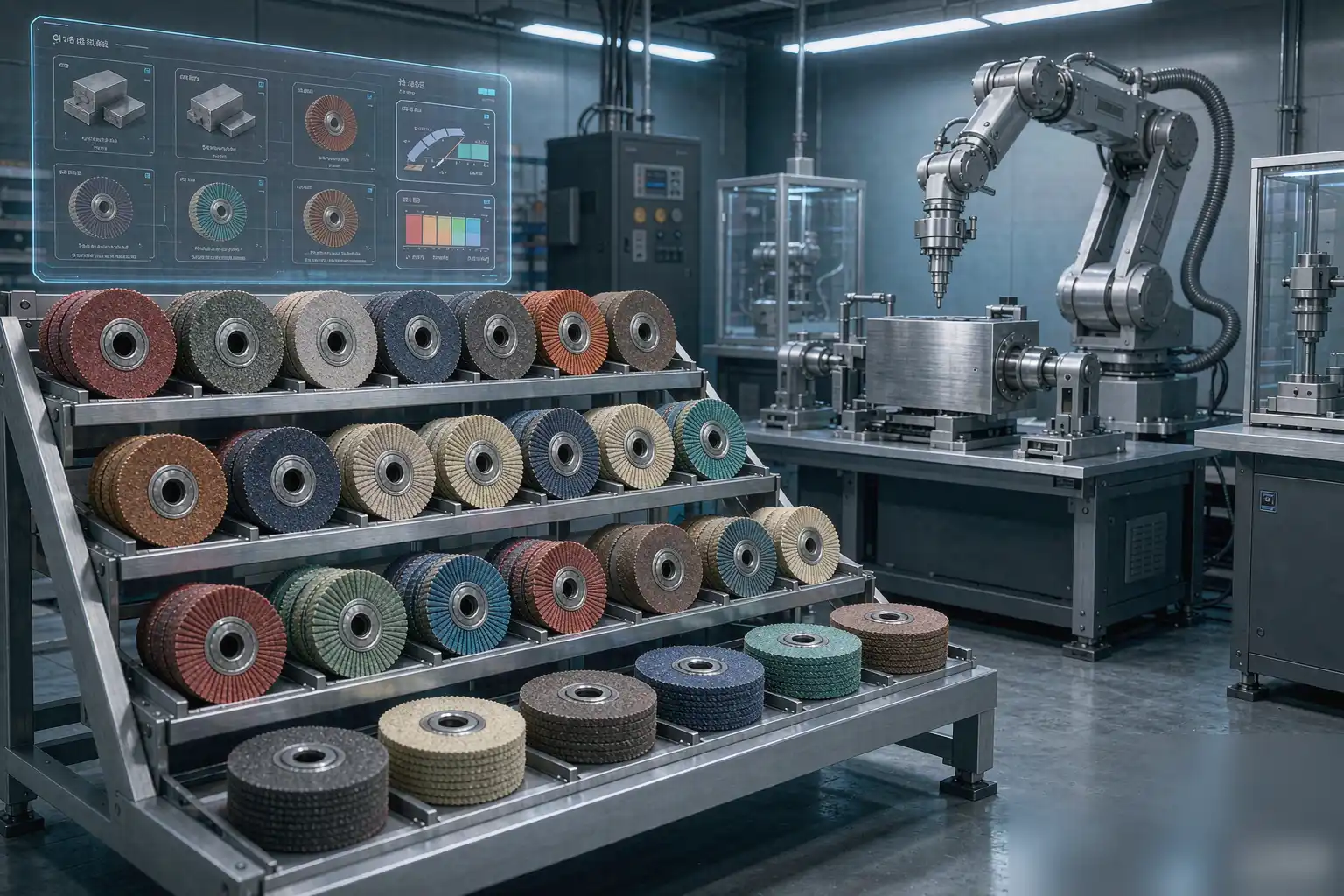
The table below maps common abrasive families to the robotic applications where they perform best. Use it as a starting reference before fine-tuning grade and grit for your specific part geometry.
| Abrasive Type | Best Robotic Application | Typical Workpiece | Key Advantage |
|---|---|---|---|
| Aluminum Oxide (A) | General deburring, light grinding | Mild steel, cast iron | Low cost, forgiving |
| Zirconia Alumina (Z) | Heavy stock removal | Stainless, high-alloy steel | Tough, slow wear |
| Ceramic (C) | High-rate precision grinding | Hardened steel, superalloys | Self-sharpening, cool cut |
| Silicon Carbide (SiC) | Non-ferrous, brittle materials | Aluminum, titanium, ceramics | Sharp, low pressure cut |
| Cubic Boron Nitride (CBN) | Hardened steel finishing | HRC 50+ components | Exceptional wheel life |
Selecting from this matrix narrows the field quickly, but the final choice still depends on bond, grit, and grade. The subsequent sections explain those levers in detail.
Bond Systems and Their Role
The bond holds grains until they dull, then releases them to expose new cutting points. Vitrified bonds are rigid and excel at precision grinding with strong coolant flow. Resin bonds absorb shock and suit robotic oscillation where impact loads vary.
Conversely, metal bonds support superabrasives and deliver the longest life on high-volume steel lines. Rubber bonds, though less common, produce fine finishes on contour-following paths. The bond decision therefore trades rigidity against compliance for the robot’s motion profile.
Grit Size and Surface Finish
Grit size controls the average scratch depth and thus the achievable roughness. Coarse grits (24–46) remove stock rapidly but leave a rough surface; fine grits (120–320) refine finish at lower material rates. Between these extremes, medium grits balance throughput with acceptable finish.
Additionally, grit must align with the robot’s path resolution. A very fine wheel on a coarse robot path yields no benefit because the motion error dominates the surface texture. Hence, specify grit only after the cell’s positional accuracy is known.
Wheel Hardness and Grade Selection
Grade describes how strongly the bond grips the grain, not the grain’s own hardness. A soft grade releases dull grains early, keeping the wheel sharp on hard materials. A hard grade retains grains longer, which suits soft materials that load the wheel.
Furthermore, robotic cells favor slightly softer grades than manual setups because constant feed accelerates dulling. By choosing a grade that self-dresses under load, engineers reduce unplanned stops. This small adjustment often improves consistent finish more than any single hardware change.
Wheel Speed and Robotic Force Control
Surface speed at the contact point governs heat generation and cut rate together. Robotic spindles typically run 20–45 m/s, below the limits of vitrified wheels but adequate for most steel grinding. The controller then modulates contact force to keep that speed effective.
Consequently, grinding wheel selection must include a force budget. Too much force fractures the bond prematurely; too little glazes the wheel and burns the part. A calibrated force window, matched to grade, is essential for stable automated output.
Coolant and Lubrication Strategy
Coolant extends wheel life and protects the workpiece from thermal damage during long robotic cycles. Flood coolant clears chips and lowers the contact temperature, while minimum-quantity lubrication reduces mist in enclosed cells. The choice shapes both wheel wear and finish quality.
In addition, some resin-bond wheels perform poorly with water-based coolant due to bond softening. Therefore, the coolant type should be locked in before the wheel is ordered, not discovered during commissioning. This coordination prevents costly rework of the entire abrasive package.
Dressing and Conditioning for Consistency
Dressing resets the wheel face by removing loaded material and restoring sharp grains. In robotic cells, scheduled dressing between batches keeps the cut rate predictable. Without it, the wheel glazes and the controller compensates with higher force, accelerating wear.
Moreover, in-process conditioning using a stationary diamond nib maintains geometry on contoured paths. This practice is central to the top automated robotic grinding questions raised by new adopters. A disciplined dressing plan turns wheel life from a guess into a measured variable.
Matching Wheels to Workpiece Material
Carbon steel pairs well with zirconia or ceramic on a vitrified bond for aggressive, cool cutting. Stainless demands free-cutting grains to avoid work hardening at the surface. Aluminum requires silicon carbide to prevent loading and smearing of the soft metal.
Similarly, titanium needs sharp, open-structure wheels with generous coolant to control its low thermal conductivity. Selecting against the material’s properties, rather than a generic catalog, is the difference between a cell that runs and one that struggles daily.
High-Mix Production Considerations
When a cell must serve many part variants, wheel changeover becomes a scheduling cost. Quick-change flanges and standardized wheel diameters reduce non-cutting time between families. A smaller wheel inventory with broad application range often beats a deep catalog.
Indeed, many shops achieve flexibility by standardizing on ceramic grain across several grades. This approach supports robotic grinding for high-mix low-volume production without multiplying SKUs. The result is simpler procurement and faster recipe changes.
Monitoring Wear and Predictive Replacement
Modern cells log spindle current, force, and cycle time to infer wheel wear before failure. A rising current draw at constant feed signals dulling and triggers a dressing or change. This data-driven method replaces fixed time intervals with actual condition.
Furthermore, tracking wear per part family builds a reliable life model for planning. Over time, the cell schedules wheel swaps during natural gaps, eliminating surprise downtime. Predictive replacement is where good grinding wheel selection pays back its engineering effort.
Safety and Compliance in Automated Cells
Wheels must carry the correct speed rating and be guarded per regional machinery directives. Robotic enclosures contain fragments, but the wheel still requires balanced mounting and verified spindle compatibility. Documentation should travel with each wheel specification.
Also, resin and rubber bonds degrade with age and storage heat, so rotation of stock prevents surprise failures. A simple first-in-first-out rule protects both safety and process stability. Compliance is not separate from selection; it is built into the spec sheet.
Common Mistakes in Wheel Selection
Engineers frequently over-specify hardness, assuming a harder wheel lasts longer, then fight glazing and burns. Others ignore coolant compatibility and watch resin bonds soften mid-shift. A third error is copying a manual grinder recipe onto a robot without adjusting grade.
Finally, many teams skip dressing validation and blame the abrasive for inconsistent finish. Avoiding these pitfalls starts with treating grinding wheel selection as a system decision. The wheel, robot, coolant, and dressing plan must be specified as one integrated process.
Building Your Selection Workflow
A practical workflow begins with the material and target finish, then narrows grain and bond from the matrix above. Next, set grade one step softer than manual, confirm coolant compatibility, and define a dressing interval from trial data. Finally, instrument the cell to monitor wear.
By following this sequence, process engineers turn abrasive choice from intuition into a repeatable method. The payoff is stable cycle times, lower scrap, and wheels that wear predictably under robotic duty. Strong grinding wheel selection is ultimately what separates a demonstrator cell from a production-proven one.
KEY POINT — Treat the wheel, robot, coolant, and dressing plan as one integrated system; tuning any single factor in isolation rarely solves chronic finish or wear problems.
Quick Reference Checklist
- Identify workpiece material and required surface finish first.
- Select abrasive grain from the application matrix, not from habit.
- Choose bond and grade for robotic feed, one step softer than manual.
- Confirm coolant compatibility before ordering the wheel.
- Define a dressing interval and instrument wear monitoring from day one.
PROCESS IMPACT — A corrected wheel specification typically cuts scrap by 20–40% and extends wheel life 1.5–3× versus a generic manual recipe on the same robotic cell.
This is educational content, not a specification or a quote.