

AT A GLANCE · The future of metal finishing is being reshaped by robotics, sensors, and software that now work together on the shop floor. Manufacturers no longer treat grinding, polishing, and deburring as purely manual trades but as data-driven processes. This shift helps plants raise surface quality while reducing their exposure to labor shortages. In the sections below, we map the trends that will define the next decade of finishing operations.
From Manual Craft to Programmable Process
For decades, finishing quality depended almost entirely on the skill of individual operators. Two workers could produce different results on the same drawing, and training a replacement took months of close supervision. Today, force-controlled robots repeat precise motions thousands of times without fatigue or inconsistency. Consequently, plants gain predictable surface results across every shift and every worker on the line. Moreover, programmable paths make it easier to audit, document, and steadily improve each cycle after the fact. As a result, finishing is becoming a measurable engineering discipline rather than a craft held by a few specialists. The change also makes output easier to hand to new staff without losing quality.
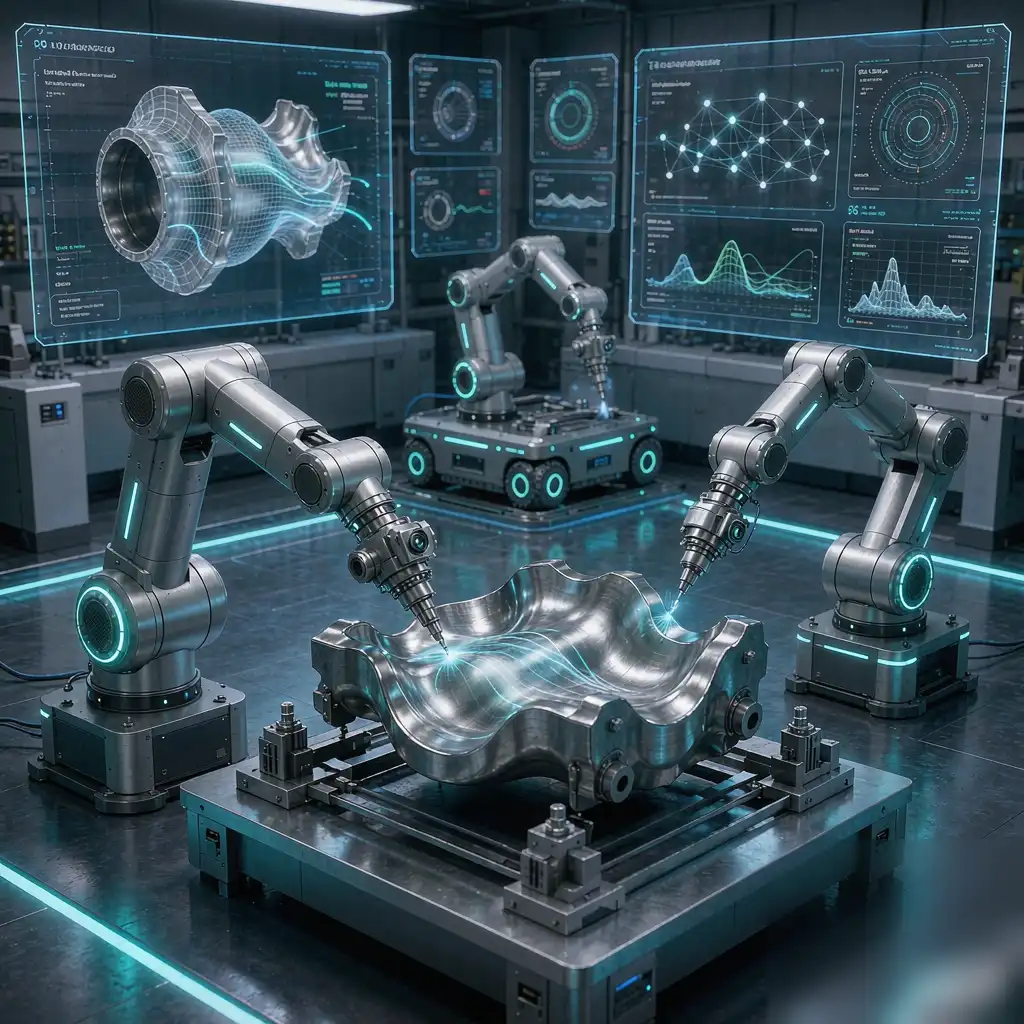
Force and Compliance Sensing Becomes Standard
Modern cells measure contact force in real time during grinding and polishing passes. As a result, the robot adjusts pressure the moment a part varies in dimension from the nominal model. This feedback loop prevents burn marks, gouges, and uneven material removal that manual work often hides until final inspection. Therefore, even thin-walled or soft components finish consistently from the first part to the last in a run. Plants report fewer reworks once compliance sensing becomes part of the baseline design rather than an expensive add-on. The sensor data also feeds continuous improvement by showing exactly where contact force drifted during production.
AI-Driven Path Planning Cuts Teach Time
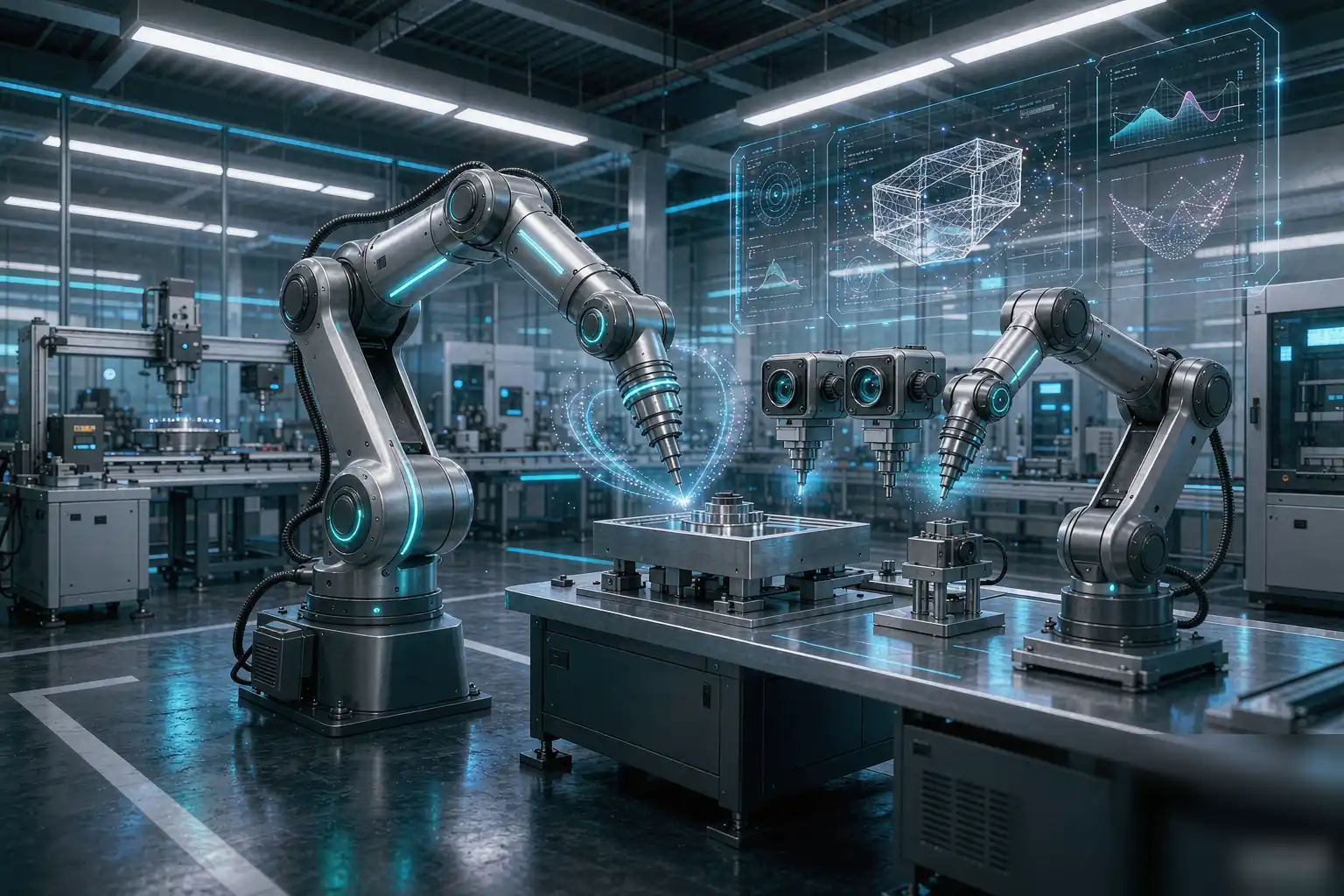
Programming a finishing path used to take hours of manual jogging and trial cuts on scrap material. Now, machine vision and learning models suggest tool routes directly from a CAD model in minutes. In addition, the system refines those routes after each batch using measured surface results from the line. This reduces setup from days to a single afternoon on many repetitive jobs. Forward-looking teams describe this change through smart surface finishing with AI and robotics, where planning and execution share one learning loop. The same models also flag when a part falls outside tolerance before polishing even begins.
The Rise of the Flexible Finishing Cell
Batch sizes are shrinking while part variety continues to grow across most machining shops. A flexible cell swaps tools and programs automatically between unrelated jobs on the same line without stopping production. Thus, one workstation now serves dozens of SKUs without manual reconfiguration or refixturing between orders. This adaptability protects margins when customer orders shift or new alloys arrive mid-quarter. We explore the economics of a flexible finishing cell for the future of metal surface treatment as more plants move away from single-purpose fixtures. The approach also smooths demand spikes that once required temporary manual labor.
FLEXIBILITY — A flexible cell pays back fastest when part variety is already high and batches are already small. Start there before automating high-volume work.
Collaborative Robots Extend Finishing Reach
Cobots bring robotic polishing and deburring to smaller shops that cannot justify full safety cages. They work safely beside operators on light buffing and edge-break tasks within a shared workspace. Because they are lightweight, integration costs stay low and floor space remains flexible for future changes. Furthermore, they free skilled staff to focus on inspection, programming, and process tuning instead of repetitive motion. Many mid-size plants now start automation here before scaling to fully enclosed high-rate cells. The low entry cost makes the first project easier to approve internally and to learn from quickly.
Digital Twins Validate Before Commissioning
Engineers now build virtual replicas of finishing cells long before steel arrives on the production floor. The twin simulates cycle time, contact force, and abrasive wear ahead of any real cutting. Accordingly, commissioning risks drop sharply because costly surprises surface inside software first. Teams also use the model to train new programs without stopping live output or risking scrap. This practice shortens payback and reduces the fear that often slows automation decisions among conservative managers. Reuse of the model supports later line expansions with far less trial and error.
In-Line Inspection Closes the Quality Loop
Cameras and laser profilometers check surfaces immediately after the final finishing pass. When a defect appears, the cell either flags the part or triggers an automatic rework cycle on the spot. Consequently, scrap falls and full traceability improves for every batch that ships to customers. This closed loop turns quality from a separate inspection step into continuous process control. Plants gain confidence to promise tighter surface specifications to demanding aerospace and medical customers. The data also helps suppliers prove compliance during audits without extra sampling.
Gripping and Fixturing for Complex Geometries
New soft and vacuum grippers hold delicate castings without leaving contact marks on finished faces. At the same time, modular fixturing shortens changeovers from hours to minutes on mixed-model lines. Therefore, complex shapes move through automation that once demanded careful, slow hand work by experienced staff. The result is broader applicability across medical, aerospace, and consumer hardware components. Shops gain the freedom to automate jobs they previously rejected as too fragile or too varied. Better gripping also reduces the risk of dropping costly machined parts during transfer.
Sustainability Reshapes Consumables and Dust
Water use, grinding slurry, and airborne dust now face tightening environmental and safety rules in many regions. Robotic cells enable dry polishing and closed-loop filtration that captures particles at the source before they spread. Hence, plants cut waste volume and energy per finished part at roughly the same time. These gains matter more as compliance costs rise and permits grow harder to obtain. Leaders treat sustainability as a cost lever rather than a reporting burden to endure. Lower consumption also reduces the variable cost tied to each shipped component.
Workforce Roles Shift Toward Supervision
Automation does not remove people; it changes the work they do each day on the floor. Operators become cell supervisors who manage programs, data, and exceptions rather than filing by hand. Meanwhile, demand grows for technicians who can tune force profiles and interpret surface scans accurately. Plants that train early avoid the skills gap that slows later adopters during peak demand. Upskilling turns a feared disruption into a clearer, better-paid career path for existing staff.
- Cell supervisors who monitor programs and exceptions in real time
- Process technicians who tune force and speed profiles
- Quality analysts who read surface scans and trend data
Each role builds on existing shop knowledge rather than replacing it. Therefore, training investment stays practical, local, and easier to justify to leadership.
Edge Computing Keeps Control Local
Finishing data now stays close to the machine through compact edge computing nodes on the line. Because latency matters, local processing enables instant force and speed adjustments during a single pass. In turn, plants feed dashboards that predict tool wear before a belt or disc fails mid-job. This connectivity supports steady, evidence-based improvement without sending every record to the cloud. Security also improves when sensitive process data remains on the factory-owned network. Local control keeps production running even if the wider enterprise network drops temporarily.
Modular Cells Lower the Upgrade Barrier
Suppliers are converging on modular cell designs with standard mechanical and software interfaces. Standard links let shops mix arms, spindles, conveyors, and vision without custom fabrication for each project. As a result, upgrades become incremental rather than costly rip-and-replace investments that freeze capital. This lowers the barrier for plants that want to start small and expand as demand grows. The trend makes automation a staged investment instead of an all-or-nothing bet on one vendor. Open interfaces also reduce the risk of long-term technology lock-in.
Maturity Snapshot Across Key Trends
The table below rates where each trend stands today and how ready most plants are to adopt it. Use it to sequence your own roadmap rather than chasing every headline at once.
| Trend | Impact on Finishing | Plant Readiness |
|---|---|---|
| Force compliance sensing | Fewer defects, stable quality | High — proven, available |
| AI path planning | Lower teach time, faster changeover | Medium — emerging |
| Flexible cells | More SKUs per line | Medium — growing |
| In-line inspection | Less scrap, full traceability | High — proven |
| Edge connectivity | Predictive wear, better security | Low — early |
Most plants should begin with proven items and pilot the emerging ones in parallel. This balanced approach limits risk while building internal capability. Readiness improves fastest when teams touch the technology directly rather than only reading about it.
Outlook to 2030 and Beyond
The next five years will blend these trends into default practice rather than isolated novelty. Early adopters already treat finishing as a measurable, connected process with clear ownership and targets. Going forward, the gap between leaders and laggards will widen as collected data compounds into advantage. Planning now preserves options later when capital and floor space grow scarce during recovery. Our view of the latest industrial surface finishing technologies in 2026 shows momentum building across every major region. The plants that start pilots this year will lead the next procurement cycle.
WHAT TO WATCH — Track force-sensing cost per cell, AI teach-time savings, and scrap reduction from in-line inspection. These three metrics signal when automation clears your payback target.
ROI estimates assume stable volume and the cited yield gains; model your own numbers before investing.