

In-House Finishing Automation vs Outsourcing: A Cost Model
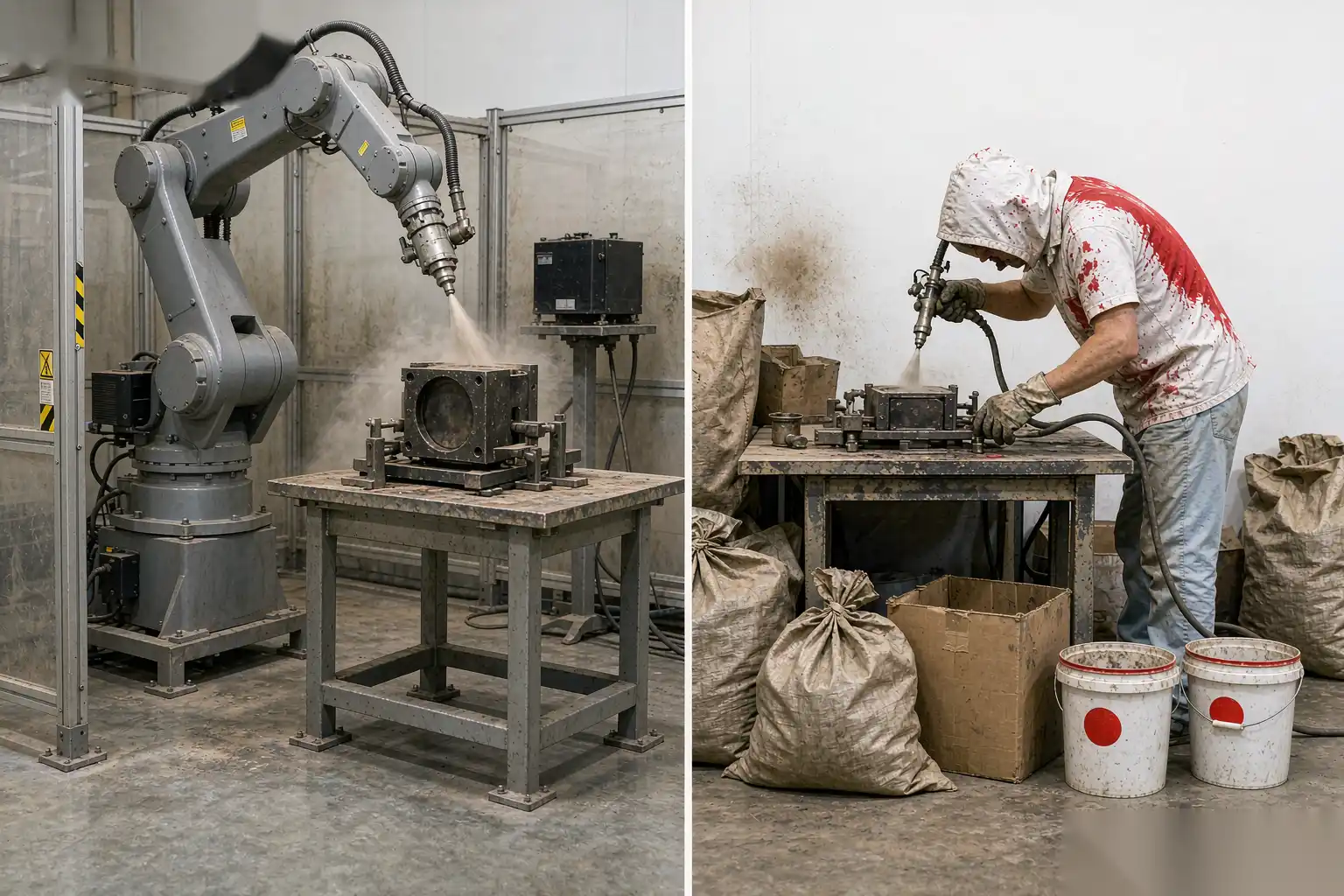
Most die casters reach the build-versus-buy question the same way: a finisher quotes a 6 to 9 percent increase on deburring and polishing, the lead time stretches from five days to three weeks, and a shipment comes back with 4 percent reject because the subcontractor changed an abrasive without telling anyone. At that point the plant manager asks whether it is cheaper to run the finishing in-house with a robotic cell. The answer is rarely a simple yes or no. It is a function of annual volume, part mix, intellectual property, and how much quality risk you can tolerate on a customer’s doorstep.
This article builds a cost model you can drop your own numbers into. We will separate the visible cost of outsourcing from the hidden cost, put a realistic capital and operating figure on a DZ Machinery robotic finishing cell, and show a worked payback table for a bracket running at 180,000 pieces per year. We will also set out the cases where sending parts out is still the rational choice.
The build-versus-buy decision in die casting finishing
Before any number is written, four triggers decide whether the question is even worth modeling. If your operation hits two or more of these, in-house automation deserves a serious engineering study rather than a reflexive quote comparison.
- Annual finished volume above roughly 120,000 pieces of a single family, where the per-piece handling and freight cost stays constant while your volume climbs.
- A part mix that changes slowly, so a dedicated fixture and tool path amortize over years instead of months.
- Proprietary geometry or surface specification you do not want to ship as a CAD file and a sample to an outside shop.
- Customer lead-time expectations under two weeks that an outside finisher cannot reliably meet because they batch your parts behind three larger accounts.
The reverse triggers push you toward outsourcing. If you run 30 different part numbers at 2,000 pieces each, a single robotic cell will spend more time in changeover than in cutting. If the finish spec is cosmetic Grade A on a consumer face where 1 percent visual reject is acceptable to the customer, a manual outside shop with skilled labor may beat a robot on first-cost. If your demand swings 3x seasonally, owned capacity sits idle for months and eats the payback.
A useful first screen is labor exposure. The article on polishing labor shortage automation covers why manual finishing headcount is hard to staff and retain in most markets we serve. When a finisher quotes a price that only works because they pay low wages, that price is unstable. Your cost model should treat outsourced unit price as a moving target with annual escalation, not a fixed input.
What outsourcing really costs beyond the unit price
The quoted price per piece is the smallest and least informative number in the decision. A die caster comparing a 0.85 USD outsourced finish against an in-house fully-burdened 0.62 USD is often comparing the wrong things. Build the outsourced total cost of ownership line by line.
- Unit finishing price, quoted at a specific annual volume and a specific part revision. Re-quote every 12 months; assume 4 to 8 percent annual escalation in labor-heavy regions.
- Freight both ways. Castings are dense. At 2.4 kg per piece and 180,000 pieces per year, you move 432 tonnes of material across the gate twice. At a blended 0.06 USD per kg landed, that is roughly 52,000 USD per year before any packaging.
- Minimum order quantities and batch sizing. Outside shops batch to fill a line. If your customer pulls 5,000 pieces a week but the finisher runs 20,000 at a time, you carry 15,000 pieces of finished-goods inventory at perhaps 0.40 USD per piece in tied-up cost and warehouse space.
- Quality risk and rework. Field reject at the customer is the expensive failure mode. A 2 percent return-and-rework loop, with freight, sorting, and scrap at 30 percent of the piece, can add 0.05 to 0.12 USD per piece in true cost even when the finisher “warrants” the work.
- Communication and engineering overhead. Every drawing change, every complaint, every first-article approval costs your quality and purchasing staff time. Budget 4 to 8 hours per month at fully-burdened engineering rates; small in absolute terms but real.
- Lead-time risk. An outside bottleneck that slips your delivery commits you to premium freight to the end customer. Model at least one slip event per year at a realistic penalty.
The point is not that outsourcing is bad. It is that the 0.85 USD quote is closer to 1.10 to 1.35 USD of true cost once freight, inventory, and risk are loaded. That is the number your in-house cell must beat.
The capital and operating cost of a DZ robotic finishing cell
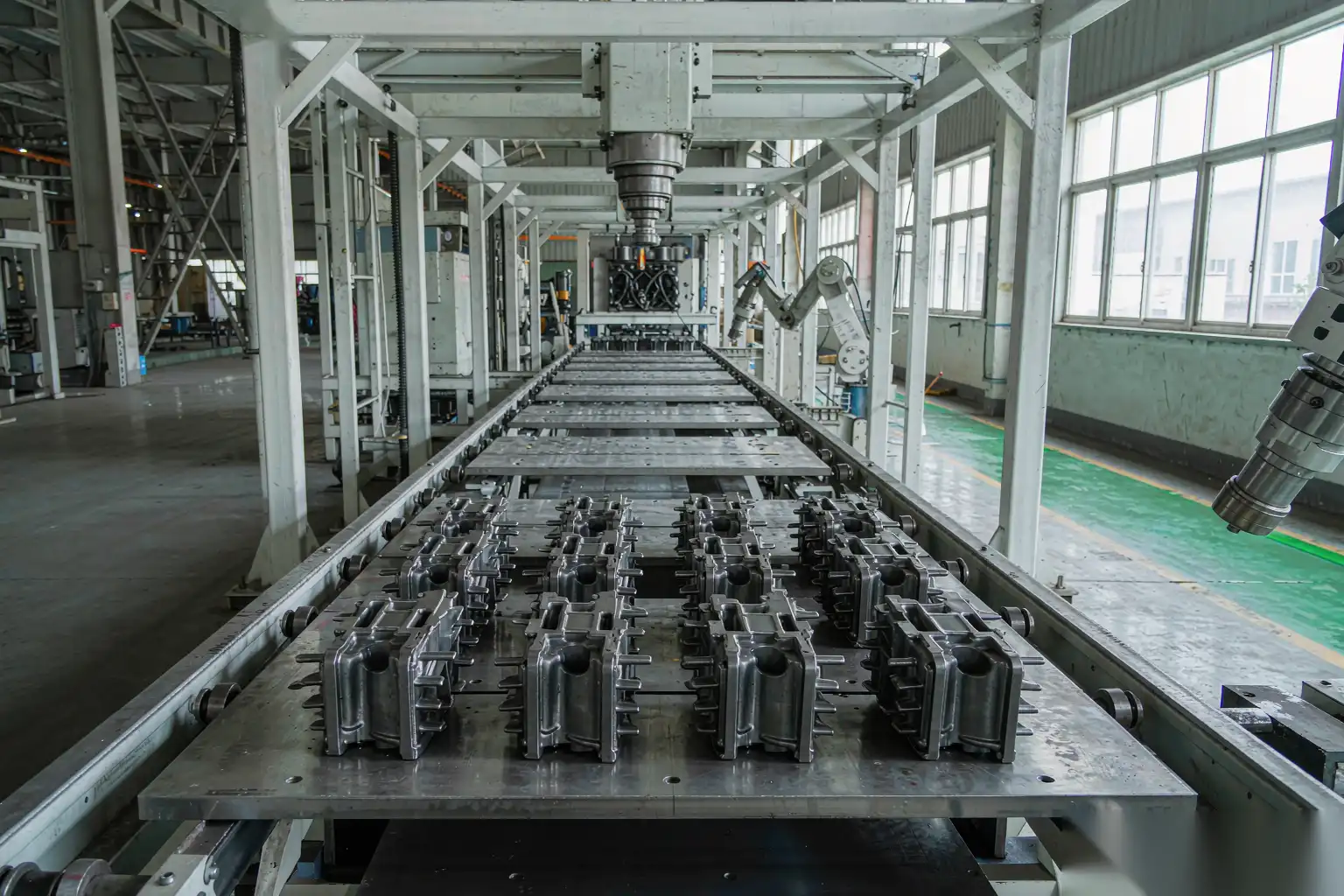
A DZ Machinery robotic deburring and polishing cell for aluminum die castings is built around a 6-axis robot with force-controlled floating spindles, a multi-station rotary table, automated abrasive belt stations, and an integrated dust collection enclosure. For a mid-size bracket family the typical configuration looks like this.
- One 6-axis robot, repeatability 0.05 mm, payload sized for the fixture and tool, not the part.
- Two to three processing stations: a belt grinding station for gate and parting-line removal, a flap-wheel or non-woven station for edge radiusing, and a buffing or polish station where the spec demands it.
- A 2-position or 4-position rotary index table so load and unload overlap cycle time.
- Force-feedback control on the spindles so the tool follows casting variation instead of grinding a fixed path into scrap.
- Enclosure, dust extraction rated for aluminum fines, and light-curtain safeguarding.
- Fixturing designed per part family, with quick-change locators for revision changes.
Capital range for this class of cell, installed and commissioned, runs roughly 180,000 to 320,000 USD depending on station count, robot payload, and whether polishing to a mirror cosmetic grade is required. A deburring-plus-light-edge-break cell sits at the low end; a full deburr-plus-polish cell with automatic wax feed and multiple wheels sits at the high end.
Operating cost per year:
- One operator per cell at a supervisory level (the cell self-loads and unloads in most layouts), roughly 0.5 to 1.0 FTE depending on part handling.
- Abrasive consumables: belts and wheels wear. For a bracket at 180,000 pieces per year, consumable cost lands near 0.04 to 0.07 USD per piece.
- Electricity: the robot, spindles, and extraction draw 8 to 14 kW peak, about 0.02 to 0.03 USD per piece at industrial rates.
- Maintenance and spare tooling: budget 8,000 to 14,000 USD per year for belts, spindle bearings, and preventive service.
- Floor space: a complete cell occupies roughly 18 to 28 square meters including the load buffer and extraction.
The detail that surprises first-time buyers is how much of the cost is in fixturing and process development, not the robot. We spend more engineering hours tuning the force profile and belt sequence than we do mounting the arm. That development cost is a one-time item, typically 15,000 to 30,000 USD, and it is what makes the cell hold tolerance on a real casting with real variation.
The piece-cost math for a DZ cell depends entirely on volume, because the capital recovery is fixed. At 180,000 pieces per year and a 4-year straight-line recovery of 250,000 USD capital plus 30,000 USD development, the fixed burden is about 0.39 USD per piece before labor and consumables. Add labor at roughly 0.10 USD per piece, consumables at 0.05 USD, and energy plus maintenance at 0.05 USD, and the in-house fully-burdened cost lands near 0.59 USD per piece. Against the true outsourced cost of 1.10 to 1.35 USD, the cell wins by a wide margin at this volume.
A worked payback model
The table below models a representative aluminum bracket, 2.4 kg, deburr plus edge break plus light polish, at 180,000 pieces per year. Figures are fully-burdened annual costs in USD. Replace the inputs with your own; the structure holds.
| Cost element | Outsourced (true cost) | In-house DZ cell | Note |
|---|---|---|---|
| Unit finish price | 0.85 x 180,000 = 153,000 | 0 | In-house has no unit price |
| Freight both ways | 52,000 | 0 | Internal transfer only |
| Finished-goods inventory carry | 36,000 | 12,000 | Smaller batches in-house |
| Quality rework and returns | 18,000 | 4,000 | Tighter process control |
| Capital recovery (4 yr) | 0 | 62,500 | 250,000 cell + 30,000 dev |
| Labor | 0 | 18,000 | 0.5 FTE supervisory |
| Consumables | 0 | 9,000 | Belts and wheels |
| Energy and maintenance | 0 | 9,000 | Extraction, spares |
| Annual total | 259,000 | 114,500 | |
| Cost per piece | 1.44 | 0.64 |
At these assumptions the in-house cell saves roughly 144,500 USD per year against the true cost of outsourcing. Against the 280,000 USD installed capital and development, the simple payback is under 2 years. Even if you discount the savings by assuming the outsourced quote stays flat (it will not), payback remains under 3 years.
Sensitivity matters more than the point estimate. Drop volume to 90,000 pieces per year and the fixed burden per piece roughly doubles to about 0.78 USD, pushing the in-house cost to near 1.03 USD per piece. The cell still beats the 1.44 USD true outsourced cost, but the margin narrows and the payback stretches past 3 years. Below about 60,000 pieces per year of a stable family, the model usually flips in favor of outsourcing unless IP or lead-time constraints dominate.
Floor space, labor, and throughput trade-offs
A robotic cell is not free of constraints, and the cost model above hides a few real trade-offs you should plan for before committing capital.
- Throughput ceiling. A single cell with a 2-position table typically sustains 400 to 900 pieces per hour depending on cycle time and stations. If your casting line produces 1,200 pieces per hour, one cell cannot keep up and you either buffer or run two cells. The capital number scales with that decision.
- Labor shifts from doing to supervising. You do not eliminate the operator; you reduce one finishing line of 4 to 6 people to roughly half an FTE per cell who loads, monitors, changes abrasives, and handles exceptions. The saving is real but it is a reduction, not a zero.
- Floor space is opportunity cost. Twenty-five square meters taken by a cell is twenty-five square meters not available for another use. In a plants global south or Germany where floor rent is real, charge it. At 120 USD per square meter per year, 25 square meters is 3,000 USD annually, small but part of the burden.
- Changeover time. Fixture swaps between part families take 20 to 60 minutes including re-teach and first-article check. A mixed, low-volume plant lives in changeover; a single-family high-volume plant barely sees it. This is the single biggest reason the same cell is economic for one shop and not the next.
These trade-offs are why we recommend modeling at your actual part-family distribution, not at a single hero part. The robotic cell OEE and uptime improvement discussion explains how availability and changeover losses flow through to effective piece cost, and it is worth reading before you finalize the throughput row in your model.
When outsourcing still wins
The model above is built to be honest about where it loses. There are clear cases where sending finishing out is the better engineering and financial decision.
- Low and lumpy volume. Under roughly 60,000 pieces per year of a stable family, the fixed capital recovery dominates and the in-house cost per piece exceeds outsourced true cost.
- Wide part mix with frequent revision. If you run dozens of part numbers that each change every quarter, fixture and path development cost outruns the savings. An outside shop absorbs that variety across many customers.
- Cosmetic Grade A consumer faces where skilled hand finishing produces a look a robot path cannot yet match at first cost. For many faucet and hardware faces this is still true, which is why DZ also builds polishing lines for exactly that segment, but for a bracket it is rarely the constraint.
- Bridge capacity during demand spikes. Owning to peak means paying for idle machines in the trough. A sensible hybrid keeps a base load in-house and spills surge volume to a finisher.
- No internal maintenance capability. A robotic cell needs someone who can diagnose a spindle fault and recalibrate a force profile. If your plant has no automation maintenance skill, the cell downtime will erase the savings. Build that capability or budget for a service contract before you buy.
A pragmatic structure many of our customers land on is a base-in-house, surge-outsourced hybrid: own one cell sized to 70 percent of average demand, and contract the top 30 percent of peak to a finisher. This caps capital while keeping lead time and IP control on the steady volume.
Integrating the cell with your casting line
The cost model assumes the cell runs at its rated throughput, which only happens if it is integrated with the casting and trimming operation rather than treated as a standalone island.
- Position the cell adjacent to the trim press so castings move in still-warm handling fixtures, cutting the load-unload labor and the risk of mis-oriented parts.
- Feed the cell from a conveyor or pallet buffer sized to cover one casting-machine cycle plus the robot cycle, so a brief trim-press stop does not stall the robot.
- Share quality data. The cell should report per-piece cycle, abrasive runtime, and force deviations back to the same dashboard as the casting machine, because a drift in shot profile shows up first as a change in deburring force. The aluminum die casting cost factors guide details how scrap and cycle losses upstream flow straight into finishing cost downstream.
- Plan the fixture as part of the tooling, not an afterthought. We design the locator surfaces from the trimming die datum so the part is held consistently from trim through finish, which is what lets the force-controlled spindle hold edge break within 0.2 mm.
When the cell is integrated this way, the effective throughput rises and the labor burden falls, which improves the payback beyond the standalone numbers in the table. It also means the quality loop closes: a casting defect is caught at finish rather than at the customer.
Building the case on your own numbers
The model here is a framework, not a quote. Pull your last 12 months of outsourced finishing spend, add the freight and inventory you probably are not tracking, and compare against an installed cell cost we can scope from your part drawings. The decision is almost never about the robot. It is about volume stability, part-family concentration, and whether you can staff and maintain the automation. Get those three right and the payback math usually writes itself.
DZ Machinery builds force-controlled robotic deburring, grinding, and polishing cells for aluminum and zinc die castings, and we scope the capital, throughput, and payback with you from your actual part drawings and annual volumes before any equipment is ordered. Talk to our engineering team about your finishing volume and we will model the cell against your current outsourced cost.