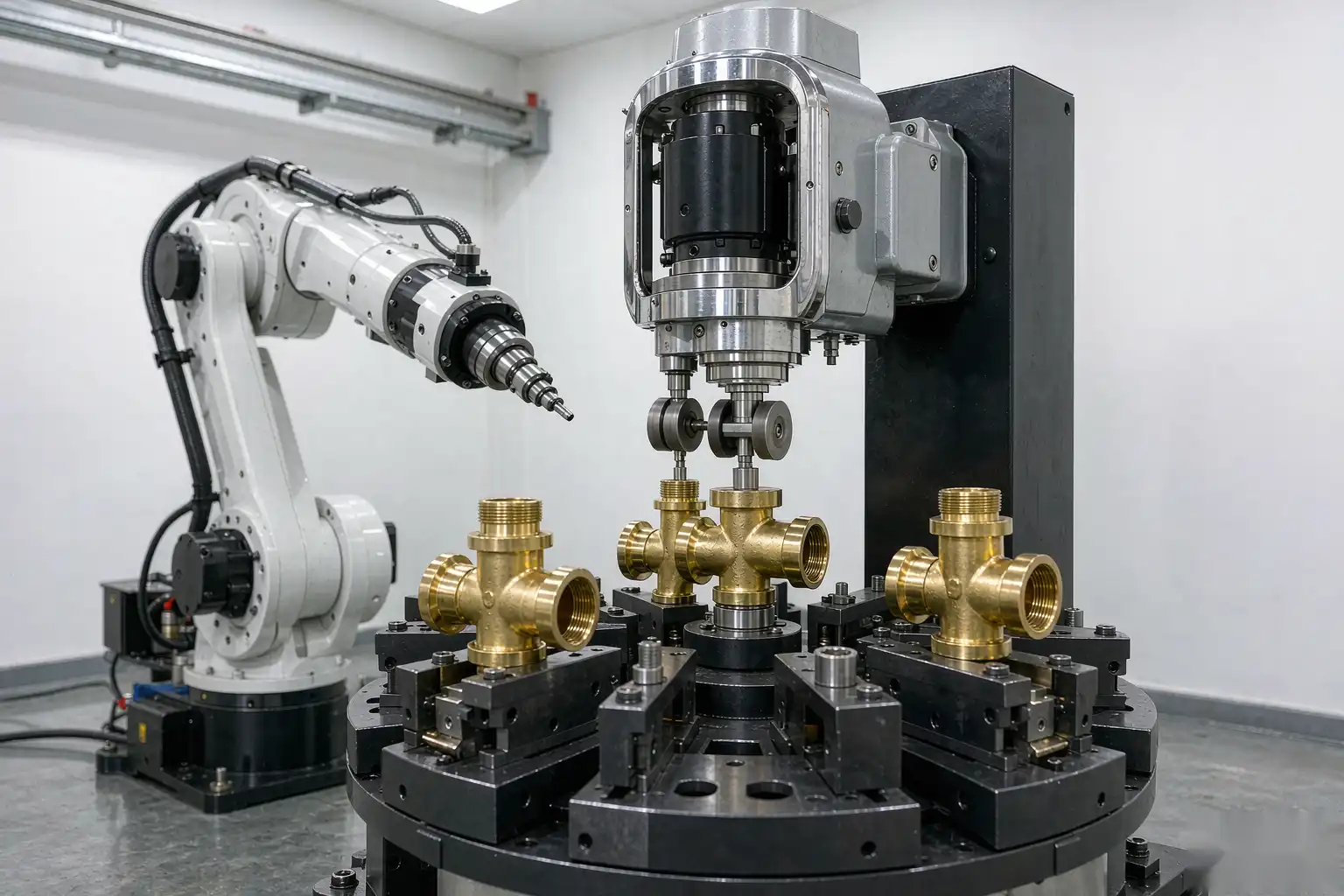



QUICK FACTS
| Typical cycle | 20–120 s/part |
| Spindle range | 6,000–18,000 RPM |
| Force control | Active compliance ±5 N |
Deburring machine specifications look precise and mean different things across builders. Two machines quoting identical numbers can perform very differently, because the measurement conditions behind those numbers vary. This guide separates the parameters that predict performance from the ones that decorate brochures.
We walk the spec sheet line by line, explain what each parameter actually governs, and give you a template for writing requests that force comparable answers.
Anatomy of a Deburring Spec Sheet
Spec sheets organize roughly into five groups: motion, spindle, tooling, control, and peripherals. Each group contains parameters that matter and parameters that sell. Learning the difference takes one careful reading.

| Group | Parameters That Matter | Often Decorative |
|---|---|---|
| Motion | Repeatability, axes, working envelope | Maximum speed |
| Spindle | Continuous power, speed range, runout | Peak power |
| Tooling | Compliance method, changer capacity | Max tool diameter |
| Control | Force control resolution, programmability | Screen size |
| Peripherals | Extraction capacity, guarding class | Cabinet color |
Spindle Parameters That Predict Performance
The spindle does the work, so its parameters deserve the closest reading. Three matter and one routinely misleads.
Continuous Power, Not Peak
Peak power ratings describe brief bursts. Continuous duty ratings describe what the spindle sustains through a shift. Deburring loads are intermittent but repeated, so continuous rating governs your cycle times. Always ask for both and compare the continuous figure.
Speed Range and Control
Different tools need different speeds. Brushes, blades, and rotary files each have optimal ranges. A spindle with a wide, well-controlled range handles more part types. Verify that speed is controlled under load rather than only at idle.
Runout Specification
Spindle runout determines edge quality and tool life. Quality builders specify runout at the nose in microns, measured to a standard. A spec sheet silent on runout is either hiding a number or not measuring one. Ask directly.
The Misleading One: Maximum Torque
Maximum torque sounds important and is rarely the constraint in deburring. Deburring removes small amounts of material at relatively high speed. Torque matters far less than speed stability under varying load, which almost nobody publishes.
Motion Parameters That Matter
Motion specifications determine what geometry the machine can reach and how consistently it returns. Two parameters dominate.
Repeatability Over Accuracy
Accuracy describes hitting an absolute position. Repeatability describes returning to the same position every time. Deburring cares far more about repeatability, because programs are taught relative to the part rather than to absolute coordinates.
Ask how repeatability is measured: at what speed, at what load, at what temperature, and over how many cycles. Conditions change the number substantially, and builders quoting favorable conditions are not lying but are not comparing either.
Working Envelope Versus Part Size
The envelope must contain your part plus the tool plus approach paths. Builders quote envelope as empty space. Your part plus fixture plus tool holder needs more room than the part alone suggests. Add clearance generously.
Force Control: The Parameter Most Buyers Miss
Force control separates machines that handle casting variation from machines that fight it. Three specifications describe its quality, and they are frequently omitted.
| Force Parameter | What It Governs | Good Target |
|---|---|---|
| Resolution | Finest force adjustment | 1 N or better |
| Response time | How fast it reacts to variation | Under 20 ms |
| Stability range | Force held across part positions | Within 5% of setpoint |
Machines without force control rely on rigid paths, which work beautifully on consistent machined parts and struggle on castings. Match the capability to your actual part variation rather than buying the most sophisticated option by default.
Our deburring process optimization guide explains how force settings interact with feed rate and tool condition in production.
Tooling and Compliance
Tooling determines what materials and geometries the machine handles. Compliance determines how it handles variation. Both deserve specification.
Compliance Method
Compliance can be mechanical, pneumatic, or servo-controlled. Mechanical compliance is simple and robust. Pneumatic compliance is tunable and common. Servo compliance is most precise and most expensive. Match the method to your variation and budget.
Tool Changer Capacity
Capacity should exceed your current tool count with margin. Tools wear, and duplicate tools extend runtime between changes. Six to ten pockets suits most casting work; single-process parts need fewer.
Tool Holders and Standardization
Standard tool holders let you source consumables competitively. Proprietary holders lock you to one supplier for years. Ask which standard the machine uses, and prefer common interfaces where performance allows.
Control Platform Considerations
Control capability shapes daily life more than most hardware specifications. Four questions reveal the platform’s character.
How quickly can an operator modify a path? Watch this live rather than accepting a description, because interface design varies enormously and directly affects your changeover time.
What diagnostics does the platform expose? Machines that report force traces, cycle times, and error histories turn troubleshooting into data analysis. Machines that report errors as codes leave you guessing.
Is the platform supported in your region? A capable platform with no local support is a risk. Verify the support network before valuing the features.
Can programs transfer to other machines? Standard program formats protect you from vendor lock-in and simplify adding a second machine later.
Parameters That Mislead Buyers
Three specifications routinely appear prominently and matter less than buyers assume.
Maximum traverse speed affects air time, not cutting time, and deburring cycles are mostly cutting. A faster traverse shortens non-productive motion marginally and says nothing about process capability.
Number of axes sounds decisive but only helps if your parts need the extra articulation. A five-axis machine deburring flat plates is spending money on unused freedom.
Positional accuracy at no load is a laboratory number. Your machine cuts under load, at temperature, with tool wear. Loaded repeatability is the number that predicts your production results.
A Spec Template That Forces Comparable Answers
Write your request for quotation around this template. Every builder answers the same rows, and comparison becomes straightforward rather than interpretive.
| Specification | Required Value | Measured Under |
|---|---|---|
| Spindle continuous power | kW | Full duty cycle, stated ambient |
| Spindle runout | microns at nose | Named standard |
| Repeatability | mm | Loaded, at operating temperature |
| Force control stability | % of setpoint | Across stated part variation |
| Changeover time | minutes | Between two named part families |
| Availability target | % | From installed machines, not design |
The last row is the one builders resist most and the one that matters most. Design availability is a calculation; installed availability is a fact. Ask for the fact.
For guidance on evaluating the builder behind the spec sheet, our deburring machine manufacturer selection guide extends this rigor to vendor assessment.
Verification at Acceptance
Specifications earn trust when verified on your parts. Build acceptance testing around the same parameters your RFQ specified, and measure with your instruments.
Run your three hardest parts, at production variation, for a full shift. Measure edge quality, cycle time, and dimensional change. Compare against the quoted numbers and discuss gaps before final payment rather than after.
Document the results. The record protects you during warranty disputes and becomes your baseline for detecting drift in later years. Good commissioning records are the cheapest insurance in automation.
Environmental and Utility Specifications
Utilities rarely appear in comparisons and regularly disrupt installations. Power requirements vary by region, and machines built for one grid may need transformers for another. Verify voltage, phase, and frequency early.
Compressed air requirements deserve equal attention. Deburring tools and compliance systems consume air steadily, and undersized supply causes force instability that looks like a machine defect. Size the supply from the specification, not from the machine you are replacing.
Our automated surface finishing budget guide includes utility upgrades among the hidden costs that most capital requests omit.
Specification Drift After Purchase
Specifications describe a new machine, and machines change with use. Establish a baseline at acceptance and re-measure annually to detect drift before it affects production quality.
Spindle runout, repeatability, and force stability all drift measurably. Annual checks convert surprises into scheduled maintenance, and the records also support resale value when the machine eventually moves on.
Software Licensing and Future Costs
Ask whether software features require ongoing licenses. Some platforms charge annually for advanced functions like force control or vision integration, and those fees belong in your operating budget rather than surfacing as surprises.
Confirm that updates are included and that programs remain editable without a service contract. Software terms rarely appear on spec sheets and regularly cost more over five years than buyers expect.
Reading Specs Like an Engineer
Deburring machine specifications reward skepticism and punish literal reading. Ask how each number was measured, under what conditions, and against which standard.
Focus on continuous power, loaded repeatability, force stability, and runout. Treat maximum speed, axis count, and peak torque as secondary. Match capability to your real part variation rather than to the most impressive number on the page.
Then verify at acceptance, on your parts, with your instruments. That final step converts specifications from promises into facts, which is the only form in which they actually help you.
Safety and guarding requirements vary by region — follow local codes and OEM guidance.