

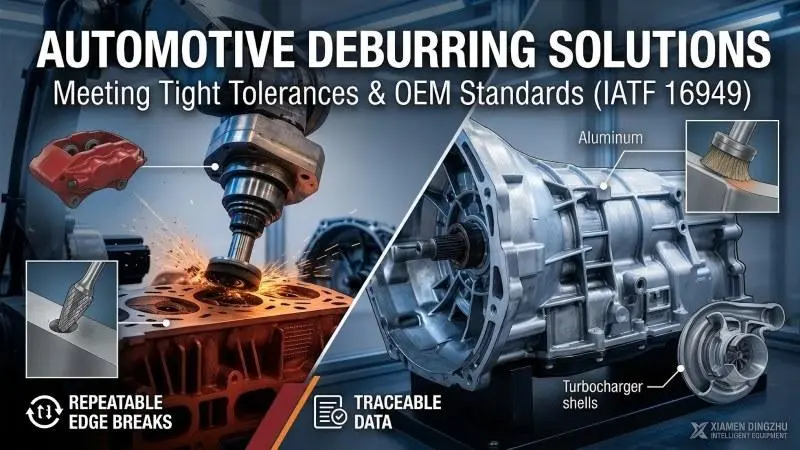
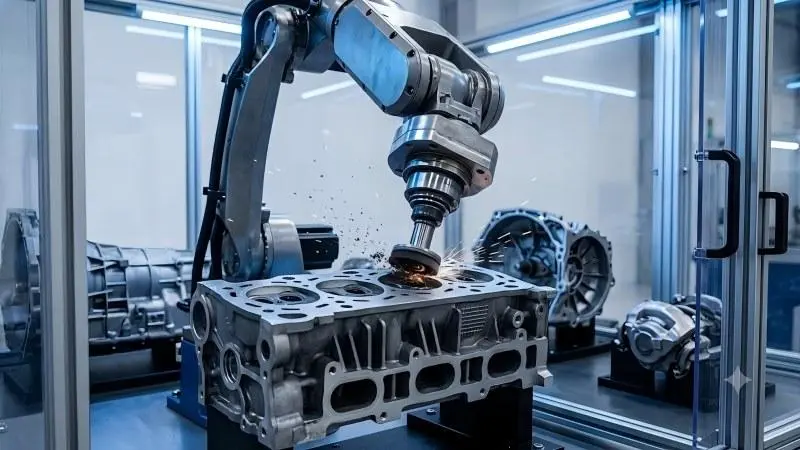
Automotive castings — cylinder heads, transmission housings, brake calipers, turbocharger parts, and suspension brackets — carry some of the tightest deburring tolerances in the metalworking industry because burrs directly threaten sealing surfaces, bearing bores, and fluid passages. A deburring machine for automotive parts must therefore deliver repeatable edge breaks, never compromise a critical datum, and integrate with the high cadence of automotive supply lines. NADCA data shows die-cast automotive components can require up to 12 separate finishing operations; consolidating them on automated equipment is a primary cost lever for Tier-1 and Tier-2 suppliers.
Why Automotive Deburring Is Different
Automotive parts are rarely single-feature. A cylinder head may need flash removed from parting lines, cross-holes chamfered, and oil galleries cleaned of brittle burrs that could later enter the lubrication system. The deburring machine must be programmed per feature, often using a mix of rotary brushes for soft edges and carbide burrs for hard iron. For a broader view, see our guide to iron casting deburring.
Common Automotive Part Families and Their Needs
- Aluminum die-cast housings: thin walls, risk of deformation — use compliant low-force brushing at 12,000–16,000 RPM.
- Brake calipers (ductile iron): hard burrs at drilled holes — carbide burr or coated abrasive at 8,000–10,000 RPM.
- Turbocharger shells: tight internal passages — often tumble or flow-finishing rather than robotic.
- Stator and bracket stampings/castings: high volume — through-feed brush or rotary-index cell.
Machine Architecture Options
The right layout depends on volume and part family mix. Our foundry selection guide maps architecture to output, and our scrap-reduction guide explains how consistent automation lowers ppm defects.
| Factor | Robotic Cell | Rotary Index Table |
|---|---|---|
| Best part complexity | High (multi-axis paths) | Low–medium (single face) |
| Typical throughput | 400–900 parts/hr | 600–1,200 parts/hr |
| Changeover time | 5–10 min (offline program) | 15–40 min (fixture swap) |
| Capital cost | Higher | Lower per station |
QUICK DECISION TIP
Prioritize access to cross-holes and internal edges first — those are the burrs most likely to cause warranty claims, not the visible parting-line flash.
Quality Gates Automotive Buyers Expect
OEM quality systems (IATF 16949 aligned with ISO 9001) require traceability. A production deburring machine should log cycle count, spindle load, and any force-feedback fault per part serial. This data feeds SPC and supports PPAP documentation for new program launches.
Integrating With the Line
Most automotive deburring machines sit between the trim/press operation and washing. Plan for part orientation handoff — a vibratory bowl or pallet conveyor that presents the casting in a known pose reduces robot search time and stabilizes cycle rate.
Validating Burr Removal for PPAP and Audits
Automotive programs demand evidence, not assertions. Beyond the go/no-go gauge, capture the force-feedback fault log as process capability data and retain microsection photos for the worst-case feature. When a new die or alloy enters, re-run the first-article validation so the deburring program is confirmed against the actual casting variation, not an assumed nominal.
Common Mistakes to Avoid
- Undersizing the robot payload and fighting vibration at the edge.
- Skipping coolant on iron and burning the tool before the part is done.
- Programming only the visible face and missing internal cross-hole burrs.
- Treating deburring as separate from grinding instead of one cell.
Throughput Estimation Example
Consider a brake-caliper line needing 6 deburr features at roughly 1.2 s each, plus 2 s load/unload on a dual-fixture cell. Cycle time ≈ (6 × 1.2) + 2 = 9.2 s, giving about 390 good parts/hr and ~3,100 per 8-hour shift. Compare that to a manual bench at ~120 parts/hr, and the capacity gap — not just labor — is what justifies the cell for automotive volume.
Material-Specific Tooling Switchover
Plants running both aluminum and iron automotive parts should standardize tooling changeover into a documented procedure: swap the brush or burr, load the material preset, and confirm RPM and force limits before the first part. Keeping a separate, labeled wheel library per alloy prevents the costly mistake of running an iron program on a soft aluminum housing. A 5-minute changeover done to a checklist beats a 30-minute troubleshooting session after a scrap burst.
Frequently Asked Questions
Can one machine deburr both aluminum and iron automotive parts?
Yes with quick-swap tooling and program presets, though abrasive media must be matched to each material to avoid loading or burning.
What edge break is typical for sealing surfaces?
0.1–0.3 mm radius is common on machined aluminum faces; iron bores often specify 0.2–0.5 mm.
How do I prove burr removal for PPAP?
Use a go/no-go edge gauge plus periodic microsection; automated force-feedback logs provide process evidence.
Is coolant needed during deburring?
For iron and high-RPM aluminum work, light mist improves tool life and surface finish; dry brushing suits soft flash only.
Need help specifying the right machine?
Contact Xiamen Dingzhu Intelligent Equipment — we size deburring and grinding cells to your castings, volume, and tolerances. Talk to our application engineers.
References
- American Foundry Society — afsinc.org
- NADCA — nadca.com
- ISO 9001 — iso.org
This article is for general guidance only and does not constitute a specification or quote. Confirm process parameters with the equipment supplier for your parts.