

Aluminum Die Casting Machines: Types, Tonnage, and Selection
Why Machine Selection Matters
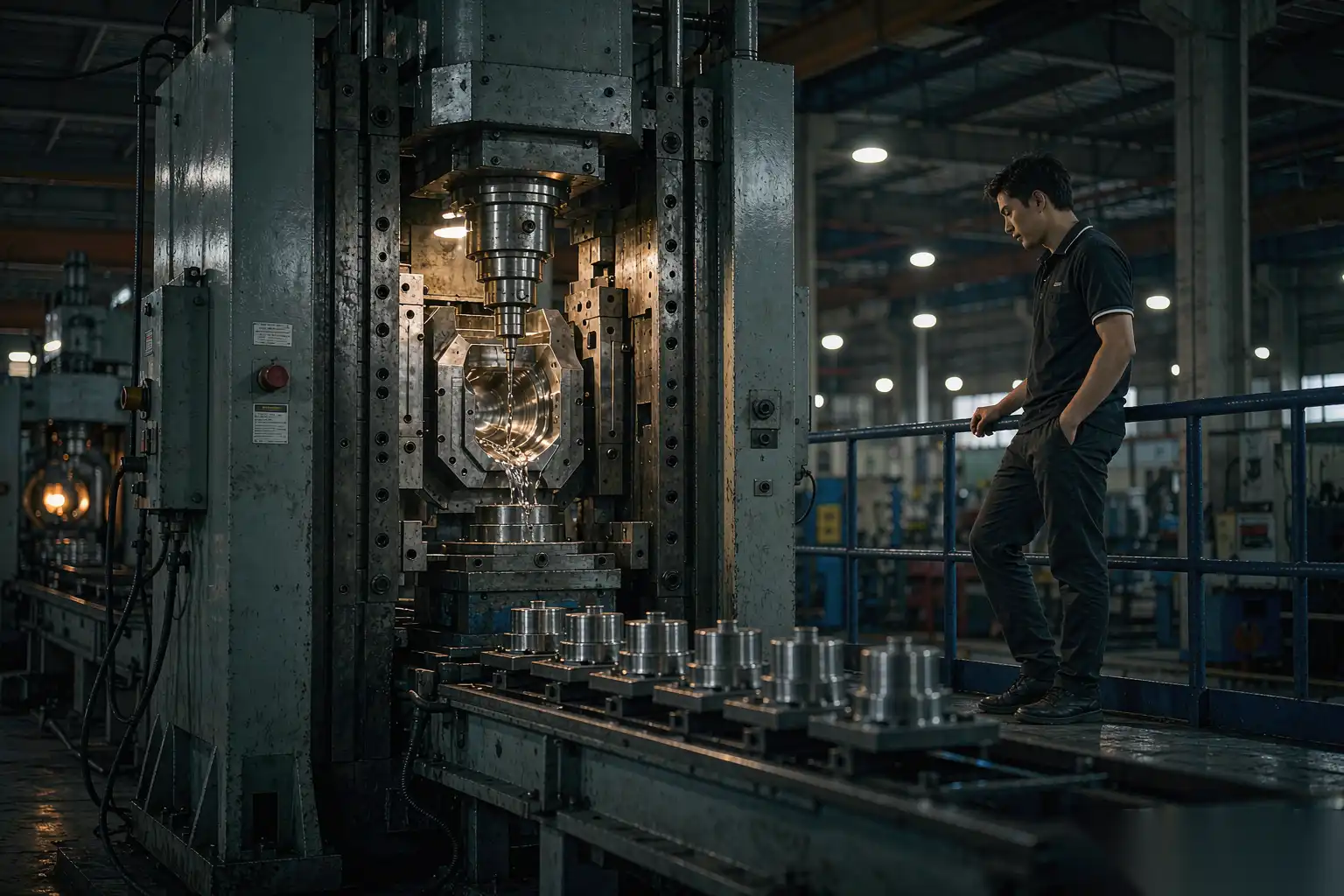
The die casting machine is the central piece of equipment in a die casting operation. The right machine enables quality production, efficient cycle time, and consistent parts. The wrong machine creates quality problems, long cycle times, and high scrap rates.
Machine selection affects:
- Part size and weight — machine platen size and shot weight
- Production rate — cycle time and number of machines
- Energy consumption — different machines have different efficiency
- Maintenance cost — newer machines typically have lower maintenance
- Operator skill required — modern machines are easier to operate
- Automation compatibility — newer machines integrate better with robots and automation
This article covers the types of machines, the key specifications, and how to select the right machine for your needs.
Hot-Chamber vs Cold-Chamber Machines

Hot-Chamber Machines
Used for: zinc, magnesium, and lead alloys (low melting point metals)
How it works: the metal is melted in a furnace integral to the machine. A plunger draws the metal from the furnace through a goose neck and into the die.
Advantages:
- Faster cycle time (no ladling step)
- Lower energy consumption (no ladle heating)
- Better temperature control
- Smaller footprint
Disadvantages:
- Cannot be used for aluminum (the iron plunger and goose neck cannot handle the high temperature of molten aluminum)
- Limited to small parts (machine size constrained by gooseneck design)
Typical tonnage: 20-800 tons clamping force
Cold-Chamber Machines
Used for: aluminum, magnesium, copper alloys, and other high-melting-point metals
How it works: the metal is melted in a separate furnace. A ladle pours the metal into a cold chamber (shot sleeve) in the machine. A plunger then injects the metal into the die.
Advantages:
- Handles high-melting-point alloys (aluminum at 660°C+)
- Wider range of part sizes
- Easier to maintain the metal melting separately
Disadvantages:
- Slower cycle time (ladling step adds 5-15 seconds)
- Higher energy consumption (ladle needs heating)
- More operator involvement (or automation required for ladling)
Typical tonnage: 80-4,000+ tons clamping force
For aluminum die casting, you need a cold-chamber machine. The rest of this article focuses on cold-chamber aluminum die casting machines.
Key Machine Specifications
Clamping Force (Tonnage)
The maximum force the machine can apply to keep the die closed during injection. Determines the maximum projected area of the part.
Rule of thumb: the clamping force (in tons) should be at least equal to the projected area of the part (in square inches) multiplied by the injection pressure (in psi), divided by 2,000.
More practically:
- Small parts (under 100 cm² projected area): 100-200 ton machines
- Medium parts (100-500 cm²): 200-500 ton machines
- Large parts (500-2000 cm²): 500-1500 ton machines
- Very large parts (over 2000 cm²): 1500+ ton machines
For a typical A380 die casting with 30-50 MPa injection pressure, the rule of thumb is:
- 1 ton clamping force per cm² projected area
- Or 7 tons per square inch
Shot Weight
The maximum amount of metal (in kg) the machine can inject in one cycle. Determines the maximum part weight (including runner and overflow).
Typical values:
- Small machines (200 ton): 1-3 kg shot weight
- Medium machines (500 ton): 3-10 kg shot weight
- Large machines (1000 ton): 10-25 kg shot weight
- Very large machines (2500+ ton): 25-100+ kg shot weight
The part weight should be 50-70% of the maximum shot weight to allow for runner and overflow.
Platen Size
The size of the fixed and moving platens that hold the die. Determines the maximum die size.
Typical values:
- Small machines: 600 × 600 mm platen
- Medium machines: 900 × 900 mm platen
- Large machines: 1,200 × 1,200 mm platen
- Very large machines: 1,800 × 1,800 mm+ platen
The die should fit comfortably on the platen with margin for clamping and alignment.
Die Height (Daylight)
The maximum distance between the platens when open. Determines the maximum die height.
Typical values: 400-1,500 mm depending on machine size.
Tie Bar Spacing
The distance between the tie bars (the vertical columns that hold the platens). Determines the maximum die width.
Rule of thumb: the die width should be 80-90% of the tie bar spacing to allow for clamping and clearance.
Injection Pressure
The maximum pressure the injection system can apply. Determines the filling capability for thin walls and complex geometry.
Typical values:
- Standard machines: 30-70 MPa
- High-pressure machines: 70-100 MPa
- Very high pressure: 100-150 MPa (for vacuum or specialized processes)
Higher pressure enables thinner walls and more complex geometry, but increases clamping force requirements.
Injection Speed
The speed at which the metal fills the die cavity. Affects surface finish, fill quality, and cycle time.
Typical values:
- Slow shot (filling): 0.1-0.5 m/s
- Fast shot (final fill): 1-10 m/s
Modern machines allow precise control of the shot profile throughout the injection cycle.
Real-Time Process Monitoring
Modern die casting machines include:
- Shot profile monitoring: real-time display of shot position, speed, and pressure throughout the cycle
- Die temperature monitoring: thermocouples in the die connected to the machine controller
- Cavity pressure sensing: pressure sensor inside the cavity for closed-loop control
- Automatic process adjustment: closed-loop control of shot parameters based on cavity pressure
- Data logging: every cycle logged for quality traceability
These features are not luxuries — they are essential for high-quality production. A machine without real-time monitoring will produce parts with more variability than a machine with it.
Machine Manufacturers
Die casting machine brands come and go, and a long vendor list ages quickly. What matters more than the brand badge on the machine is whether the machine is right for your part and whether the supplier behind it can support you for the next ten years.
At DZ Machinery, we take a different position: rather than selling you a machine brand, we look at your part first — projected area, shot weight, wall thickness, and annual volume — and then help you specify the machine class, clamping tonnage, and process-monitoring package that fits. If you already have machines on your floor, our robotic finishing cells integrate with them regardless of brand; if you are building a new line, we can support the whole layout from casting machine to trim press to finishing cell.
When you evaluate any machine supplier, use the same three tests. First, ask for real-time process monitoring capability — shot profile, cavity pressure, and die temperature logging on every cycle. Second, ask for the local service response time in writing; a machine down for two weeks costs more than any discount. Third, ask for references running parts similar to yours in size and alloy. A supplier who passes those three tests is worth shortlisting, whatever the logo on the machine.
Machine Selection for a New Project
For a new die casting project, the machine selection process:
- Determine the projected area of the part (length × width in cm²)
- Determine the part weight (in kg, including runner/overflow margin)
- Select machine tonnage based on the rule of thumb (1 ton per cm² for A380)
- Select shot weight capacity to be 1.5-2x the part weight
- Select platen size to be 1.2-1.5x the die size
- Specify injection pressure to be 30-50 MPa for typical A380 work, 50-100 MPa for thin walls
- Specify shot profile control — real-time monitoring of shot speed, position, pressure
Example: for a part with 300 cm² projected area, 2 kg part weight, and 600 × 600 mm die size, a 400-500 ton machine with 4-5 kg shot weight and 900 × 900 mm platen would be appropriate.
Cost of Die Casting Machines
New machine costs (rough estimates):
- 200 ton cold-chamber machine: $150,000-300,000
- 500 ton machine: $300,000-600,000
- 1,000 ton machine: $500,000-1,000,000
- 2,000+ ton machine: $1,000,000-3,000,000+
Used machines are typically 30-50% of new cost, depending on age and condition.
In addition to the machine, plan for:
- Furnace (aluminum melting): $30,000-100,000+
- Ladling equipment or automatic ladler: $20,000-100,000
- Die spray system: $10,000-30,000
- Quench tank or conveyor: $5,000-30,000
- Trim press: $30,000-100,000
- Robot (if automated): $50,000-200,000+
A complete die casting cell with machine, furnace, automation, and trim press typically costs $300,000-1,500,000 depending on size and level of automation.
Machine Maintenance
Die casting machines require regular maintenance:
- Daily: lubrication, hydraulic checks, platen alignment
- Weekly: die clamping checks, cooling system inspection
- Monthly: hydraulic fluid analysis, electrical inspection
- Quarterly: shot system calibration, platen alignment verification
- Annually: major inspection, hydraulic system service, control system update
A well-maintained machine lasts 20-30+ years. A poorly maintained machine may need major rebuild at 10-15 years.
Energy Efficiency
Modern die casting machines are significantly more energy efficient than older machines:
- Servo-hydraulic systems: 30-50% more efficient than traditional hydraulic
- Variable frequency drives: further reduce energy consumption
- Heat recovery: capture waste heat from the die for facility heating
Energy cost is typically 10-20% of die casting operating cost. A modern efficient machine can save $20,000-100,000+ per year in energy cost compared to an older machine.
Matching the Cell Around the Machine
The machine is the center of a die casting cell, but the cell — furnace, ladler, sprayer, extraction, trim press, and finishing — decides whether the machine’s capability ever reaches the P&L. A 800-ton machine feeding parts to a manual deburring bench is a cell that produces castings at machine speed and finished parts at bench speed, and the gap between the two is where die casting margins quietly disappear. When evaluating an investment, price the whole cell, not the machine, and schedule the bottleneck deliberately: it is cheaper to buy a machine slightly larger than the die requires than to discover the trim press or the finishing bench cannot keep pace.
Two integration points deserve early attention. Automatic ladling and die spraying convert cycle time from an operator-skill variable into a process constant — and process constancy is what makes every downstream step, including finishing, tunable at all. And the handoff from trim press to finishing determines whether castings arrive at deburring in presentation order or in a jumble that a robot must first sort.
DZ Machinery builds that last link. Our robotic deburring, grinding, and polishing cells are designed to take parts directly from trim — matched conveyance, matched fixturing, matched cycle rate — so the casting cell’s output flows to finished parts without a manual buffer growing in between. If you are quoting a new machine right now, quote the finishing cell in the same exercise; the combined number is the one your CFO should see, and it is almost always friendlier than machine-plus-labor-forever.
FAQ About Aluminum Die Casting Machines
How much does an aluminum die casting machine cost?
A new 500-ton machine costs $300,000-600,000. Smaller machines are cheaper; larger machines are more expensive. A complete die casting cell with all supporting equipment costs $500,000-2,000,000+.
What tonnage do I need for my part?
Rule of thumb: 1 ton of clamping force per cm² of projected area for A380. A part with 300 cm² projected area needs a 300 ton machine. Add margin (typically 1.3-1.5x) for process safety.
Should I buy a new or used machine?
New machines offer the latest control systems, energy efficiency, and warranty support. Used machines are cheaper but may need maintenance and have older control systems. For new facilities with long-term plans, new machines are usually the better investment.
Can a cold-chamber machine be used for zinc?
Yes, but it’s not optimal. Hot-chamber machines are designed for zinc and are faster, more efficient, and produce higher quality zinc parts. A cold-chamber machine can do zinc, but cycle time and quality will be worse than a hot-chamber machine.
Choosing the Right Machine
The right die casting machine is determined by:
- Part size and weight — projected area, shot weight
- Production volume — cycle time matters more at high volume
- Quality requirements — tighter quality needs better process control
- Budget — new vs used, Chinese vs Western
- Local support — service availability in your region
At DZ Smart Manufacturing, our team has experience with all major die casting machine brands and can help you evaluate the right machine for your production needs. We also offer automated finishing cells that integrate with new or existing die casting machines.
See our automated finishing cells for die casting operations