


Aluminum Die Casting Cost Factors: What Drives the Per-Part Price
Why Die Casting Cost Is Hard to Estimate
Aluminum die casting cost is notoriously difficult to estimate accurately because:
- Many interacting factors: material, machine time, labor, finishing, quality, overhead
- Supplier-specific variation: different suppliers have different cost structures
- Volume-dependent: cost per part changes dramatically with volume
- Tooling amortization: the upfront tooling cost affects per-part cost for the entire production life
- Hidden costs: engineering changes, quality inspection, packaging, logistics
A quote from one supplier may differ by 30-50% from a comparable quote from another supplier. Understanding the cost structure helps you evaluate the quotes intelligently.
The Cost Structure of a Die Cast Part
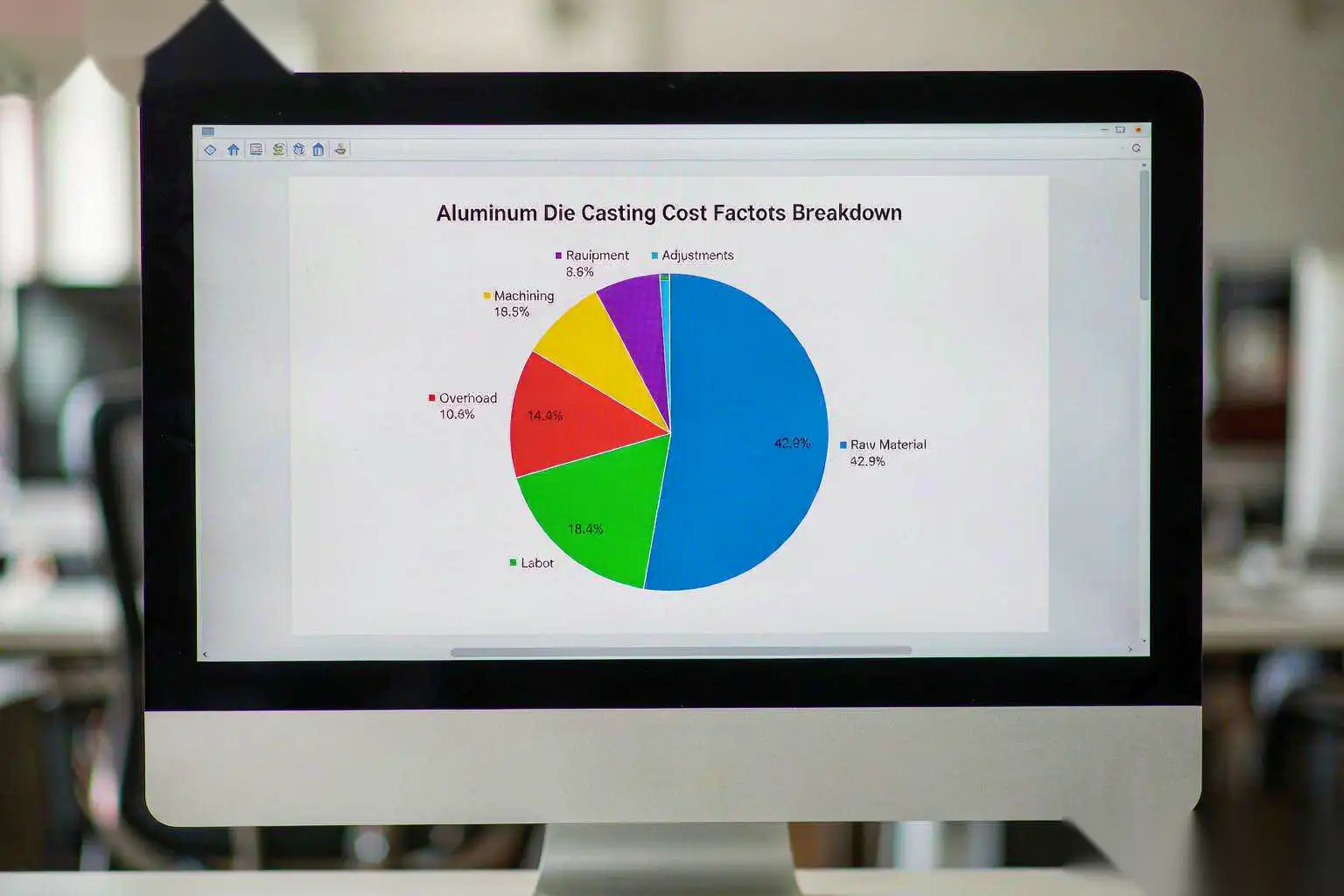
For a typical aluminum die casting project, the per-part cost breaks down roughly as:
| Cost Component | % of Per-Part Cost | Notes |
|---|---|---|
| Material (alloy) | 25-40% | varies with part weight, alloy cost |
| Casting (machine + labor + overhead) | 20-35% | varies with cycle time, machine size |
| Finishing | 15-35% | varies with cosmetic requirements |
| Quality and inspection | 5-10% | varies with quality requirements |
| Packaging and logistics | 3-5% | varies with destination, mode |
| Tooling amortization | 5-15% | varies with volume |
These percentages shift dramatically based on part size, complexity, volume, and finishing requirements. A simple small part might be 40% material, while a large cosmetic part might be 35% finishing.
Material Cost
Material is the largest single cost component for most parts.
Alloy Cost
| Alloy | Relative Cost (vs A380) |
|---|---|
| A380 (standard) | 1.0x (baseline) |
| A383 | 1.05x |
| A384 | 1.10x |
| A413 | 1.05x |
| A390 | 1.30x |
| Magsimal-59 | 1.80x |
| A201/A206 | 2.50x |
A380 is the cheapest because it tolerates 30-50% recycled content. Higher-performance alloys use more primary metal and require tighter process control.
Material Utilization
The ratio of part weight to total material used:
- Cast part weight: the net weight of the finished part
- Runner and overflow weight: typically 20-50% of the cast part weight
- Sprue and biscuit: typically 5-15% of the cast part weight
- Total material used: cast part + runner + overflow + sprue
A part with 30% material utilization means 30% of the alloy ends up in the finished part, and 70% is runner, overflow, and sprue that is re-melted. Better gate design and process control improve utilization, reducing material cost per part.
Recycled Content
A380 routinely contains 30-50% recycled aluminum. The recycled content is much cheaper than primary aluminum (typically 20-40% less). The die caster buys alloy based on a specific recycled content percentage, and the cost is negotiable.
Casting Cost
Casting cost is driven by machine time, labor, and overhead.
Machine Cost
- Hot-chamber machines (zinc): $20-100 per hour operating cost
- Cold-chamber machines (aluminum): $50-300 per hour operating cost
- Large machines (over 800 tons): $200-500 per hour operating cost
The cost per part = (machine cost per hour × cycle time in hours) / parts per cycle.
A 30-second cycle time on a $150/hour machine = $1.25 machine cost per part. A 60-second cycle time on the same machine = $2.50 per part.
Cycle Time
Cycle time depends on:
- Part size and weight: larger parts take longer to fill and cool
- Wall thickness: thicker walls take longer to cool
- Cooling system efficiency: better cooling = shorter cycle
- Ejection time: depends on part complexity
- Spray and lubrication time: depends on part size
- Machine response time: faster hydraulic and control systems
Cycle time optimization is one of the most effective ways to reduce cost. A 20% cycle time reduction is worth 15-20% per-part cost reduction.
Labor Cost
- Direct labor: machine operators, finishing operators, inspectors
- Indirect labor: supervisors, maintenance, quality, planning
In a modern automated die casting cell, direct labor is 10-20% of the casting cost. In a manual operation, it can be 30-50%.
Overhead
- Facility cost: building, utilities, insurance
- Equipment depreciation: machines, robots, finishing equipment
- Maintenance: preventive and corrective
- Quality system: ISO certification, calibration, training
Overhead is typically 30-50% of the casting cost. It is fixed regardless of volume, which is why higher volume reduces per-part overhead cost.
Finishing Cost
Finishing can be 15-35% of the part cost, especially for visible consumer parts.
Finishing Steps and Costs
| Finishing Step | Typical Cost per Part |
|---|---|
| Trim and deflashing | $0.05-0.30 |
| Tumbling / vibratory | $0.10-0.50 |
| Shot blasting | $0.10-0.40 |
| Robotic deburring | $0.20-1.00 |
| Robotic polishing | $1.00-5.00 |
| Hand polishing | $3.00-10.00 |
| Anodizing (Type II) | $0.30-1.50 |
| Hardcoat anodizing (Type III) | $0.50-3.00 |
| Powder coating | $0.50-3.00 |
| Wet paint | $1.00-5.00 |
| Plating (chrome/nickel) | $2.00-10.00 |
The wide range reflects part size, complexity, and quality requirements. A small simple part is at the low end; a large complex cosmetic part is at the high end.
Finishing Cost Drivers
- Number of process steps: each step adds cost
- Hand vs automation: hand finishing is 3-10x more expensive than robotic
- Cosmetic requirements: Class A cosmetic standards drive cost up significantly
- Part size: larger parts cost more in absolute terms
- Volume: higher volume justifies automation, reducing per-part cost
Quality and Inspection Cost
The cost of ensuring the part meets specification:
- Visual inspection: 100% or AQL sampling
- Dimensional inspection: CMM, optical comparator, go/no-go gauges
- X-ray inspection: for critical parts (porosity detection)
- Pressure testing: for pressure-tight parts
- Mechanical testing: tensile, hardness on first article and periodic samples
- Surface finish measurement: for cosmetic parts
For safety-critical parts, quality costs can be 15-20% of total cost. For non-critical parts, 3-5%.
Tooling Cost (Amortization)
Tooling is paid upfront, but the cost is amortized over the production volume.
Tooling Cost Factors
- Die complexity: single cavity, slides, multi-cavity
- Steel grade: H13 standard, premium steel (W302, Dievar) for high volume
- Surface treatment: nitriding, polishing, PVD coating
- Engineering changes: budget 10-15% of original tooling for ECs
- Tool shop location: Chinese tool shops are 50-70% cheaper than Western
Amortization Example
A $50,000 die used for 100,000 parts:
- Amortization per part: $0.50
- Plus EC budget (10%): $0.05
- Total tooling cost per part: $0.55
The same $50,000 die used for 1,000,000 parts:
- Amortization per part: $0.05
- Plus EC budget: $0.005
- Total tooling cost per part: $0.055
Tooling cost per part drops 10x as volume increases 10x. This is why high-volume projects favor die casting despite the high upfront tooling cost.
Cost Estimation Methods
Three common approaches for estimating die casting cost:
1. Per-Part Quote from Supplier
The most accurate method. Send the drawing to a qualified supplier and request a quote at your target volume. A serious supplier responds within 5-10 business days with a detailed cost breakdown.
2. Per-Part Estimate from Rules of Thumb
Less accurate but useful for early-stage estimates. Common rules of thumb:
- Aluminum die casting cost per kg: $5-15 per kg of finished part (excluding tooling and finishing)
- Finishing cost per kg: $2-10 per kg depending on requirements
- Tooling cost per part: based on volume, as shown above
- Total cost per part: material + casting + finishing + quality + tooling amortization
3. Cost Modeling Software
For high-volume or high-complexity projects, use specialized die casting cost modeling software. These tools take detailed part geometry, alloy, finishing, and volume inputs and produce cost estimates with 10-20% accuracy.
Cost Reduction Opportunities
The largest cost reduction opportunities, in order of impact:
- Cycle time reduction — 10-20% cycle time reduction can save 5-15% per part
- Material utilization improvement — better gate design can save 10-20% on material cost
- Finishing automation — robotic polishing can reduce finishing cost by 50-80% versus hand work
- Yield improvement — each 1% yield improvement reduces per-part cost by 1-2%
- Volume leverage — committing to higher volume gives better pricing
- Alloy selection — choosing the cheapest acceptable alloy
- Tolerance relaxation — looser tolerances reduce inspection cost and reject rate
- Design simplification — fewer slides, simpler geometry = cheaper die and faster cycle
Hidden Costs to Watch For
- Engineering change fees: the supplier may charge for any post-tooling design change
- Setup and tryout fees: first-batch setup at the supplier may be billed separately
- Packaging costs: custom packaging for retail or specific shipping requirements
- Tooling modification fees: changes after PPAP are typically billed at hourly rates
- Quality surcharge: premium inspection or certification may be billed separately
- Logistics and duties: import duties, freight, customs fees (if sourcing internationally)
- Inventory carrying cost: longer lead times mean more inventory, which has a cost
Always request an itemized quote so you can see exactly what is included and what is extra.
Cost Negotiation Tips
- Get 3-5 comparable quotes to establish a fair price range
- Ask for itemized quotes — material, casting, finishing, quality, tooling separately
- Understand the volume break — get quotes at multiple volumes to find the breakeven
- Negotiate tooling terms — deposit, milestones, payment on T1 sample
- Negotiate payment terms — net 30 or net 60 is often possible for established customers
- Be willing to commit volume — multi-year volume commitments unlock better pricing
- Don’t negotiate on quality — alloy substitution or quality reduction is not a real saving
- Don’t negotiate on tooling ownership — your tooling, your property, full stop
Where the Cost Actually Moves
Every die casting cost model has the same five buckets — material, machine time, finishing, quality, and overhead — but the buckets do not matter equally, and the leverage is never where newcomers look. Material price gets the attention because it is quotable, yet a ten percent alloy price swing moves total part cost by only three or four percent. Machine time is where the real money sits: every second of cycle time multiplied across a million shots is a salary line, which is why die cooling design and shot discipline reward engineering attention far beyond their popularity. Finishing is the silent bucket — a quarter to a third of part cost in most programs — and the only one that can shrink without touching the casting at all, through better flash control, robotic deburring, and polish programs tuned to the actual cosmetic map rather than the whole part.
The practical cost review asks three questions in order. Can the cycle lose two seconds without quality risk? Can the cosmetic map shrink a zone? Can the finishing cell run unattended through the shift? Each yes is worth more than any alloy negotiation.
DZ Machinery occupies that third question on purpose. Our deburring, grinding, and polishing cells are built to run at rate with one operator supervising several cells, which converts the finishing bucket from a headcount problem into a capital line with a two-to-three-year payback. When customers model total program cost with us before tooling release, finishing automation is usually the largest single lever they had not yet pulled — larger than the alloy choice and often larger than the machine tonnage decision.
FAQ About Aluminum Die Casting Cost
What is the per-part cost of a typical aluminum die casting?
For a medium-sized part (100-500 g finished weight) at 10,000-50,000 parts/year, the per-part cost (excluding tooling) is typically $2-8 for material + casting, plus $1-5 for finishing. Total per-part cost is $3-13 depending on complexity and finishing.
How much does the die cost?
A simple single-cavity die from a Chinese supplier is $15,000-40,000. A complex single-cavity die with slides is $40,000-100,000. A multi-cavity die is $60,000-200,000. Western suppliers charge 2-3x more.
When does die casting become cost-effective vs machining or plastic?
The breakeven depends on part complexity, but typically:
- vs machining from billet: 1,000-3,000 parts/year
- vs plastic injection molding: 2,000-5,000 parts/year
- vs 3D printing: 5,000-10,000 parts/year
Above these thresholds, die casting is usually the cheapest option.
What is the most cost-effective alloy?
A380 with high recycled content is the cheapest. Higher-performance alloys (A390, Magsimal, A201) are 30-150% more expensive per kg.
A Realistic Cost Management Approach
A successful die casting project manages cost through:
- Accurate initial estimates — use supplier quotes for serious estimates, rules of thumb for early-stage planning
- DFM review — identify cost reduction opportunities before tooling
- Detailed quotes — itemize cost components to find negotiation opportunities
- Process optimization — cycle time, yield, material utilization
- Finishing automation — the largest single cost reduction in many projects
- Volume leverage — long-term volume commitments unlock better pricing
- Continuous improvement — track cost over time, identify and act on trends
At DZ Smart Manufacturing, our robotic finishing cells typically reduce finishing cost by 50-80% versus manual hand work, while improving quality and consistency. If you are evaluating the cost of an aluminum die casting project and want feedback on the finishing scope, our engineering team can review your part spec and provide a cost comparison of manual vs automated finishing.
See our automated surface finishing for aluminum die castings