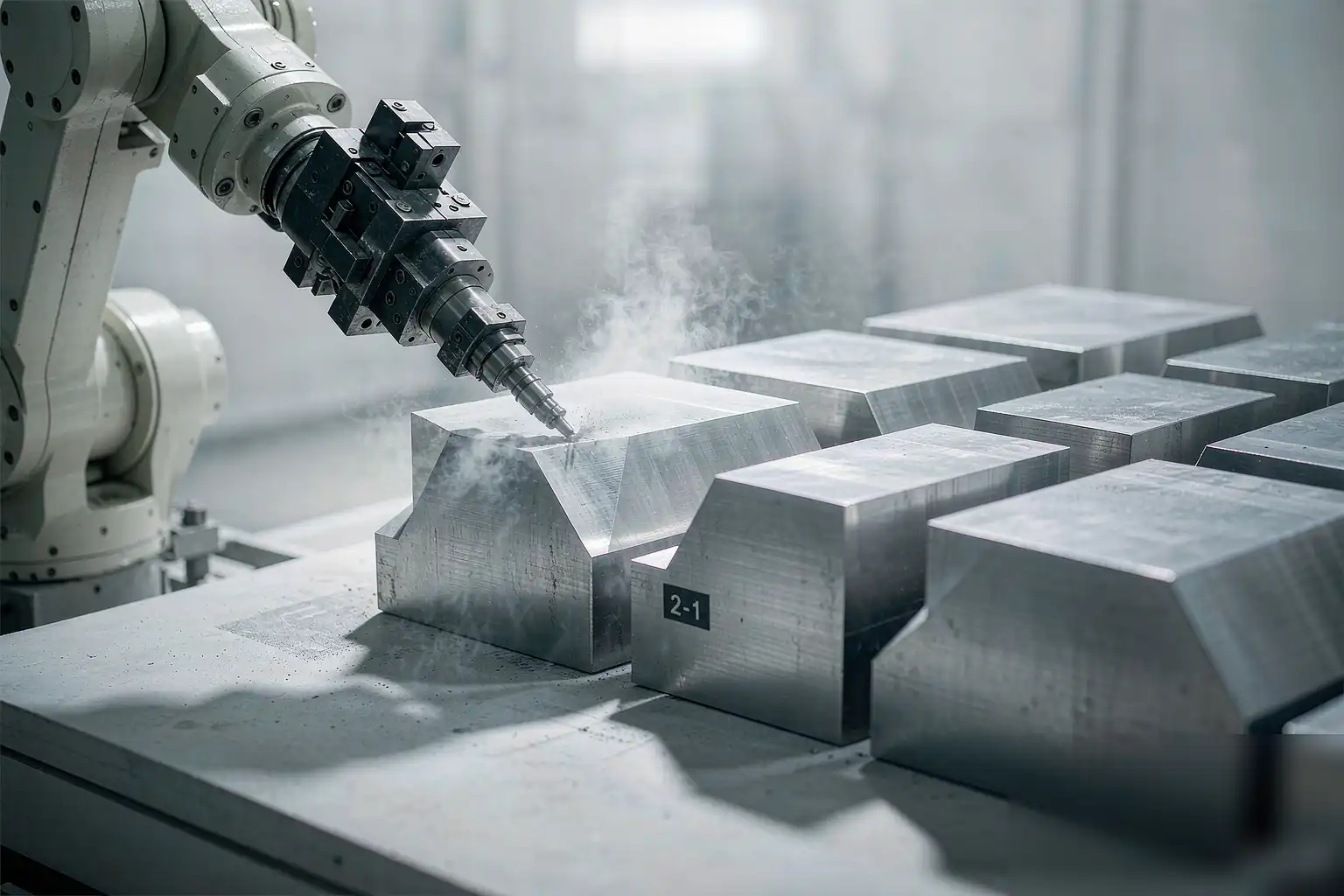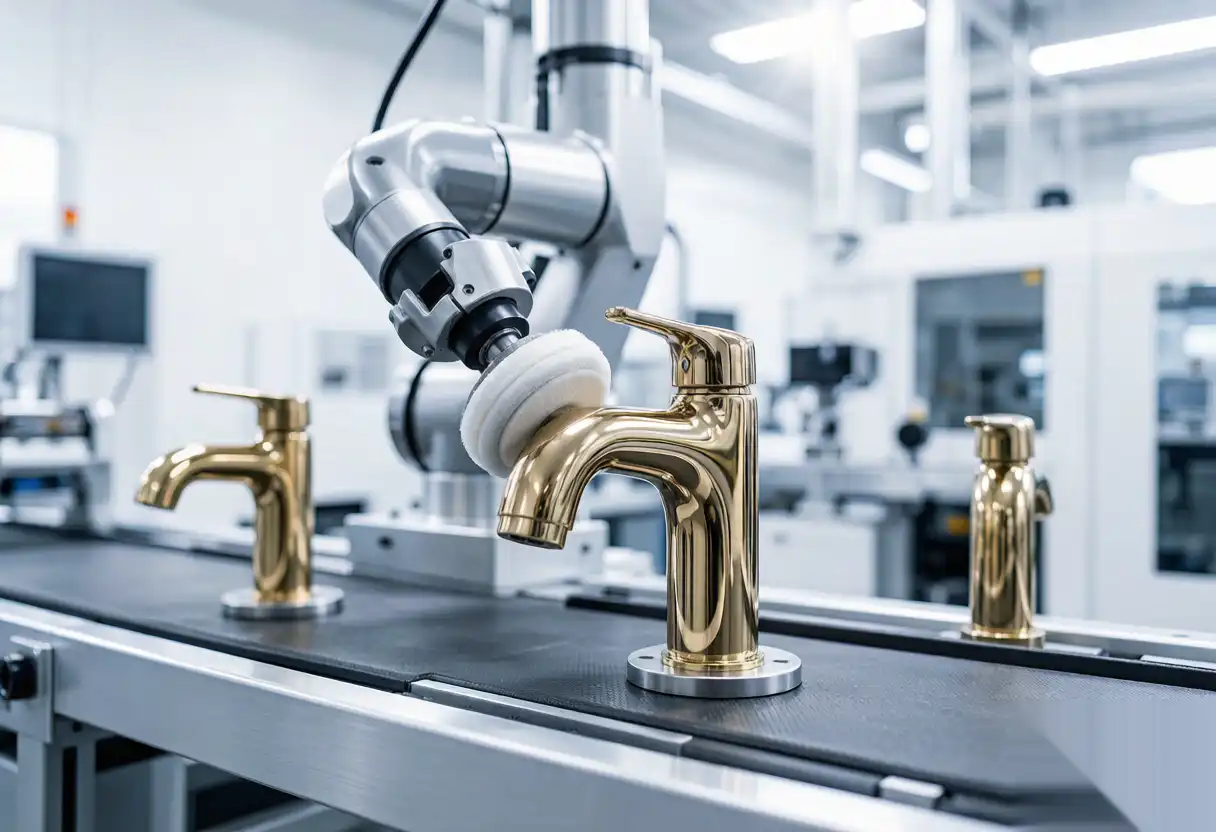


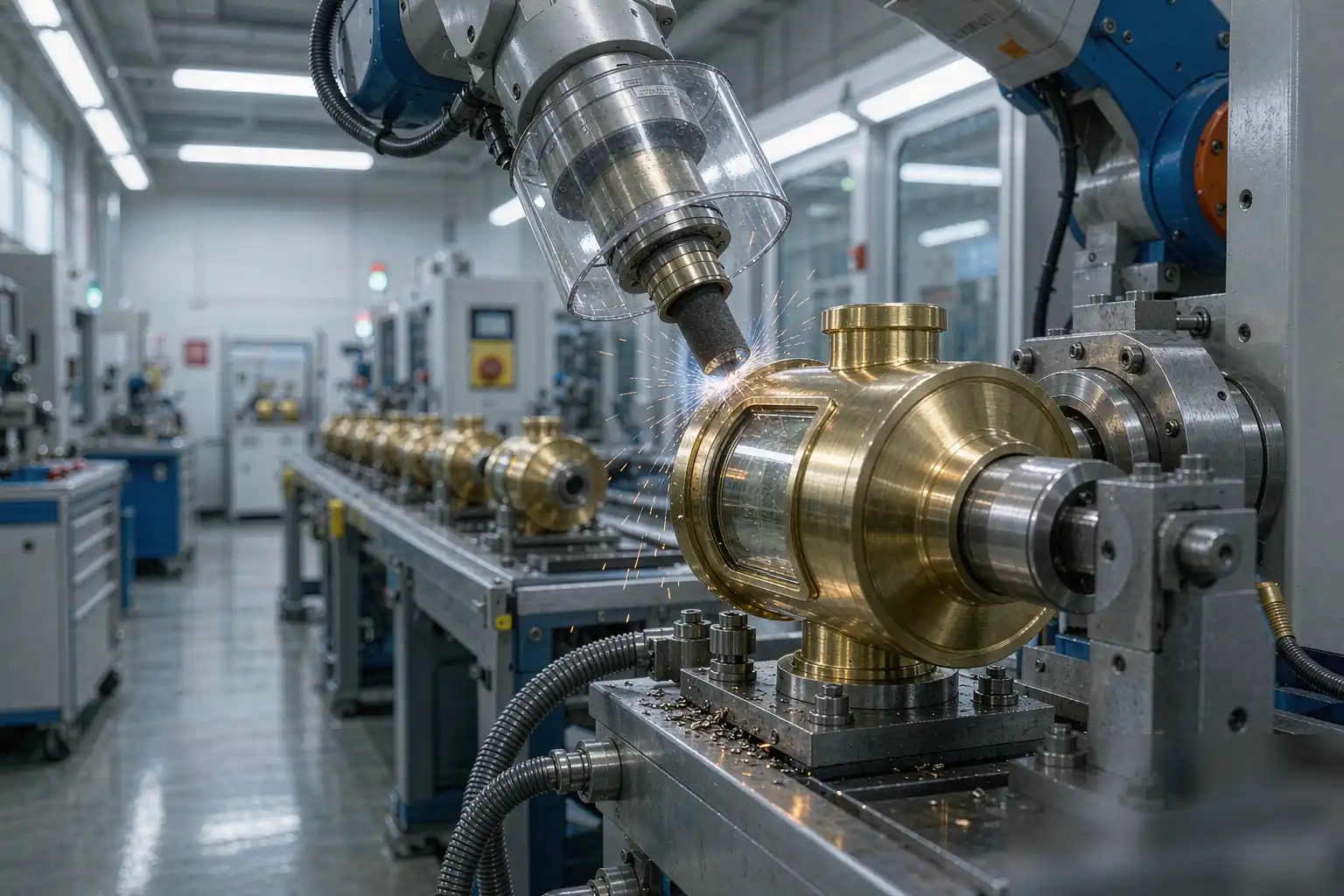
Metal casting finishing for water meter housings pairs a demanding external finish with delicate internal features, and the plants that automate it reach payback inside twelve to eighteen months on labour alone. The housing is small, the volumes are huge, and every unit carries the same geometry — three conditions that make it one of the cleanest automation cases in brass. Metal finishing automation economics scale with volume, and meter housings never lack volume.
What Makes Meter Housings a Special Case
A water meter housing is a brass casting with a polished exterior, machined faces, and internal threads that must survive finishing untouched. The external surface shows the water utility’s brand, so it ships visible — but the threads and chamber inside are the function.
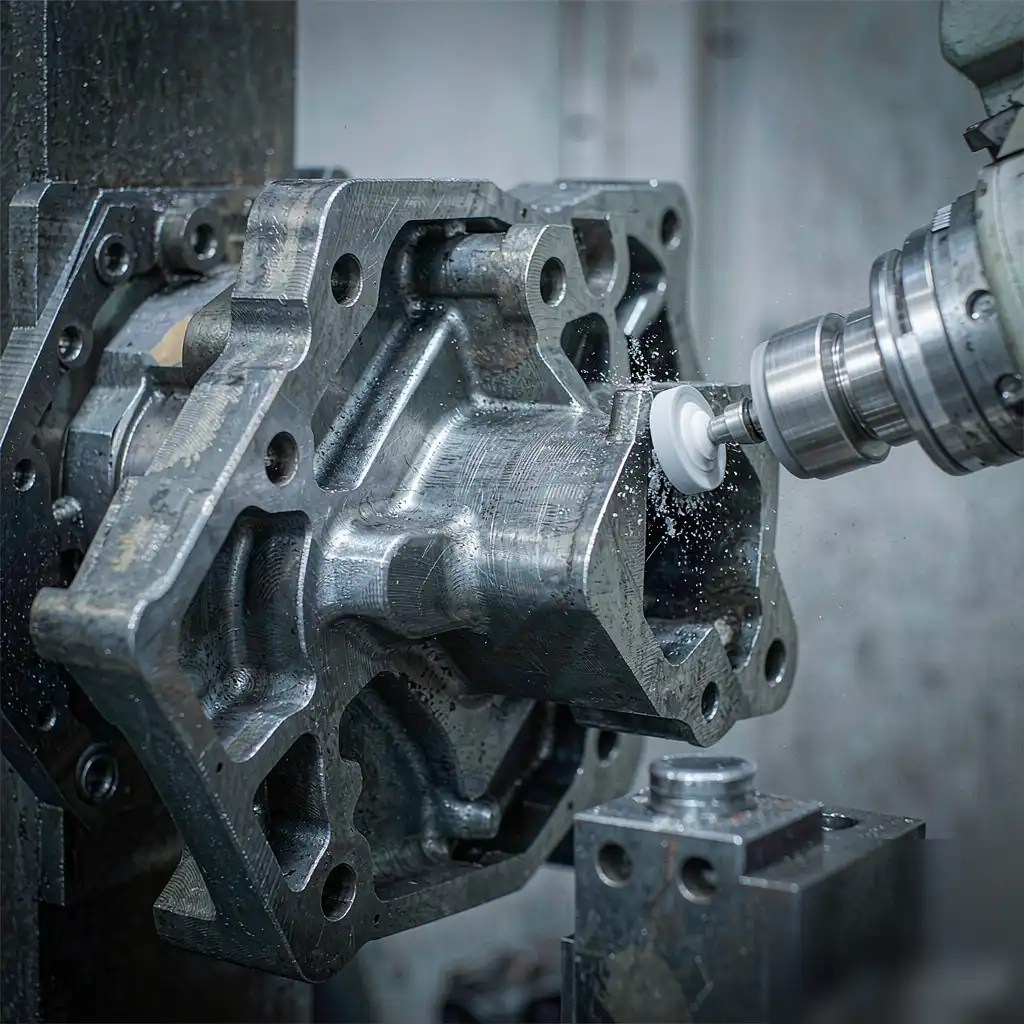
That split drives the whole process. Exterior finishing must be aggressive enough to erase casting texture, while anything that enters the chamber must be controlled to a fraction of a millimetre.
Volumes reinforce the case. Utility contracts run in the hundreds of thousands per year per plant, with a single dominant geometry and only a handful of size variants. Automation thrives on exactly that profile.
Brass itself behaves well — it cuts cleanly, takes compound without loading wheels badly, and rarely work-hardens at finishing forces. Of the common casting alloys, it is the friendliest to automate.
Anatomy of the Automated Solution
The standard configuration runs four stations in sequence, sized to the housing’s small footprint and high rate.
Station one deburrs the parting line and threads the external stub removal, using a brush and a small carbide tool in one pass. Station two grinds the exterior faces on a belt, clearing casting texture. Station three buffs the exterior to the utility-spec finish with compound. Station four blows down and visually checks the chamber and threads before packing.
Tray feeding replaces fixtures between stations. Housings sit in cavities on a pallet conveyor, and each station’s robot picks from the same tray datum. Changeover between housing sizes is a tray swap, measured in minutes.
Internal protection is simple and absolute: no tool enters the chamber. Exterior tools approach on tangents, and thread zones get brush treatment only.
Case: A Utility Supplier’s Conversion
A plant supplying residential meters ran eleven manual benches across two shifts before conversion. The manual process held output but not consistency — utility inspectors flagged finish variation quarterly, and thread damage escapes cost real claims.
After two automated lines, the same plant runs one operator per line and a part-time inspector. The metrics moved as follows.
| Metric | Manual Benches | Automated Lines | Change |
|---|---|---|---|
| Daily output | 14,000 housings | 19,500 housings | +39 % |
| Finishing headcount | 11 workers | 3 workers | −73 % |
| Finish rejects | 2.8 % | 0.6 % | −79 % |
| Thread-damage escapes | 0.4 % | 0.05 % | −88 % |
| Compound per 1,000 pcs | Baseline | 74 % of baseline | −26 % |
The reject cuts matter beyond their face value. Utility contracts carry penalty clauses, and finish consistency flags put the whole contract in review — the automation removed a business risk, not just a cost line.
The Twelve-Month Payback Model
The table below models the cash flow for one line at the case plant’s volumes. Wages are blended, and consumables include belts, brushes, and compound.
| Line Item | Monthly Effect | Basis |
|---|---|---|
| Labour released | +$21,000 | 4 workers × blended wage × 1.4 burden |
| Rework and scrap avoided | +$5,400 | 2.2 pt reject cut × volume × unit value |
| Compound and belt savings | +$1,900 | Dosed application vs manual |
| Energy and extraction | −$900 | Spindles, robot, dust system |
| Maintenance and consumables | −$2,600 | Belts, brushes, dressing, service |
| Net monthly | +$24,800 | — |
Against a single-line investment of three hundred ten thousand dollars, net savings close the gap in twelve and a half months. The second line starts from a trained crew and shared spares, so it pays back faster — nearer ten.
Your numbers will differ with local wages and housing size, but the shape holds: labour dominates, rework accelerates, and consumables are real but secondary.
Pitfalls Specific to Brass Small Castings
Brass dust is heavier than aluminium dust and settles instead of floating, so extraction design must pull low, not just high. Plants that copy aluminium ducting find brass dust pooling under the trays within weeks.
Small parts punish gripper sloppiness. A housing picked half a millimetre off-centre polishes a visible band into the flank. Hard stops and part-present sensors cost little and prevent the drift.
Wheel loading sneaks up on brass. The alloy polishes so easily that operators stretch wheel life too far, and finish drifts before anyone notices. Cycle-count-based wheel changes — not visual checks — keep the line stable.
Finally, thread protection needs a physical rule, not a procedure: fixtures and trays designed so no orientation can ever present a thread zone to a wheel. The 0.05 percent escape rate in the case table comes from that geometry-first discipline.
Verifying Quality for Utility Customers
Utility specs emphasise appearance consistency and dimensional integrity. Sample each line start with a gloss check on three housing zones, and gauge one machined face per thousand for stock-removal drift.
Thread checks run on a go/no-go gauge at the packing station — cheap, fast, and exactly what a utility auditor asks to see.
Keep the records by lot. Robotic grinding consistency provides the stability, but the audit pass comes from showing the trend charts, not from possessing them.
Scaling Beyond the First Line
The first line proves the process; scaling is replication with discipline. Clone programs, standardise tray families across lines, and keep one spare-parts pool rather than line-private stock.
Add automatic packing when the second line lands. At meter-housing rates, manual boxing becomes the next labour bottleneck surprisingly fast, and it is the easiest station to automate next.
For plants whose mix extends beyond meters — valves, fittings, couplings — turnkey surface finishing packages the same stations into a wider product line, sharing the vision and wash infrastructure across geometries.
Changeover Across Housing Sizes
Utility suppliers rarely run one housing size. Residential, commercial, and semi-industrial meters share the process but not the geometry, so changeover speed decides how well the line follows the order book.
Tray-based feeding makes the swap mechanical: each size family has its own pallet set, and the line’s vision locate absorbs the small positional differences between trays. Program selection from the HMI completes the change.
Measured changeover runs under fifteen minutes in a tray-fed line, including first-article verification. If your quotation assumes fixture swaps longer than that, the assumption will show up as missed shipments during mixed-demand weeks.
Keep the first article of every size in a reference cabinet. When finish questions arise months later, the physical benchmark answers faster than any specification document.
Quality Agreements With Utility Customers
Utility contracts specify finish and dimension through inspection protocols the utility controls. The practical consequence: your quality records must speak their language before the first audit, not after the first finding.
Agree the sample plan in writing during contracting — which zones, which instrument, which acceptance numbers. Verbal agreements about “visual inspection” unravel at the first dispute, in the utility’s favour.
Map your cell’s data to their protocol. The cell logs Ra by zone and thread checks by lot; the agreement needs those exact fields named so the audit becomes a printout rather than a project.
Review the agreement annually against your process data. Trends that stay inside spec still drift, and the annual review is where you catch drift while it is still information rather than a finding.
Operating Changes From One Line to Two
The second line changes the operation more than the first, because the plant now has redundancy, shared spares, and a scheduling problem instead of a capability problem.
Consolidate spares on day one of the second line. Two lines sharing one pool halve the stock investment and double the availability of any single part — only if the pool is physically shared, not split by line loyalty.
Cross-train operators across both lines deliberately. The plant that runs line one with “her” operators and line two with “his” operators has built a staffing fragility that automation was supposed to remove.
Standardise programs between lines. Divergent copies of the same housing program on two lines create a defect that appears on only one — the most confusing category of quality problem to diagnose.
Brass Dust and the Housekeeping Ledger
Meter-housing plants move serious tonnage of brass, and the dust settles wherever the extraction misses. The working rules are simple: pull low because brass dust sinks, filter by alloy rather than sharing media, and clean the trays on a cycle count.
Dust that settles on tray cavities shifts housing positions by hundredths of a millimetre — invisible singly, cumulative across a shift, and visible in the finish as a banding pattern inspectors learn to recognise. A nightly blow-off and a weekly tray wash remove the whole failure class.
Extraction filters belong on the maintenance calendar with belt and brush changes. Falling airflow at the hood is the earliest signal, and it costs one minute to check with an anemometer against the install-day baseline.
Water meter housing finishing rewards early automation: stable geometry, high volume, and a friendly alloy. The case metrics and the payback model above show why this niche converts faster than almost any other brass product.
This article is for general guidance only; confirm process parameters with the equipment supplier for your specific parts.