

AT A GLANCE · Automotive parts deburring for OEM production means removing every burr and flash from safety-relevant castings while holding cycle time, traceability, and audit standards that general industry never sees. The right robotic solution depends on the part family, the volume, and which OEM standard your plant must pass. Automotive component finishing considerations start with the part; this overview maps solutions across the families.
What Makes Automotive Deburring Different
OEM drawings specify burr height, edge radius, and cleanliness limits with numbers, not adjectives. A bracket that passes in general industry can fail a customer audit on a burr a fingernail barely catches.
Cleanliness specs add another layer. Residual chips inside a transmission case become circulating debris in a vehicle, so OEMs demand particle counts and washed-part validation that shape the whole cell layout.
Traceability is the third difference. Each part must link back to casting lot, machine, and shift, so the cell must log identity without slowing the cycle.
Finally, PPAP documentation covers the finishing process like any other. Change a tool, and you may owe the customer a new capability study.
Solutions by Part Family
Four families cover most automotive deburring demand. Each rewards a different machine configuration, and mixing them in one cell is where projects go wrong.
| Part Family | Dominant Geometry | Recommended Solution | Key Risk |
|---|---|---|---|
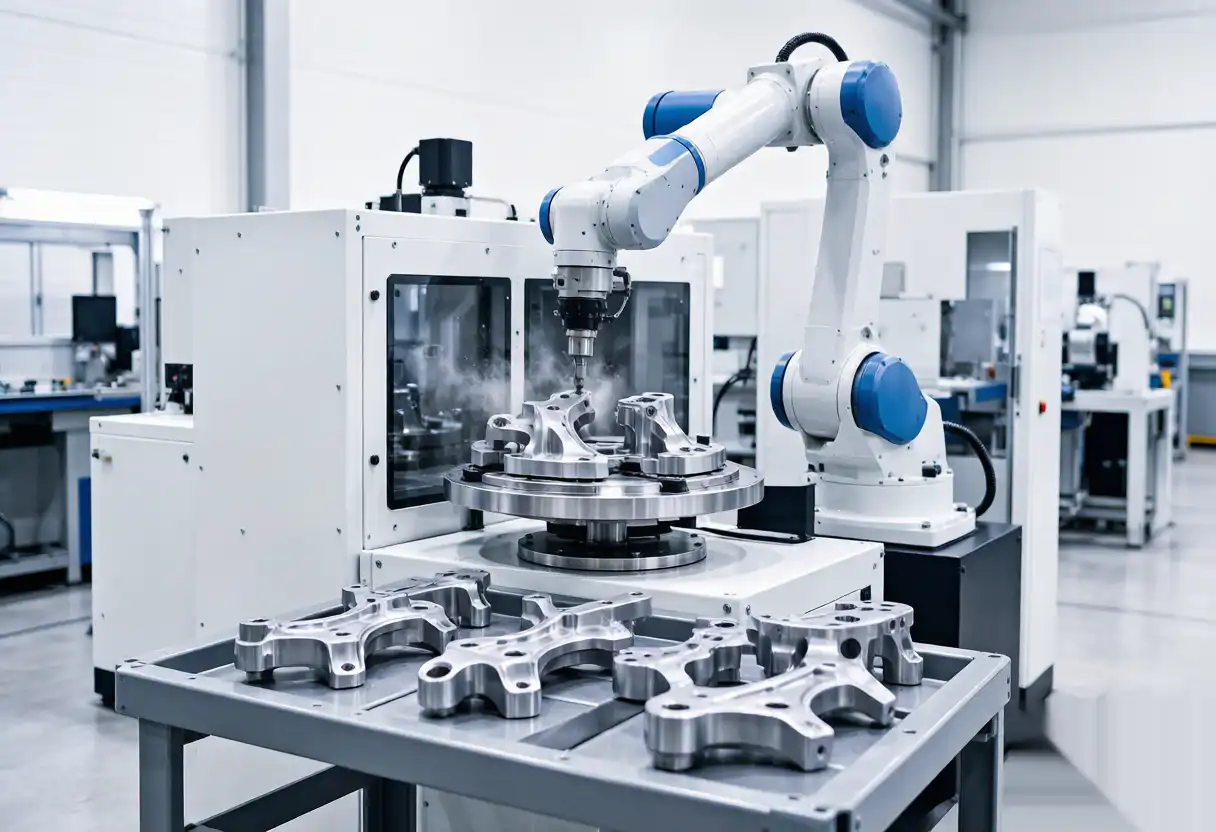
| Cylinder heads / blocks | Deep pockets, oil galleries | Robot + high-speed spindle + vision locate | Broken tools deep in galleries |
| Transmission cases | Closed cavities, bolt bosses | Dual-station robot cell + wash + particle count | Cleanliness failures at audit |
| Structural castings | Long rails, multi-face ribs | Two-robot coordinated cell, part-positioned tools | Cycle time on long paths |
| Brackets and mounts | Small, high variety | Flexible tray cell with quick-change fixtures | Changeover killing OEE |
Cylinder-head cells lean on vision because casting shift moves galleries between shots. Structural cells lean on coordinated motion because paths run metres, not millimetres. Bracket cells lean on fixture logistics because variety, not geometry, is the enemy.
Cycle Time Math Before You Buy
Capacity planning decides cell count more than any feature list. The table below shows the arithmetic for a common two-shift pattern at eighty-five percent overall equipment effectiveness.
| Scenario | Part Cycle | Daily Demand | Cells Required |
|---|---|---|---|
| Transmission case | 95 s | 2,400 | 4 |
| Cylinder head | 140 s | 1,500 | 4 |
| Structural rail | 75 s (2 robots) | 3,200 | 3 |
| Bracket mix (avg) | 35 s | 9,000 | 3 |
Always model demand at the customer’s peak week, not the average. Automotive volumes step up mid-programme, and adding a cell later costs double what sizing it now costs.
Verify the cycle in a supplier demo on your castings, with your gating and flash condition. Demo parts hand-prepared to look nice are a classic trap.
The OEM Audit Checklist
Customer audits for finishing cells focus on process control and records. Prepare the following before the auditor arrives, not the week before.
- Process sheets per part. Tool, path number, force, speed, and cycle documented and revision-controlled.
- Capability data. Cpk on burr height and edge radius from a run of at least one hundred parts.
- Tool change records. Life counters with actual change history, not calendar guesses.
- Escape containment. Proof that a failed part cannot reach the customer — gates, locks, and quarantine bins.
- Traceability sample. Pick any shipped part number and reconstruct its lot, machine, and inspection records in minutes.
- Cleanliness validation. Particle count results from washed parts, with the wash process itself documented.
- Change control. PPAP or customer approval records for every tool or path revision since launch.
Plants that pass audits treat this list as the cell’s operating system. Plants that fail treat it as paperwork assembled the night before, and auditors can tell.
Cell or Line: Matching Architecture to Volume
Standalone cells suit mixed part families and mid volumes. Each cell runs its own program, and a schedule board sequences parts to meet the day’s mix. Changeover stays under fifteen minutes when fixtures are palletised.
Dedicated lines suit single high-volume families. Stations in sequence — gate cut, deburr, wash, inspect — run one part nonstop. Dedicated lines win on cost per part but lose flexibility if the programme ends.
The hedge between them is a modular line: cells with standardised interfaces that re-sequence when volumes shift. Upgrading a production line with automated metal finishing walks the phased route many tier-1s take from first cell to modular line.
For low-volume, high-mix programmes — motorsport components, service parts — high-mix low-volume robotic grinding approaches keep changeover cost down while preserving automotive-grade process control.
Sourcing the Equipment: What to Demand
Ask every candidate supplier the same three questions. First, show my part running in your shop with my casting condition. Second, quote tool life and consumable cost per thousand parts. Third, describe your support inside forty-eight hours.
Reject quotes that bundle the robot, spindles, and fixtures into one opaque number. An itemised quote lets you benchmark and lets your maintenance team plan spares.
Insist on program backup and offline programming capability. When a program corrupts at 2 a.m., the difference between a restore and a re-teach is a shift of output.
Reference visits beat reference letters. A supplier confident in their installations will arrange one; a supplier who cannot is telling you something.
Staffing the Cell Honestly
Automated deburring does not run itself. Plan one trained operator per shift per two to three cells, plus maintenance technicians cross-trained on the robot controller.
The operator’s real job is first-part checks, tool life monitoring, and anomaly response. Give them authority to stop the cell; catching a worn tool at part five beats scrapping two hundred parts.
Training should cover program selection, tool changes, and recovery from common faults. Suppliers who include two weeks of on-site training after commissioning are pricing honesty, not generosity.
Cleanliness Engineering in Practice
Cleanliness failures cause more automotive deburring escalations than burr escapes. The fix is engineering the wash and validation into the cell layout from the first drawing, not bolting them on after the first audit.
Wash stations need part-specific nozzle manifolds. A generic spray bar wets the outside of a transmission case and leaves the bolt bosses dry; a manifold that targets the drawing’s cleanliness-critical zones actually cleans them.
Validation closes the loop. Filter-residue analysis on sample parts, run quarterly and after any process change, converts “we think it’s clean” into a number the customer’s auditor accepts.
Sequencing matters too: deburr, then wash, then inspect, then package. Any handling after the wash reintroduces exactly the debris the wash removed, so conveyors and trays after that point need their own cleaning schedule.
Tool Management at Automotive Scale
Tool life at automotive volumes turns over weekly, and manual tracking collapses under the pace. Cycle-count-based management inside the controller is the working standard.
Each tool carries a life budget in cycles; the cell counts down, alarms at threshold, and refuses to start the next part with an expired tool. Maintenance replaces on the alarm, and the counter resets through a supervisor login.
Predictability improves when you split life budgets by alloy and feature. A cutter that lasts forty thousand bracket bores might last eight thousand through hardened bosses — averaging them guarantees failure somewhere.
Stock levels follow consumption data, not intuition. Three months of usage history turns spares ordering from a monthly argument into a replenishment trigger.
Data and Traceability Architecture
Automotive traceability starts at the cell controller and ends in a query your quality team can run without IT. The architecture is simpler than vendors imply: part identity in, process data attached, results attached, all keyed to lot and timestamp.
Identity comes from a barcode or datamatrix read at load. The cell stamps every cycle with tool IDs, force log summary, and inspection results, writing one compact record per part.
Storage belongs in the plant’s existing system — a SQL table or the MES — not in the robot controller’s memory. Controllers crash; databases get backed up.
Test the retrieval path monthly. Pick a shipped part number at random and reconstruct its record. If it takes more than ten minutes, the traceability you paid for is theoretical.
The Ramp Plan Nobody Quotes But Everybody Needs
Between installation and full-rate production sits a ramp that schedules forget and budgets ignore. A new deburring cell typically needs four to six weeks to reach steady output: the first fortnight runs at half rate while paths tune, and the second fights the tooling surprises your castings were hiding.
Staff the ramp deliberately. Double operator coverage for the first month costs little against the alternative — a cell trusted at half rate becomes permanently derated by scheduling habits.
Define exit criteria for the ramp in the project plan: two weeks at target rate, reject rates inside the capability band, and changeover at the promised time. Ramp ends when the data says so, not when the commissioning engineer flies home.
Budget the ramp’s consumables separately too. First-month tool consumption runs fifty to eighty percent above steady state while parameters settle, and the surprise on the consumables invoice is the one nobody forecasts.
Automotive parts deburring succeeds when the solution matches the part family, the capacity math is done before purchase, and audit readiness is designed into the cell. Specify on those three fronts and the OEM standards stop looking scary.
This is educational content, not a specification or a quote.