

QUICK FACTS
| Tolerance | ±0.05 mm typical |
| Setup time | 30–90 min first article |
| Target finish | Ra 0.2–0.8 µm |
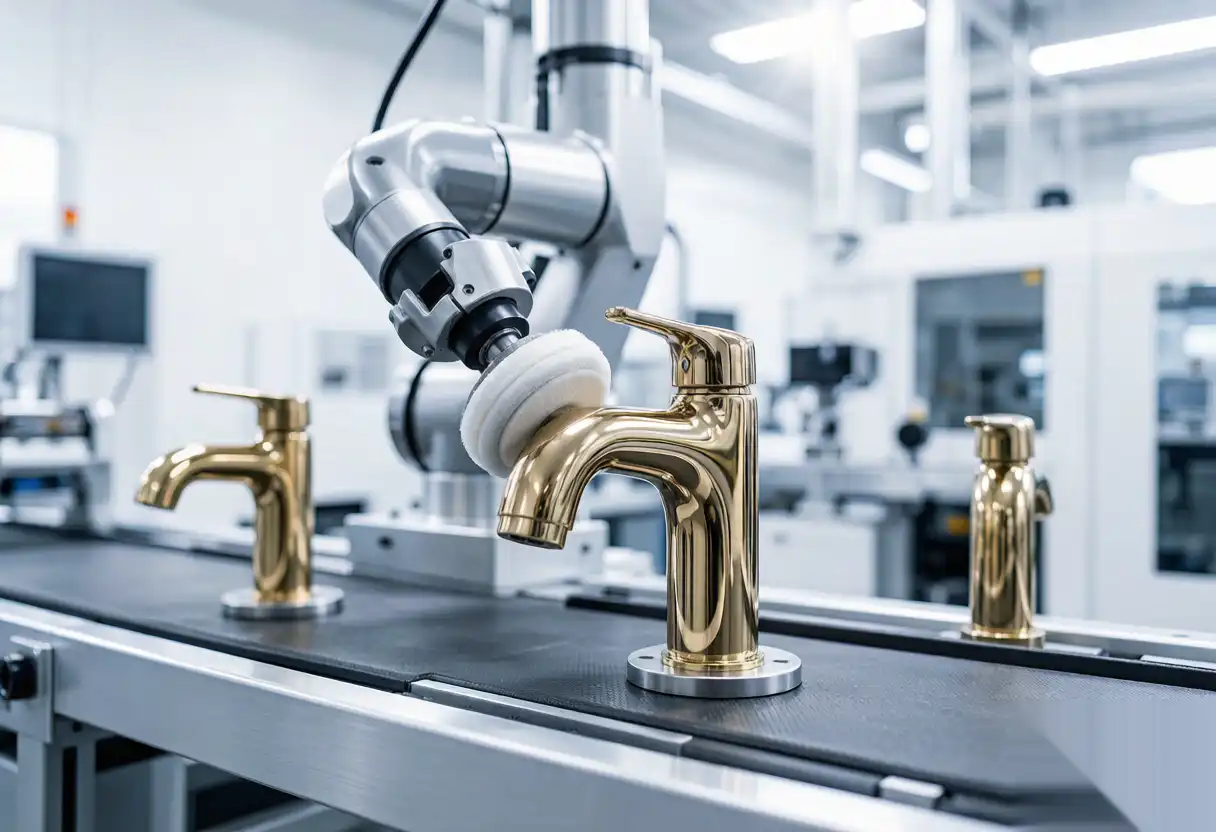
Faucet polishing automation replaces the most labour-intensive finish step in sanitary-ware plants with a robotic buffing cell that holds a uniform mirror surface across every shift. A single operator can tend two cells, and the finish on part one thousand matches part one. Brass faucet polishing has always depended on skilled hands, so the switch raises fair questions about quality, cost, and payback.
Why Manual Faucet Buffing Drives Plants Toward Automation
Manual buffing of faucet bodies takes forty to ninety seconds per surface and demands real skill. The worker must follow compound curves, keep contact pressure steady, and avoid burning the finish. Experienced buffers are becoming scarce, and training a new one to full productivity takes three to six months.
Labour cost is only part of the problem. Consistency drifts over a shift as arms tire, and reject rates climb on Monday mornings and month-end rushes. A plant running two hundred thousand faucets a year can lose four to six percent of output to finish rework.
Dust and compound mist add another cost layer. Manual stations need strong extraction, regular housekeeping, and health monitoring. Robotic cells contain the mess inside guarding and run extraction only when the spindle turns.
Finally, manual buffing caps output at headcount. When a big order lands, the only manual answer is overtime, which raises cost per part and lowers quality at the same time.
How Robotic Buffing Works on Faucet Bodies
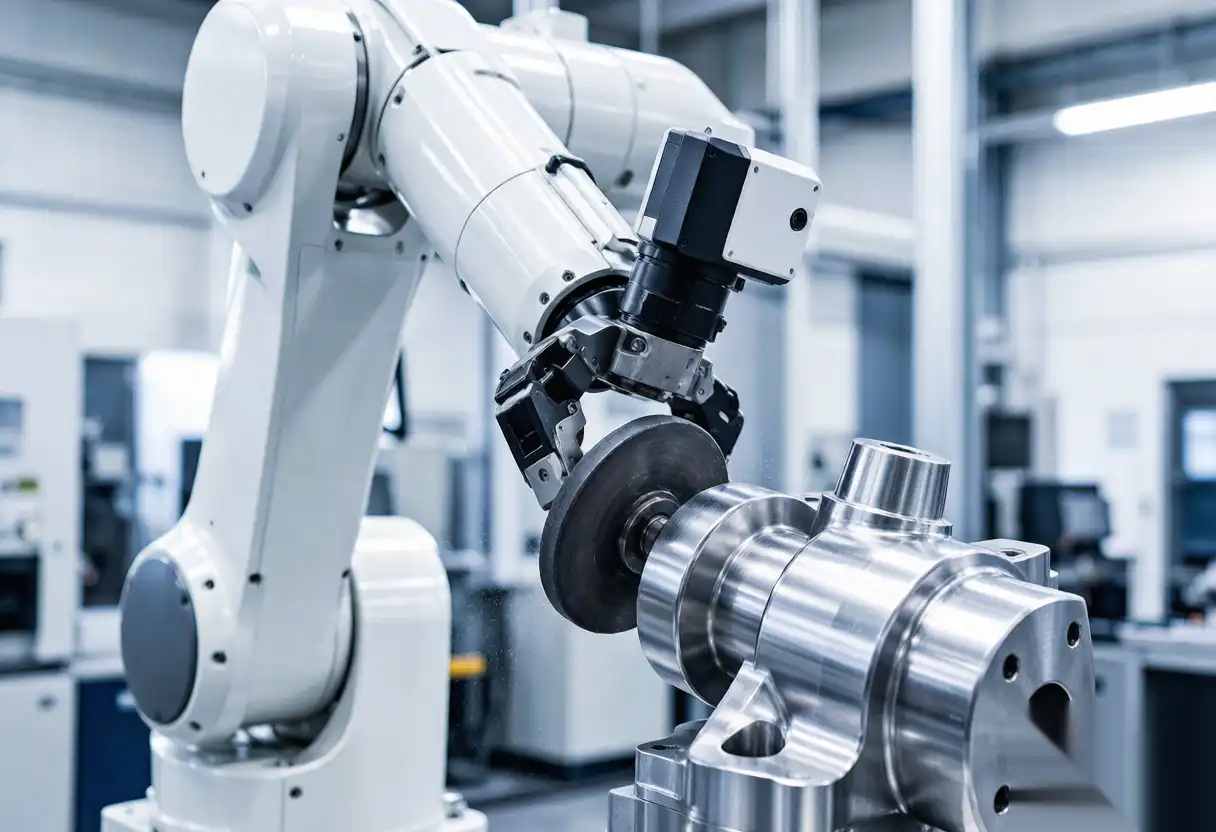
A robotic buffing cell is not a robot holding a hand tool. It is a coordinated system where the robot, the spindle, the compound applicator, and the part fixture all follow a taught program tuned to the part geometry.
The process usually runs in three passes. First, a cut pass with a firm sisal wheel removes tool marks and blends the machined areas. Second, a colour pass with a softer cotton mop brings up the shine. Third, a wipe or brush station clears compound residue before inspection.
The robot holds the faucet against the wheel rather than the wheel against the faucet. This orientation lets one wheel serve many surface zones, and the robot can rotate the part to keep contact angle constant across curves.
Force control keeps the contact pressure between six and twelve newtons. That window is firm enough to cut, yet gentle enough to avoid flat spots on curved spouts and handles.
| Process Stage | Wheel Type | Typical Force | Cycle Target |
|---|---|---|---|
| Cut pass | Sisal + grey compound | 8–12 N | 15–25 s |
| Colour pass | Cotton mop + white compound | 6–9 N | 10–20 s |
| Residue clear | Brush or cloth wheel | 2–4 N | 5–10 s |
| Load and unload | Gripper exchange | — | 8–15 s |
What a Real Conversion Looks Like
Consider a mid-size plant making brass faucet bodies for a European brand. Before conversion, twelve buffer stations ran two shifts and produced about nine hundred polished bodies per day with a five percent rework rate.
After installing two robotic cells, the same output came from one operator per shift and a loader. Rework fell below one percent, mostly parts with casting pores that no finish process can hide.
| Metric | Manual (12 stations) | Robotic (2 cells) | Change |
|---|---|---|---|
| Daily output | ~900 bodies | ~1,100 bodies | +22 % |
| Direct labour | 12 workers × 2 shifts | 2 operators × 2 shifts | −83 % |
| Finish rework rate | 5.0 % | 0.9 % | −82 % |
| Surface consistency (Ra spread) | 0.15 µm band | 0.05 µm band | 3× tighter |
| Compound consumption | 100 % baseline | 78 % baseline | −22 % |
The numbers above reflect a typical two-cell conversion on mid-size brass bodies. Your own ratios will shift with part mix, shift pattern, and local wage levels, so treat them as directional rather than guaranteed.
The Cost Structure Behind the Investment
Buyers often see the robot arm price and stop there. The honest budget includes tooling, guarding, extraction, integration, and the first year of consumables.
| Cost Element | Share of Project | Notes |
|---|---|---|
| Robot + controller | 25–35 % | Payload 10–20 kg class is enough |
| Spindles and wheels | 10–15 % | Two per cell for cut and colour |
| Fixtures and grippers | 10–18 % | Dedicated per faucet family |
| Guarding and extraction | 8–12 % | Safety rated, dust rated |
| Integration and programming | 15–25 % | Path teaching, force tuning |
| Training and spares | 5–8 % | Two operators plus maintenance |
A complete single cell for faucet bodies typically lands between one hundred twenty and one hundred eighty thousand US dollars. Payback at the labour savings in the case above runs twenty to twenty-six months; adding the rework savings pulls it under eighteen.
Automatic buffing machine technologies explain the spindle and force-control options behind these numbers. Understanding them helps you compare quotes on capability rather than price alone.
Fixtures and Tooling Details That Decide Quality
Curved faucet geometry is the real challenge. The fixture must present the spout, body, and handle surfaces to the wheel without shadowing any zone, and it must repeat position within two hundred microns.
Most integrators use a quick-change pallet with three-point location. One pallet per faucet family keeps changeover under ten minutes. Families with very different sizes need their own pallet sets.
Wheel selection follows the alloy and the preceding process. Machined brass with light tool marks can go straight to the colour pass. Sand-cast or gravity-cast surfaces with more texture need the full cut pass first.
Compound delivery matters more than most buyers expect. A timed spray bar that doses every fifteen to twenty cycles beats manual stick application on both consistency and consumption. Metering by cycle count also keeps wheels from loading.
Verifying the Finish Before You Ship
Acceptance starts with a gloss or Ra check on a sample from each batch. A handheld profilometer on three zones — spout crest, body flank, and handle root — catches variation that the eye misses.
Visual inspection under standardised lighting catches haze, drag lines, and compound residue. Many plants keep one human inspector after two cells; the inspection is faster than buffing and catches casting defects the cell cannot fix.
Track the numbers on a simple control chart. When Ra drifts up, the wheel is worn or the compound dose is late. When drag lines appear, contact angle has shifted and the path needs a touch-up.
Choosing a Supplier Who Fits Sanitary Ware
Not every robot integrator understands faucet geometry. Ask for references on parts of similar size and alloy, and for sample parts run in their demo cell before you sign.
Check support terms carefully. Regional spare-parts stock, response time guarantees, and remote diagnostics access separate suppliers who finish the project from suppliers who finish the commissioning week.
Sanitary-ware polishing machine selection covers the evaluation checklist in more depth. The short version: insist on a paid feasibility trial with your own castings before the purchase order.
Implementation Advice From Conversions That Went Well
Start with your highest-volume family, not your hardest geometry. Proving the cell on a stable part builds operator trust and tunes your maintenance routine before the hard parts arrive.
Involve your best manual buffer in path teaching. Their knowledge of where the finish burns and where it never cuts clean is exactly what the programmer needs. Plants that exclude the old crew usually pay for it in rework.
Plan wheel and compound stock for six months from day one. Lead times on specialty mops can stretch, and a cell waiting on consumables burns capital without output.
Changeover Between Faucet Families
Family changeover decides real output more than cycle time does. A cell that changes families in eight minutes loses under two percent of a shift; one that takes forty minutes loses ten.
The mechanics are simple: palletised fixtures, program selection from the HMI, and wheel presets stored per family. The discipline is what matters — stage the next family’s pallets during the current run, and the swap is lift, dock, and select.
Verify the first part after every changeover with the Ra check from the acceptance routine. Two minutes of verification prevents a full tray of mismatched finish from reaching inspection.
Maintenance and Consumables Planning
A buffing cell consumes wheels, compound, and dressing time on a schedule you can predict. Budget sisal wheel replacement every one hundred fifty to two hundred fifty operating hours, cotton mops every eighty to one hundred twenty, and compound by cycle count rather than by shift.
Weekly maintenance fits in one hour: clean extraction filters, check spindle runout, grease the robot’s axis six, and inspect nest clamp faces for brass build-up. Monthly maintenance adds belt tension checks and a fixture gauge against the master.
Keep the consumable plan visible at the cell. When wheel changes drift from the schedule, finish consistency drifts with them — slowly enough to blame the alloy, quickly enough to lose a customer audit.
Answering the Objections You Will Hear Internally
Someone will ask whether the robot can handle the mixed handle-and-spout geometries. The answer is fixture families: group parts by reachable zones, and most plants cover eighty percent of the catalogue with three or four of them.
Someone else will worry about the learning curve. Plan on eight weeks from installation to full-rate operation, with the supplier’s engineer on site for the first two and reachable by remote support afterwards.
The finance question is payback, and the case table already answers it: at the labour and rework savings shown, the cell clears its own cost inside two years, faster where wages are high.
Faucet polishing automation succeeds when the cell, the fixtures, and the consumables are engineered together. Plants that treat it as a robot purchase get a machine; plants that treat it as a process conversion get the results in the tables above.
The approaches described are starting points; an application engineer should tune them to your line.