

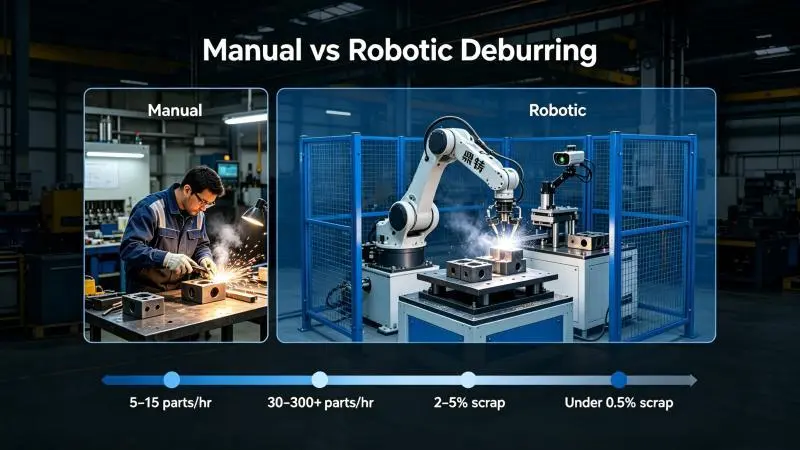
The debate between robotic deburring and manual deburring is not about which method is “better” in the abstract — it is about which one fits your volume, geometry, and quality targets. Manual grinding still has a place, but for a large and growing share of metal casting finishing, robotics now wins on cost per part, consistency, and safety. This article lays out the trade-offs with hard numbers so you can decide with confidence.
If you have not yet defined your requirements, start with our deburring machine selection guide and the five features to look for.
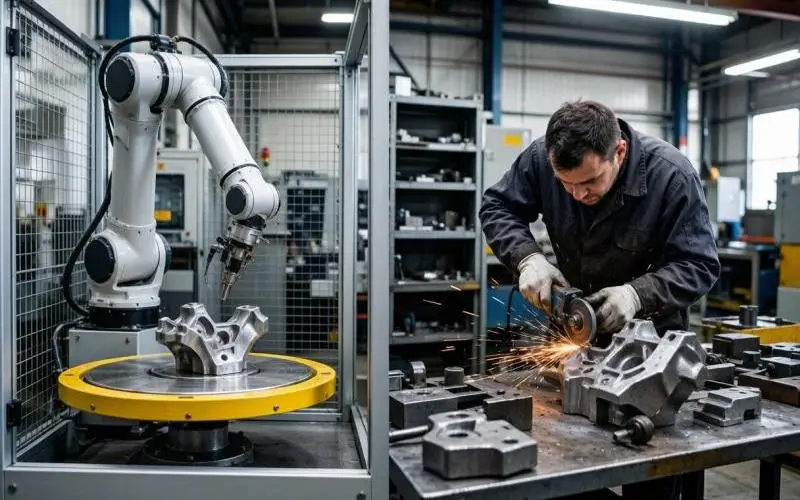
What Manual Deburring Looks Like Today
Manual deburring uses pneumatic die grinders, belt sanders, and fixtures at ergonomically designed stations. Modern manual stations include dust extraction and torque-controlled tools, but the skill — and the variation — still lives in the operator’s hands.
- Best for: Under 5,000 parts/year, castings over 100 kg, prototypes, and rework.
- Investment: $2K–$15K per station.
- Labor: $30–$50/hr per operator, often two shifts.
- Quality: Inconsistent; scrap from defects typically 2–5%.
What Robotic Deburring Delivers
A robotic deburring cell pairs a six-axis robot with compliant, force-sensing tooling. Modern cells use machine vision to locate variable flash and adapt paths per part.
- Best for: Complex 3D castings, mixed-model production, volumes over 10,000 parts/year.
- Investment: $80K–$250K+ installed.
- Throughput: 30–300+ parts/hr depending on geometry.
- Quality: Repeatable to ±0.1 mm; scrap under 0.5%.
Head-to-Head Comparison
| Factor | Manual | Robotic |
|---|---|---|
| Throughput | 5–15 parts/hr | 30–300+ parts/hr |
| Consistency | Variable | ±0.1 mm repeatable |
| Scrap from defects | 2–5% typical | Under 0.5% |
| Labor | 1 operator / station | 1 operator / 2–4 cells |
| Capital | $2K–$15K | $80K–$250K+ |
| Cost per part | $0.50–$3.00+ | $0.05–$0.50 |
| Changeover | Instant | 5–60 min (software) |
| Safety risk | High | Low (guarded cell) |
| Payback | N/A | 12–24 months |
A ductile iron foundry running 35,000 brake calipers/year replaced six manual stations with one robotic cell and one through-feed belt machine. Combined investment: $165K. Payback: 14 months. Scrap dropped from 4.2% to 0.3%.
When Manual Still Wins
Robotics is not universal. Manual stays the right call when:
- Volume is genuinely low (under ~5,000 parts/year) and will stay there.
- Parts are too large or too few to justify cell design.
- You need unlimited flexibility for one-off prototypes and rework.
When Robotics Clearly Wins
- Volume > 10,000 parts/year — the cost-per-part gap alone pays back the cell.
- Quality-sensitive edges — sealing surfaces, safety radii, cosmetic finishes.
- Safety and labor pressure — guarding against repetitive-strain and grinding-dust injuries while freeing skilled labor.
Our complete robotic deburring buyer’s guide covers the specification details once you decide to move forward.
Do not frame this as “replace all manual labor.” The highest-ROI move is usually to automate your top five high-volume part numbers first, keeping manual stations for the long tail of low-volume work.
Frequently Asked Questions
- Q: Is robotic deburring too expensive for a small foundry?
A: Not anymore. Implementation cost for robotic cells has dropped roughly 30% since 2020, and a phased approach (highest-volume parts first) can pay back in under 18 months even at 10K–50K parts/year. - Q: What about programming for many part numbers?
A: Vision-guided systems generate paths from the actual part, cutting programming time by up to 80% for mixed-model runs. Stored programs make changeover a software action. - Q: Will robots handle casting-to-casting variation?
A: Only with force and vision control. Rigid path-following robots will not; adaptive cells will. This is the single biggest differentiator.
Conclusion: Make the Call on Volume and Quality
Manual deburring remains valid for low volume and extreme flexibility. For everything above roughly 10,000 parts/year — or any part where edge quality and safety matter — robotic deburring beats manual on cost, consistency, and risk. Score your top part numbers and model the five-year cost per part before deciding.
Get a Robotic vs Manual ROI Estimate
Send us your top five part numbers, volumes, and current cost per part. We will return a side-by-side payback model.
References and Further Reading
- U.S. Bureau of Labor Statistics, “Nonfatal Occupational Injuries Involving Days Away From Work,” 2023.
- Robotics Business Review, “Annual Robot Market Report,” 2025.
- Dingzhu — Intelligent robotic deburring case studies and cell specifications.