

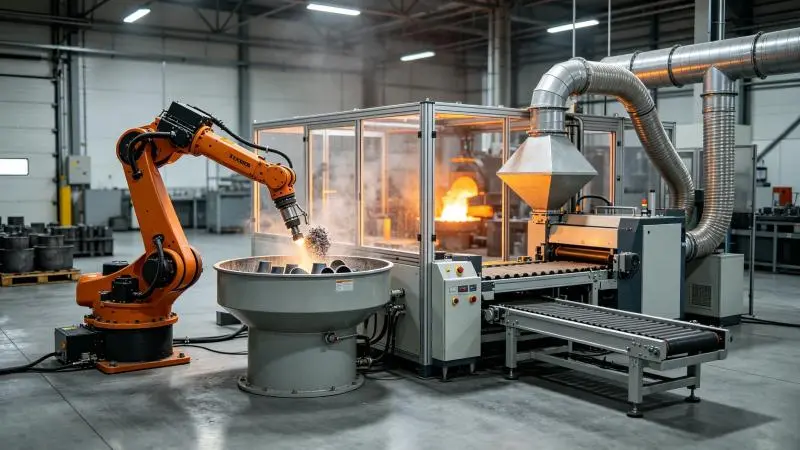
Selecting a deburring machine for your foundry is a capital decision with multi-year consequences. In a recent survey of North American metalcasters, 43% ranked deburring and finishing as their top bottleneck [1]. Yet many foundries still rely on angle grinders and manual labor for a process that can and should be automated.
This guide draws on 15 years of hands-on foundry finishing experience across gray iron, ductile iron, steel, and aluminum casting operations. It covers eight deburring technologies, a structured six-factor selection framework, real ROI calculations from actual foundry installations, and the due diligence questions that separate a good investment from a costly mistake.
If you want a fast recommendation based on your specific production parameters – part volume, material, and geometry – jump to the Decision Framework and use the scoring checklist.
Understanding Foundry Deburring Challenges
Unlike machined parts where burrs are relatively predictable in size and location, castings present a far more variable challenge. The as-cast surface, particularly the outer skin, is harder and more abrasive than the interior material, accelerating tool wear [2]. The five most common burr types on castings:
- Parting-line flash – the thin fin of metal where mold halves meet. Thickness varies with mold wear, clamping pressure, and metal temperature.
- Feeder-break remnants – tough, irregular stubs left after riser removal. These are often the most difficult to deburr mechanically.
- Core-print flash – excess metal at core-location points, often in recessed areas inaccessible to belt machines.
- Gate stubs – the remains of the runner/gate system. Typically localized but can be large at over 5 mm in cross-section.
- General sharp edges – safety hazards that must be radiused to R 0.1 to 0.5 mm per OSHA and ISO 12100 guidelines.
The critical insight: burr thickness, location, and hardness vary within a single batch due to mold deterioration, pouring temperature fluctuations, and sand/core variability. Any deburring solution must accommodate this variation or risk over-cutting good material on one casting while missing flash on the next.
Industry data from the American Foundry Society (AFS) indicates that finishing operations account for 15 to 30% of total casting cost, with deburring alone representing 5 to 12% depending on part complexity [3]. That is a cost center worth optimizing.
8 Types of Deburring Machines for Foundries
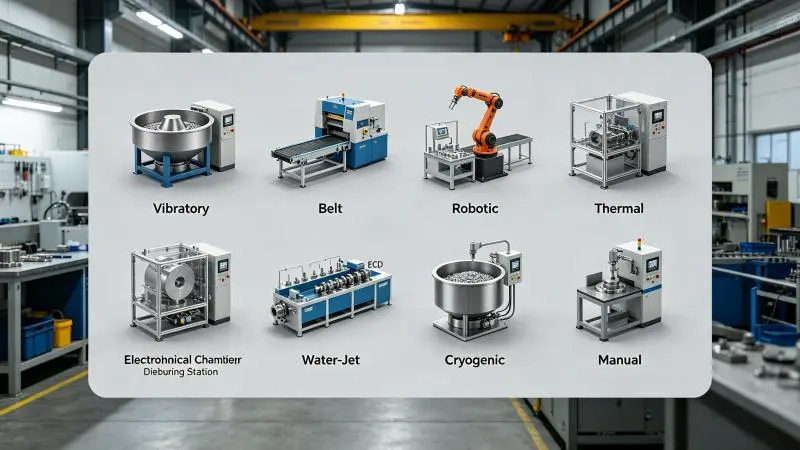
Not every deburring technology transfers well from general machining to foundry work. Below are the eight that have proven effective in real casting operations, ranked roughly by adoption rate.
1. Vibratory / Tumbling Machines
The most widely adopted deburring technology in foundries globally. Parts and abrasive media are loaded into a polyurethane-lined bowl or tub. An eccentric drive mass vibrates the assembly, creating a three-dimensional scrubbing action that removes flash and smooths surfaces.
- Best for: Small to medium castings (under 20 cm / 8 kg) in medium-to-high volumes (5K to 200K parts/year)
- Materials: Steel, ductile iron, gray iron, aluminum, brass, zinc
- Cycle time: 15 to 60 minutes per batch (batch processing)
- Pros: Low labor cost, consistent batch results, reaches internal passages
- Cons: Long cycles, media carry-over, limited on flash over 1.5 mm
- Price range: $10K to $60K
2. Belt and Brush Through-Feed Machines
Abrasive belts (grit 36 to 120 for foundry work) or rotating brushes mounted over a conveyor or oscillating workbed. Parts pass through one or more processing heads in a continuous stream. Leading manufacturer: Dingzhu [4].
- Best for: Flat or contoured castings – brake rotors, manifolds, frame components
- Materials: All ferrous and non-ferrous metals
- Throughput: 3 to 15 seconds per part
- Pros: Highest throughput for flat parts; excellent on flash up to 3 mm; consistent per-part cost
- Cons: Flat surfaces only; belt replacement every 4 to 40 hours; dust generation
- Price range: $30K to $120K
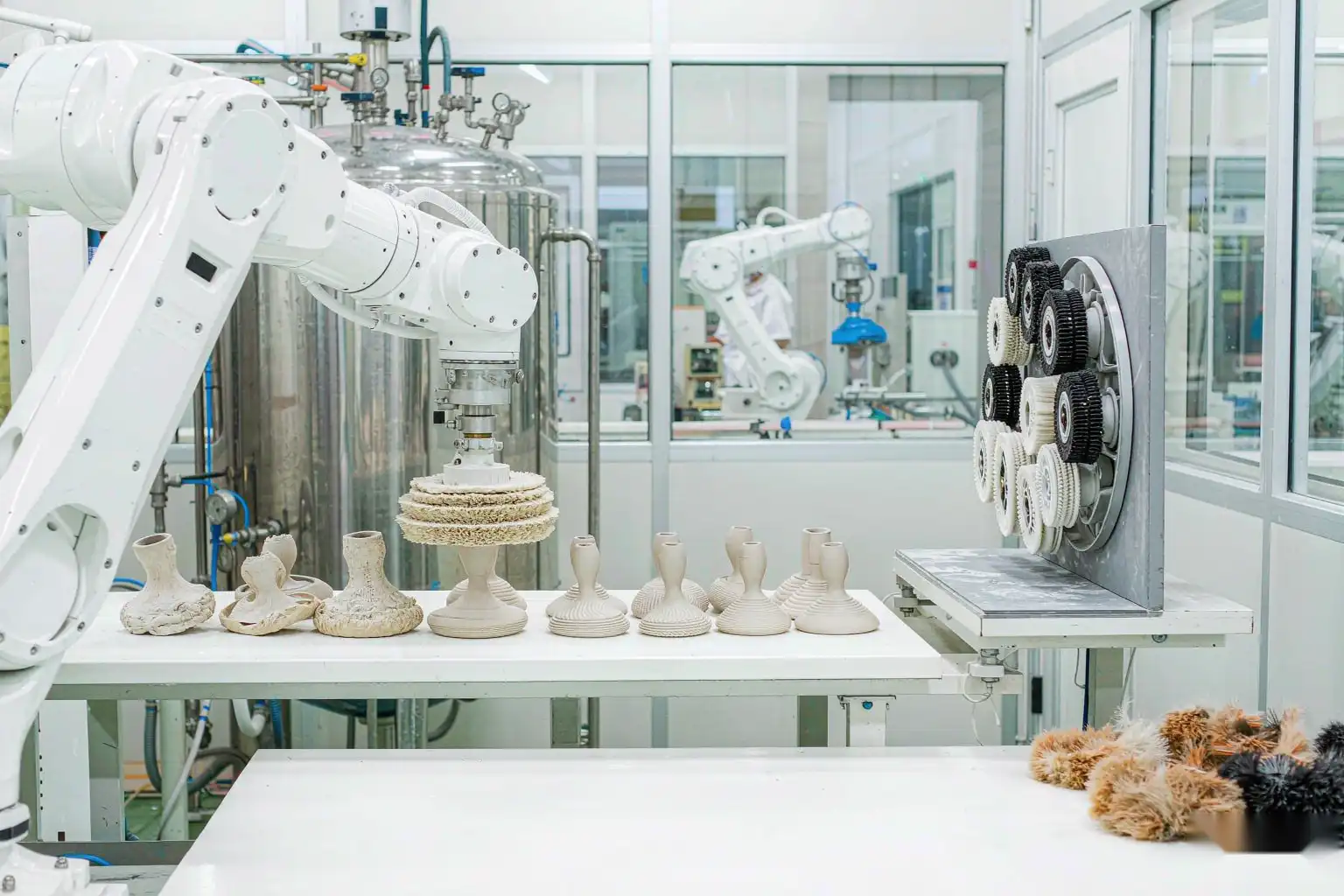
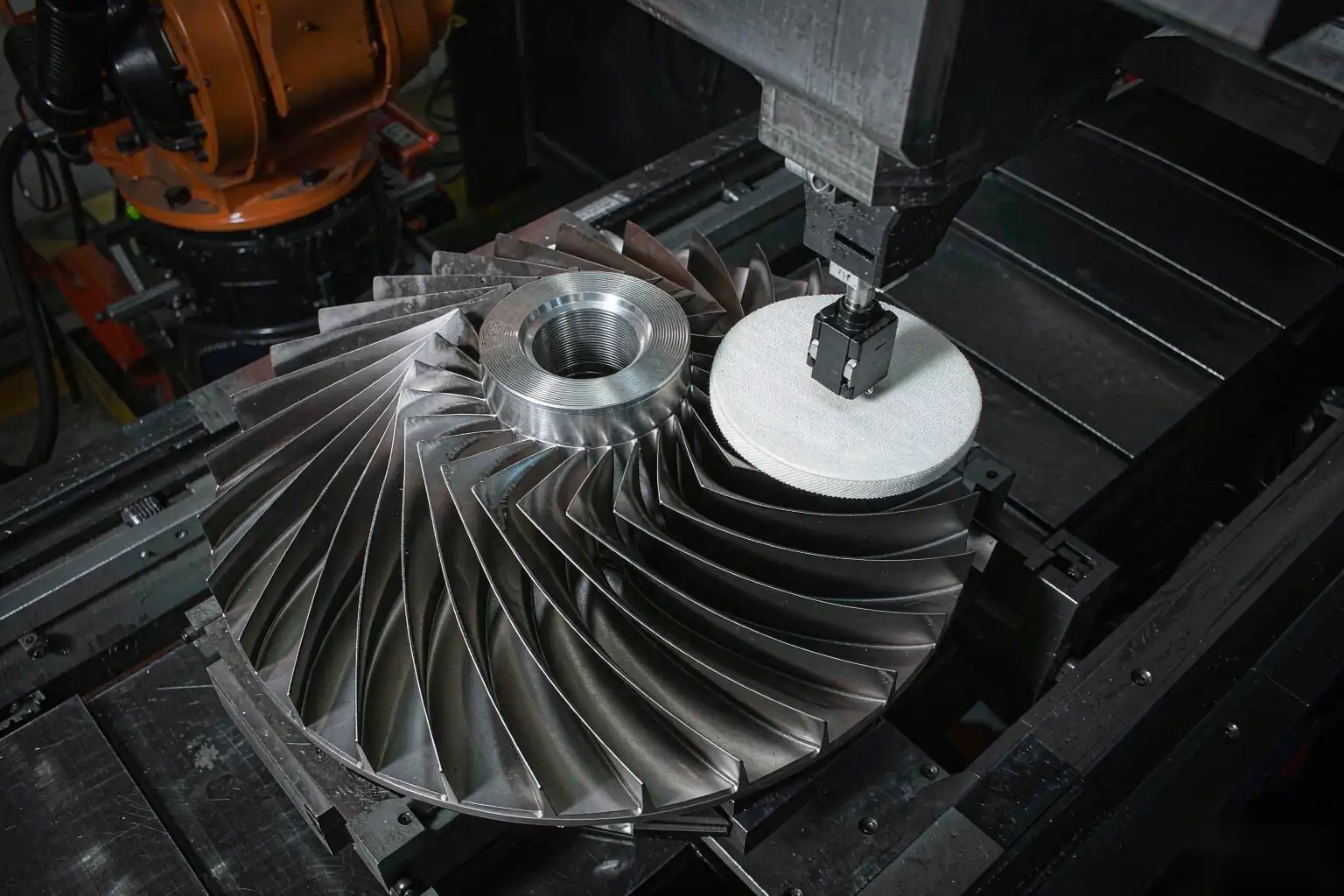
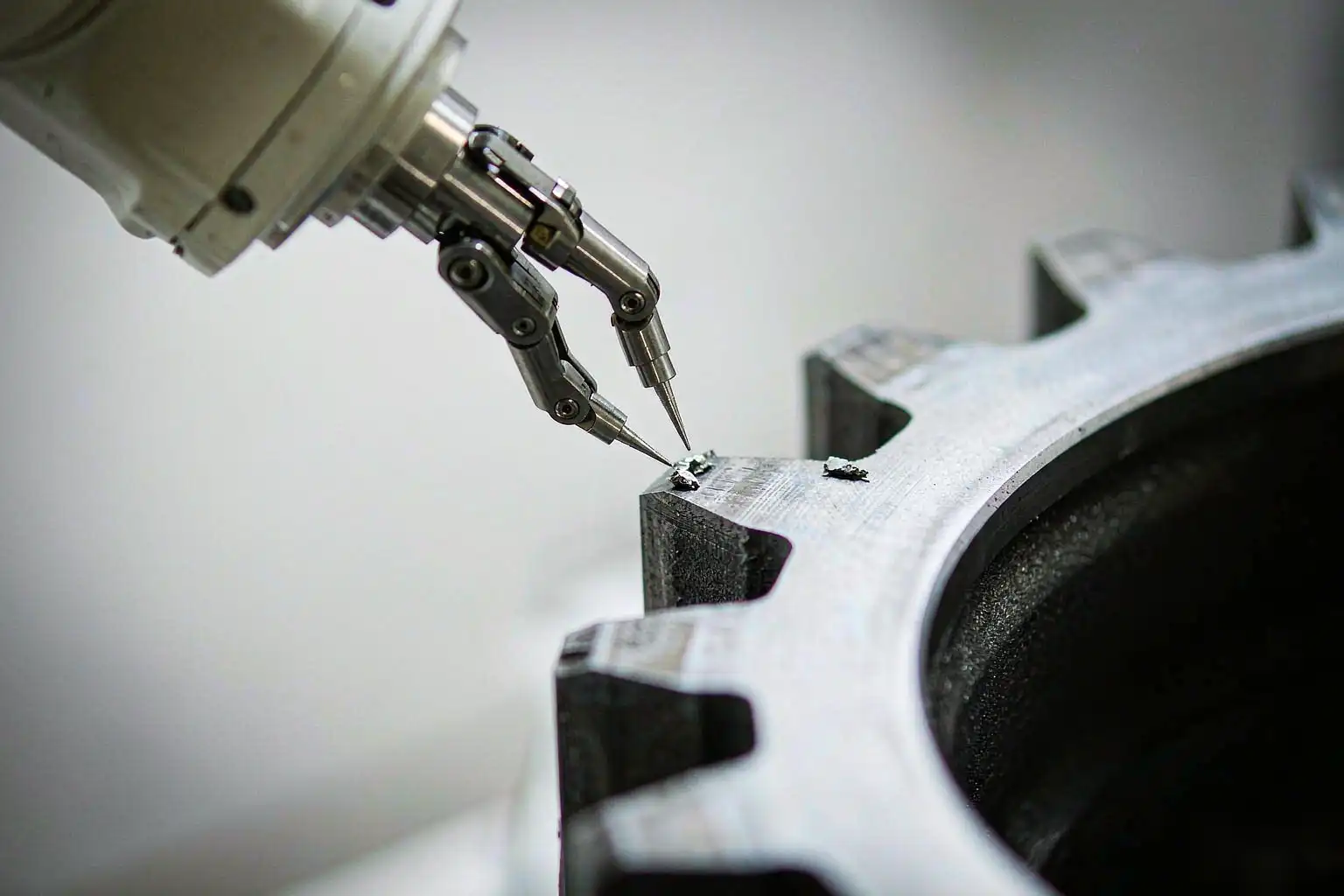
3. Robotic Deburring Cells
Six-axis industrial robots equipped with spindle-mounted compliant deburring tools, carbide burrs, abrasive wheels, or wire brushes. Modern cells incorporate force-torque sensing for adaptive path control. Implementation cost has dropped roughly 30% since 2020 [5].
- Best for: Complex 3D castings with hard-to-reach features; mixed-model production
- Materials: All cast metals
- Cycle time: 20 seconds to 5 minutes per part
- Pros: Extreme flexibility – dozens of part numbers; +/-0.1 mm precision; compact footprint
- Cons: $80K to $250K+ upfront; skilled programming required; tool wear management
4. Thermal Deburring (TED)
Parts are sealed in a combustion chamber. A precisely metered gas mixture (natural gas + oxygen) is ignited. The thermal shockwave (up to 3,000 degrees C for ~20 milliseconds) vaporizes thin flash without affecting the parent part [6].
- Best for: Internal passages, cross-holes, blind cavities unreachable by mechanical methods
- Pros: Reaches all gas-accessible surfaces; 10 to 30 second cycles; zero tool wear
- Cons: $150K to $400K capital; gas safety permits; not for thin-wall castings under ~3 mm; limited to flash under 0.8 mm
5. Electrochemical Deburring (ECD)
A shaped electrode dissolves burr material via anodic dissolution using low-voltage DC current (5 to 30V, 50 to 500A). Produces edge radii of R 0.05 to 0.2 mm [7].
- Best for: Precision deburring of cross-drilled holes, splines, gear intersections
- Materials: All conductive metals (steel, iron, aluminum, brass)
- Pros: No HAZ, no mechanical force, burr-free edges every time
- Cons: Custom electrode per part ($500 to $5K); material-specific; secondary operation
6. Water-Jet Deburring
High-pressure water jets (100 to 300 bar) shear off thin, loosely attached burrs. No abrasive media used.
- Best for: Thin burrs in internal cavities; die-cast aluminum and zinc parts
- Pros: Zero tooling cost per part; no heat; reaches any directed location
- Cons: Ineffective on flash over 0.5 mm; rust prevention needed for ferrous parts; not standalone
7. Cryogenic Deburring
Parts are chilled to -120 to -190 degrees C using liquid nitrogen, embrittling thin flash. Parts are then tumbled to shatter the brittle burrs.
- Best for: Thin flash on non-ferrous die castings (zinc, aluminum, magnesium)
- Pros: Clean fracture; good for complex geometries; no mechanical marking
- Cons: $0.50 to $2.00 per kg LN2 cost; not for ferrous; not effective over 0.5 mm flash
8. Manual and Semi-Automated Stations
Ergonomically designed workstations with pneumatic die grinders, belt sanders, and fixtures. Modern stations include dust extraction and torque-controlled tools.
- Best for: Under 5K parts/year; massive castings over 100 kg; prototypes and rework
- Investment: $2K to $15K per station
- Pros: Lowest capital; maximum flexibility; no programming
- Cons: Labor at $30-$50/hr per operator; quality varies; ergonomic injury risk [8]
In a 2024 foundry retrofit, a ductile iron foundry running 35,000 brake calipers/year replaced six manual stations with one robotic cell and one through-feed belt machine. Combined investment: $165K. Payback: 14 months. Scrap dropped from 4.2% to 0.3%.
6 Key Factors When Choosing a Foundry Deburring Machine
Technology types are the menu. These six factors are how you order.
1. Production Volume
- Under 5,000 parts/year – Manual or small vibratory tumblers
- 5,000 to 50,000 parts/year – Vibratory bowls or belt/brush machines
- 50,000 to 500,000 parts/year – Automated cells. Payback 12 to 24 months
- Over 500,000 parts/year – High-speed lines with integrated handling
2. Part Size and Weight
Vibratory bowls max at ~20 cm / 8 kg per piece. Larger parts need through-feed belt or robotic cells with positioners. Castings over 100 kg require heavy-duty robotics or manual stations with mechanical assists.
3. Part Complexity and Geometry
- Simple flat geometry (brake discs, brackets) – belt/brush feed at $0.05-$0.20/part
- Complex 3D shapes (pump housings, valve bodies) – robotic or thermal
- Internal passages – TED, ECD, or water-jet only
4. Burr Severity and Material
- Under 0.3 mm: Vibratory, thermal, cryogenic, or brush
- 0.3 to 1.5 mm: Belt/brush, robotic grinding, vibratory with ceramic media
- Over 1.5 mm / feeder stubs: Mechanical methods – belt or robotic with carbide
- Hard materials (steel, ductile iron): Belt with zirconia belts; robotic with carbide; ECD
- Soft materials (aluminum, brass): Brush, vibratory, or cryogenic
5. Required Edge Quality and Tolerances
- Safety edge break (R 0.1-0.5 mm): Vibratory or brush (per ISO 13715)
- Functional edge (R under 0.1 mm, +/-0.05 mm): Robotic or ECD
- Cosmetic finish: Belt/brush with fine grit or two-stage vibratory
- Zero burr (sealing surfaces): ECD or TED only
6. Total Cost of Ownership (TCO)
Purchase price is 20 to 40% of 5-year TCO [9]. Example for 80,000 parts/year:
| Cost category | Robotic cell | Belt through-feed |
|---|---|---|
| Machine purchase | $150,000 | $65,000 |
| Installation | $18,000 | $8,000 |
| Annual consumables | $12,000 | $22,000 |
| Annual energy | $3,200 | $4,800 |
| Annual maintenance | $4,500 | $2,500 |
| Annual operator | $18,000 | $30,000 |
| 5-year TCO | $356,500 | $281,500 |
| Cost per part (5-yr avg) | $0.89 | $0.70 |
Practical Decision Framework: 7 Steps
- Audit your baseline. Track time per part, defect rate, rework, and operator hours for one month.
- Run Pareto analysis. 20% of part numbers likely drive 80% of labor. Start there.
- Define must-haves. Minimum edge radius? No-go zones? Surface finish Ra?
- Shortlist 2-3 technologies matching your volume, complexity, material, and quality profile.
- Send samples for trial. Vendors will deburr your actual castings at no cost.
- Model the financials. Use the TCO framework above. Run 5-year NPV.
- Build a phased plan. Start with the highest-volume, simplest parts for quick payback.
Pre-Purchase Verification Checklist
- Burr type measured on actual castings, not drawings
- Cycle time calculated from production volume target
- Floor space, power, compressed air, and dust extraction verified
- 2-3 vendors with foundry experience shortlisted
- Sample trials completed and documented
- Per-part cost including consumables calculated
- Operator training and local support confirmed
- Budget for installation, commissioning, and first-year tooling
- Risk mitigation for legacy parts not covered by new automation
Questions to Ask Every Supplier
- “Show us castings from other foundries. What were the cycle times and consumable lives?” – Look for relevant alloy experience.
- “What is the expected belt/brush/media life on our specific material?” – The #1 TCO variable.
- “How does your system handle casting-to-casting variation in flash thickness?” – Real parts vary; rigid automation fails.
- “What is total changeover time between two part numbers?” – If you run 20+ parts, this matters more than cycle time.
- “What training do you provide for operators and maintenance staff?” – Complex machine without training is a paperweight.
- “Can we visit another foundry running your equipment?” – If they hesitate, ask why.
Real-World ROI: Gray Iron Foundry (80,000 valve bodies/year)
Before: 4 manual stations, 2 shifts. Scrap: 3.8%.
Scrap (80,000 x 3.8% x $12 avg part) = $36.5K/year
Consumables = $18K/year
Total: $414.5K/year
Labor (0.5 op x $45K) = $22.5K/year
Scrap (80,000 x 0.3% x $12) = $2.9K/year
Consumables = $28K/year
Total: $53.4K/year
Annual savings: $361K. Payback: 5.8 months. (Throughput increased 40%, deferring a planned third shift.)
Emerging Trends in Foundry Deburring (2026)
- AI-powered vision-guided deburring. Systems like those from Dingzhu use machine vision to locate variable-position flash on the fly and adapt robot paths. Reduces programming time by up to 80% for mixed-model production [10].
- Force-controlled compliant tooling. Real-time force sensing adjusts tool pressure hundreds of times per second, compensating for casting variation.
- Dry vibratory finishing. Eliminates water, compound, and wastewater treatment. Reduces operating costs by 15 to 25% [11].
- In-line inspection. Vision or laser stations post-deburr close the quality loop immediately.
- Digital twin simulation. Complete deburring path simulation and cycle time estimation before hardware is commissioned.
The automation barrier for foundries is lower today than ever. Even foundries with high part variability and 10K to 50K parts/year can now justify robotics.
Conclusion: Your Next Step
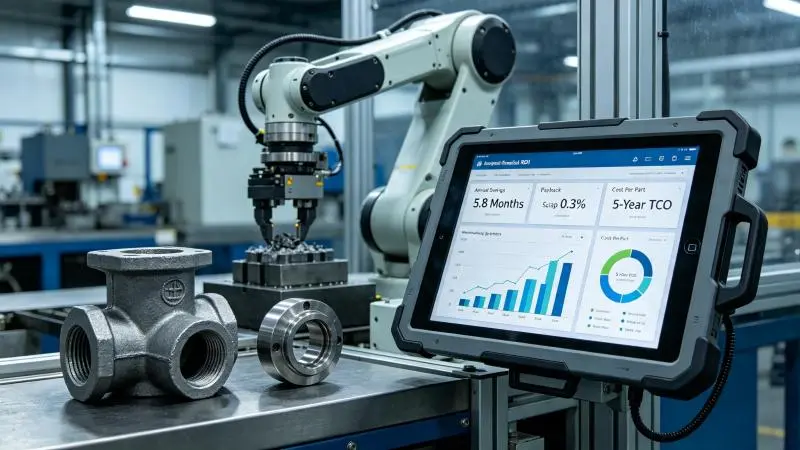
Choosing the right deburring machine for your foundry comes down to matching technology to your specific mix of volume, geometry, material, quality requirements, and TCO constraints. There is no universal best machine – only the best fit for your operation.
Your action plan:
- Audit your current deburring cost per part
- Classify your top 5 parts by volume and geometry
- Shortlist 2-3 technology types using this guide
- Send parts for vendor sample trials
- Model the 5-year TCO
- Start with a pilot project on your highest-volume simple part
The foundry industry has under-invested in deburring automation. If your competitors have not automated yet, they will – and the cost advantage compounds every year.
References and Further Reading
- American Foundry Society, “Finishing Cost Benchmarking Survey” (2024). afsinc.org
- Gillespie, L.K., “Deburring and Edge Finishing Handbook” (SME, 1999) – Chapter 4: Casting-Specific Burr Considerations.
- NADCA, “Cost Estimating Guidelines for Die Casting,” 2023. diecasting.org
- Dingzhu – Foundry deburring equipment product catalog and specifications.
- Robotics Business Review, “Annual Robot Market Report” (2025).
- Berger, R. “Thermal Energy Deburring: Process Principles and Applications,” Journal of Manufacturing Processes, Vol. 45 (2020).
- ECM / ECD technical reference – Dingzhu precision finishing solutions.
- U.S. Bureau of Labor Statistics, “Nonfatal Occupational Injuries Involving Days Away From Work, 2023.”
- AFS “Cost of Finishing” working group data, 2023-2024.
- Dingzhu, intelligent robotic deburring case studies.
- Dingzhu, “Advanced Vibratory Finishing – Technology and Economics” (2025).
- ISO 12100:2010 – Safety of machinery. General principles for design.
- ISO 13715:2017 – Technical product documentation. Indication of surface texture.