

A foundry in Turkey called us about eighteen months ago. They make aluminum bracket castings — thick, load-bearing parts, a few thousand a month — and a machinery salesman had them convinced they needed a high-pressure die casting cell. The quote was eye-watering: a 600-ton machine, a complex die, a cooling tower. We walked them through the part instead, and the honest answer was that a gravity die casting machine would do the job for a third of the money, with properties that actually suited a thick section. They bought the gravity cell. Six months later their scrap rate on that part dropped from double digits to under four percent.
If you run a foundry and you’re weighing casting methods, this is the guide I wish more buyers got before they signed. Gravity die casting — what most of the world calls permanent mold casting — isn’t the headline process HPDC is, but for a wide band of real production work it’s the smarter, cheaper choice. Here’s where it earns its keep.
What a Gravity Die Casting Machine Actually Is
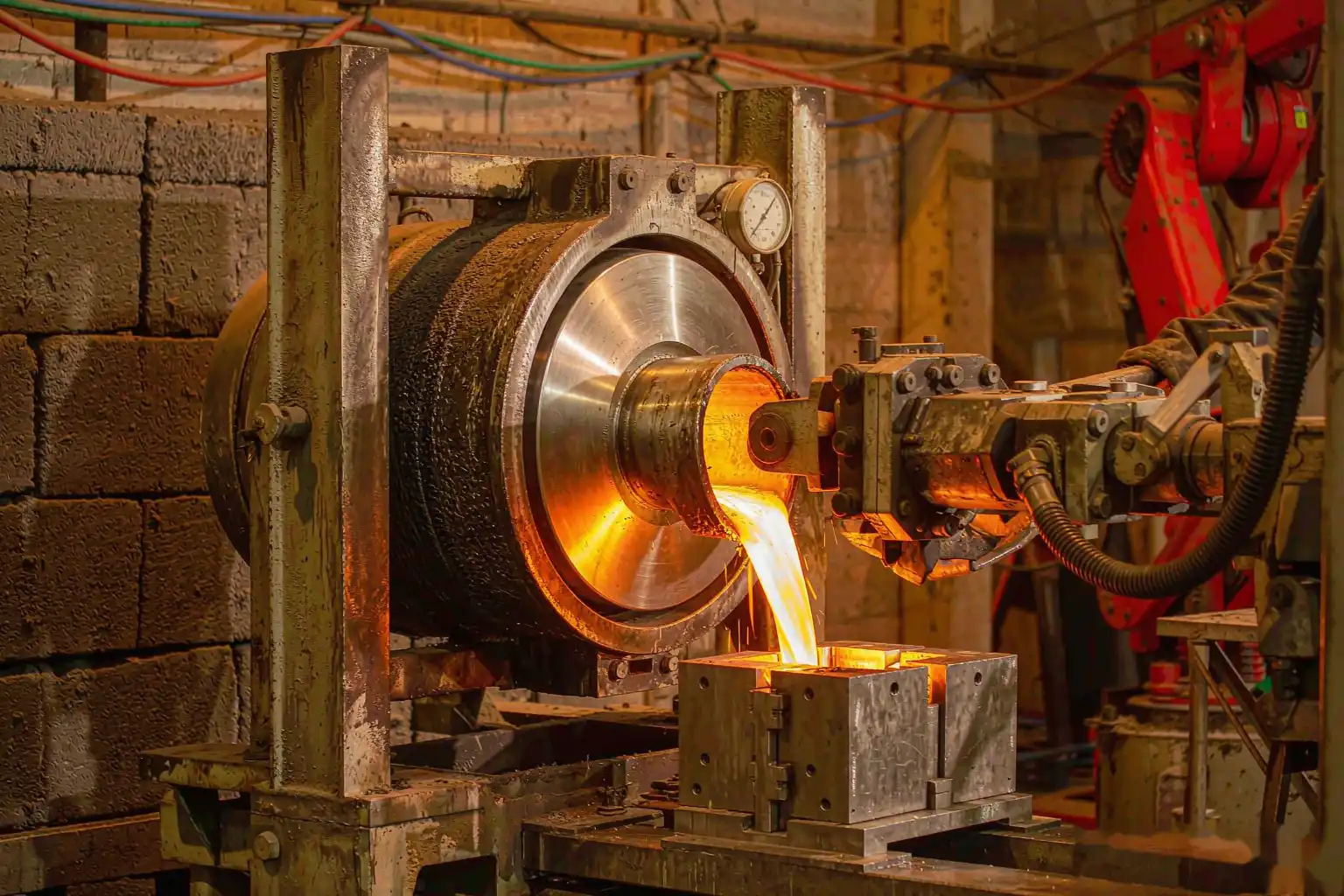
Strip away the jargon and it’s simple. A reusable steel (or cast iron) mold — the “die” — is mounted on a machine. Molten metal is poured in by gravity, with no hydraulic injection and no applied pressure beyond the head of the pour. The machine’s job is to hold the mold, let it open and close, manage cooling, and eject the part. Two common styles dominate: a stationary book-type mold that opens like a book, and a tilt-pour machine that rotates the crucible so the metal enters smoothly and fills from the bottom.
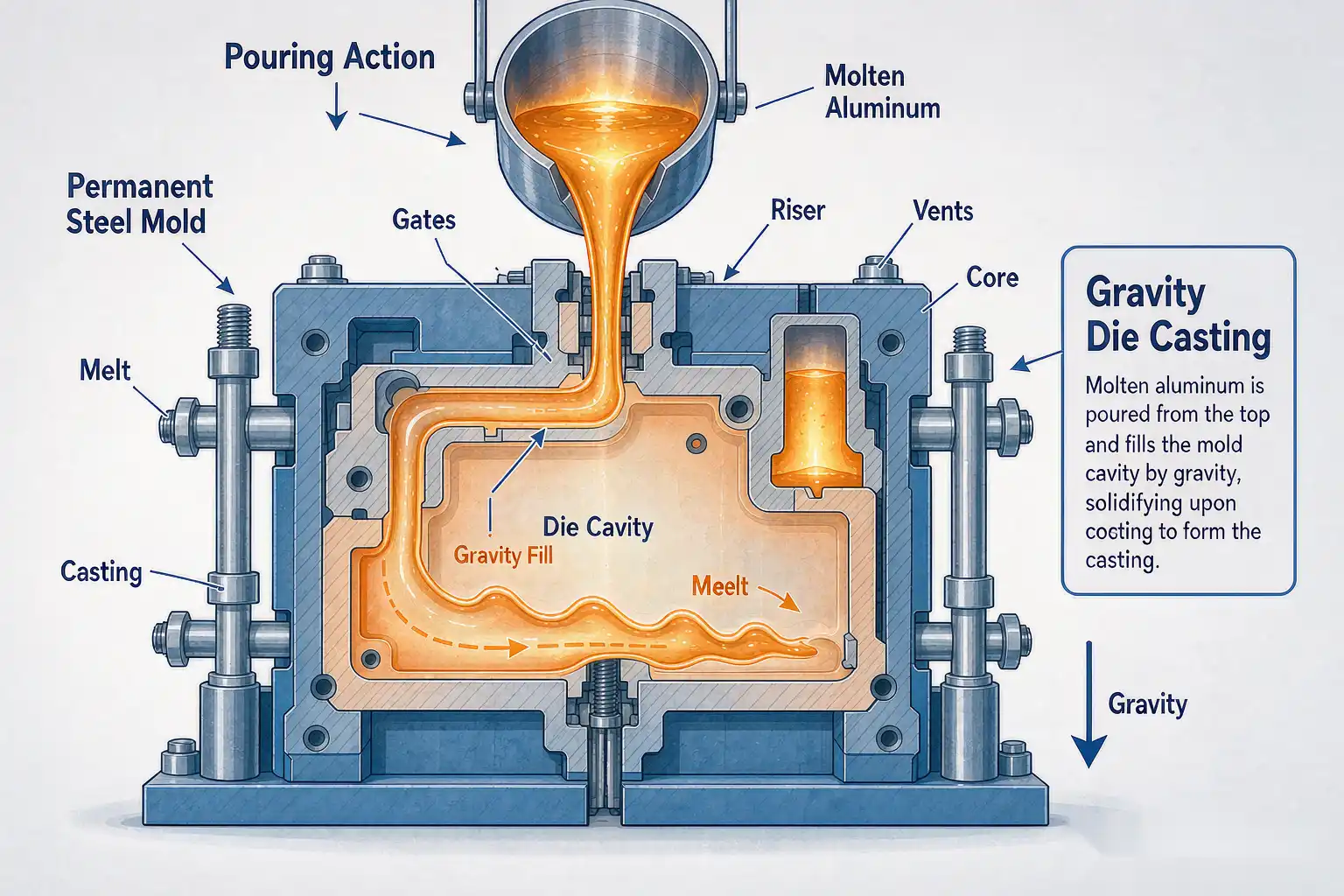
Because there’s no high-pressure shot, the tooling is far less stressed than an HPDC die. That single fact drives most of the benefits below.
Key Benefits for Metal Foundries
Lower Tooling and Machine Cost
This is usually the first thing a buyer notices. No shot-end, no 400–1,000 ton clamp, no accumulator. A gravity die and its machine cost a fraction of an equivalent HPDC cell. For a foundry running dozens of different parts in modest volumes, that lower entry cost means you can tool up a new part without betting the quarter’s budget. If you’re still deciding how a part should be specified before you tool it, our die casting DFM checklist covers the rules that apply to permanent molds too.
Better Properties for Thicker Sections
Gravity filling lets the part solidify directionally — from the farthest wall back to the gate — which pushes shrinkage into a riser you can cut off, not into the part. For sections thicker than about 4 mm, a gravity die casting is typically denser and less porous than a high-pressure part of the same geometry, where the fast shot can trap air. That’s why cylinder heads, pump bodies, and structural brackets are still gravity or low-pressure work, not HPDC.
Flexibility for Mid Volume and Prototypes
A permanent mold is quick to re-cut and the machine is forgiving. You can run a manual cell for a few hundred parts, move to semi-automatic for a few thousand, and add a robot for tens of thousands — often on the same basic frame. That ladder doesn’t exist on an HPDC line, where you’re either in high volume or you’re losing money.
Surface and Dimensional Control Above Sand
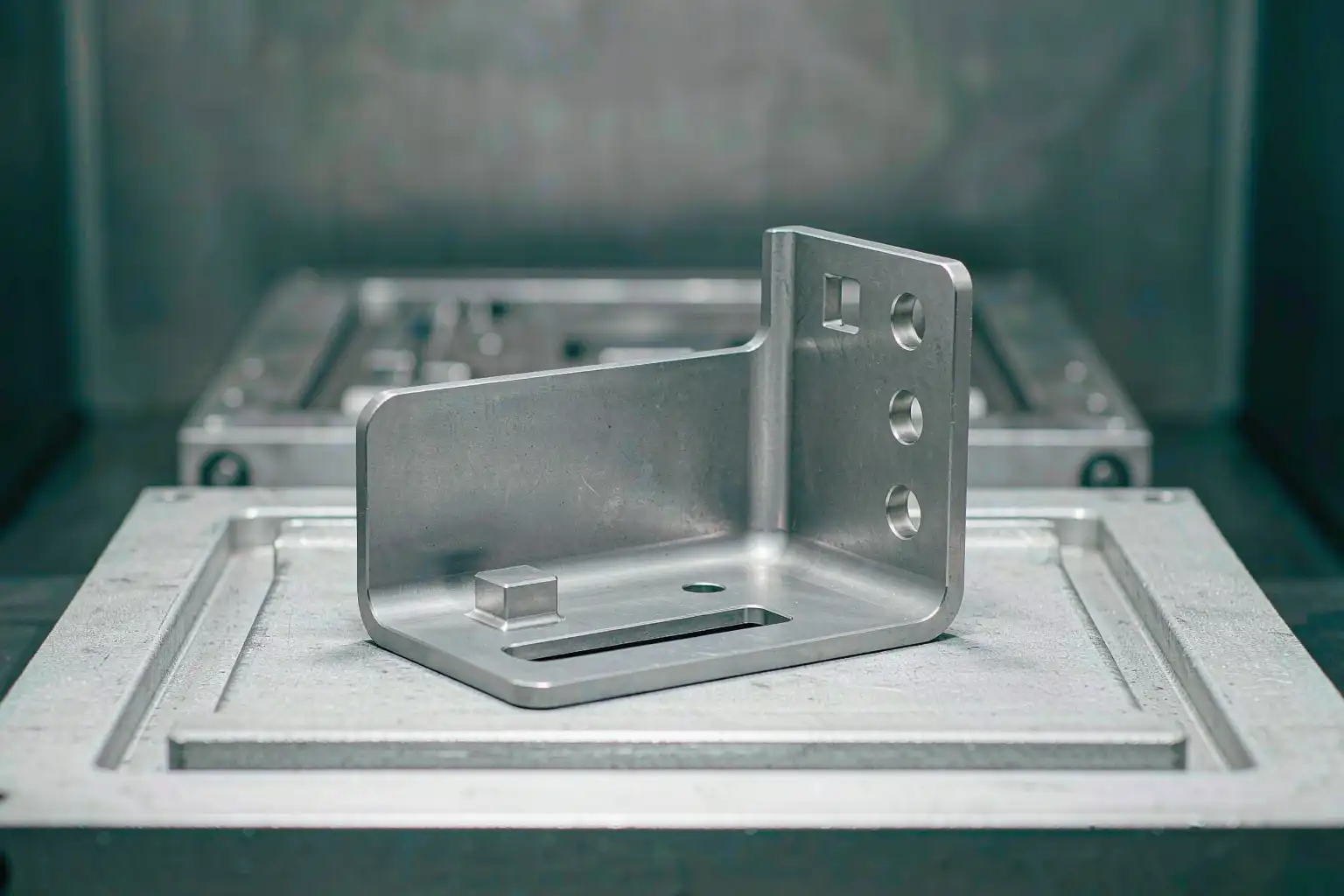
Against sand casting, gravity die wins on repeatability and finish. You get a consistent, chill-controlled surface and tight tolerances without the variability of a bonded-sand mold. For many decorative or functional aluminum parts, that means less machining and a cleaner as-cast look straight out of the mold.
Where Gravity Dies Beats — and Loses To — the Alternatives
Pick gravity die casting when your part is thicker-walled, lower-volume, and properties matter more than per-piece speed. It beats sand on consistency and HPDC on cost and density for that band of work.
It loses when you’re stamping thin-wall components by the million — HPDC is faster and cheaper per shot there. And it loses to sand when the part is enormous, one-off, or geometrically impossible to pull out of a rigid steel mold. Mixing those up is the expensive error we see most often.
Tilt-Pour vs Stationary: Which Machine?
A stationary book mold is cheap and rugged, good for simpler parts and higher rates once dialed in. A tilt-pour machine pours gentler, reduces turbulence and dross, and suits parts that hate air entrainment. If your alloy is prone to oxidation (magnesium especially) or your part has thin feeders, tilt-pour pays for itself in fewer rejects. Cooling design matters as much as the style — our notes on die cooling system design apply directly to permanent molds and often decide the cycle time.
Three Mistakes That Cost Foundries
1. Sizing the machine to the dream part. Buy for the part you actually run this year, not the hero part you might run. Oversized clamp and furnace just burn energy and oxidize metal you aren’t using.
2. Forgetting ejection and draft. A permanent mold has to let the part out. Under-drafted features that were fine in sand will lock in steel. Design draft in from the drawing, not the rework.
3. Leaving finishing out of the plan. The casting is half the job. Trimming, deburring, and any machining have to keep pace or you build a WIP pile. Tonnage and shot size drive the casting rate, and our machine tonnage and shot-size guide helps you size the whole cell, not just the pour.
A Pre-Quote Checklist
Before you talk to a supplier, write down:
- Alloy and typical section thickness of the part
- Monthly volume now and in 18 months
- Finished-part tolerances and any surfaces that must stay as-cast
- Floor space, power, and cooling water available
- How the part leaves the cell — trim, deburr, machine
Send that with a sample or drawing. A supplier who asks about your ejector scheme and cooling water is one who’ll deliver a cell that runs.
Frequently Asked Questions
What is the difference between gravity die casting and high pressure die casting?
Gravity die casting pours molten metal into a reusable steel mold with no applied pressure; HPDC injects it at high force. Gravity is cheaper to tool and denser for thick parts, while HPDC is faster and cheaper per piece for thin-wall high volume.
Which alloys work in a gravity die casting machine?
Primarily aluminum and magnesium, plus zinc and some copper-based alloys. Cast iron and steel permanent molds are also used for iron castings. Ferrous work at very high melting points is the exception, not the rule.
Is gravity die casting good for prototypes?
Yes. The tooling is cheaper and easier to modify than an HPDC die, so it suits bridge production and prototypes from a few hundred parts upward before you commit to high-volume tooling.
How does cycle time compare with other methods?
Slower per shot than HPDC but faster and more consistent than sand. Cycle time is set mostly by die cooling and section thickness, not by machine brand.
This guide was prepared by the application engineering team at Xiamen Dingzhu Intelligent Equipment Co., Ltd. (DZ Machinery), which designs and commissions deburring, grinding, polishing, and die-casting lines for manufacturers across more than a dozen countries. Specifications above reflect typical permanent-mold practice; confirm exact parameters against your part and supplier before purchase.
Tags: gravity die casting, gravity die casting applications, die casting machine, die casting, foundry, aluminum die casting, machine selection, buying