

AT A GLANCE · Used automatic polishing machines sell for thirty to sixty percent of new price, and that discount is either the best decision in your year or the most expensive mistake. The difference lies in what you inspect before paying.
This guide separates the components that age gracefully from the ones that quietly expire. It gives you an inspection checklist, pricing benchmarks, and the specific conditions where buying secondhand genuinely beats buying new.
Why Used Machines Come to Market
Understanding why a machine is for sale predicts its condition. Four reasons dominate, and they carry very different risk profiles.

| Reason for Sale | Risk Level | What to Verify |
|---|---|---|
| Production moved or outsourced | Low | Hours, maintenance records |
| Business closure or bankruptcy | Medium | Records may be lost; inspect thoroughly |
| Upgrade to newer capacity | Low to medium | Age, reason for capacity change |
| Machine failed to meet needs | High | Why it failed; often the parts, not the machine |
The last category deserves skepticism. Machines sold because “it did not work for us” often carry process problems that follow the hardware. Ask specifically what the machine could not do, and judge whether that limitation affects your parts.
What Wears Out and What Lasts
Machines age unevenly. Structure and frames last decades. Controls and wear components do not. Knowing which is which focuses your inspection on things that actually matter.
Lasts Well: Structure and Frames
Cast bases, welded frames, and machine beds survive decades if they were not crashed. Check for cracks at weld joints and leveling feet. Structural problems are rare but essentially unfixable, so inspect them first.
Lasts Well: Motors and Gearboxes
Industrial motors run for decades with bearing service. Listen for roughness and check for overheating signs. Gearboxes with clean oil and no metallic sheen usually have long service left. Oil analysis is cheap and revealing.
Wears Out: Spindles and Bearings
Polishing spindles run at high speed under load, and their bearings wear measurably. A spindle with detectable runout will produce inconsistent finishes no matter how good the rest of the machine is. This is the single most important inspection item.
Wears Out: Controls and Drives
Control hardware ages by obsolescence more than failure. A fifteen-year-old controller may run perfectly while being unsupported by its manufacturer. Verify that the control platform is still serviceable and that programming software is obtainable.
Wears Out: Way Covers, Seals, and Wiring
Cosmetic wear is negotiable; electrical degradation is not. Polishing dust is conductive and abrasive, and it attacks connectors and cabinets. Open the electrical cabinet. Dust inside it tells you how the machine was really treated.
The Inspection Checklist
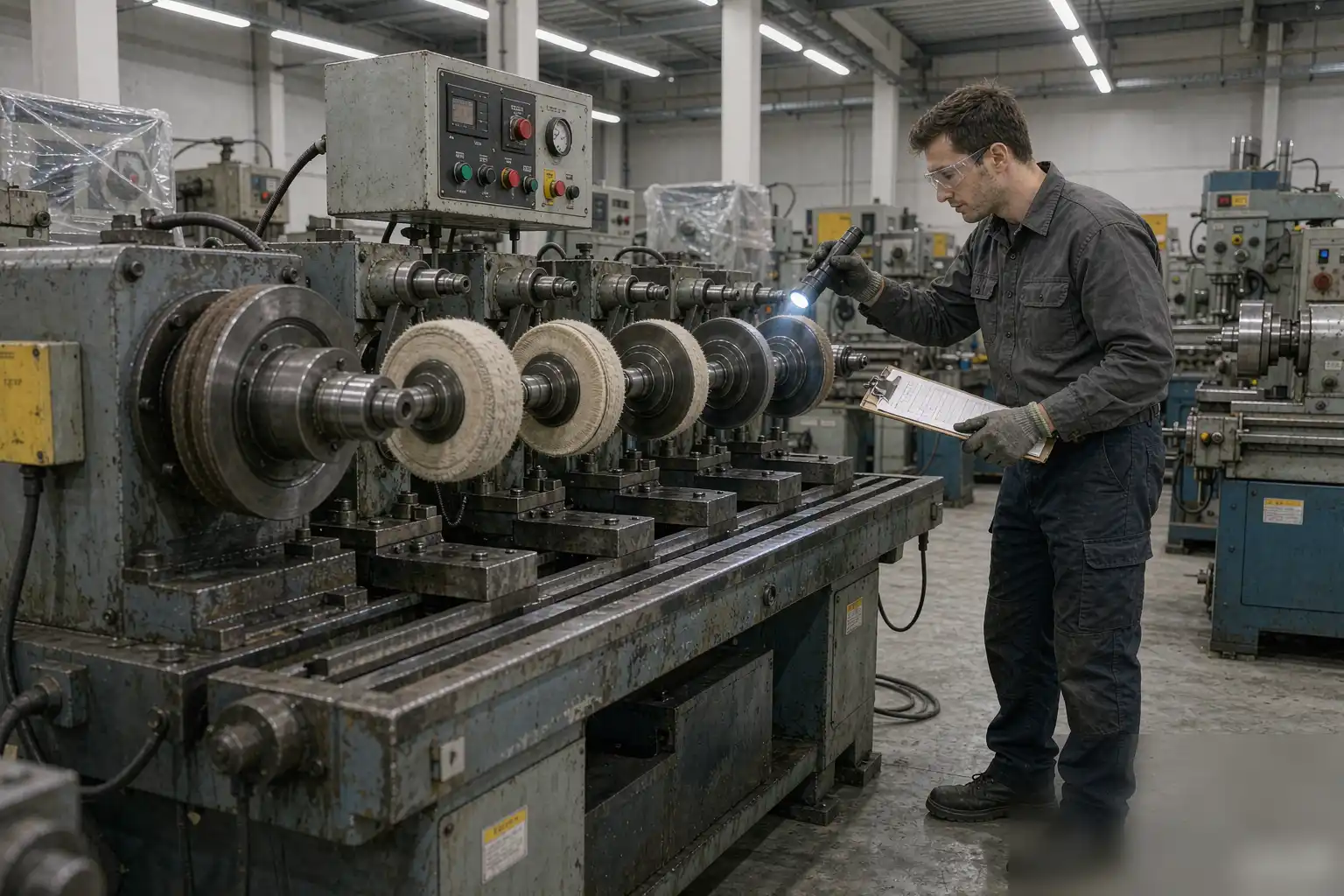
Run this checklist on site, with power on, and preferably with your own parts. Budget two hours; the second hour usually saves more than the first.
| Check | Method | Pass Condition |
|---|---|---|
| Spindle runout | Dial indicator on spindle nose | Within builder’s new-machine spec |
| Spindle bearing noise | Listen at speed, full range | Smooth, no roughness or rumble |
| Axis repeatability | Indicator on repeated moves | Consistent within tolerance |
| Way and guide condition | Visual and backlash check | No visible scoring, minimal play |
| Electrical cabinet | Open and inspect | Clean, dry, no dust ingress |
| Control boot and software | Power up, load a program | Boots clean, programs accessible |
| Safety systems | Trip each interlock | All stop the machine reliably |
| Coolant and extraction | Operate both | No leaks, adequate flow |
Two checks decide most purchases: spindle runout and control supportability. A machine failing either should be priced as parts, regardless of how clean the paint looks on the outside.
Pricing Benchmarks
Used pricing follows age, condition, and supportability. These benchmarks assume a functioning machine from a recognized builder with available support.
| Age | Percent of New Price | Condition Assumption |
|---|---|---|
| 0 – 3 years | 60 – 75% | Excellent, records complete |
| 4 – 7 years | 45 – 60% | Good, some wear items due |
| 8 – 12 years | 30 – 45% | Serviceable, controls aging |
| 13+ years | 15 – 30% | Parts value plus rebuild potential |
Machines priced above these bands need justification, usually in tooling or fixtures included with the sale. Machines below them need explanation, usually an undisclosed problem. Ask for the story in both directions.
Hidden Risks Buyers Miss
Four risks catch experienced buyers, and each has a mitigation that costs less than discovering the problem after delivery.
Missing Documentation
No manuals, no electrical drawings, no parameter backups. This turns routine maintenance into archaeology. Mitigate by requiring documentation in the sale, or by pricing a controls retrofit into your offer.
Proprietary Consumables
Some machines use proprietary wheels or tool holders. If the builder no longer supports them, consumable costs rise permanently. Verify consumable availability and price before committing, not after your first stockout.
Fixture Loss
Fixtures are often sold separately or scrapped. Without them, you face design and build costs that can reach five figures per part family. Confirm which fixtures come with the machine, in writing, with part numbers.
Transport and Rigging
Moving a polishing machine costs real money, and damage during transport is a genuine risk. Budget rigging, freight, insurance, and reinstallation. Get transport quotes before finalizing your offer, because they affect the total materially.
When Buying Used Genuinely Wins
Three situations favor secondhand strongly. Recognize them and the decision becomes easy.
First, when you are entering a new process and need to learn before committing capital. A used machine teaches your team what the process demands, and the lesson costs a fraction of a new machine’s price.
Second, when production volume is uncertain. A used machine at forty percent of new price carries far less risk if the contract does not materialize. Flexibility has real value in uncertain markets.
Third, when the machine class is mature and unchanged. Polishing mechanics have not changed dramatically in a decade. A well-maintained machine from a mature generation often performs comparably to current models for real production work.
For comparison on the new side, our polishing machine price guide lays out the new-equipment tiers and their typical cost ranges.
When to Walk Away
Three findings should end the conversation regardless of price. Detectable spindle runout beyond specification, because inconsistent finish will follow you forever. Unsupportable controls with no retrofit path in your budget. And structural cracks or crash damage in the frame.
Also walk away when the seller refuses a powered inspection. A machine that cannot be demonstrated running is a machine you are buying blind, and the discount is rarely large enough to justify that gamble.
Negotiating and Closing
Use your inspection findings as leverage, item by item. Spindle rebuild cost, missing fixtures, and transport each justify reductions. Present them with quotes attached rather than as opinions, and the negotiation stays factual.
Structure payment to protect yourself. Hold a portion until the machine runs your parts at your site. Sellers confident in their machine accept that structure; sellers resisting it are telling you what they expect to happen.
After the Machine Arrives
Plan a controlled start. Replace fluids and filters, verify grounding and safety systems, and run a light production trial before committing to schedule. Small problems found early stay small.
Then invest in training. A used machine often arrives without process knowledge, and rebuilding that knowledge matters more than any mechanical refurbishment. Our operator training guide for automated grinding and polishing gives you the four-week structure to rebuild it properly.
Refurbishment Options Worth Pricing
Some used machines deserve a refurbishment budget rather than a discount argument. Spindle rebuilds, control retrofits, and new guarding each have known costs, and each converts a marginal machine into a reliable one.
Spindle rebuilds typically run a fraction of replacement cost and restore new-machine runout. Control retrofits are larger investments, but they also solve the obsolescence problem permanently. New guarding brings an older machine to current safety expectations.
Price these three before making your offer, and negotiate the machine price accordingly. A seller who understands the refurbishment scope often accepts a lower price, because they know the alternative is a machine that sits unsold.
The Honest Verdict
A used automatic polishing machine can be an excellent decision or an expensive lesson. Inspection decides which. Run the checklist, price the hidden risks, and hold payment until the machine proves itself on your parts.
Do that, and the discount becomes real value. Skip it, and you will discover why the previous owner sold the machine, several months after the check clears.
Buyers who follow this framework rarely regret the purchase. They know what they bought, what it needed, and what it cost in total. That clarity, more than the discount itself, is what makes a secondhand machine worth having.
Keep every inspection record after the purchase. The file becomes your maintenance baseline, your resale document, and your evidence if a problem surfaces later. Good records are the quiet advantage that experienced buyers carry into every negotiation.
Bring a dial indicator and a skeptical colleague. Those two tools, used properly on site, have saved more buyers from bad machines than any checklist ever written.
The discount is real, and so are the risks. Inspection is what converts one into the other.
Consult your quality team before changing an approved process.