

QUICK FACTS
| Tolerance | ±0.05 mm typical |
| Setup time | 30–90 min first article |
| Target finish | Ra 0.2–0.8 µm |
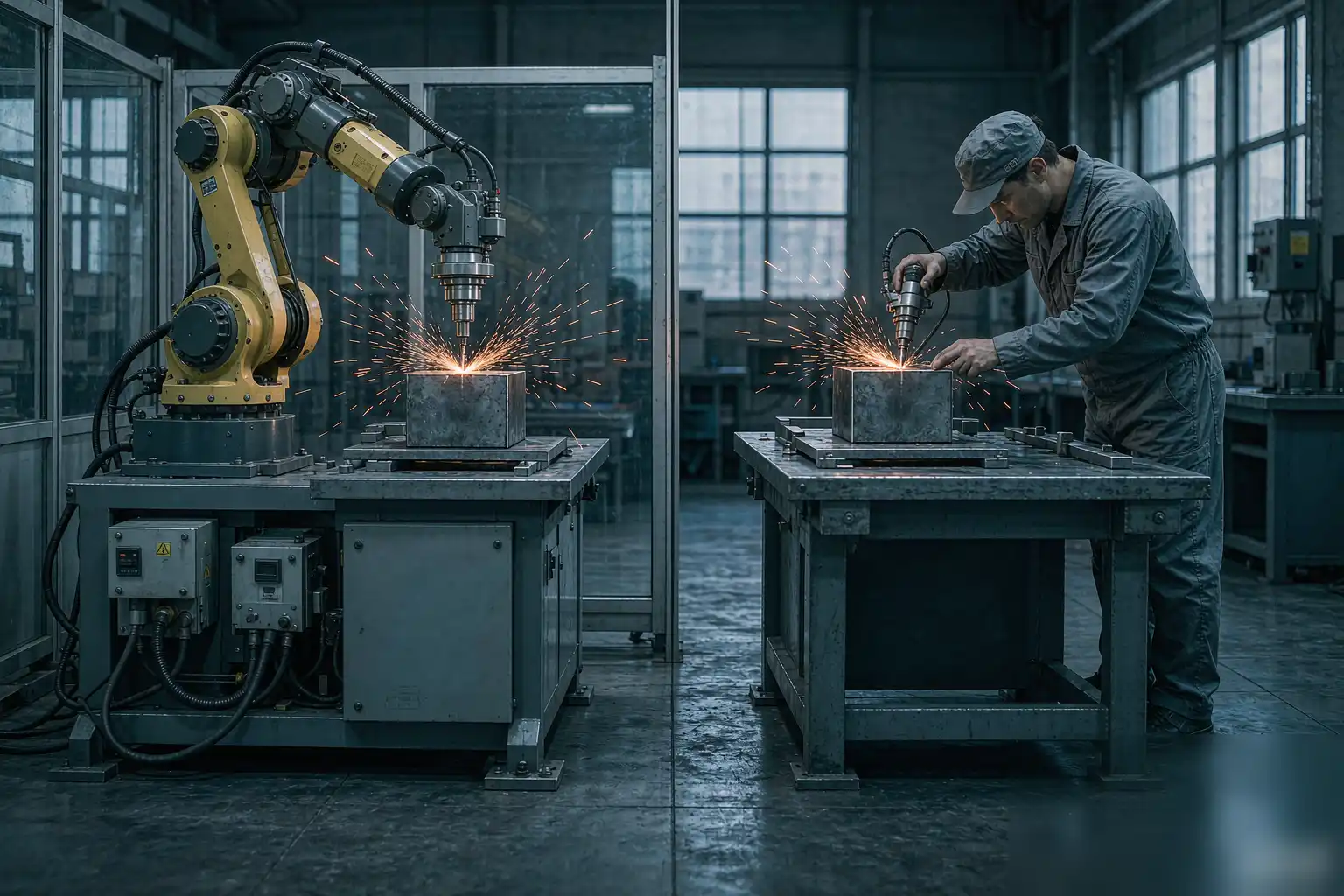
Robotic grinding versus manual grinding is not a technology debate. It is a cost structure question, and 2026 labor markets have moved the answer decisively for most plants. This comparison builds both cost models honestly, including the items managers usually forget.
We compare fully loaded labor, quality economics, safety exposure, and capacity effects. Then we find the break-even volume where the arithmetic flips, and outline a hybrid transition path for shops that cannot jump in one step.
The True Cost of a Manual Grinding Bench
Manual grinding looks cheap because the invoice is small. A bench, a dust hood, and a grinder cost a fraction of a cell. The real cost lives in the operator, and it is larger than payroll suggests.
Start with fully loaded wages. Benefits, insurance, and supervision typically add forty to eighty percent to base pay. Then count the productive hours lost to fatigue, because grinding is physically demanding and output drops measurably across a shift.
Add turnover. Grinding benches lose people to cleaner jobs, and every replacement carries recruiting time and a learning curve measured in weeks of reduced output. Shops that never calculate turnover cost consistently underestimate their manual grinding spend.
The Robotic Cost Structure
Robotic grinding shifts cost from labor to capital. The structure is front-loaded: a large investment followed by a smaller, steadier operating spend. Understanding that shape is what makes the comparison fair.
| Cost Item | Manual Grinding | Robotic Grinding |
|---|---|---|
| Labor per shift | One operator per bench | One operator per two to three cells |
| Output consistency | Falls across the shift | Flat across the shift |
| Reject rate | Operator and hour dependent | Program controlled, typically lower |
| Consumables | Wheels and discs, uncontrolled usage | Wheels, metered and logged |
| Safety exposure | Dust, noise, vibration, injury risk | Guarded, exposure near zero |
| Capital | Low | High |
None of these rows is controversial individually. The disagreement in most plants is about magnitude, so measure your own numbers rather than arguing from averages. Two weeks of logging settles most debates permanently.
Head-to-Head Annual Cost
Here is the comparison at a moderate two-shift operation with four grinding positions. Adjust the labor rate to your region and the model stays valid.
| Annual Item | Four Manual Benches | Two Robotic Cells |
|---|---|---|
| Operators required | 8 across two shifts | 3 across two shifts |
| Loaded labor cost | $496,000 | $186,000 |
| Consumables | $28,000 | $34,000 |
| Rework and scrap | $90,000 | $32,000 |
| Maintenance and service | $6,000 | $32,000 |
| Depreciation (7 years) | $4,000 | $74,000 |
| Annual total | $624,000 | $358,000 |
The robotic column wins on labor and quality, and loses on capital and service. The gap of roughly 266,000 dollars annually supports a substantial investment. Most plants find the payback lands between eighteen months and three years.
Quality Economics Behind the Gap
Quality is where the comparison quietly becomes decisive. Manual grinding produces variation between operators, between hours, and between Mondays and Fridays. Robotic grinding produces the same result every cycle until a tool wears past its compensation limit.
Consistency shows up downstream. Parts that arrive at assembly with uniform edges fit without fighting. Parts that arrive at coating with uniform roughness accept finish evenly. Both effects reduce complaints that never trace back to the grinder in anyone’s accounting.
Then there is inspection. Consistent processes need less of it. Plants frequently reduce inspection sampling after automation stabilizes, and that labor saving rarely appears in the original business case. Our deburring process optimization guide covers the parameter discipline that keeps consistency from drifting.
Safety and Liability Costs
Grinding benches concentrate risk. Respirable dust, noise above safe thresholds, hand-arm vibration, and the ever-present possibility of acute injury. Each carries direct costs and insurance costs that compound quietly year after year.
Robots move that risk behind guarding. Exposure drops to near zero for routine operation, and the remaining tasks are loading and inspection. Insurance premiums often reflect the change, and workers’ compensation claims fall in plants that convert.
The recruiting effect deserves mention too. Younger workers increasingly avoid grinding benches. A shop with cells fills positions faster, and faster hiring is a real competitive advantage in tight labor markets.
Capacity Effects That Reshape the Business
Cost comparisons miss the growth argument. Manual grinding caps output at operator hours. Robotic cells run unattended through breaks, and often through the night, without the quality penalty that tired operators produce.
That extra capacity changes what a shop can quote. Contracts requiring volumes beyond your bench capacity become quotable. Rush orders stop displacing scheduled work, which reduces the overtime that quietly inflates manual cost models.
Some shops find the capacity gain more valuable than the cost saving. A cell that lets you accept one additional mid-size contract per year can justify itself without counting a single labor hour. Model both effects and the case usually strengthens.
Finding Your Break-Even Volume
The comparison flips at a specific volume for every shop. Below it, manual grinding stays rational. Above it, robotics wins increasingly decisively. Calculate your own crossing point with three inputs.
| Input | How to Measure | Typical Threshold |
|---|---|---|
| Annual grinding hours | Operator hours logged per year | Above 3,000 hours favors robotics |
| Loaded labor rate | Wage times 1.4 to 1.8 | Higher rates shorten payback |
| Reject cost per month | Scrap plus rework plus claims | Above $4,000/month favors robotics |
Most two-shift operations clear all three thresholds comfortably. Single-shift shops with low reject costs sit closer to the line and should model carefully. For the full investment model, see our robotic grinding machine cost and ROI analysis.
Parts That Still Belong on a Bench
Honesty requires admitting where manual wins. One-off prototypes, extremely low volumes, and parts with wildly inconsistent geometry still favor skilled hands. A human adapts to a strange part faster than a programmer writes a path.
Repair work, artistic finishing, and jobs requiring judgment about how much material to remove also stay manual. The economics of programming simply do not work for quantities measured in single digits. Keep a bench for these, deliberately.
The Hybrid Transition Path
Few shops convert overnight, and they should not. A staged transition protects cash and builds skills. Move your highest-volume, most stable part family to the cell first, and leave the long tail on benches.
The second stage adds the next family once the first has run a full quarter. By stage three, your programmers know the system well enough to evaluate families themselves, and the cell network grows without vendor dependence.
Teams planning this sequence should read our complete workshop automation guide, which places grinding conversion inside a whole-plant plan rather than treating it as an isolated project.
What 2026 Changed About the Math
Three shifts moved the calculation this year. Labor markets tightened further, pushing loaded rates upward. Robot prices held roughly flat in real terms as supply chains normalized. And force-control capability became widely available rather than premium-priced.
The combined effect shortened payback periods by roughly six months compared with a few years ago. Projects that were marginal in 2022 now clear approval thresholds routinely. Plants that last modeled this comparison several years ago should rerun the numbers.
Tooling and Consumables in Both Models
Consumable behaviour differs between the two approaches. Manual grinding burns discs unevenly, because pressure varies with the operator and the hour. Robotic grinding meters wheel wear against logged cycles, and usage becomes predictable enough to forecast.
Predictability has a cost advantage beyond the material itself. Purchasing in planned quantities beats emergency buying, and emergency buying is the default in shops that cannot forecast consumption. The saving is modest monthly and real annually.
Robots also protect tooling. Consistent pressure and feed rates keep wheels cutting rather than glazing, which extends service life. Shops converting from manual often report lower consumable spend per part despite the higher hourly rate of automated tooling.
Making the Call
Robotic grinding wins the cost comparison for most two-shift operations running stable part families. It loses for one-off work, very low volumes, and highly variable geometry. Everything between those poles is a modeling exercise.
Log your grinding hours, calculate your loaded labor rate honestly, and price your rejects at full cost. Run the three thresholds. The answer will be clear, and it will be yours rather than a vendor’s estimate.
Then convert in stages, keeping a bench for the work that genuinely belongs there. That combination, automated volume plus manual flexibility, is what competitive shops actually run in 2026.
Whichever route you choose, measure the result honestly. Log hours, rejects, and consumables for one quarter after any change, then compare against this model. Evidence beats opinion, and opinion is what most grinding decisions still run on today.
Revisit the comparison every two years. Labor rates move, robot prices move, and your product mix changes with them. Shops that refresh the model periodically catch the moment when automation starts paying, instead of discovering it years after their competitors did.
Start with the two-week logging exercise. It costs nothing beyond attention, and it replaces every assumption in your plant about which approach actually costs less at your volumes.
This is educational content, not a specification or a quote.