

High-pressure die casting has taken over most aluminum and zinc part categories, but bathroom faucets are a notable exception. Premium bathroom hardware still ships with castings made by gravity die casting (permanent mold casting), and the reasons are not nostalgia — they are metallurgical, cosmetic, and economic.
The metallurgical reason is the slower fill. Gravity die casting fills a steel mold in 5 to 20 seconds instead of the 50 to 200 milliseconds of high-pressure die casting. The slower fill lets dissolved gases escape before the metal solidifies, which reduces porosity in the casting. For a faucet body that sees internal water pressure, lower porosity means fewer leaks in service.
The cosmetic reason is the smoother surface. Gravity die castings come out of the mold with a smoother surface than high-pressure die castings because there is no high-velocity spray to entrap air or generate flow lines. For a decorative bathroom faucet that ships with a polished or plated finish, the smoother starting surface saves 30 to 50 percent of the polishing time.
The economic reason is the lower tooling cost for low-to-medium volume. A gravity die casting mold costs roughly 30 to 50 percent of a high-pressure die casting mold for the same part, because the mold is simpler (no high-pressure clamping, no complex cooling) and the cavity steel does not need to withstand the same injection forces. For a faucet line that runs 20,000 to 200,000 parts per year per model, the lower tooling cost wins.
The Gravity Die Casting Process for Faucets

A typical gravity die casting cell for bathroom faucets looks like this:
| Station | Operation | Time per cycle |
|---|---|---|
| 1 | Mold preheat and lubrication | 30 to 60 seconds |
| 2 | Manual or robotic pour | 10 to 20 seconds |
| 3 | Solidification | 30 to 90 seconds (depending on wall thickness) |
| 4 | Mold open and part removal | 15 to 30 seconds |
| 5 | Trimming and gate removal | 30 to 60 seconds |
| 6 | Mold clean and re-lubricate | 30 to 60 seconds |
Total cycle: 2.5 to 5 minutes per part. Compare to 45 to 90 seconds for high-pressure die casting. The slower cycle is the cost of the better surface and lower porosity.
The pour itself is the most variable step. Manual pouring relies on the operator’s judgment of the pour rate and the cut-off temperature. Robotic pouring (a tilting furnace or a metered ladle on a robot arm) removes the variability and is the standard for any premium faucet line that wants consistent quality.
Alloys for Faucet Bodies
Three alloy families are common for bathroom faucet bodies:
Aluminum alloys
A380, A383, ADC12 — the standard aluminum alloys, easy to cast, good surface finish, good for chrome plating and powder coating. Aluminum is the lowest cost option but the lightest, which is sometimes a feature (easy to install) and sometimes a bug (feels cheap in hand).
Brass alloys
C360 (free-cutting brass), C85700 (lead-free brass), C89510 (lead-free brass with bismuth) — the premium alloys for high-end faucets. Brass feels heavier and more solid in hand, machines beautifully for the cartridge hole, and accepts chrome plating with excellent adhesion. The cost is roughly 2x to 3x aluminum.
Zinc alloys
Zamak 3, Zamak 5 — less common for faucet bodies but used for handles and decorative trim. Zamak delivers the sharpest detail of any casting alloy, which is why high-end manufacturers use it for sculpted handles and lever trim.
For premium bathroom hardware, the typical build is a brass body with Zamak handles. For mid-range, the typical build is an aluminum body with Zamak handles. For budget, the typical build is an all-aluminum faucet with a polymer or Zamak handle.
The Mold (Permanent Mold) for Faucet Casting
A gravity die casting mold for a faucet body is a multi-part steel assembly:
- Cavity block — typically H13 or H11 steel, machined to the faucet body geometry with a polished or sand-blasted interior surface depending on the finish required.
- Cores — sand cores or metal cores for the internal water passages. Metal cores last longer but cost more; sand cores are cheaper but allow more complex internal geometry.
- Covers and ejectors — the mold halves clamp with bolts or a toggle clamp, separate to release the part, and re-close for the next cycle.
- Heating and cooling — the mold is heated before the pour (typically 200 to 350°C depending on the alloy) and cooled during solidification to control the cooling rate.
A well-built faucet mold lasts 50,000 to 100,000 pours before requiring refurbishment of the cavity surface. The mold cost is roughly $15,000 to $50,000 per part depending on the complexity, which is significantly lower than a high-pressure die casting mold for the same part.
Surface Finish and Plating Prep
The cast faucet body leaves the mold with a surface that needs significant preparation before plating. The preparation sequence is:
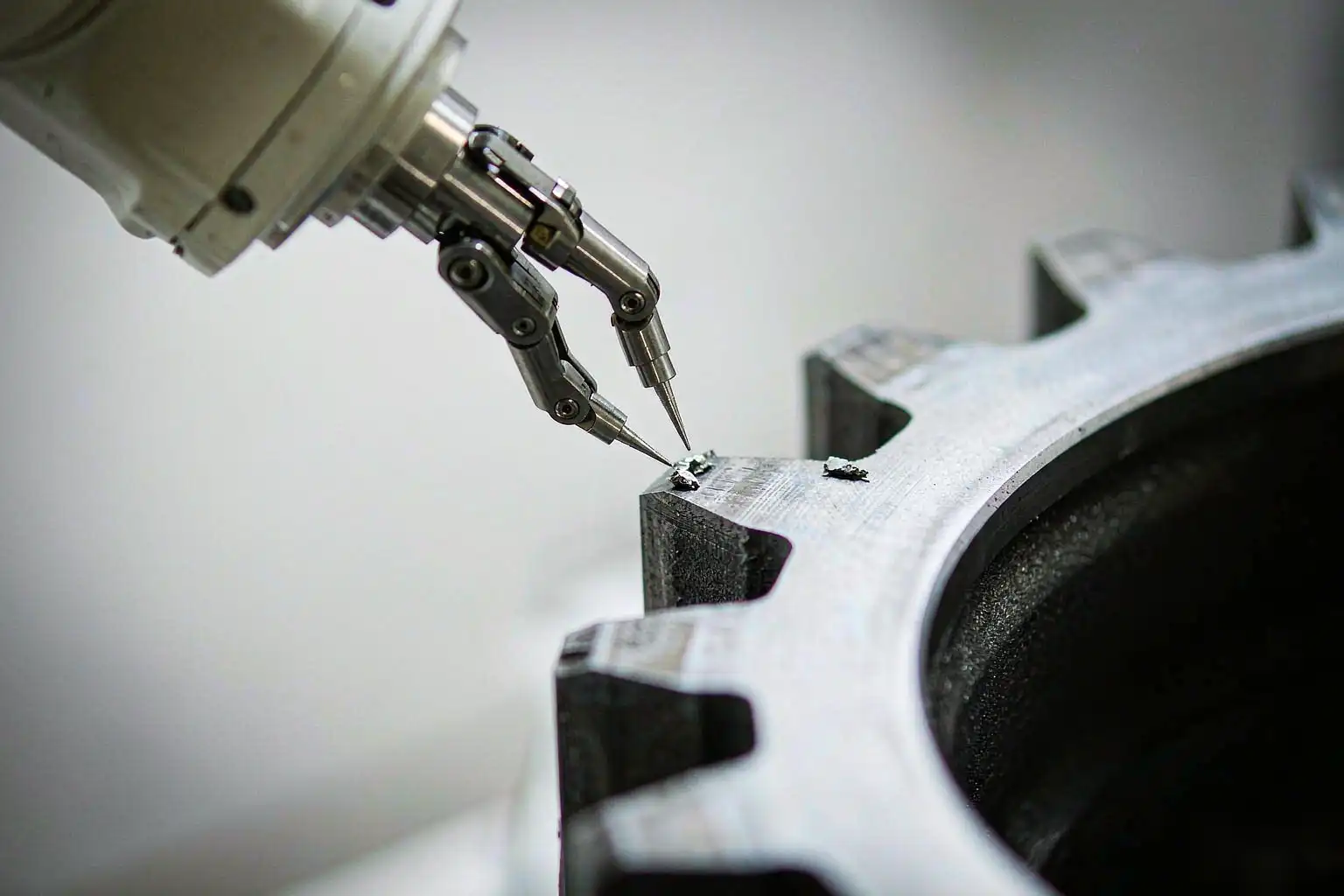
- Gate and overflow removal — the gates are cut or ground off.
- Parting line removal — the mold parting line is sanded or buffed smooth.
- Pre-polishing — the body is rough polished to remove the casting skin and any small surface defects.
- Polishing to plating grade — the body is polished progressively to 600 grit or finer, depending on the plating spec.
- Cleaning — the body is washed and dried in preparation for plating.
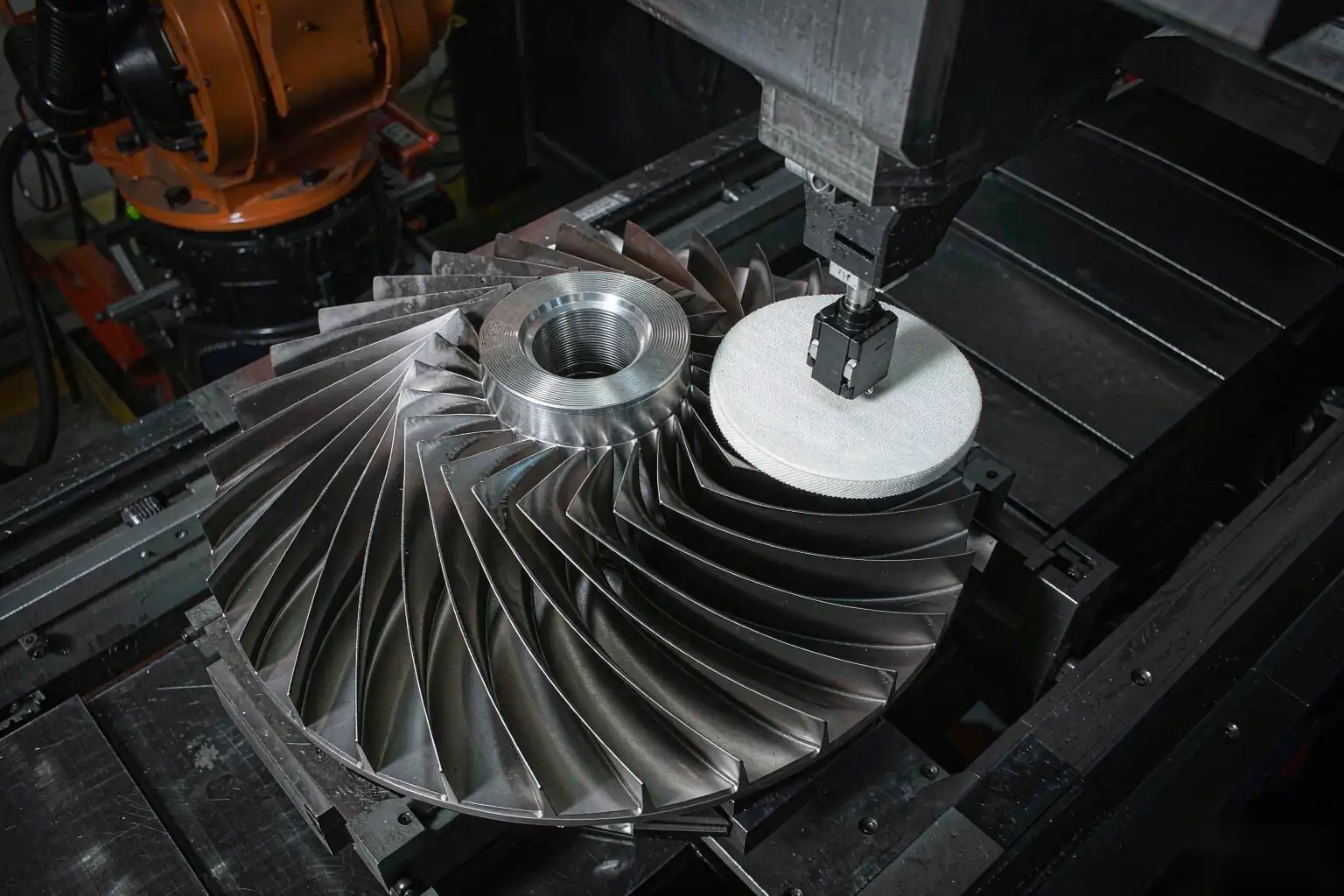
The polishing step is the most labor-intensive part of the process. For premium faucets that ship with a mirror chrome finish, the polishing sequence involves six to eight progressive buffing stages. Manual polishing takes 20 to 40 minutes per body. Robotic polishing cuts that to 4 to 8 minutes per body and holds a tighter finish grade.
Robotic Polishing for Faucet Bodies
The premium faucet industry has moved aggressively to robotic polishing over the past decade. The reasons are the same as for any decorative finishing operation: labor cost, labor availability, and finish consistency.
A robotic polishing cell for faucet bodies typically has four to six stations:
| Station | Operation | Wheel |
| 1 | Pre-polish (cut down) | Sewn cotton, cutting compound |
| 2 | Color | Loose cotton, coloring compound |
| 3 | Final color | Soft cotton, finishing compound |
| 4 | Wipe and inspection | Soft cotton |
| 5 | Wash and dry | Aqueous wash, hot air dry |
| 6 | Defect touch-up (manual) | Hand buffing |
The robot holds the part against each wheel with a programmed force, angle, and trajectory. The program is fine-tuned for the specific faucet geometry and adjusted as the wheel wears. A well-tuned cell holds a consistent finish grade within ±5 percent across 100,000 parts.
Plating the Faucet Body
Premium faucets ship with one of three plating finishes:
Chrome plating
The most common premium finish. Multi-layer plating stack: copper (8 to 20 µm) for leveling and coverage of porosity, bright nickel (8 to 15 µm) for reflectivity and ductility, optional satin nickel for brushed look, then chrome (0.1 to 0.5 µm) for wear and tarnish resistance.
PVD (Physical Vapor Deposition)
The premium alternative to chrome. PVD gives a harder, more wear-resistant finish in colors that chrome cannot match (brushed nickel, black, rose gold, brass). PVD requires a much smoother substrate than chrome (typically 0.05 µm Ra or finer) and is more expensive.
Powder coating
The mid-range and budget option. Powder coating is durable, color-stable, and lower cost than chrome or PVD, but the cosmetic feel is different — softer, warmer, more matte. Powder coat is also more forgiving of substrate surface defects, which is why it is common on lower-priced product lines.
Common Defects in Gravity Die Cast Faucets
- Porosity at thick sections — slower fill lets gas escape, but thick sections still sink and create internal porosity. Fix: add risers or chills to feed the thick sections during solidification.
- Cold shuts on thin walls — if the pour cools too much before filling the thin walls, the streams meet cold. Fix: increase pour temperature, increase fill speed, or thicken the thin walls.
- Surface laps and flow lines — manual pouring is inconsistent. Fix: robotic pouring, mold preheat, and proper venting.
- Parting line flash — worn or improperly clamped mold. Fix: mold maintenance, clamp force adjustment.
- Dimensional drift on cooling — uneven wall thickness causes uneven cooling, which warps the part. Fix: uniform wall design, balanced cooling.
A premium faucet manufacturer rejects parts with any of these defects because the consumer will see them under the bright bathroom light. The reject rate on a robotic polishing and plating line should be below 2 percent for a well-controlled process.
How DZ Smart Manufacturing Approaches Faucet Finishing
DZ Smart Manufacturing runs robotic polishing cells for faucet bodies, handles, and trim. The cell layout is tuned for the multi-stage polish that premium faucets require. We can deliver a polished-and-plated-ready body, or a complete turnkey faucet line including the casting partner.
For bathroom hardware manufacturers evaluating a robotic polishing investment, contact DZ for a finishing trial on your faucet body. We will run your part through a 4 to 6 station cell and show you the finish grade, cycle time, and reject rate before you commit to the capital.
Before signing off on a robotic polishing cell for faucet bodies, plan for a manual touch-up station at the end of the cell. Robotic polishing handles 90 to 95 percent of the surface finish, but the remaining 5 to 10 percent — typically in deep undercuts, internal radii, or decorative details — still wants a hand buffer. A two-station manual touch-up after the robot keeps the overall reject rate below 2 percent and protects the cell from being judged by the parts only a human can finish.
The other hidden cost in robotic faucet polishing is buffing wheel wear. Premium plated parts require a consistent wheel surface, and the wheel wears every 200 to 400 parts depending on the wheel compound. Plan a wheel change routine into the cell cycle, and budget for the wheel consumption in the per-part cost. A cell that ignores wheel wear drifts in finish grade by 10 to 15 percent over a single shift, and the reject rate climbs with it.
Author: Mr. Lai Dingren, General Manager, DZ Smart Manufacturing. 20+ years in cast metal finishing and automated polishing. LinkedIn: linkedin.com/in/dzivy
About this article: Educational content. The process and economics are typical industry practice. Validate with your own samples before committing to a capital investment.